U.S. Jalapeño Salmonella Recall: Products to Check and What to Do
Smartor 편집팀
August 16, 2026

This guide focuses on what shoppers can do now rather than repeating news headlines. Counts, affected-product categories, dates, and health guidance below come from FDA, CDC, and USDA Food Safety and Inspection Service materials available through August 14, 2026. Because the investigation is active, use this article as a checklist and then confirm the current “Current Update” and “Recalled Products” sections on the FDA outbreak page.
CDC says epidemiologic and traceback evidence identified jalapeño peppers grown in Sinaloa, Mexico, and distributed by Coast Citrus Distributors as the source of this multistate Salmonella outbreak. Coast Citrus Distributors agreed to recall the linked peppers. Companies that received the ingredient then began their own downstream recalls for foods made with those peppers. FDA currently labels the investigation “Ongoing.”
FDA’s August 14 status update reports 345 illnesses, 36 hospitalizations, and zero deaths. The latest reported illness onset was July 20. Cases were reported in Alabama, Arkansas, California, Colorado, Georgia, Illinois, Indiana, Kansas, Kentucky, Louisiana, Michigan, Minnesota, Missouri, Montana, North Carolina, North Dakota, Nebraska, Ohio, Oklahoma, South Carolina, Tennessee, Texas, Utah, Virginia, Washington, Wisconsin, and Wyoming. These are states with reported cases; they should not be read as an exact substitute for the separate lists of states where individual recalled products were distributed.
The affected ingredient moved through wholesalers, restaurants, food-service companies, and manufacturers. FDA says Coast Citrus Distributors does not appear to have supplied the fresh peppers directly to grocery stores. However, manufacturers used the peppers in finished foods that reached retail shelves. That is why checking a clamshell of salsa, a refrigerated wrap, a deli meal, or a frozen leftover can be as important as checking whole peppers.
CDC and FDA also describe actions by two restaurant chains. Chipotle changed suppliers for affected stores beginning July 20, and QDOBA stopped using the peppers on July 28 and is no longer serving jalapeños at any location. Based on those removal steps, the agencies say they do not consider there to be a current ongoing outbreak risk from those establishments. That assessment does not remove the need to check products purchased elsewhere or food stored at home.
The first category is fresh jalapeños grown in Sinaloa and distributed by Coast Citrus Distributors, including wholesale and food-service inventory. Look for “Sinaloa, Mexico” and “Coast Citrus Distributors” on a case label, invoice, produce record, or package. FDA specifically says that if you froze fresh jalapeños from that source—or if you cannot determine which company supplied frozen peppers—discard them.
The second category is finished food recalled by Taylor Fresh Foods. The company announcement posted by FDA lists certain items sold through Hannaford, Kroger, Stop & Shop, Target, Trader Joe’s, Walmart, and Whole Foods. The list spans diced jalapeños, a rice-and-bean burrito, a spicy roast beef sandwich, cheese dips, pico de gallo, taco dip, guacamole, a shrimp salad, and several salsas. Distribution centers in Alabama, Arkansas, Florida, Georgia, Illinois, Indiana, Kansas, Kentucky, Louisiana, Massachusetts, Maine, Michigan, Minnesota, Missouri, Mississippi, Nebraska, New Hampshire, New York, Ohio, Oklahoma, South Carolina, Tennessee, Texas, Vermont, Wisconsin, and West Virginia received listed products. The recall includes specified Best If Used By dates through August 16.
The third category is a group of Whole Foods Market salsas, guacamoles, pico de gallo products, condiments, and prepared foods. FDA identifies online and in-store sales in Texas, Oklahoma, Louisiana, Arkansas, Wisconsin, Michigan, Illinois, Indiana, Iowa, Missouri, Kentucky, and Ohio, with listed Best Before/Best By dates from August 7 through August 16. Not every product from those departments is recalled. Match the exact PLU, item description, and date rather than relying on the store name or the general word “guacamole.”
The fourth category includes certain NatureBest and H‑E‑B products. FDA’s August 14 update identifies soup mix, pico de gallo, stuffed mushrooms, and diced jalapeños distributed to retail customers in Texas and Louisiana between July 3 and August 5. Each item has its own UPC, size, lot codes, and use-by range. A brand match by itself is not enough; compare all available identifiers to FDA’s current table.
The fifth category is prepared meat and poultry food. USDA FSIS issued a public health alert because several FSIS-regulated establishments received an FDA-regulated jalapeño ingredient included in the recall. FSIS provides a separate PDF with product names, establishment numbers, distribution states, and contact information. At the time of the alert, there were no confirmed illnesses attributed specifically to the FSIS-regulated products, but the agency still tells consumers not to eat listed items and warns that some may remain in refrigerators or freezers.
Anyone who bought or ate a listed product should take the recall seriously. You may need to check even if you never purchased loose jalapeños. Recent purchases of salsa, pico de gallo, guacamole, salads, wraps, sandwiches, burritos, dips, and store-prepared meals can contain the ingredient. Restaurants, caterers, retailers, and other food businesses should review invoices, case labels, receiving dates, and supplier records because their exposure can be broader than a household’s.
Anyone can develop a Salmonella infection. CDC says children younger than five, adults 65 and older, and people with weakened immune systems have a greater chance of severe illness. Adults 50 and older who have underlying medical problems, such as heart disease, may also face increased risk. People who are pregnant or receiving treatment for a chronic condition should promptly share any possible exposure and symptoms with a clinician familiar with their health.
Symptoms typically begin six hours to six days after swallowing the bacteria. Diarrhea, fever, and stomach cramps are common. Most people recover without treatment in four to seven days, but severe diarrhea or dehydration can require medical care or hospitalization. A household member’s lack of symptoms does not make a recalled item safe to serve. Prevention begins with not eating the product.
Do not taste a suspect food to decide whether it is safe. Remove it carefully so liquid does not drip onto other food, and place it in a sealed bag or container. Restaurants and retailers should stop sale or service immediately while preserving case labels, invoices, and receiving records needed to identify the supplier.
Check the front, back, and bottom of the package. Photograph the item name, brand, net weight, UPC or PLU, lot code, Best By/Use By/Best If Used By date, and USDA establishment number if present. If the paper receipt is gone, use the retailer’s app, online delivery history, loyalty account, or credit-card transaction date to identify the store and purchase window.
Open the FDA source page rather than relying on a search-result snippet or a social-media screenshot. Search within the page for the store or brand, then compare the full product description and date. Recall scope can change, so the live page takes priority over a saved image. If meat or poultry is part of the prepared food, also check the current FSIS product PDF.
Do not eat a recalled item. Package it so another person or animal cannot retrieve it from the trash, or follow the retailer’s return instructions. Taylor Fresh Foods says refunds are available at the place of purchase. If a store asks you to retain the package for a refund, keep it sealed and physically separated from food, and call before bringing it in.
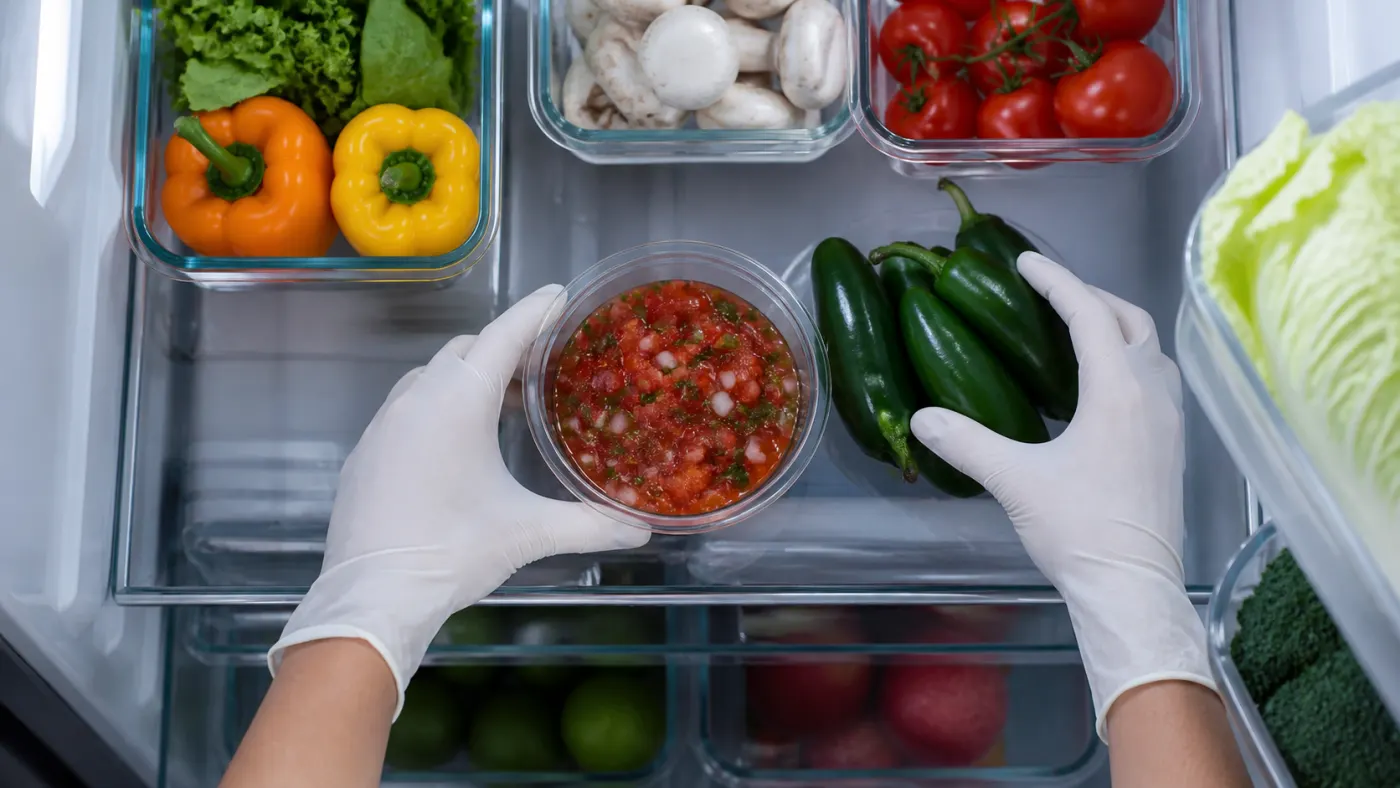
CDC advises washing items and surfaces that may have touched the recalled food with hot, soapy water or in a dishwasher. Check refrigerator shelves and drawers, cutting boards, knives, tongs, containers, and handles. Remove food residue and wash first, then apply a food-contact-safe sanitizer according to its label. If other uncovered food had direct contact, consult FDA food-safety guidance or a local health department about whether it should also be discarded.
Eating a recalled food does not mean everyone will become ill, but document the product, date and time eaten, who shared it, and when any symptoms begin. Keep label photos and receipts. If illness develops, tell the healthcare provider specifically that there may have been exposure to a food recalled in the jalapeño-linked Salmonella outbreak. Do not start antibiotics or anti-diarrheal medication on your own; treatment decisions belong with a clinician.
CDC recommends calling a provider for diarrhea with a fever above 102°F; diarrhea lasting more than three days without improving; bloody diarrhea; vomiting so frequent that you cannot keep liquids down; or signs of dehydration. Dehydration signs include urinating very little, a dry mouth or throat, and dizziness when standing. Parents of young children, older adults, and people with weakened immune systems should use a lower threshold for seeking personalized advice.
Urgency depends on the individual. Call 911 or local emergency services for acute warning signs such as loss of consciousness, severe weakness, confusion, or trouble breathing rather than waiting on general online guidance. This article is consumer information, not a diagnosis or a substitute for individual medical care.
For meat and poultry food-safety questions, the USDA Meat and Poultry Hotline is 888‑674‑6854. FSIS also operates an online consumer complaint system for meat, poultry, and egg products. For fresh produce and other FDA-regulated foods, use the contacts listed on the FDA investigation page and the relevant manufacturer announcement.
No. The agencies do not recommend trying to make a recalled product safe at home. FDA and CDC say not to eat it and to discard or return it. Household cooking may be uneven, and preparation can contaminate hands, cutting boards, utensils, and nearby food before the item is heated.
No. You cannot identify Salmonella by smell, taste, or appearance. The printed date helps identify products; it does not mean bacteria disappear after that date. Freezing is also not a reliable way to eliminate Salmonella. Follow FDA’s advice for frozen peppers whose supplier cannot be confirmed.
No. The official notices name specific items, sizes, codes, date ranges, and distribution areas. You do not need to discard every food from a named retailer. At the same time, do not assume a jalapeño product is safe simply because it came from a different store. Compare multiple identifiers with FDA’s live tables.
CDC does not direct every symptom-free person with a possible exposure to seek routine testing. Record what you ate and when, then monitor for symptoms. Ask your own clinician if you are in a higher-risk group or have a medical condition that changes the decision. Seek care promptly if symptoms or CDC’s severe warning signs develop.
Write down the location, visit date, and menu item, then ask whether that location received the recalled supplier’s peppers. A restaurant can review invoices and delivery records. CDC and FDA provide a specific current-risk assessment for Chipotle and QDOBA after their removal actions; do not automatically apply that conclusion to unrelated businesses.
Yes. FDA’s investigation is ongoing, and FSIS says it expects additional downstream products may be identified as the ingredient recall progresses. If a related food is in your freezer, do not treat a single check as final. Revisit the update date and the current product PDF before using it.
Last checked August 16, 2026, in the U.S. Eastern time zone. Agency findings and product lists may change after publication.
브라우저 메뉴에서 앱 설치 또는 홈 화면에 추가를 선택해 주세요.
[…] Read this guide in English → […]