
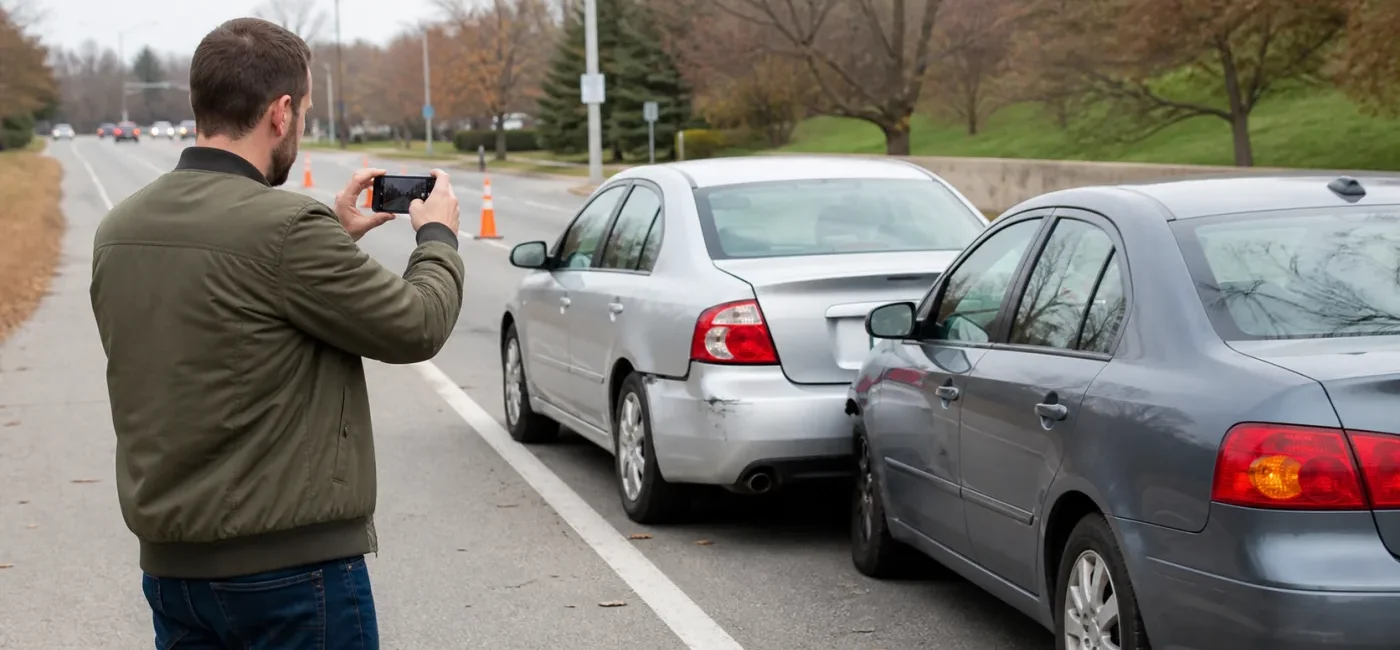
After a New York car crash, the useful first move is protecting people, preserving reliable evidence, meeting reporting rules, and starting the right insurance process—not clicking the first advertisement. This guide uses current New York DMV and Department of Financial Services guidance to organize the first minutes, the first day, the No-Fault timeline, and the point at which legal advice may be worth seeking.
Key takeaways
- Protect life and prevent a second collision first. Call 911 when anyone may be injured or an active roadway hazard remains. Move people and vehicles only when it can be done safely and consistently with police instructions.
- Exchange license, insurance, registration, and contact information. Photograph the full scene before taking close-ups of each vehicle, damage area, lane, signal, sign, road condition, and sight line.
- Check the New York DMV reporting threshold. A driver must report a crash involving death, injury, or more than $1,000 in damage to the property of any one person. Calling police and filing the motorist report can be separate duties.
- Notify the insurer promptly. DFS tells drivers to report an accident promptly and to read their policy’s notice requirements rather than assuming an app submission completed every obligation.
- Do not miss the injury-claim clock. DFS says written notice for a No-Fault claim should be made as soon as reasonably practicable and generally no later than 30 calendar days after the crash, unless a clear and reasonable justification supports a late filing.
This article provides general information, not legal, medical, or insurance advice for a particular claim. The crash location, policy language, vehicle use, injuries, and parties involved can change the correct procedure and deadline. Confirm your own situation with the relevant agency, insurer, and a properly licensed professional.
What happened
This distinction matters because a search result may compress a complicated legal rule into a phrase such as a “new 51 percent rule.” Drivers should not treat that phrase as an operative legal standard without checking the law in effect on the date of their crash. Official statutes, current agency instructions, policy terms, and fact-specific legal advice carry more weight than a headline or sponsored result.
The search trend does reveal a practical problem. People often have three urgent questions at once: What must I report? Who pays medical and vehicle expenses? When should I speak with a lawyer? Trying to answer all three through a single search can mix advertising with procedure. A safer sequence is to secure the scene and evidence first, complete official and insurance notices second, and evaluate dispute risk third.
The New York DMV reporting rule
The New York DMV’s “File a Motorist Crash (Accident) Report” page explains the trigger under Section 605 of the Vehicle and Traffic Law. A driver involved in a New York crash must file a report when a person is injured or killed, when damage to the property of one person—including the driver—exceeds $1,000, or when an e-bike or e-scooter is involved and a person is injured or killed. DMV warns that a driver’s privilege may be suspended until a required report is filed.
When a person is injured or killed, police must be notified immediately in addition to the motorist report. In a property-damage-only crash, the involved drivers must exchange license, insurance, and registration information. When a parked vehicle or other property is damaged, or a domestic animal is injured, the driver must locate the owner or contact police. DMV offers an online Motorist Report Submission Portal and a mail option using Form MV-104.
A modern bumper can hide sensors, brackets, absorbers, cameras, radar units, paint work, and calibration costs. That makes the $1,000 line hard to judge from the shoulder of the road. If damage could approach the threshold or anyone may be hurt, checking police, DMV, and insurer instructions promptly is more reliable than deciding that a crash “looks too small to document.”
The insurance and No-Fault timeline
New York DFS advises a driver involved in a crash to report it promptly to the insurance company and the local police department. An auto policy is a contract, and the notice, cooperation, inspection, and repair provisions can vary. Starting a claim in an app is useful, but keep the claim number, adjuster or department name, requested documents, and next deadline in a separate log.
For an injury-related No-Fault claim, DFS says written notice should identify the injured person and include reasonably obtainable information about when, where, and how the crash occurred. Notice should be filed as soon as reasonably practicable and generally within 30 calendar days. After receiving the notice, the insurer generally must send an Application for Benefits and an explanation of rights and obligations within five business days. Tell medical providers that treatment relates to a motor-vehicle crash, and retain treatment records, bills, pharmacy receipts, transportation costs, and wage-loss documents.
No-Fault is intended to handle certain injury-related economic losses without first resolving who caused the crash, but it is not a universal answer for every loss or person. The correct insurer may depend on whether the injured person was a driver, passenger, pedestrian, bus passenger, household member, or occupant of another vehicle; whether the vehicle was uninsured or a hit-and-run; and whether a rental, employer, delivery, or rideshare policy applies. Do not accept an on-scene promise that “one policy will handle everything.” Ask each relevant insurer to identify the proper claim route in writing.
Who may be affected
Every driver in a New York crash should check the New York requirements, even if the vehicle is registered in another state. Police attendance does not automatically prove that an insurance notice or driver-filed report has been completed.
Passengers and pedestrians benefit from early, factual records. Note the seating position, seat-belt use, direction of impact, first symptom, medical visit, transportation expense, and missed work by date. Some symptoms can emerge later, but diagnosis belongs to a medical professional, not an online checklist. Severe pain, altered consciousness, breathing difficulty, uncontrolled bleeding, or neurological symptoms require emergency attention before claim paperwork.
Owners who were not driving may need to provide policy information, permission to use the vehicle, registration, and financing details. Family cars, company vehicles, delivery vehicles, rideshare cars, and rentals can involve several potential insurance layers. Reporting to an app company or employer should not be assumed to replace notice to a personal insurer.
Owners of parked cars, fences, buildings, and other property may also have claims. If the owner cannot be found, do not assume that leaving a note satisfies every duty. Follow police instructions, preserve the time and location, photograph the damage, and record attempts to locate or contact the owner.
Drivers who are not comfortable reading English should request an interpreter or language support before signing documents they do not understand. Do not rush into a broad release or written statement at the scene. At the same time, do not delay required identity and insurance exchanges or public-safety instructions.
What to do now
Minutes 0–10: safety and emergency response
- Stop, activate the hazard lights, and assess the traffic environment. If remaining in a travel lane, blind curve, or high-speed location creates greater danger, move only as safely as conditions and police guidance permit.
- Check yourself, passengers, the other vehicle, and nearby pedestrians. Give 911 the precise location and describe injury, fire, leaking fuel, blocked lanes, or another active hazard.
- Do not step into moving traffic to improve a photograph. If the scene is unsafe, wait in a protected location and let responding officers manage the roadway.
- Avoid arguing about fault or making a roadside settlement. Statements such as “I am completely fine,” “this is all my fault,” or “let us keep insurance out of it” can be premature. Exchange verifiable facts instead.
Minutes 10–30: exchange information and document the scene
If it is safe, collect the other driver’s name, contact information, license details, insurer and policy details, registration, and plate. When receiving a photo of a card, zoom in before leaving to confirm that the information is legible. Ask witnesses for names and contact details without coaching their account or starting an argument.
Photograph from wide to close. Begin with vehicle direction, lane position, intersection geometry, traffic signals, signs, construction, weather, visibility, and the overall scene. Then capture all four sides of each vehicle, each damage area, debris, tire marks, and relevant objects. Video can preserve spatial relationships, but keep still photographs too. Preserve the originals and do not post files containing plates, insurance cards, faces, or private details publicly.
The same day: insurer notice and evidence preservation
Use the number on the insurance card or the insurer’s verified app or website. Search ads can route a caller to a lead-generation service, so confirm the company name and domain before submitting personal information. Provide confirmed facts, and do not guess about speed, distance, fault percentage, or the final extent of an injury. Record the claim number, department, next contact date, tow destination, and whether storage fees are accruing.
Back up photographs and videos before editing them. Create one folder for the crash while keeping original timestamps and files. Save text messages, email, the police incident number, towing receipts, rideshare trip details, and the original dashcam clip in the same folder. Many dashcams record in a loop, so lock or export the relevant segment before it is overwritten.
Build one evidence-and-claim file
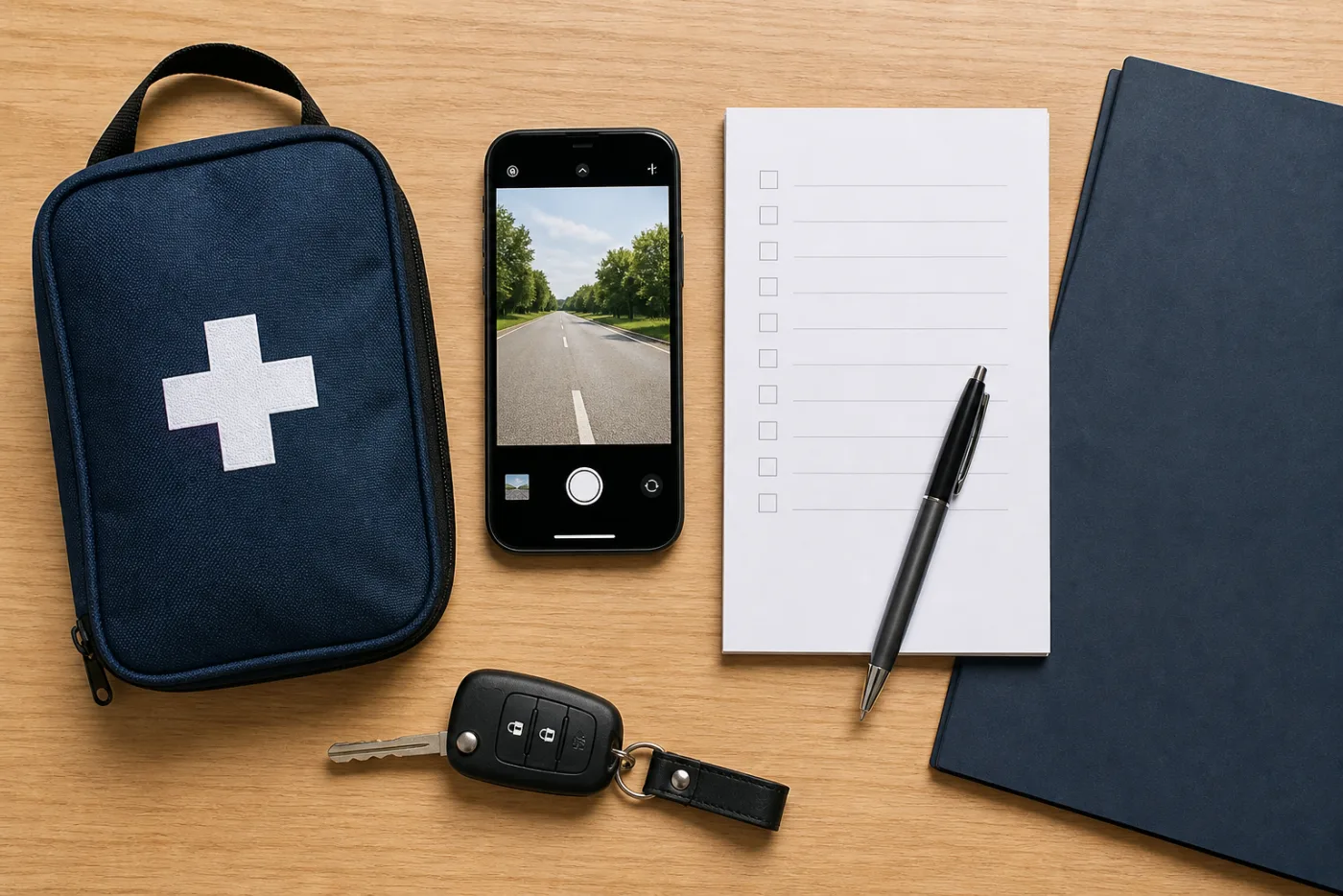
On one paper or digital log, write the crash date, time, exact location, weather, vehicle directions, occupants, witnesses, police incident number, and insurance claim number. For every later call, record the date, time, person, department, key answer, and promised next action. This is not a pressure tactic; it is a personal record that reduces confusion when several people provide different instructions.
Before repairs, ask what inspection the insurer requires. Emergency safety work may be necessary, but a repair, disposal, or salvage decision can make the original damage harder to inspect. Get the towing and storage company’s legal name, address, daily charge, and release conditions in writing. Photograph personal items and make a list when retrieving them from the vehicle.
Within 24 hours: reassess health and reporting duties
Reassess symptoms and obtain appropriate care. Describe when a symptom began without minimizing or exaggerating it. Tell the provider that the condition may relate to a vehicle crash so the right records and billing pathway can be used. Keep visit summaries, prescriptions, test results, transportation receipts, and missed-work notes.
Review the DMV reporting threshold again once injuries and likely repair costs are clearer. If the crash qualifies, use the official online portal or MV-104 process and preserve proof of submission. A police incident or report number does not, by itself, answer whether the driver has a separate filing duty.
Over the next several days: connect medical, wage, and repair records
Do not let the No-Fault notice or the insurer’s Application for Benefits sit unopened. Ask whether the medical provider will bill the No-Fault insurer directly or whether the patient must pay and seek reimbursement. For missed work, ask the employer what wage-verification form is required. A self-employed person should organize canceled appointments, tax records, invoices, and other reliable evidence of actual lost income. Keep copies and a transmission record for every submission.
Review a repair estimate by damage operation, part, labor, scan, and calibration—not just the total. If the insurer’s figure differs from the shop’s estimate, ask for the difference in writing. Ask whether driver-assistance sensors need post-repair calibration. If a totaled car leads to a replacement purchase, Smartor’s used-car buying checklist covers VIN checks, recalls, history reports, and an independent inspection.
When an attorney consultation may help
A fast-rising attorney query does not make counsel mandatory for every small property-damage claim. A driver can begin safety, reporting, insurance notice, and evidence preservation immediately. Early advice becomes more valuable, however, when rights, deadlines, medical causation, insurance priority, or litigation risk are no longer straightforward.
- An injury persists or may involve surgery, long-term care, disability, or substantial wage loss.
- A driver or insurer disputes how the collision happened, who is responsible, or whether a condition resulted from the crash.
- The matter involves a hit-and-run, an uninsured or underinsured vehicle, several vehicles, a truck, a delivery driver, or a rideshare trip.
- An insurer denies a claim or requests a document, examination, release, or detailed statement whose significance is unclear.
- A government vehicle, public entity, or road-defect claim may carry a notice deadline shorter than an ordinary lawsuit deadline.
- The crash involves a death, a child, major non-vehicle property loss, or parties and policies in multiple states.
At a consultation, ask more than “What are my odds?” Request a written explanation of the scope and fee arrangement. Ask about the contingency percentage, who advances filing, expert, investigation, and record costs, who owes those costs if there is no recovery, who will actually handle the matter, how often the client receives updates, and who controls settlement decisions. Pressure to sign immediately, guarantees of a result, refusal to identify the responsible lawyer, or a request to sign blank documents are warning signs.
Advertising rank does not verify a lawyer’s registration or fit. Search the exact name in the New York court system’s official attorney directory and compare the office and registration details before signing an engagement agreement. Also remember that government and insurance deadlines continue to run while a consultation is being scheduled.
How to verify the official rules
- Crash-report duty: Use the New York DMV page for the current threshold, online portal, MV-104, and filing instructions. Confirm that the address is on
dmv.ny.govrather than relying on a search snippet. - Insurance and No-Fault: Use the New York DFS consumer auto-insurance guide for notice, No-Fault, physical-damage, and dispute procedures. Compare the guide with the actual policy and written insurer instructions.
- Attorney registration: Use the New York State Unified Court System Attorney Search and compare the exact name, registration record, and office details.
- Claims of a new fault rule: Do not treat “new rule starts today” as established until the official law and effective date are identified. Ask how the law in effect on the crash date applies to the specific facts.
Frequently asked questions
If police came to the scene, do I still need MV-104?
Possibly. New York DMV says the driver must report a qualifying crash. Police notification and the driver’s report can be separate procedures. Check whether the crash involved death, injury, or more than $1,000 in damage to the property of any one person.
Can two drivers settle a small scratch in cash?
A scratch can conceal sensor, bracket, paint, and calibration costs, and symptoms may not be obvious immediately. Complete the required information exchange, follow reporting law, and check the policy’s notice requirement before making a private payment or signing a broad release.
Must I immediately give a recorded statement to the other insurer?
First identify who is asking, the purpose of the statement, and what your own policy requires. Stick to known facts and do not guess. When injury or liability is seriously disputed, or the legal effect of a request is unclear, consider advice from a licensed attorney before signing a release or providing an extensive statement.
If I do not hurt right away, can I ignore the No-Fault deadline?
Medical decisions belong to a clinician. If symptoms develop, do not delay in asking the insurer about the correct procedure. DFS says written injury notice should be made promptly and generally within 30 days; whether a late-filing justification is accepted depends on the facts.
Which insurer handles a pedestrian or cyclist?
DFS says a pedestrian struck in New York generally files with the insurer of the vehicle that struck the person. A hit-and-run, uninsured vehicle, e-bike or scooter, household policy, or other fact may change the route. Confirm the specific path with the insurers and DFS.
Do rental and rideshare crashes follow the same process?
The immediate safety and evidence principles are the same, but additional contracts and insurers may apply. Rental, platform, personal, employer, or credit-card coverage can depend on the vehicle and trip status. Keep a separate official claim number for every company notified.
May I repair the vehicle immediately?
Except for necessary safety measures, confirm the insurer’s inspection and estimate procedure first. Keep pre-repair photographs and estimates. Ask in writing about shop choice, repair guarantees, supplements, and calibration. If storage charges are increasing, address the location and fees promptly.
Is every attorney fee simply a percentage of the settlement?
No single answer covers every agreement. Read how contingency fees and filing, expert, medical-record, investigation, copying, and other costs are handled, including what happens if there is no recovery. Put the fee and decision-making terms in the written engagement agreement.
Does an online headline prove that New York law changed?
Official sources
- New York State DMV: File a Motorist Crash (Accident) Report — reporting triggers, police notice, information exchange, online portal, and MV-104
- New York State Department of Financial Services: Auto Insurance Information for Consumers — crash notice, No-Fault, and physical-damage claim guidance
- New York State Unified Court System: Attorney Search — attorney registration lookup
Prepared by the Smartor Editorial Team · Last checked August 18, 2026. Agency pages and policy procedures can change; recheck before filing.