Central Ohio Flash Flood Warnings: Road, Evacuation and Power Safety
Smartor 편집팀
August 20, 2026

This guide was independently prepared from the live National Weather Service alerts for Ohio, the NWS flood-safety guidance and Ready.gov at 6:00 a.m. Eastern. It is designed for people deciding whether to commute, take children to school, make a delivery or check on a family member. It does not replace a live warning. Wireless Emergency Alerts, local police and fire instructions, road barricades and the newest NWS bulletin always take priority.
NWS Wilmington issued and extended several flood-related alerts across Ohio on Thursday morning. A Flash Flood Warning issued at 5:47 a.m. covered central Fairfield County and northeastern Pickaway County until 8:45 a.m. Radar and automated gauges indicated that 1 to 2.5 inches of rain had fallen, with up to 2 more inches possible. The bulletin said flash flooding was ongoing or expected soon along small creeks and streams, urban streets, highways, underpasses and other low-lying or poorly drained locations.
Communities named in that warning included Lancaster, Baltimore, Buckeye Lake, Bremen, Millersport, Pleasantville, Fairfield Beach and Lithopolis. A separate warning issued at 5:32 a.m. covered northeastern Auglaize County, Hardin County, northern Logan County, northeastern Shelby County and northwestern Union County until 9:30 a.m. It cited 1 to 3 inches of rain already received, rainfall rates of 1 to 2 inches in an hour and another 1 to 2 inches possible. The NWS characterized the potential impact as life-threatening flash flooding.
An earlier warning for portions of Fairfield, Franklin and Licking counties cited 2 to 4.5 inches of rain and reports of water rescues in Pataskala. Parts of eastern Columbus, Reynoldsburg, Gahanna, Pickerington, Granville, Groveport and the Buckeye Lake area were included. Some short-duration warnings were scheduled to expire during the morning commute, but expiration does not automatically mean every road has drained or reopened. A new warning may also replace an older one.
The event was not limited to street flooding. River warnings were posted for locations including the Great Miami River near Middletown, Raccoon Creek near Granville, the Great Miami River at Sidney and the Little Miami River at Spring Valley. A river can continue rising after the rain at your house stops because runoff is still moving downstream. That is why a clear sky or lighter rain is not enough evidence that a riverside trail, bridge approach or low road is safe.
A Flood Watch means conditions could support flooding across a relatively broad area and time window. Use that lead time to change travel plans, identify higher ground, charge phones, bring medication and documents together, and move valuables only if it is safe. A watch does not mean every address will flood, but it does mean you should be ready to act without delay if a warning follows.
A Flood Advisory generally signals flooding that is expected to be less severe than a warning but can still make low spots and poorly drained roads hazardous. A Flood Warning means flooding is imminent or occurring. A Flash Flood Warning warns of rapidly developing flooding that may leave little time to react. For either type of warning, move to safety and follow the specific instructions in the bulletin instead of waiting for visual proof.
People inside the NWS county list and warning polygon face the most immediate risk, but your home address is only one part of the decision. Your workplace, child’s school, medical appointment or delivery route may be inside a warning even when your house is not. Check the origin, the full route and the destination separately. A navigation app may know about congestion but miss changing water depth, a washed-out shoulder, a missing manhole cover or a newly placed barricade.
Drivers in darkness and early-morning rain face added risk because the boundary between wet pavement and standing water can be almost invisible. It is especially difficult to judge depth in an underpass, at a low intersection or on a rural road without streetlights. The fact that another vehicle made it across does not prove the pavement remains intact or that your vehicle will behave the same way.
People in basements, garden apartments and homes near creeks, drainage channels or low ground can be at risk without going outside. Water around a breaker panel, furnace, outlet, extension cord or appliance can become an electrocution hazard. If water is entering a lower level, do not go down to retrieve property. If officials tell you to move to a higher floor or evacuate to higher ground, move people and pets first.
Older adults, children, people with disabilities, people who need refrigerated medicine or powered medical equipment, and families who may not understand an English alert need a more specific plan. Put medication, identification, insurance information, mobility-device supplies, chargers and pet items in a waterproof grab bag. Ask building management how an accessible evacuation will work if elevators lose power.
Delivery drivers, home-health workers, construction and landscaping crews, farm workers and school transportation staff may be exposed for hours across several counties. Small creek bridges, unpaved access roads and work sites beside drainage ditches can become isolated before a major highway does. Employers should allow workers to stop, reroute or wait in a safe building rather than treating a warning as an ordinary delay.
Open the NWS Active Alerts page for Ohio and look for your county, alert type, issue time and expiration time. When possible, check whether your address is inside the warning polygon on the map. If you must travel, review alerts for the origin, every county on the route and the destination. Confirm closures through official state and local transportation or emergency-management sources.
Do not rely on a screenshot or a reposted social-media graphic. It may preserve an old expiration time after a bulletin has been extended or replaced. In the official NWS entry, read the fields for the affected area, issue and expiration times, description and instructions. Refresh before leaving and again if conditions change.
The safest decision is the one made before your tires touch the water. Ready.gov says six inches of moving water can knock a person down and one foot can sweep a vehicle away. The roadbed may be eroded beneath opaque water. A manhole cover may be gone, and downed electrical lines may be energizing the water. Four-wheel drive, a taller truck or familiarity with the road does not remove those hazards.
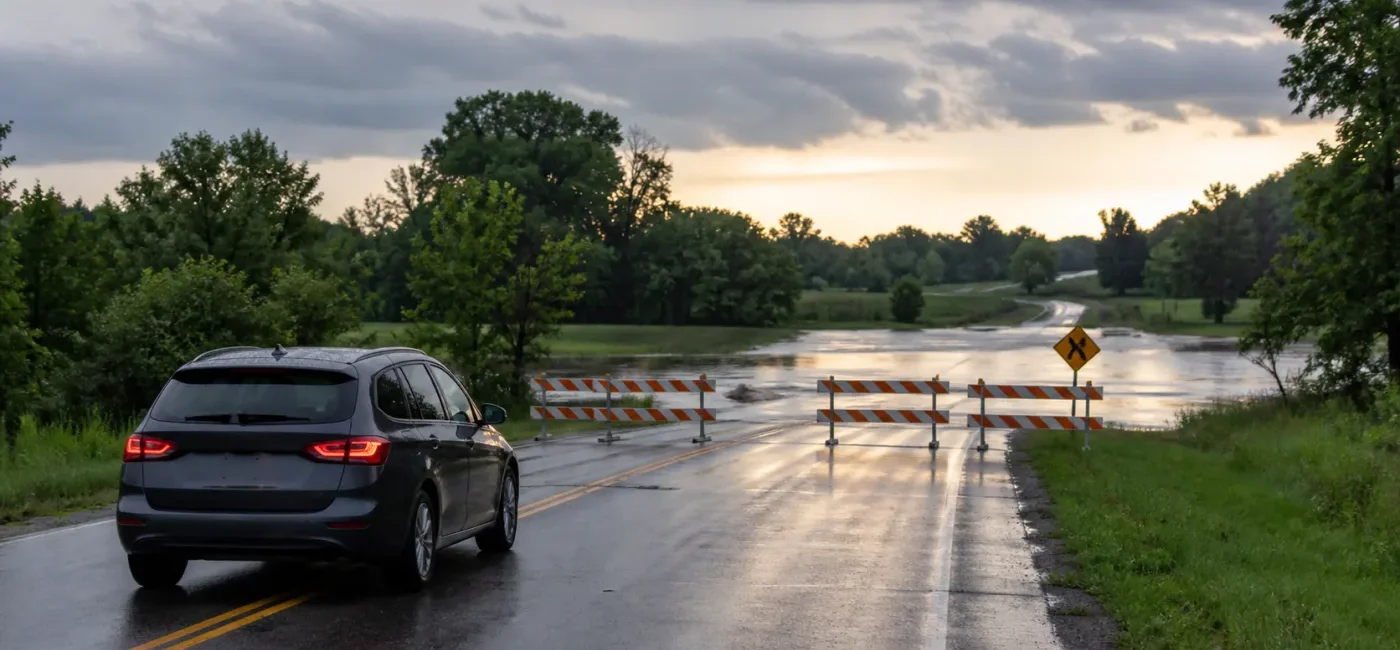
Never move a barricade or drive around it on a shoulder or lawn. Back away far enough to use an official detour. If you need to stop, choose a safe parking area or sturdy building on higher ground, away from a creek, culvert, low bridge or steep slope.
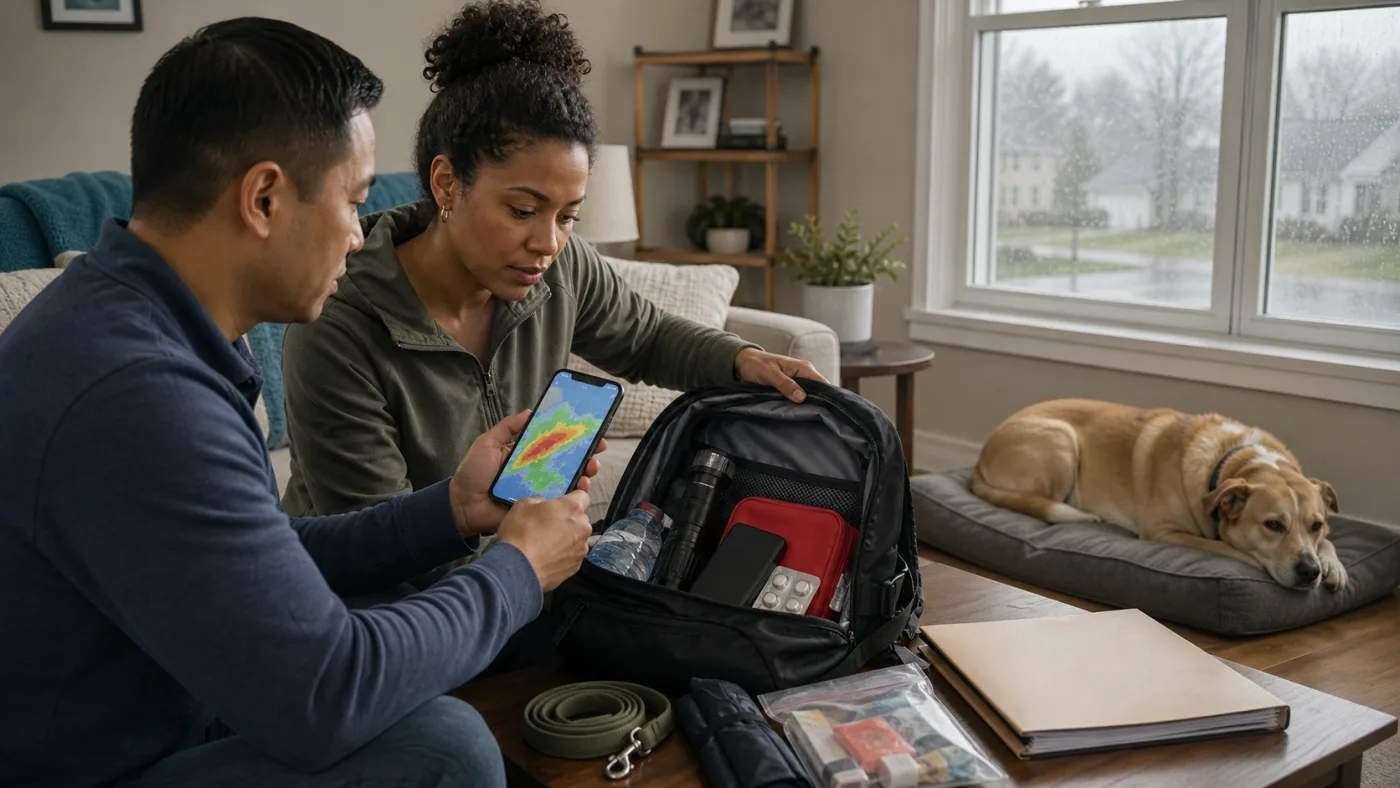
Place phones, power banks, prescription medicine, glasses, identification, insurance information, keys, flashlights, drinking water and pet leashes in a waterproof bag. Ready.gov recommends protecting important papers in a waterproof container and keeping password-protected digital copies. If flooding is already imminent, stop packing and move people and pets to safety.
Give every household member a short assignment: who helps a child or older relative, who handles pets, and where everyone will meet. Cellular networks may become congested, so identify one contact outside the affected area and use text messages when possible. Tell children never to approach floodwater or cross a barricade, even if adults are nearby.
Depending on the situation, Ready.gov advises moving to higher ground or a higher floor. If rising water traps you inside a building, move to the highest safe level. Go onto the roof only when necessary and signal for help. Do not enter a closed attic without a way out; continuing water rise can trap you there. Follow local evacuation orders and 911 instructions.
Do not enter a flooded basement to switch off a breaker. Shut off electricity only from a dry, safe location and only when utility or fire-safety guidance allows it. Never touch an outlet, appliance, breaker, extension cord or generator connection while standing on a wet surface or in water.
If water has not reached the vehicle, retreat or turn around while there is still a dry route. If fast-moving water traps the vehicle, call 911 and provide the road name, nearest intersection, visible landmarks and number of occupants. Ready.gov says to stay inside a vehicle trapped in rapidly moving water and get onto the roof if water begins rising inside. Conditions vary, so follow a dispatcher or rescuer’s directions when communication is available.
Do not step into swift water to push another vehicle or attempt an untrained rescue. Do not send a child or pet into the water first. Keep sightseers away from blocked areas so fire apparatus and rescue crews can reach people who need help.
A downed line may be energized even when the neighborhood appears to have lost power. Stay away from the wire and anything it touches, including water, fences, trees and vehicles. Report it to 911 and the electric utility. If you smell gas or hear a hissing sound, avoid flames and electrical switches, leave safely and call from outside.
Never operate a generator, charcoal grill or fuel-burning camping device inside a house, basement, garage or porch. Follow the manufacturer’s instructions and place a generator outdoors, well away from windows, doors and vents while keeping it safely protected from moisture. Headache, dizziness, nausea or confusion may be signs of carbon-monoxide poisoning; move to fresh air and call 911.
Do not return to a closed road or flooded property until authorities say it is safe. A receding flood can leave damaged bridge supports, contaminated water, sharp debris, displaced animals, mold and electrical hazards. If entry is authorized, wear heavy gloves, protective clothing and boots. Children should not participate in flood cleanup.
Photograph damage from a safe position and ask your insurer what to document before cleaning or discarding items. Ready.gov notes that standard homeowners policies generally do not cover flooding, which may require separate flood insurance. Coverage depends on the actual policy and cause of loss, so contact the insurer directly. New coverage will not retroactively cover this event, but the National Flood Insurance Program is worth reviewing after the immediate danger passes.
Do more than read the alert headline. Confirm the affected area and the specific hazard. “Watch means prepare; warning means act” is a useful starting point, but the instruction field in the current bulletin and orders from local authorities control what you should do. If you are near a boundary, use the polygon and your exact address rather than the county name alone.
No. Different Watches, Advisories and Warnings cover specific counties, river points and polygons. Check your address and route on the current NWS alert page instead of assuming a statewide condition.
Not necessarily. Runoff can continue raising streams after local rain ends, and pavement may be damaged beneath the water. Do not enter until barricades are removed and the responsible authority confirms that the road has reopened.
No. You cannot reliably measure depth, current or road damage from the driver’s seat. The Ready.gov figures are danger warnings, not safe thresholds. Turn around whenever water covers the road.
A Flash Flood Warning concerns rapidly developing flooding that may leave very little reaction time. A Flood Warning may cover river flooding or other flooding that is imminent or occurring. Both are warnings and require immediate safety action in the affected area.
Do not enter if water is coming in, electrical equipment is wet or officials have ordered evacuation. Electrocution and entrapment can be fatal. Wait until authorities and qualified electrical professionals say the area is safe.
No. A barricade may mark washed-out pavement, swift water, downed lines or an active rescue that you cannot see. Use an official detour.
Ready.gov notes that standard homeowners policies generally do not cover flooding. The answer depends on your policy and the cause of damage, so contact your insurer and confirm whether you have separate flood coverage.
Enable Wireless Emergency Alerts, enroll in local emergency notifications, and use the NWS Active Alerts page or NOAA Weather Radio as a second source. Do not wait for a single social-media account or app notification.
Facts last checked at 6:00 a.m. Eastern Time on August 20, 2026. Flood alerts and road conditions may change immediately after publication. Call 911 for life-threatening danger or rescue needs and follow on-scene instructions.
브라우저 메뉴에서 앱 설치 또는 홈 화면에 추가를 선택해 주세요.
[…] Read this flood safety guide in English → […]