

Tires are easy to overlook, but they are the only parts of a vehicle that actually touch the road. A “0 unrepaired recalls” result from a VIN search does not necessarily tell you everything about the tires currently mounted on your car. Replacement tires can be recalled separately, and a manufacturer may not have your current contact information if you bought the car used or replaced the tires through another shop. The safest routine combines a vehicle VIN search, a Tire Identification Number (TIN) check, confirmation with the tire maker or dealer, and a hands-on pressure, tread, and damage inspection.
This guide walks U.S. drivers through a practical 20-minute check they can do in a driveway or parking area. It explains what to do after receiving a recall notice, how to document each tire, what a DOT date code can and cannot tell you, how to prepare for a dealer appointment, and which maintenance checks still matter even when no recall appears. It does not ask you to remove a wheel, lift a vehicle, or crawl underneath a car.
The key distinction: vehicle recalls and tire recalls require different checks
NHTSA’s recall page is useful for finding unrepaired safety recalls associated with a vehicle’s VIN or license plate. NHTSA also explains that searches by year, make, and model—or for tires and other equipment—return broader recall, investigation, complaint, and manufacturer-communication results. That distinction matters: a single VIN search may not identify every issue affecting an aftermarket tire installed later.
Tire recalls are commonly defined by the manufacturer, product line, size, production period, and part or all of a TIN range. Two tires with the same brand and model name are not automatically in the same recall population. You also should not assume all four tires were produced together. A puncture repair, collision repair, or prior owner may have led to one tire being replaced at a different time. Check all four tires and the spare individually.
A 20-minute tire recall checklist
- Park on a flat, well-lit surface. Set the parking brake and turn the vehicle off. Do not kneel beside a tire on a busy shoulder unless you have adequate separation from traffic.
- Gather basic tools. A phone, flashlight, clean cloth, tire-pressure gauge, and notes app are enough to start. A dedicated tread-depth gauge is helpful.
- Photograph the driver-door placard. It lists the vehicle manufacturer’s recommended tire size and cold inflation pressure. Do not confuse that pressure with a maximum value molded into a tire sidewall.
- Create a location record. Label photos left front, right front, left rear, right rear, and spare. Location matters if only one tire is different.
- Photograph the brand, product line, and size. Use overlapping pictures if the information does not fit into one frame.
- Find the DOT marking and full TIN. A complete TIN may appear on only one sidewall. If the date portion faces inward, do not crawl under the vehicle; ask a shop with a proper lift to document it.
- Use NHTSA’s recall search. Search the vehicle by VIN, then review tire recalls separately using the product information and affected range.
- Confirm uncertain matches. Give the full TIN to the tire maker’s customer service team or an authorized dealer and request written confirmation when possible.
- Read the remedy and interim instructions. Look for “do not drive,” speed or distance limits, inspection requirements, and appointment instructions in the actual recall notice.
How to read a TIN and date code
The DOT marking on a tire sidewall is followed by identifying information. The portion most familiar to drivers is the final four-digit date code: the first two digits normally represent the production week and the last two represent the production year. A code ending in 2324, for example, indicates production in the 23rd week of 2024. That date is only one part of a recall comparison. A notice may also specify plant, size, and manufacturer codes, so compare the complete affected range—not just four digits.
Sometimes the outward-facing sidewall shows only a partial marking while the complete TIN is on the inward-facing side. Never rely on a jack alone or place your body under a parked vehicle just to read it. A tire shop can rotate the wheel on a lift and document the number safely. Wipe loose dirt away and use a flashlight. Heavy sidewall dressing can create glare that makes the molded characters harder to photograph.
Why tire age alone does not establish a recall
Production date is one part of a condition assessment, but there is no universal rule that a tire becomes “recalled” at a certain age. A safety recall concerns a defined defect and affected population. Replacement decisions may also involve manufacturer recommendations, vehicle-maker guidance, storage conditions, heat and ultraviolet exposure, driving patterns, cracking, deformation, and tread condition. An older tire may have no recall, while a relatively new tire can fall within a specific recalled batch.
Four common recall-search outcomes
1. The TIN clearly matches the affected range
Call the contact listed in the recall notice or an authorized dealer. Ask about replacement inventory, scheduling, cost, and any temporary driving restriction. Safety recalls generally include a remedy without a charge to the owner, but eligibility and the exact scope must be confirmed under that campaign. Have the receipt, installation date, current mileage, and clear tire photos ready.
2. The brand and product name match, but the TIN range does not
Do not decide based on appearance or product name alone. Provide the complete number to the manufacturer and save a case number or email response. A newly announced campaign can be updated as production records are reviewed, so a company may advise you to check again after additional affected numbers are loaded.
3. No recall appears, but the tire has a warning sign
A search with no match means you did not find a current public recall covering the information entered. It does not certify the tire’s physical condition. A bulge, apparent tread separation, exposed cord, deep sidewall damage, repeated pressure loss, or a new vibration still warrants prompt professional inspection. Consumers can also submit a safety complaint to NHTSA. Detailed reports from multiple drivers can help the agency identify a possible defect pattern.
4. There is no receipt and the tire history is unknown
This is common with a used vehicle. Record the brand, product line, size, and TIN for every tire and contact the manufacturer if the search is unclear. Treat tires with different brands or dates as separate items. For a broader pre-purchase review, see Smartor’s used car buying checklist.
Monthly safety checks still matter when there is no recall
Cold inflation pressure
NHTSA recommends checking every tire, including the spare, at least once a month when the tires are “cold”—generally after the vehicle has not been driven for at least three hours. Find the correct value on the Tire and Loading Information Label at the driver-side door edge or pillar, or in the owner’s manual. A number molded into the tire sidewall relates to the tire’s limits; it is not the same as the vehicle manufacturer’s recommended cold pressure.
A dark TPMS warning light is not a substitute for a gauge. The system is designed to warn when a tire is significantly underinflated; it is not a precise monthly report showing that all tires match their target. Pressure can change as outdoor temperatures shift, so check again before a long trip or a major seasonal temperature change.
Tread depth and uneven wear
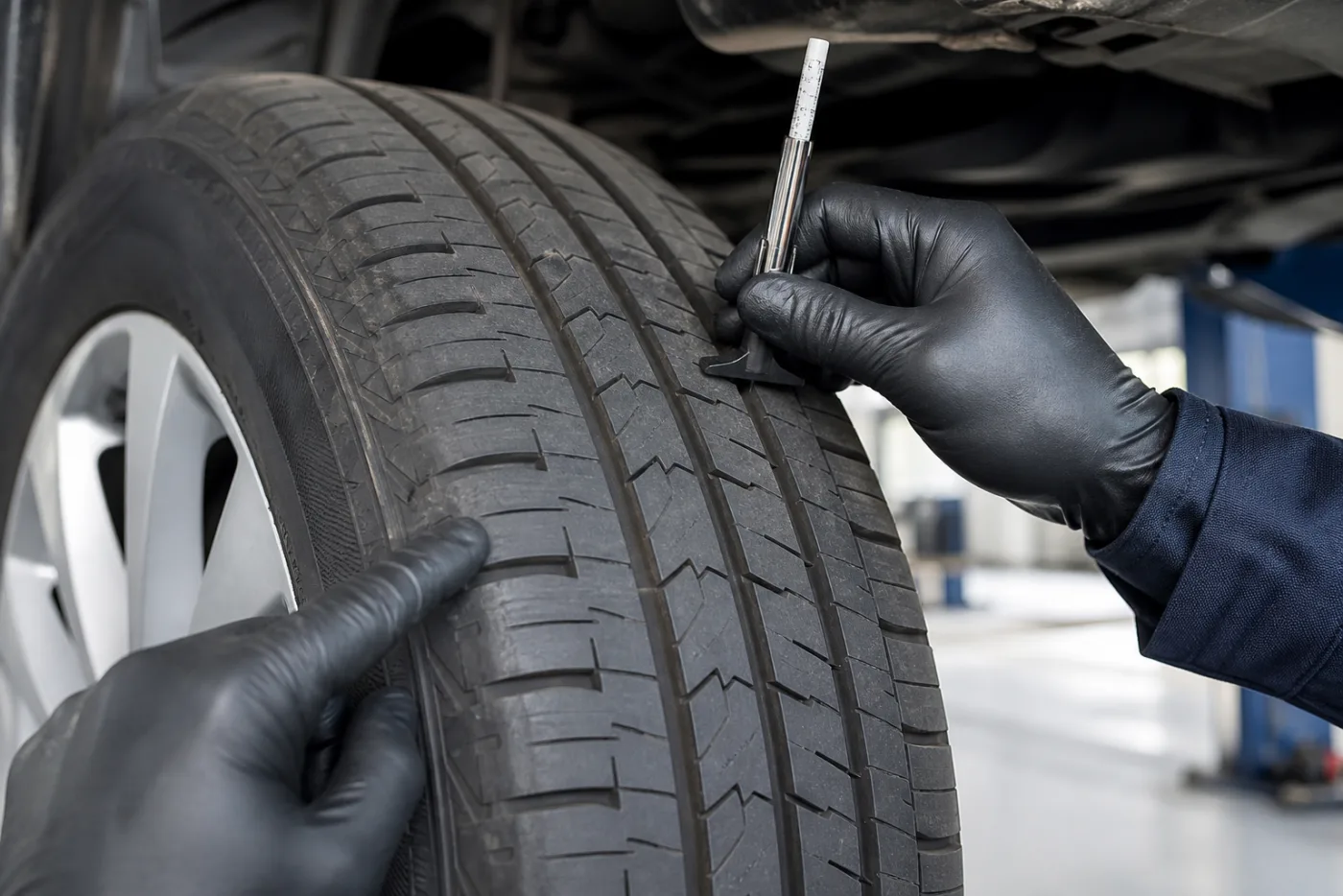
NHTSA states that tires are unsafe and should be replaced when tread is worn to 2/32 of an inch. Look for built-in wear bars becoming level with the tread. A tread-depth gauge lets you compare the inner, center, and outer grooves at several points around the tire. Heavy wear on one edge or cupped wear may call for more than new rubber; ask about inflation, alignment, wheel balance, and suspension condition.
Sidewalls, valves, and embedded objects
Under good light, look for a bulge, cut, crack, abrasion, or exposed reinforcement on each sidewall. If a nail or screw is embedded in the tread, pulling it out immediately can increase the leak. Check pressure and ask a qualified shop about a safe repair. A missing valve cap, leak around the valve, or bent wheel deserves attention as well. Repairability depends on puncture location and size, internal damage, and tire-maker guidance; an exterior plug alone should not automatically be treated as a permanent repair.
Rotation, balance, and alignment
Follow the vehicle manual for rotation timing and pattern. NHTSA notes that, if recommended by the manufacturer, rotation may be performed every 5,000 to 8,000 miles or sooner when uneven wear develops. Vehicles with different front and rear sizes or certain drivetrains may not allow a standard cross-rotation. Record the mileage and each tire’s new position on the service receipt. That history is useful for recall and warranty conversations later.
Real-world example: one tire has a different production date
Imagine it is Friday evening and your family plans to drive 400 miles the next morning. Photos show that the two front tires and left rear share the same product and similar date codes, while the right rear was produced in a different year. The vehicle VIN search says there are zero unrepaired recalls.
- Do not stop at the VIN result. Record the full TIN and size of the right-rear tire separately.
- Compare the brand, product line, size, and production range against tire recall results.
- If the complete TIN is hidden or the result is unclear, send the photos to the manufacturer or tire dealer.
- At the same time, check cold pressure, tread depth, cracks, and bulges on all four tires.
- If recall status remains uncertain and a physical warning sign is present, postpone the trip or use another vehicle rather than assuming one different tire is harmless.
The lesson is that a recall search and a condition inspection do different jobs. The recall search looks for a known defect population; pressure, tread, and visual checks assess the tires mounted on your vehicle today.
What to collect before calling a dealer
- Vehicle year, make, model, and 17-character VIN
- Brand, product line, size, and complete TIN for all four tires and the spare
- Sidewall and tread photos labeled by vehicle position
- Installation date, retailer, and receipt or card record if available
- Current odometer reading and estimated tire mileage
- When pressure loss, vibration, noise, or a bulge first appeared
- NHTSA recall number or manufacturer campaign number
- Call date, representative name, case number, interim driving guidance, and appointment date
If you already paid to replace a tire that is later confirmed as recalled, keep the receipt and any pre-removal photos. Ask the manufacturer whether that campaign has a reimbursement process. Eligibility, documentation, and deadlines vary, so do not invent or assume a reimbursement amount or cutoff date.
Eight mistakes that make a tire check less reliable
- Stopping after a VIN search. Replacement tires may require a separate product and TIN check.
- Matching only brand and model. Size and affected identification range matter.
- Assuming all four tires are identical. One may have been replaced after a puncture or repair.
- Inflating to a sidewall maximum. Use the vehicle placard’s recommended cold pressure.
- Trusting a dark TPMS light. Use a gauge at least monthly.
- Crawling under the vehicle to read an inward TIN. Ask a properly equipped shop.
- Ignoring damage because no recall appears. Current physical condition is a separate safety question.
- Discarding receipts and call details. Save photos, search date, and case number in one folder.
A monthly tire routine you can save on your phone
Choose a memorable time, such as the first weekend of every month. When the tires are cold, measure all four plus the spare, check tread at three points across each tire, and inspect sidewalls and valves. Look under the parked car for a new stain or small pieces of rubber. Do an extra check before a long trip, after hitting a major pothole or curb, and after a large seasonal temperature swing.
Organize photos in a dated folder such as “2026-08 tire check,” then add rotation and replacement receipts. If a collision actually happens, evidence and insurance steps depend on state law; Smartor’s New York car crash checklist is an example of a state-specific follow-up resource.
FAQ
Does a zero-result VIN search mean my tires are not recalled?
No. It is useful for unrepaired vehicle recalls, but separately purchased tires may need to be checked by product information and TIN range.
Are the final four TIN digits enough?
They help identify production week and year, but a recall may depend on plant, size, and other identifying codes. Compare the complete range in the notice and confirm the full TIN with the manufacturer.
Is replacement always free when a tire is recalled?
Safety recalls generally provide a no-charge remedy, but you should confirm that the specific tire qualifies and what the campaign covers. Mounting, related services, inventory, and reimbursement questions should be answered by the notice and manufacturer rather than assumed.
I did not receive a letter, but my tire appears to match. What should I do?
Contact the manufacturer or authorized dealer with the full TIN, product information, and recall number. Used-car purchases, address changes, or missing registration information can prevent a notice from reaching the current owner.
How often should I search for tire recalls?
Record the information when new tires are installed, review official results periodically, and check promptly after a manufacturer notice or credible safety report. Continue monthly condition checks regardless of recall status.
A tire has a bubble but holds pressure. Can I keep driving?
Normal pressure does not prove that the tire structure is sound. A bulge can indicate internal damage. Avoid highway and long-distance driving and obtain prompt professional inspection.
Is buying a used tire safe?
A used tire can have an unknown storage, repair, impact, and internal-damage history. Before purchase, verify the full TIN, recall status, correct vehicle fitment, tread, sidewalls, and internal condition with a qualified professional.
Bottom line: pair the number check with a physical inspection
The most useful sequence is straightforward: check the vehicle VIN, record the full TIN for all four tires and the spare, compare official recall ranges, and then inspect cold pressure, tread, and sidewall condition. Save photos and case numbers. When anything remains uncertain, get a qualified inspection before a highway trip. A 20-minute record can help you catch both a missed recall notice and everyday problems such as slow leaks or uneven wear.
Official sources consulted
- National Highway Traffic Safety Administration (NHTSA), TireWise: buying, pressure, tread, maintenance, and recall guidance
- NHTSA recall search for vehicles, car seats, tires, and equipment
- NHTSA safety problem reporting
Last reviewed August 21, 2026. Recall populations and manufacturer remedies can change, so recheck the official notice and manufacturer instructions before an appointment.
[…] Smartor 편집팀 August 21, 2026 Read this guide in English → […]