
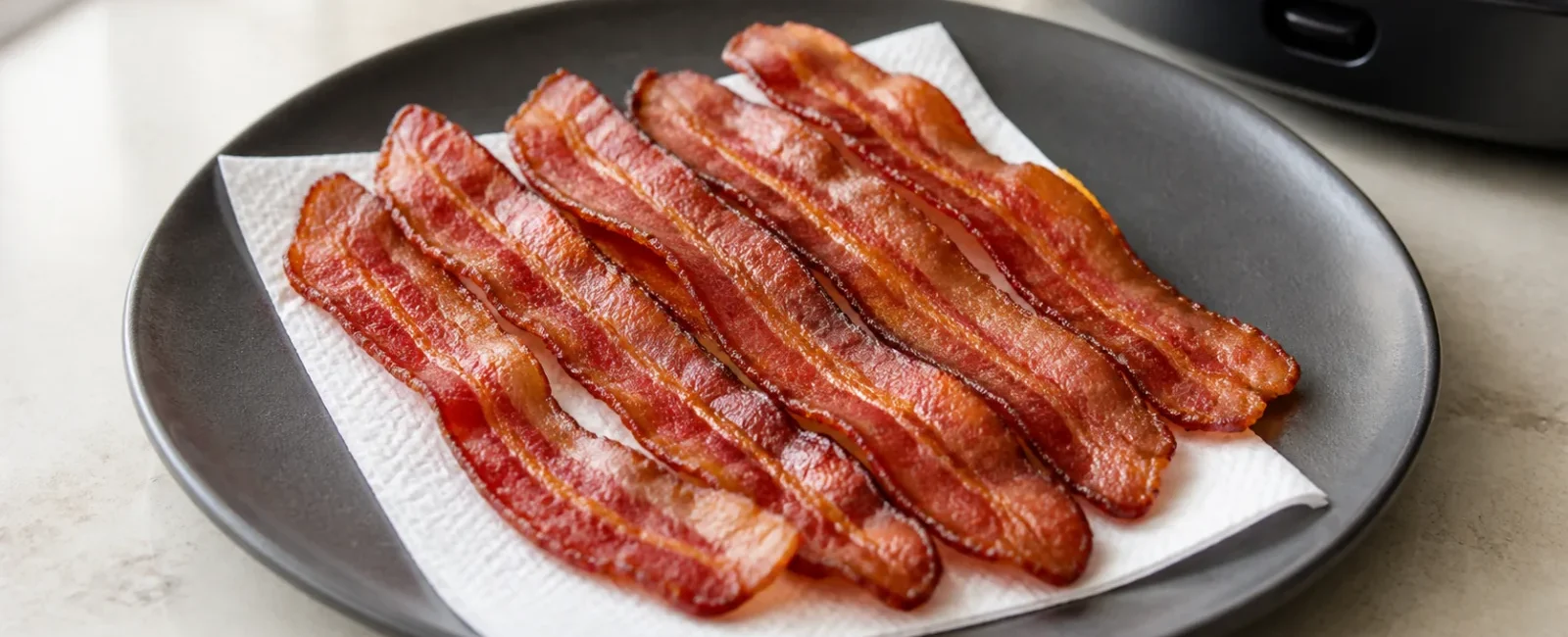
Air fryer bacon turns evenly crisp when eight regular-cut strips—about 8 ounces (227 g)—cook at 350°F (177°C) for 8 to 10 minutes. Bacon can smoke when rendered fat overheats, so begin at 350°F, arrange it in one layer, and reposition the strips halfway through. Start checking thin bacon at 7 minutes and thick-cut bacon at 10 minutes.
Air fryer bacon at a glance
- Prep time: 5 minutes
- Cook time: 8 to 10 minutes
- Total time: 13 to 15 minutes
- Temperature: 350°F (177°C)
- Yield: 8 strips, 4 servings
- Serving size: 2 strips
- Safety benchmark: The general minimum for raw whole-cut pork is 145°F (63°C) followed by a 3-minute rest; because thin bacon is difficult to probe accurately, also follow the package directions and cook it thoroughly until crisp
Exact ingredients
- 8 strips regular-cut refrigerated bacon, about 8 ounces (227 g)
- 1/4 teaspoon coarsely ground black pepper, optional
Do not add cooking spray. Bacon releases its own fat, and extra oil can increase splattering and smoke. Basket capacity varies. If the strips cannot lie in one layer without overlapping, cook them in two batches.
Preparation
- Keep the bacon refrigerated at 40°F (4°C) or below until you are ready to cook.
- If full strips do not fit flat in the basket, cut them crosswise in half. The edges may touch at first, but do not stack or overlap them.
- Check that the lower drip tray and basket are free of old grease and crumbs. Residue can smoke when fresh bacon fat reaches it.
- Wash hands, the cutting board, and utensils that touched raw bacon with hot, soapy water. Use clean tongs and a clean plate for the cooked bacon.
How to cook crispy bacon at 350°F
- Preheat: If the manufacturer recommends preheating, heat the air fryer to 350°F (177°C) for 3 minutes. A model that starts cold may add 1 to 2 minutes to the first batch.
- Arrange: Place the bacon in a single layer. Leave room for airflow; slight edge-to-edge contact is fine because the strips shrink as they cook.
- First cook: Air-fry at 350°F for 5 minutes.
- Reposition: Open the basket and turn the bacon with clean tongs. Swap strips from the center with those near the outer edge.
- Finish: Cook regular-cut bacon for 3 to 5 minutes more. Begin checking thin bacon at 7 minutes total and thick-cut bacon at 10 minutes, then check every minute.
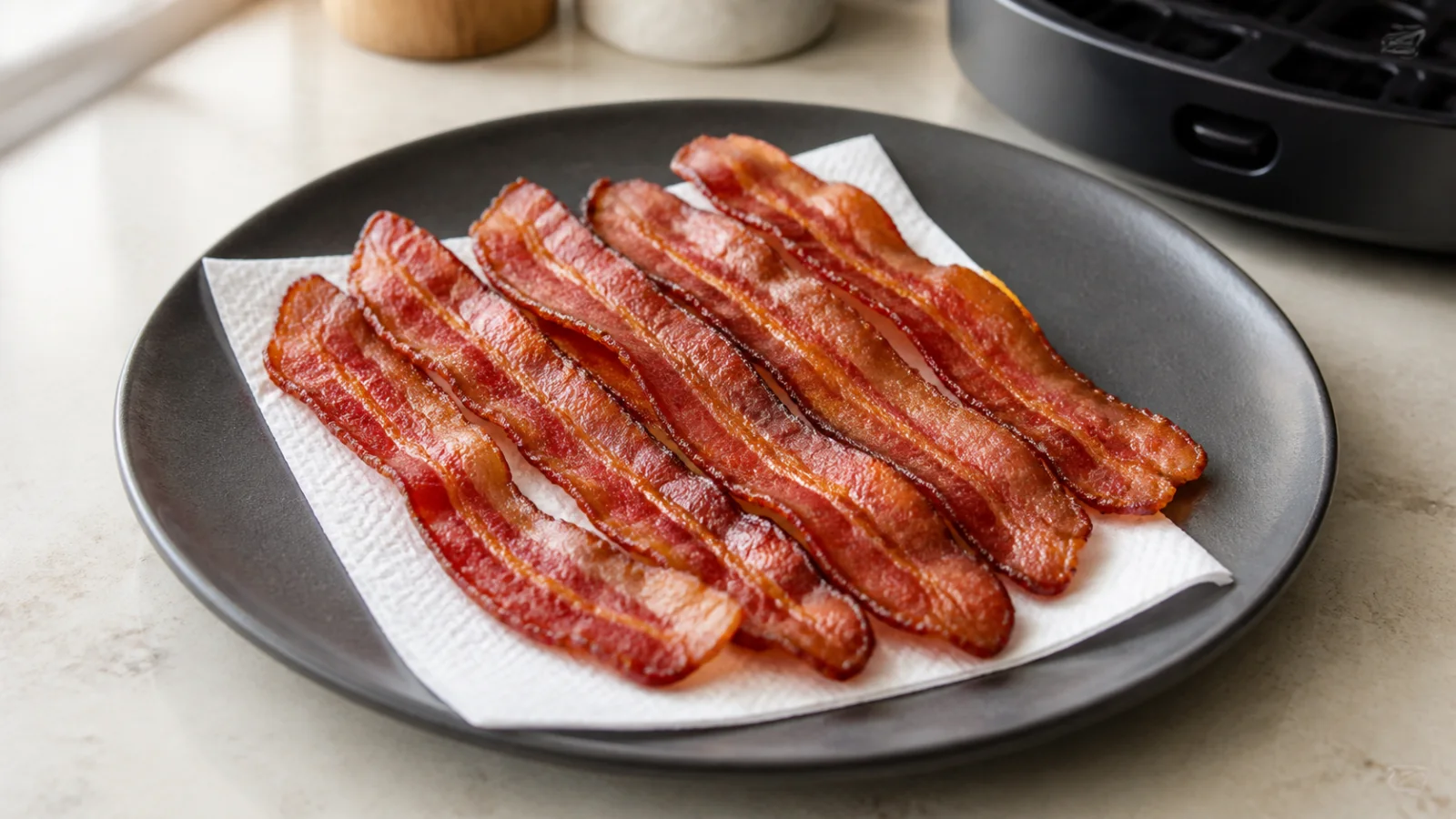
- Drain: Remove the bacon when it is just slightly softer than your target. Drain it on a clean paper-towel-lined plate for 2 minutes; it firms and crisps as it cools.
Air fryer bacon temperature and time chart
| Type | Temperature | Estimated time | When to check |
|---|---|---|---|
| Thin-cut pork bacon | 350°F (177°C) | 7–9 minutes | Turn at 5 minutes; check at 7 |
| Regular-cut pork bacon | 350°F (177°C) | 8–10 minutes | Turn at 5 minutes; check at 8 |
| Thick-cut pork bacon | 350°F (177°C) | 10–14 minutes | Turn at 6 minutes; check at 10 |
| Refrigerated cooked bacon | 325°F (163°C) | 2–4 minutes | Arrange in one layer; check at 2 |
These ranges assume a preheated basket-style air fryer and cold refrigerated bacon. Bacon made with sugar or maple syrup browns faster. Appliance size, heating-element position, and fat content can shift the finish time by 1 to 3 minutes. Record the first batch’s actual time to make later batches more predictable.
Safe temperature and doneness
FoodSafety.gov lists 145°F (63°C), followed by a 3-minute rest, as the minimum internal temperature for raw whole cuts of pork such as steaks, roasts, and chops. Thin bacon, however, is difficult to probe at its true center, so a thermometer reading may not be reliable. Follow the package cooking directions and USDA bacon-safety guidance, and cook raw bacon thoroughly until the edges are crisp and the fat is opaque. Curing and smoking can leave cooked bacon pink, so color alone is not a reliable safety test.
Fully cooked bacon is a ready-to-eat product; follow its package reheating directions. Turkey bacon may be sold raw or fully cooked. Do not automatically apply the pork-bacon chart—use the label’s time, temperature, and safety directions.
How to reduce smoke and grease splatter
- Cook at 350°F: This temperature lets the bacon crisp while reducing the chance that rendered fat will overheat as quickly as it can at 400°F.
- Empty the drip tray: After a batch, turn off and safely cool the appliance before transferring pooled grease to a heat-safe container. Never pour hot grease into water or down a drain.
- Work in batches: Overcrowding releases too much fat at once and restricts airflow.
- Follow the manual: Advice to put water or bread in the lower tray is not safe for every air fryer. Do not add either unless the manufacturer explicitly permits it.
- Stop persistent smoke: Turn off and unplug the appliance, let it cool, and remove pooled fat and burned debris. If you notice an electrical odor or malfunction, do not resume cooking until you check the manufacturer’s guidance.
Serving ideas and related air fryer recipes
Serve crispy bacon with eggs and toast, add it to salads or a BLT, or crumble it over a baked potato. For a hearty chicken dinner, use the air fryer chicken drumsticks guide. For a lighter protein, see the air fryer salmon recipe. The crispy air fryer chicken wings are another quick option when you need a 400°F recipe.
Storage, freezing, and reheating
Do not leave cooked bacon at room temperature for more than 2 hours. Blot excess grease, seal it in an airtight container, and refrigerate. Use within 3 to 4 days under USDA leftover guidance. For longer storage, separate the strips with parchment, seal in a freezer bag, and use within 1 month for best quality. Reheat refrigerated bacon at 325°F (163°C) for 2 to 4 minutes. Reheat frozen cooked bacon without thawing at 325°F for 4 to 6 minutes, checking after 2 minutes. Thin bacon burns quickly, so if using a microwave, check in 10- to 15-second intervals.
Frequently asked questions
Do I need to preheat the air fryer?
If the manufacturer recommends it, preheat at 350°F for 3 minutes. Preheating makes the first batch more predictable. With a no-preheat model, start cold and expect the bacon may take about 9 to 12 minutes instead of 8 to 10; judge the final color and texture.
Can bacon overlap in the air fryer?
Overlapping blocks hot air from the covered surfaces, so the bacon will not crisp evenly. The edges can touch because the strips shrink, but do not stack them. Cut long strips in half if that helps them fit in one layer.
Why does bacon crisp after it leaves the basket?
The hot fat firms as it cools and surface moisture continues to dissipate. If you wait until the bacon is completely rigid in the basket, it can taste dry or burned on the plate. Remove it while it is a little softer than the texture you want.
Can I line the basket with foil or parchment?
A liner is not necessary and can block airflow or hold a pool of hot fat. Use only a perforated liner approved by the appliance manufacturer, keep it secured under the food, and never preheat with an empty liner that can lift into the heating element.
How should I dispose of bacon grease?
Turn off the air fryer and wait until the grease is cool enough to handle, then transfer it to a heat-safe container. Dispose of solidified fat according to local rules, never in a sink or toilet. To save it for cooking, strain it into a clean, covered container, refrigerate it, and discard it if the color or odor changes.
Can I double the recipe?
Cook two batches instead of stacking the bacon. The second batch may finish 1 to 2 minutes faster because the appliance and drip tray are already hot. Turn off the air fryer and safely empty pooled grease between batches to reduce smoke.
Food safety references
- USDA FSIS: Bacon and Food Safety
- FoodSafety.gov: Safe Minimum Internal Temperatures
- USDA FSIS: Leftovers and Food Safety
Air fryers vary in heat output and airflow. Check the first batch at the minimum time, and give priority to the appliance manufacturer’s safety instructions and the bacon package directions.