Ohio Flooded Road Safety: Closures, Detours, and Vehicle Response
Smartor 편집팀
September 15, 2026

한국어 안내: 이 가이드를 한국어로 읽기
After heavy rain, the first question for drivers is not simply whether the rain has stopped. It is whether every road on the planned route is actually open and safe. Water drains at different rates, and pavement, shoulders, culverts, or bridge approaches can be damaged under water that looks shallow. The National Weather Service says six inches of fast-moving water can knock over an adult, about 12 inches can carry away most cars, and two feet can carry away SUVs and trucks.
In Ohio, do not rely on a social-media photo or a navigation app’s arrival estimate when checking flooded roads, detours, and storm-related delays. Use National Weather Service alerts, the Ohio Department of Transportation’s OHGO road information, and instructions from local authorities together. This guide covers the decision to commute or travel, what to do when water blocks the road, how to respond if a vehicle becomes trapped, and what to inspect after returning home.
Road risks often continue after the heaviest rain ends. Local news reported a collision involving an Ohio State Highway Patrol trooper who had been assisting with flood response near U.S. 23 in Ross County. The situation is a reminder that the storm’s second phase can include patrol vehicles, tow trucks, road crews, debris, lane restrictions, and drivers approaching an unexpected closure.
One incident or photograph, however, does not describe conditions across the state. The NWS active-alert list changes as warnings are issued, extended, or allowed to expire. A moment with no statewide alert still does not prove that every low crossing, creek road, underpass, or damaged shoulder is clear. The opposite is also true: a warning for one area does not mean every Ohio road is closed. Make the decision route by route using weather alerts, verified closures, and local instructions.
A Flood Watch means conditions could support flooding, so it is time to review alternate routes and be ready to change plans. A Flood Warning means flooding is occurring or expected and people in the affected area should act. A Flash Flood Warning is more urgent because dangerous water can rise quickly. When an emergency alert reaches your phone, read the affected area, expiration time, and protective instructions instead of stopping at the headline.
Flooded-road risk is not limited to homes next to a river. Poorly drained urban underpasses, construction zones, roads below railroad tracks, rural low spots, parking-lot exits, and small streams can become hazardous. These travelers should use an especially conservative go/no-go standard:
Schools, child-care centers, and employers also have a role. A message that says only “open as usual” can leave families guessing. Useful notices should identify blocked approaches, a changed pickup point, late-arrival rules, and where the next official update will appear.
A blue route line in a navigation app is not a safety inspection. Consumer maps can depend on user reports and historic traffic patterns, and a newly installed barricade or flooded township road may not appear immediately. Use navigation for directions, but use transportation authorities and on-scene controls to decide whether a road is open.
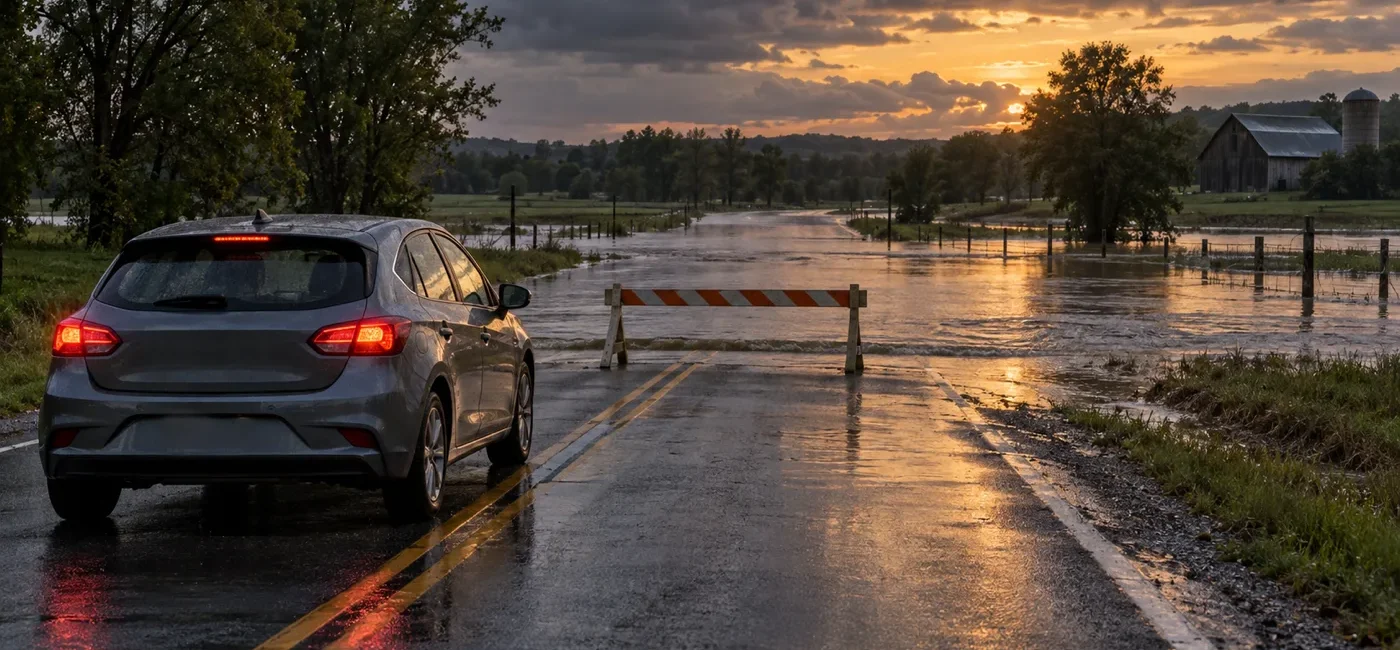
Slow down early so you do not need to brake abruptly near standing traffic. Turn on the hazard lights if needed to alert vehicles behind you, then stop or turn around at a place that does not block an intersection or driveway. Never move a barricade or drive around it. The pavement may have collapsed, a culvert may have failed, power lines or debris may be hidden, or responders may be working beyond your view.
Do not follow another vehicle through. Ground clearance, weight, air-intake position, tires, and driver choices differ. Water depth and speed can change in minutes. Even when lane markings are visible or water appears to cover only part of the wheels, you cannot inspect the roadbed below. Find a safe place to turn around instead of reversing quickly for a long distance.
Conditions vary according to depth, current, and how quickly the water is rising. Call 911 and report the road or nearby landmark, vehicle color and type, number of occupants, injuries, and whether water is entering or moving the vehicle. Use location sharing when available. Do not step blindly into fast water.
Ready.gov says that if a vehicle is trapped in rapidly moving water, occupants should remain inside, but if water is rising inside, they should get onto the roof and signal for help. On-scene conditions and instructions from 911 or rescuers take priority. Release seat belts and be prepared to open a window if escape becomes necessary, but do not leave children or people with limited mobility behind. If the vehicle begins to move or tilt, keep the emergency call connected and follow responder directions.
Reduce speed as soon as warning lights become visible. Under Ohio’s move-over principle, change to a lane away from a stopped emergency, tow, or service vehicle when it is legal and safe. If a lane change is not possible, slow substantially and leave space. Do not hold a phone up to record the scene, squeeze between cones, or ignore a flagger’s direction.
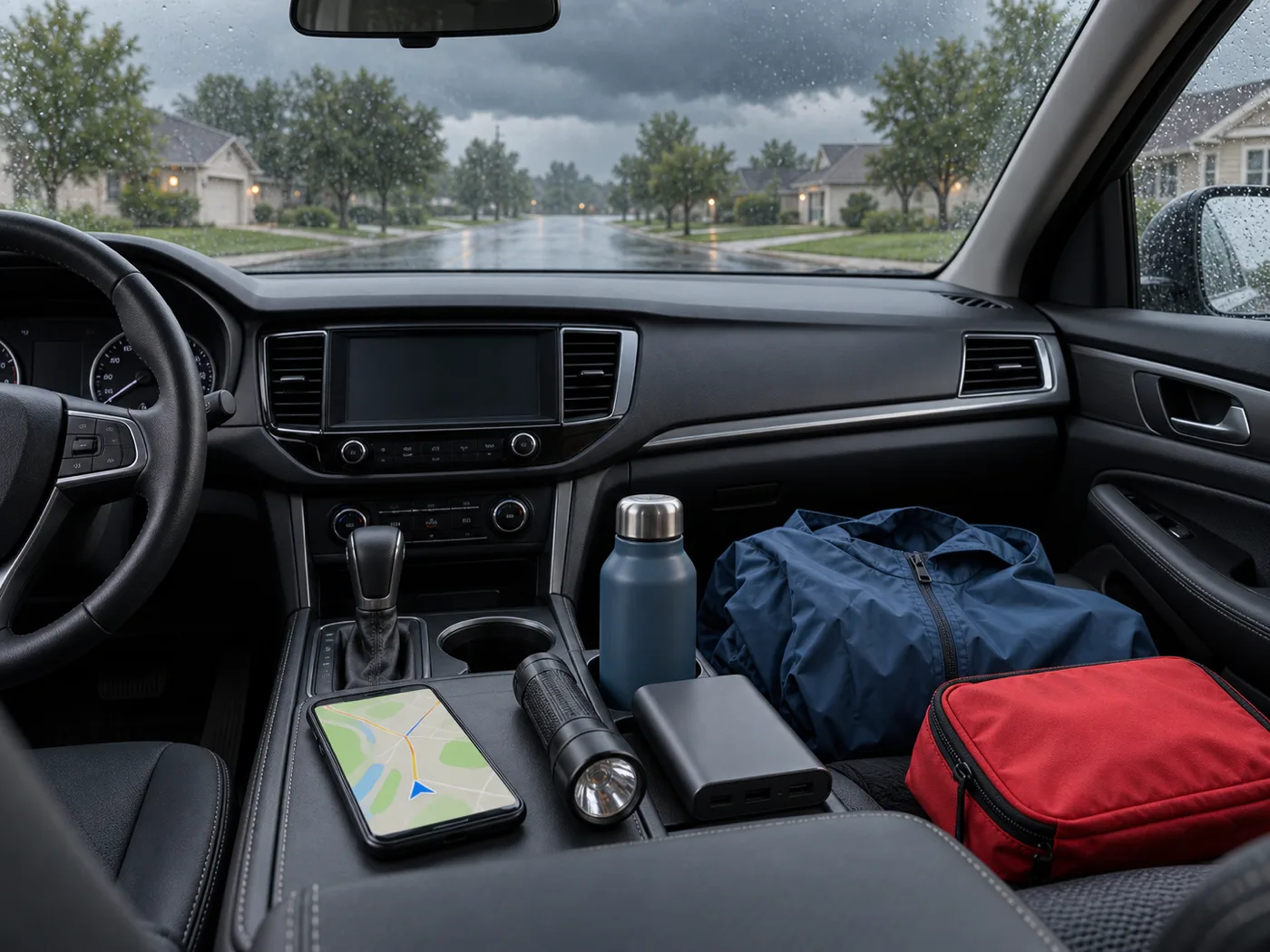
The most useful supplies help you tolerate a detour, a long wait, or a safe stop. Keep them where they can be reached, not under heavy cargo at the back of the trunk, and check them each season.
If you carry a window-breaking tool or seat-belt cutter, secure it within the driver’s reach and learn how it works before an emergency. Its presence is not a reason to enter water. Escape tools are a last resort for an unexpected entrapment, not permission to test a flooded crossing.
If water reached the wheel hubs, engine compartment, traction battery area, or interior, do not repeatedly try to start the vehicle. Water can affect the air intake, engine, transmission and axle fluids, bearings, brakes, wiring, sensors, and high-voltage system. Photograph the vehicle and visible water line from a safe position, then contact the insurer and follow the manufacturer’s guidance. Use a flatbed tow and a qualified repair facility when advised.
Electricity may be the greater hazard in a flooded garage or house. Do not stand in water while touching a breaker panel, outlet, appliance, charger, or wet electrical equipment. Ask the utility or a qualified electrician whether power can be disconnected safely. Run generators outdoors and away from windows, doors, and vents. Wear gloves and waterproof footwear for cleanup, and keep children away from contaminated water and debris.
Use this order to reduce the chance of acting on a rumor or an old photograph:
Check both the publication time and the update time. Yesterday’s closure can remain prominent in search, while an older “road reopened” post may circulate after the road closes again. When sharing information, send the official link and the time you checked it, then ask the recipient to refresh it.
The absence of an alert does not certify a particular road. Weather alerts describe broader hazards, while closures depend on local water, damage, and debris. Check OHGO, local authorities, and on-scene barricades as well.
Do not assume it is safe. Standing water can conceal a missing manhole cover, washed-out pavement, sharp debris, contamination, or an electrical hazard. Do not get out to measure it. Use a dry detour.
No. Closure data can be delayed. Verify with OHGO and the agency responsible for the road. Follow on-scene controls even when the app says to continue.
Starting it may increase engine or electrical damage and could create a safety risk. Contact the insurer, manufacturer, or repair facility first and ask whether it should be towed. High-voltage battery procedures are essential for an EV.
Send the official closure or alert link, your general location, and available alternate routes. Ask about remote work, a delayed arrival, or another reporting site. Do not bypass a barricade or cross water to meet a schedule.
No. Floodwater may contain sewage, fuel, chemicals, sharp objects, and invisible electrical hazards. Keep children and pets away, and follow local public-health guidance for cleanup and water safety.
Check alerts → verify the route in OHGO → read local closure notices → share a backup route → turn around at water or a barricade → slow down and move over near responders → do not restart a flood-exposed vehicle → preserve photos and contact records.
The safest flooded-road decision is usually simple: do not test the depth, do not copy the vehicle ahead, and do not substitute an app estimate for official road information. A detour may cost time, but it avoids the far greater risks of a washed-out road, a trapped vehicle, or a secondary collision around responders.
브라우저 메뉴에서 앱 설치 또는 홈 화면에 추가를 선택해 주세요.