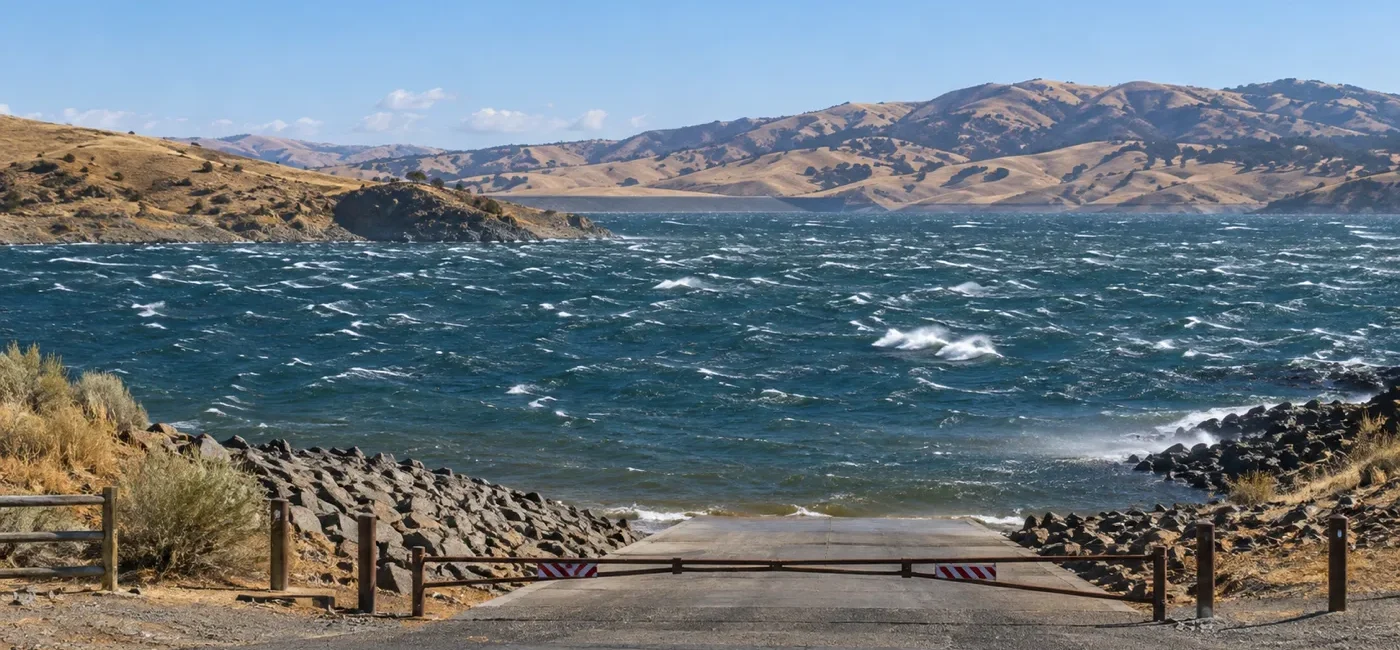
San Luis Reservoir Lake Wind Advisory: Boating and Highway 152 Safety
Smartor 편집팀
September 24, 2026

A Lake Wind Advisory is in effect for California’s San Luis Reservoir on September 24, with gusty winds and rough water expected during the afternoon and evening. The National Weather Service office in Hanford issued the advisory at 9:58 a.m. PDT. It is scheduled for 2 p.m. through 8 p.m. PDT, with west winds of 5 to 10 mph and gusts up to 25 mph. The alert covers San Luis Reservoir in the West Side Mountains north of Highway 198.
Those numbers may not sound extreme to someone standing on land. On an exposed reservoir, however, wind can build short, steep waves and make it much harder for a small boat, kayak, canoe, or paddleboard to turn around and return to shore. California State Parks separately warns that the San Luis Reservoir and O’Neill Forebay area is often very windy and that winds can rise suddenly. Visitors should check the NWS alert, park operating information, and on-site wind-warning lights before going onto the water.
The NWS alert forecasts west winds at 5 to 10 mph with gusts up to 25 mph at San Luis Reservoir during the afternoon. Its main impact statement says strong winds and rough waves on area lakes will create hazardous conditions for small craft. The advisory also tells drivers to use extra caution because winds can make travel difficult for high-profile vehicles.
A Lake Wind Advisory does not mean every cove will have the same wave height or that every vessel is automatically prohibited from operating. Actual conditions vary with wind direction, shoreline shape, fetch, boat size, loading, and operator experience. It does mean that a normal outing can become difficult quickly. A calm morning is not proof that the afternoon will remain calm, and an easy downwind trip can become a demanding upwind return that consumes much more fuel or paddling energy.
California State Parks specifically notes that winds around San Luis Reservoir and O’Neill Forebay can come up suddenly. Wind-warning lights are located at the Basalt entrance station, Quien Sabe Point, and Romero Visitor Center. On the forebay, lights are located at the Medeiros boat ramp and above the South Beach picnic area at San Luis Creek. If those lights are activated or park staff tell boaters to leave the water, follow the local direction even if a phone app shows a lower wind speed.
Low-freeboard fishing boats, lightweight aluminum boats, and personal watercraft can take spray or water over the side in repeated short waves. Steering and speed may become inconsistent, passengers can lose their balance, and unsecured tackle or coolers can shift. An engine that seems powerful enough in calm water may still make slow progress into wind and waves. Life jackets stored under a seat do not provide protection during a sudden capsize; everyone should wear a properly fitted, approved personal flotation device while on the water.
Paddle craft are directly affected by wind. A tailwind may make the outward leg feel effortless and then become a headwind that prevents a paddler from getting back. A paddleboard and its rider create a large surface for the wind, while cold-water immersion can disrupt breathing and muscle control regardless of swimming ability. During an advisory for hazardous small-craft conditions, postponing the launch is safer than relying on a plan to “stay close to shore.”
New boaters may not have practiced steering through waves, slowing for a ramp approach, or choosing a safe alternate landing. Children need life jackets sized for them; a loose adult jacket can slip off in the water. A family should base the decision on its least experienced or most vulnerable member, not on the strongest adult. If the outing changes to a picnic or shoreline walk, keep away from slippery ramps, exposed ledges, blowing equipment, and areas closed by park staff.
The NWS advisory warns that driving can become difficult for high-profile vehicles. A trailer can be pushed sideways or begin to sway, especially after a sudden steering input or hard brake application. Before leaving, inspect the coupler, safety chains, electrical connector, tire pressure, wheel security, and tie-downs. If sway starts, avoid abrupt steering, ease off the accelerator, keep the tow vehicle aligned, and slow gradually while creating more space. Follow the tow-vehicle and trailer manufacturers’ instructions for the specific braking system.
First, open the NWS alert and read its effective time, expiration time, description, instructions, and most recent update. Second, use the San Luis Reservoir State Recreation Area page and listed park contacts to verify ramp or facility conditions. Third, check Caltrans QuickMap for crashes, construction, closures, and other road information along the route. Do not make the decision from one hourly wind number in a weather app. Its observation point may be far from the launch, and gusts can be much stronger than the average wind.
Kayaks, canoes, paddleboards, and other small or nonmotorized craft should avoid the advisory period. Money already spent on travel, a reservation, or bait does not make unsafe water safer. If a rental or guided trip is involved, ask the operator in writing about weather cancellations, schedule changes, and what happens if a park facility closes. Save the official alert and any park notice for a refund or rescheduling request.
Only consider going out if local authorities allow it and the operator, vessel, and crew are genuinely suited to the conditions. At a minimum, check properly fitted life jackets, a working communications device, a whistle or sound-producing device, adequate fuel, drainage equipment, anchor and line, and navigation lights. Keep a phone in a waterproof case attached to your body. A phone placed in a loose bag may drift away during a capsize. Give a trusted person a float plan that lists the launch point, route, number of people aboard, expected return time, and who to contact if the boat is overdue.
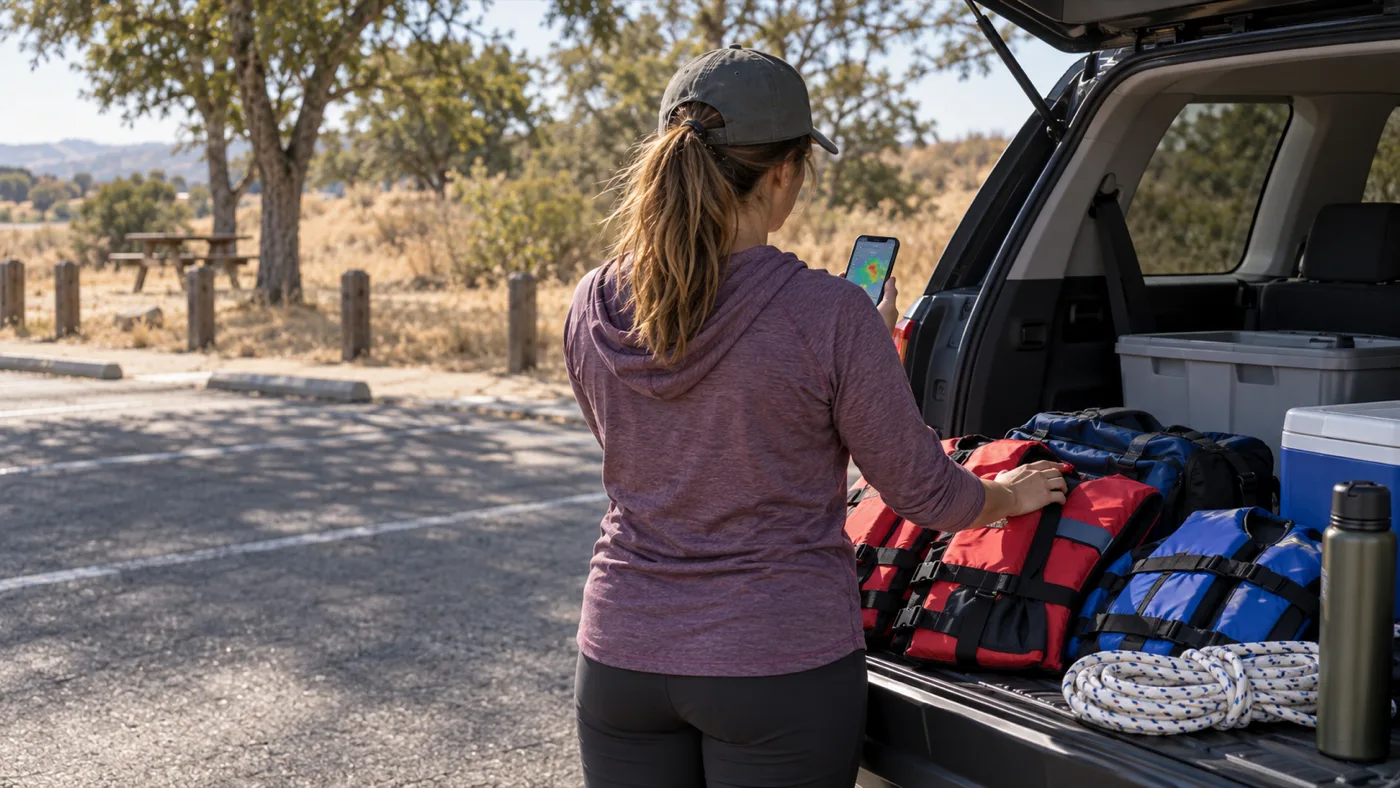
Locate the wind-warning lights identified by California State Parks before launching. Leave the water promptly if the lights activate or a ranger directs boaters to return. The presence of other boats is not evidence that conditions are safe for you. Their vessel, experience, distance from the ramp, and route may be entirely different. Waiting for “one more fish” or another short loop can put the return trip into the strongest part of the forecast wind.
Tie down awnings, folding chairs, cooler lids, empty containers, fishing rods, paddles, and anything else that can blow into a roadway or the water. Set up a tent or canopy only according to its instructions, and do not deploy it when gusts exceed what the equipment can safely handle. Never run toward traffic or the water to chase an item. Re-secure a flapping boat cover or tarp in a protected parking area before driving.
Confirm that everyone is wearing a properly fitted life jacket and move loose equipment low and secure. Passengers should sit low and near the centerline without making unnecessary movements. The operator should reduce speed and avoid taking waves directly on the side, while following the vessel manufacturer’s guidance for handling waves. Do not insist on returning to the original launch if a closer safe landing is available; follow instructions from rangers or rescuers.
If the engine fails, the boat takes on water, steering is lost, or a capsize appears possible, call 911 or the appropriate local rescue authority immediately. Report more than the name of the reservoir. Give GPS coordinates if available, the nearest landmark, the launch site, vessel color, and number of people aboard. Cellular coverage may be inconsistent, so carry a suitable secondary communications device when appropriate. After calling for help, do not enter the water or attempt a long swim unless rescuers direct you to do so.
If someone falls overboard, keep that person in sight, throw flotation, and approach carefully. An untrained person who jumps in can become a second victim. Cold-water exposure can impair breathing, judgment, and muscle function quickly. After recovery, seek urgent medical help for confusion, slurred speech, severe shivering, unusual fatigue, or other signs of hypothermia.
San Luis Reservoir State Recreation Area is reached from Highway 152. Check Caltrans QuickMap before departure for crashes, construction, or closures. A driver should not operate a phone while moving; have a passenger check updates or stop completely in a safe location. Electronic signs, law-enforcement traffic control, fire personnel, and park staff take priority over a navigation app.
Drivers towing a boat or traveling in an RV should increase following distance and avoid rapid acceleration, hard braking, and sudden lane changes. Crosswinds can be strongest in exposed sections, near passes, and where a vehicle leaves a sheltered cut. If the steering wheel is continually pushed or the vehicle cannot stay centered, slow down and proceed to a designated parking area or broad safe turnout. Do not make an abrupt stop on a narrow shoulder, soft edge, or blind curve.
Read the event, area description, effective time, expiration time, description, and instruction fields on the live alert. A screenshot or social-media summary may show an earlier version. Although this advisory lists an 8 p.m. expiration, weather changes can lead to an extension, revision, or early cancellation. Refresh the official page and check the update time.
The San Luis Reservoir State Recreation Area page provides locations, contact numbers, and information about the wind-warning lights. A website that does not show a closure is not a guarantee that every ramp remains open. Conditions can vary between Basalt, O’Neill Forebay, Los Banos Creek, and other parts of the recreation area. Contact the relevant kiosk or speak with park staff when you arrive.
QuickMap provides available information about road closures, incidents, construction, traffic cameras, and other travel conditions. It may not show a localized gust or an internal park restriction. Use it for the driving route while continuing to rely on NWS and park sources for water and wind decisions.
Not necessarily as a blanket legal rule for every vessel. The NWS does expect rough waves hazardous to small craft, and California State Parks warns that winds here can rise suddenly. Postponing a small-boat or paddle-craft trip is the prudent choice. Any local closure, activated warning light, or ranger instruction must be followed.
The alert specifically names San Luis Reservoir. Conditions and restrictions at nearby O’Neill Forebay may not be identical. Do not infer that it is safe simply because it is part of the same recreation area. Check the wind-warning lights near the Medeiros ramp and above South Beach, plus current park instructions.
One indicator should not be the entire decision. Review the latest NWS alert, visible wind and waves, ranger instructions, and the limits of your vessel and crew. Use a more conservative threshold when children, beginners, or people with limited mobility are involved.
Put on life jackets, secure gear, reduce speed, and handle waves according to the boat manufacturer’s guidance. Head for the closest safe landing or the location directed by park staff. If steering, propulsion, or flooding becomes a problem, request rescue and report your precise location and the number of people aboard.
Shore activities may carry less risk than boating, but they are not automatically safe. Stay away from slippery ramps, wave-washed edges, unstable branches, and blowing equipment. Respect closures and choose a location well back from the water.
Hard braking or abrupt steering can make sway worse. Keep the steering steady, ease off the accelerator, and slow gradually. Follow the tow-vehicle and trailer manufacturers’ instructions for your specific brake controller or sway-control system, then stop in a safe place to inspect tires, the connection, and the load.
The expiration time is not a promise that the water will become calm immediately. Check whether the alert was extended, whether the park facility is still open, and whether the boat has all equipment required for reduced visibility. A late-night launch should not be attempted merely because the listed time has passed.
This article provides general weather, boating, and travel-safety information. In an emergency, follow 911 dispatchers, park rangers, law enforcement, firefighters, and rescue personnel. Alerts and facility conditions can change quickly, so reopen the official sources before travel or launch.
브라우저 메뉴에서 앱 설치 또는 홈 화면에 추가를 선택해 주세요.
[…] Smartor 편집팀 September 24, 2026 Read this guide in English → […]