Athens Plaka Explosion: A Lodging and Gas-Leak Safety Guide for Travelers
Smartor 편집팀
September 26, 2026

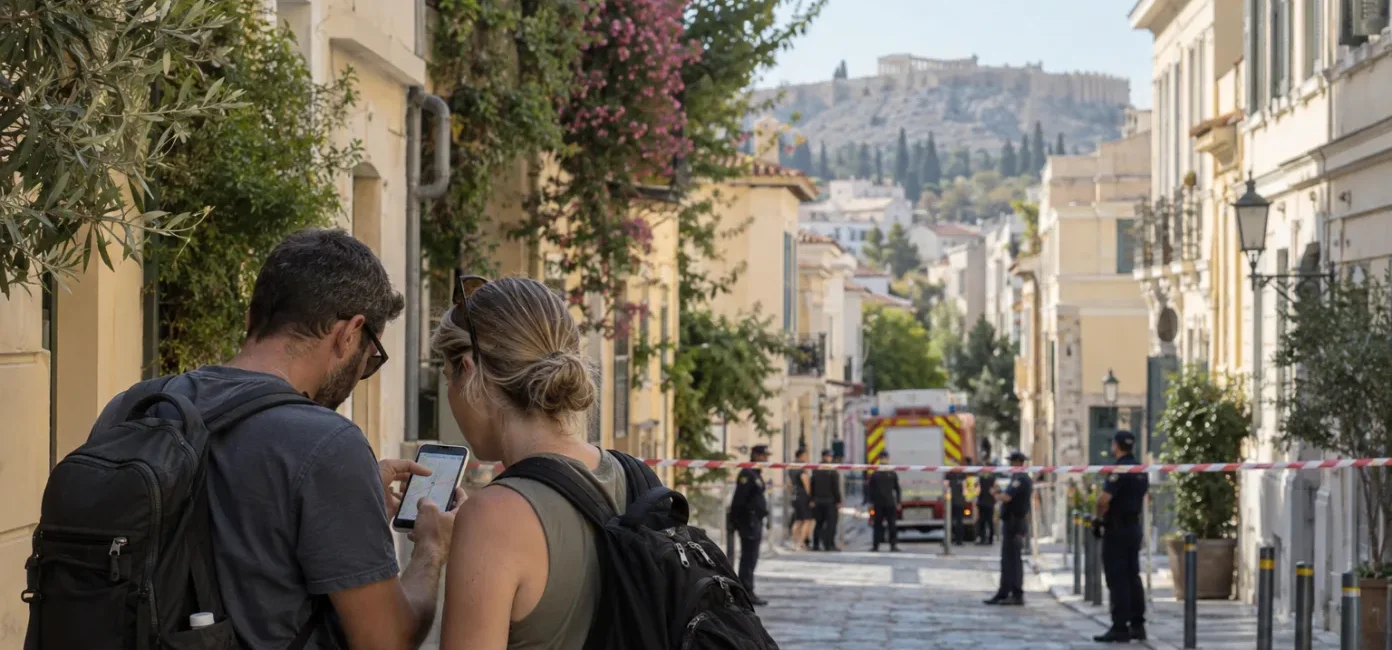
A building explosion and collapse in Athens’ historic Plaka district killed six people, including four American visitors. The site is in a heavily visited area between the Acropolis and the Temple of Olympian Zeus. Travelers in Athens do not need to treat the entire city as an emergency zone, but they should stay outside police and fire perimeters, avoid damaged neighboring buildings, and verify the status of any nearby lodging before entering.
A gas leak is the suspected cause, according to the Athens mayor, but the investigation is not complete. Do not treat an early assessment as a final finding. The most useful steps right now are practical: avoid the affected blocks, get lodging safety information in writing, leave immediately if you smell gas, call Greece’s 112 emergency number from a safe location, and preserve receipts and messages if you must change hotels or transportation.
The blast occurred in a residential building on or near Lysikratous Street in Plaka, a historic neighborhood of narrow streets, older buildings, homes, shops, hotels, and short-term rentals. The three-story building collapsed, and the blast damaged nearby structures and vehicles. Rescue crews used excavation equipment and thermal-imaging cameras while searching the rubble. BBC and CBS reported that all six victims had been recovered by Saturday afternoon.
The four Americans were reported to be a family group staying in a vacation rental. A British man and his Greek wife, who lived in the building, were also killed. CBS reported that two women were injured in an adjacent property, while BBC reported injuries from flying debris and evacuations from some nearby buildings. Identification and casualty details can change as authorities notify families, so travelers should rely on police, fire, and consular confirmation rather than circulating names from social media.
The mayor said investigators suspected a gas leak. That does not establish the precise source, ignition point, condition of the building systems, or legal responsibility. Those questions require technical investigation. Visitors do not need to diagnose the cause. Their immediate job is to respect the exclusion zone and leave promptly if they encounter gas odor, hissing, smoke, unusual structural sounds, or directions to evacuate.
Guests staying in Plaka or near the Acropolis should check the exact address of their hotel or rental. If a property is inside a restricted area or the manager says entry is prohibited, do not go inside to retrieve luggage. A building can require inspection even when damage is not obvious from the street. Ask the host or hotel, in writing, whether the property is open, who cleared it for occupancy, whether gas and electricity are available, and when guests may safely return.
Visitors headed to the Acropolis, the Acropolis Museum, or the Temple of Olympian Zeus may encounter detours even if an attraction remains open. The status of a major site and access to a nearby street are separate questions. Check the attraction’s official notice and your ticket provider, then choose a route that does not cross a police or fire line. Taxis may be unable to reach a doorway inside the historic district, so arrange a backup pickup point on a wider street.
Short-term rental guests should ask more specific questions than “Is the neighborhood safe?” Older central-city properties vary in gas service, water-heating equipment, alarms, stairwells, and exit arrangements. Ask whether the exact building has been inspected, whether the fuel supply was shut off, whether a qualified technician checked the equipment, and whether alarms and exits are working. Keep those answers inside the booking platform whenever possible.
Travelers heading to Athens International Airport should allow additional time if they are leaving from Plaka. A flight may operate normally while local streets are restricted. Send the driver both the lodging address and a second pickup point outside the narrowest streets. If using the Metro, verify that your walking route to the station does not pass through the affected block.
Debris removal does not mean a site is safe for bystanders. Masonry, windows, roofs, or temporary supports can shift after the initial collapse. Do not approach a barrier to take photos, and keep emergency access lanes clear. If a navigation app sends you toward the perimeter, follow officers’ directions instead. Travelers with children, older adults, or mobility limitations should favor wider, well-lit detours over steep or crowded side streets.
Message the hotel, property manager, or booking platform with the exact address and ask about building access, utilities, any official evacuation order, and any structural or gas inspection. If you are told to leave or cannot enter, request alternate lodging through the original booking channel. Avoid moving the conversation to cash-only arrangements or an unfamiliar payment link, because doing so can make a later refund or insurance claim harder to document.
A sulfur-like or rotten-egg odor, hissing sound, unexplained dizziness, or unusual flame behavior can signal a dangerous fuel or combustion problem. Do not investigate by turning equipment on and off. Electrical switches, outlets, exhaust fans, doorbells, elevators, and chargers can create a spark. Leave by the stairs, move well away from the building, and call 112 from a safe location.
Only operate a shutoff valve if you already know its location and correct procedure and can reach it without entering danger. In a vacation rental, the system may be unfamiliar, so it is safer to leave that task to the manager, fire service, or a qualified technician. Do not reenter simply because the odor fades. Wait until local authorities or a competent professional says the property is safe.
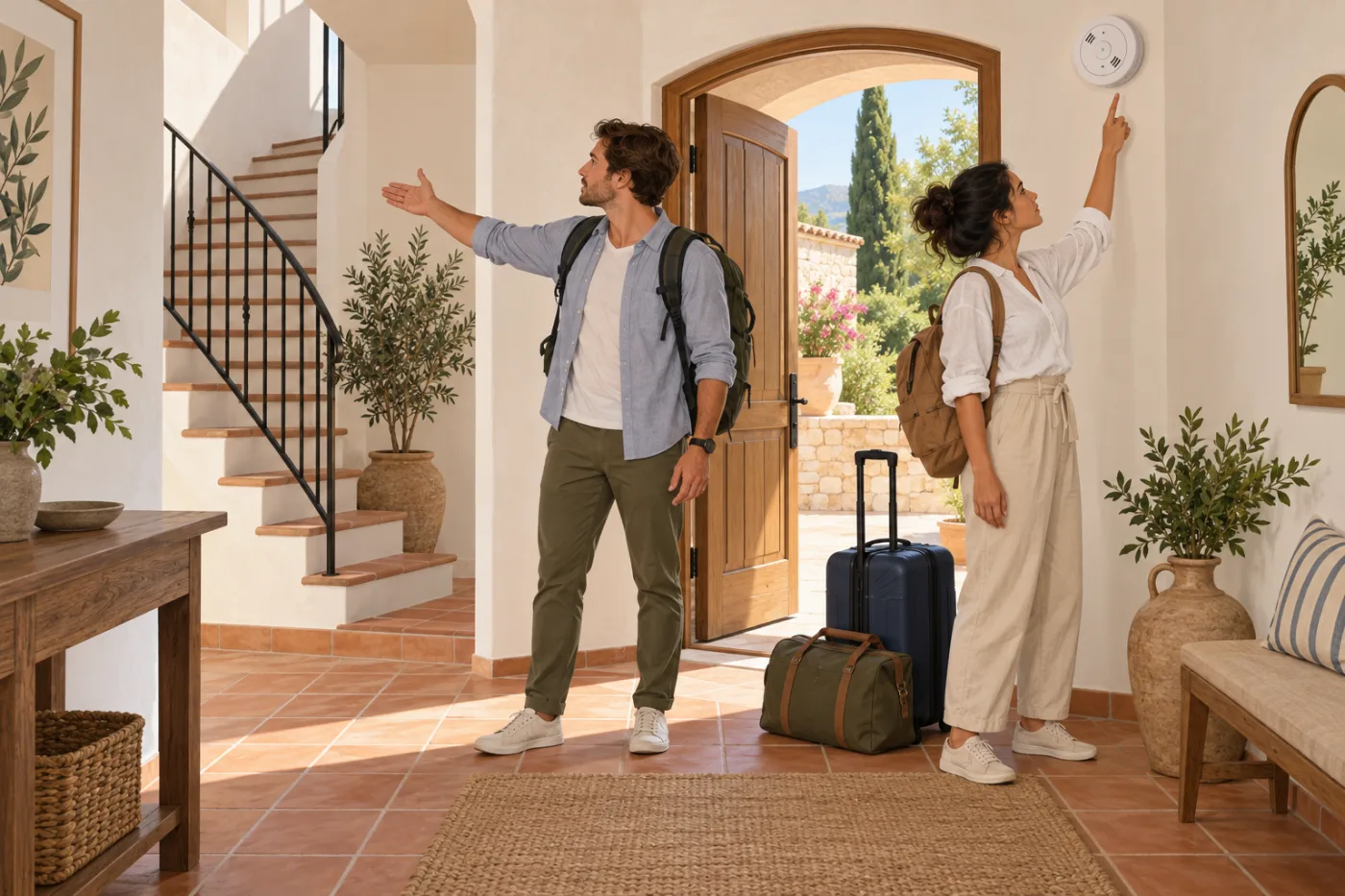
Cell service can be delayed in a crowded emergency, and batteries run down. Choose one outdoor meeting point and a backup location that are not directly in front of the building. Each traveler should have the lodging address, reservation number, a passport copy, and the insurance contact. Give children a card with a guardian’s name and phone number. Agree in advance that no one delays evacuation to pack bags.
Keep receipts for replacement lodging, taxis, fare differences, change fees, and essential purchases. If the property is closed or inaccessible, preserve the host’s message, the booking platform’s cancellation reason, and any official notice you receive. Travel insurance coverage depends on the policy language, the cause of loss, and whether an authority closed the property. Do not assume every disruption is automatically covered; open a claim and obtain a reference number.
U.S. citizens dealing with a lost passport, hospitalization, a missing family member, or a death can use the U.S. Embassy in Greece’s official American-citizen assistance channels. An embassy cannot replace Greek emergency services, conduct the local investigation, or force a private company to issue a refund. It can help with consular communication, urgent passport issues, notification, and information about local resources. Verify contact details directly on gr.usembassy.gov, not through an advertisement or unofficial directory.
Report a missing alarm, blocked exit, damaged appliance, or fuel odor immediately. Use concrete details—the exact address, floor, device, time, and odor—rather than a general complaint. If the danger is immediate or the property has no usable escape route, leaving and arranging different lodging may be the responsible choice.
Greece’s Ministry for Climate Crisis and Civil Protection describes 112 as the single European emergency number. It is free, available for people who need immediate help, and designed to connect the relevant response agencies. The system can also support caller location and send mass public-safety alerts with protective instructions during dangerous events.
Start with the location: street name, building number, nearest intersection, and a visible landmark. Then briefly describe the gas odor, explosion, smoke, injury, or person who may be trapped. If needed, ask for English. Keep the map address ready and leave the phone on so responders can call back, but do not use the phone while standing next to a suspected gas leak. Move away first.
For emergency instructions and public alerts, use the Greek Ministry for Climate Crisis and Civil Protection’s official 112 page and directions from police or firefighters at the scene. A phone alert can contain location-specific protective steps. However, the absence of an alert does not cancel an immediate warning such as a strong fuel odor, visible damage, smoke, or an evacuation order.
For U.S. citizen assistance, use the U.S. Embassy in Greece and the U.S. State Department’s Greece travel-information pages. Official U.S. government websites use the .gov domain. Avoid sponsored search results that present an unofficial phone number or request payment for “emergency registration.” A family contacting consular officials should organize the traveler’s full name, date of birth, passport details, last contact time, and lodging address.
For incident facts and the affected area, compare announcements from Athens authorities, Greek police or fire services, and multiple established news organizations. Casualty numbers, street access, and preliminary causes can change. An undated video or a post without a verifiable location should not be used to decide whether a road or building is currently open.
This is a serious incident at a specific building and its immediate surroundings. The confirmed information does not establish that all of Athens is closed or that every traveler must cancel. It also does not mean the affected block is safe merely because major attractions elsewhere remain open. Decide based on the exact location of your lodging, local restrictions, transportation and tour status, and the health and mobility needs of your group.
If a Plaka property is closed or the owner cannot provide a credible safety status, alternate lodging should take priority over preserving the original reservation. Ask for answers in writing before a cancellation deadline passes. Travelers with asthma, cardiovascular conditions, or limited mobility should also consider dust, longer detours, stairs, and access to medication.
Major incidents can quickly produce fake fundraising pages, false missing-person lists, and fraudulent “refund desks.” Be suspicious of anyone who asks for a wire transfer, a full passport image, or card details in exchange for confirming a relative’s safety or releasing a hotel refund. Start all booking changes in the app or website you originally used, and type official government addresses into the browser yourself.
Before sharing a claim about another explosion, a citywide gas shutdown, or a new death toll, identify the announcing agency and timestamp. Do not post door codes, passport screens, victim identities, or a traveler’s real-time location. Unverified information can misdirect visitors and burden emergency lines.
Current reporting concerns the collapsed building, adjacent structures, and nearby streets under inspection or control. It does not establish a districtwide closure. The perimeter can change as search and structural work continue, so check again shortly before moving through the area.
No. The mayor and news reports identify a gas leak as the suspected cause. The final technical investigation has not been reported as complete, so the source of the leak and responsibility should not be treated as settled.
Use 112, the single emergency number in Greece and the EU. It is free and can connect the appropriate police, fire, or medical response. Save 112 before you travel rather than relying on the U.S. 911 system.
Opening a door or window can help only if it can be done immediately and safely. Do not stay inside to ventilate, and never switch on an electric fan. Avoid sparks and flames, get everyone out first, and call from a safe distance.
No. Do not cross a fire or police line or ignore a manager’s no-entry direction. Tell authorities that essential documents remain inside and follow their retrieval process. If the passport cannot be recovered, contact your embassy through its official website.
Not necessarily. An attraction may remain open even when one access route is restricted. Check the operator’s notice and the seller’s cancellation policy, and preserve any documentation showing that you could not access the service.
Contact the lodging, airline, tour companions, and booking provider, and assemble the person’s last known location and time. If there is reason to suspect immediate danger, use Greek emergency channels and the U.S. Embassy in Greece’s official citizen-assistance route. Do not send passport or payment information to an unofficial “traveler locator” service.
This guide reflects official guidance and major reporting available on September 26, 2026. Street closures and access conditions can change quickly; recheck official information immediately before travel.
브라우저 메뉴에서 앱 설치 또는 홈 화면에 추가를 선택해 주세요.