
The riskiest point in a used-car purchase is not necessarily when a salesperson says the price is only good today. Risk starts earlier, when a buyer relies on one reassuring fact without cross-checking the VIN, title history, recalls, physical condition, financing, and written contract. A car can look excellent and have no major accident listed on a history report while still having deferred maintenance or a recent event that has not appeared in the data. A low monthly payment can also hide a longer term, expensive add-ons, and a much higher total cost.
This guide gives U.S. buyers a practical sequence for purchasing from a dealer or private seller. It covers setting a total budget, saving the advertisement, matching the 17-character VIN across the car and documents, checking official recalls, reviewing NMVTIS-based history information, reading the FTC Buyers Guide, taking a meaningful test drive, arranging an independent inspection, comparing price and loan terms, reviewing the final contract, and preserving records after delivery. The goal is not to grab a promising car quickly. It is to decide what must be verified before moving to the next step.
1. Set a total budget, not just a maximum listing price
A search-price ceiling does not capture sales tax, registration, dealer documentation fees, insurance, immediate maintenance, or loan interest. Separate the cash available for the purchase from your emergency savings, then reserve money for expenses that may arise during the first 90 days. Tires, brakes, a weak battery, a fluid leak, overdue scheduled service, and state inspection requirements can become real costs soon after delivery even if they do not change the negotiated price.
If you plan to finance, write down more than your target monthly payment:
- The negotiated vehicle price and the out-the-door price, including taxes, registration, and required fees
- The down payment and trade-in credit as separate numbers
- Amount financed, annual percentage rate (APR), loan term, monthly payment, and total of payments
- The individual cost of service contracts, GAP coverage, anti-theft products, or other optional add-ons
- Insurance down payment and expected premium for that specific VIN
The Consumer Financial Protection Bureau explains that shopping for loan offers before visiting a dealership can help buyers understand their options. Two loans with the same monthly payment can have very different total costs if their terms differ. Compare APR, term, amount financed, and total payments—not only the monthly number. If you are concerned about identity theft while shopping for financing, Smartor’s step-by-step guide to freezing all three credit reports explains how freezes and temporary lifts work.
2. Save the advertisement and ask questions in writing
Listings can be edited or removed, so save a screenshot or PDF before visiting. Capture the asking price, mileage, VIN, trim, drivetrain, warranty language, accident or rental-use claims, included equipment, fee disclosures, and posting date. Statements such as “one owner,” “accident-free,” “fully serviced,” or “excellent condition” are claims to verify, not inspection findings.
Use text or email for important questions so you have a record. A seller who repeatedly refuses to provide the VIN or gives vague answers about title status may be giving you a reason not to make the trip.
- What is the full 17-character VIN and current displayed mileage?
- Is the title in the seller’s name, and is there an outstanding lien?
- Has the vehicle ever had a salvage, rebuilt, flood, junk, or lemon title brand?
- Is there known collision, flood, fire, frame, or airbag-repair history?
- Are maintenance records and recall-completion receipts available?
- Will the seller allow an inspection by a mechanic chosen by the buyer?
- Are any fees or products mandatory in addition to the advertised price?
3. Match the VIN in several places instead of copying it once
The VIN is the link between the physical vehicle and its records. Do not simply copy the number from the ad and order a report. At the vehicle, compare the VIN visible through the windshield on the driver’s side, the driver-door or door-pillar label, the title and registration documents, the FTC Buyers Guide, and the purchase contract. If even one character differs, stop and obtain corrected documents and an explanation before ordering or relying on another report.
Scratches around a VIN plate, unusual rivets, an altered-looking label, adhesive residue, or a mismatch between the documents and the apparent year or model deserves professional or official review. A buyer should not assume they can authenticate a suspicious VIN by sight. Do not remove or disturb a plate or label; contact the state DMV or law enforcement if the identifier appears altered.
4. Use vehicle history as a question list, not a final answer
The National Motor Vehicle Title Information System (NMVTIS), overseen by the U.S. Department of Justice, allows consumers to obtain reports from approved providers. Depending on the available records, an NMVTIS-based report can include state title information, the latest reported odometer reading, title brands, and certain salvage or insurance total-loss information. Start from the official NMVTIS consumer page and follow its approved-provider links rather than assuming a similarly named search advertisement is official.
Read the report chronologically:
- Compare the current title state and prior registration states with the seller’s explanation.
- Check whether reported mileage generally increases over time.
- Look for salvage, rebuilt, flood, junk, lemon, or other title brands.
- Review any insurer total-loss or salvage-operator information shown.
- Flag rapid state changes, long data gaps, or dates that conflict with maintenance receipts.
A clean report is not a guarantee that the vehicle has never been damaged. Not every event reaches every database at the same time, and a history report does not assess current mechanical condition or deferred maintenance. Its best use is to identify facts and gaps that need closer attention during the physical inspection.
5. Check the VIN for open safety recalls at NHTSA
Enter the VIN on the National Highway Traffic Safety Administration’s official recall page and save the dated result. If an unrepaired safety recall appears, call an authorized manufacturer dealership with the VIN and ask about parts availability, appointment timing, and the repair process. If the seller says the repair was completed, request the repair order or dealer service record instead of relying on the statement alone.
An open recall does not automatically make every vehicle a bad purchase, but accepting the car without knowing when the remedy is available can affect safety and transportation plans. Likewise, a result showing no open recall does not certify the entire car as safe. Recall data addresses covered safety defects; it does not replace an inspection of tires, brakes, leaks, collision repairs, or general condition.
6. Read the FTC Buyers Guide beside the contract
Dealers covered by the FTC Used Car Rule must display a Buyers Guide on used vehicles offered for sale. The guide tells buyers whether the vehicle is being sold “AS IS—NO DEALER WARRANTY” or with a dealer warranty. When a warranty is offered, it identifies covered systems and the percentage of repair costs the dealer agrees to pay. It also warns buyers to get promises in writing. Private-party transactions may not be covered by the same rule, so identify who is actually selling the vehicle.
Match the Buyers Guide VIN to the car and photograph both sides. Do not treat “as is” as a casual phrase. Determine exactly what written warranty, if any, accompanies the sale. If the dealer promises an engine, transmission, air-conditioning, or other repair, put the responsible party, scope, cost allocation, deadline, and duration in the contract or a signed addendum. Any conflict between the Buyers Guide and contract should be corrected before signing.
7. Inspect the car cold, in dry weather and daylight
When possible, view the vehicle during the day when it is not raining and ask the seller not to warm the engine before you arrive. A cold start may reveal noises, smoke, warning lights, or delayed starting that are less obvious after warm-up. Bringing another person helps: one person can speak with the seller while the other follows the checklist and records observations.
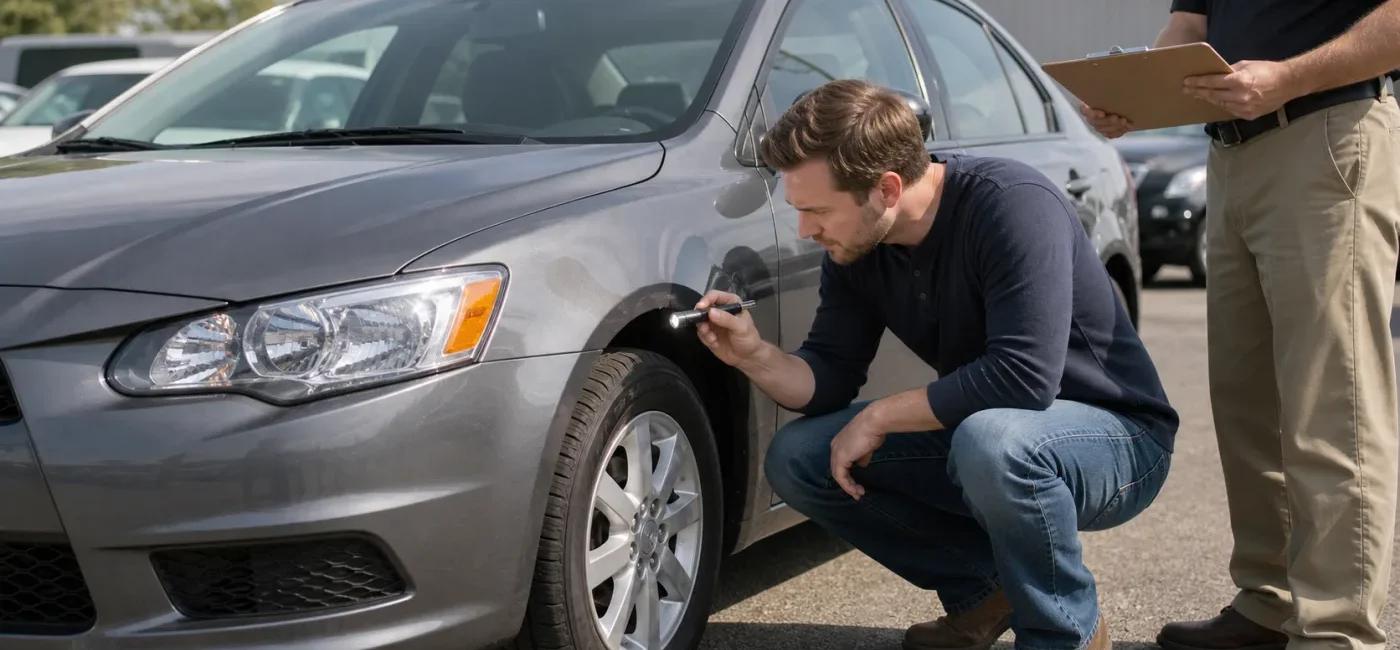
Outside, compare panel gaps and paint shades and look for moisture in lamps, mismatched glass markings, uneven tire wear, differing tire sizes, wheel damage, and visible fluid residue underneath. Lift the trunk floor and spare-tire cover if it is designed to open normally; look for moisture, rust, sediment, or musty odors without forcing trim apart. Inside, check seat belts, seat tracks, reachable carpet edges, windows, locks, climate controls, cameras, wipers, and the normal warning-light sequence before and after startup.
A walkaround is not a professional collision-repair assessment. Fresh paint, disturbed bolts, irregular welds, or unusual seam sealer should become questions for an independent mechanic or body-repair professional. Do not dismantle an airbag cover or touch high-voltage hybrid or electric-vehicle components.
8. Test-drive at several speeds with the audio off
Confirm insurance and driving permission, then use a route the seller allows. A loop around the parking lot is not enough. Include low-speed turns, smooth pavement, controlled braking, ordinary bumps, and, when safe and legal, a highway segment. Follow the owner’s manual and safe procedures for any under-hood fluid checks, and never open a hot cooling-system cap.
- Listen for rough running, metallic noises, smoke, or strong odors after startup.
- Notice repeated hesitation, slipping, or harshness during acceleration and shifting.
- Check whether the car pulls, wanders, or develops steering-wheel vibration.
- Watch for brake noise, pedal problems, vibration, or warning lights.
- Listen for clicking during tight turns and clunks over normal bumps.
- Test air conditioning, heat, defrost, gauges, and driver-assistance warnings.
Record the conditions under which a symptom appears. Notes such as “vibration near 45 mph under light acceleration,” “repeated clicking during a slow right turn,” or “coolant odor after 15 minutes” help a mechanic reproduce the concern. Clearing a warning light to see if it returns is not a substitute for diagnosis.
9. Hire a mechanic who is independent of the seller
The FTC specifically notes that a vehicle history report is not a substitute for an independent inspection. Schedule a pre-purchase inspection with a shop that has no financial connection to the seller. Ask whether the technician is experienced with the vehicle type, whether the car will go on a lift, whether scanning and photographs are included, and whether you will receive a written report. For a hybrid or EV, ask whether the shop has appropriate high-voltage training and equipment and what battery assessment is included.
A useful inspection request may cover:
- Engine and transmission leaks, cooling system, belts, hoses, and fluid condition
- Brake wear, tire life and uneven wear, steering, and suspension
- Underbody corrosion, unibody or frame repair evidence, and signs of flood or collision damage
- Emissions-related warnings and OBD readiness status
- Airbag, ABS, and other safety-system warnings and scan codes
- Separate estimates for immediate repairs, likely maintenance within six months, and monitor-only items

If the seller refuses an independent inspection, ask why in writing and seriously consider walking away. A mobile inspection can be useful when transport is difficult, but confirm whether its scope matches a shop inspection with a lift and specialized equipment. Paying for an inspection does not obligate you to buy the car. When an inspection reveals a major risk and you leave the deal, the fee may have prevented a much larger loss.
10. Example: comparing two similarly priced seven-year-old sedans
Suppose Sedan A and Sedan B have similar advertised prices. A looks cleaner, but it has few maintenance records and uneven wear across all four tires. B has cosmetic scratches but includes service receipts and a recent brake invoice. Neither report shows a major title brand, while the NHTSA VIN search shows one open recall on B.
It would be a mistake to conclude that A is automatically safer because it has no open recall, or that its cleaner paint makes it the better value. Call an authorized dealer to verify remedy availability and appointment timing for B, and independently inspect both cars. A mechanic can determine whether A’s tire wear points only to alignment or to suspension or prior collision issues, while also checking whether B’s documented brake work matches the installed parts and current condition.
Build a comparison using the out-the-door price, immediate repairs, expected 12-month maintenance, insurance, and total loan cost. A car that appears $1,000 cheaper in this hypothetical example could cost more after tires, suspension work, or higher financing expense. The number is illustrative only; actual repairs and financing must be confirmed for the vehicle, location, and buyer.
11. Separate vehicle price, trade-in, financing, and add-ons
Combining all four into one monthly payment makes it difficult to see where the cost changed. First request a written out-the-door price for the specific VIN, itemizing vehicle price, taxes, registration, dealer fees, and any claimed mandatory product. Then compare the trade-in value separately. Review the loan and optional add-ons only after those figures are clear.
For financing, compare APR, term, amount financed, monthly payment, finance charge or total payments, and any contractual early-payoff terms. If someone says an add-on is required for loan approval, ask where that requirement appears and verify it directly with the lender when necessary. For service contracts, GAP coverage, wheel-and-tire plans, or anti-theft products, check for overlap with insurance or manufacturer coverage, cancellation rules, refund calculations, and whether the price will be added to the loan and accrue interest.
12. The final 20-minute signing checklist
- The contract VIN, year, model, and mileage match the physical car.
- Vehicle price, tax, registration, documentation fees, and add-ons are itemized.
- Down payment, trade-in credit, and any old-loan payoff are accurate.
- You understand the APR, term, monthly payment, and total payments.
- The Buyers Guide agrees with the warranty and service-contract language.
- Every verbal promise appears in writing with an owner, scope, and deadline.
- There are no blanks or electronic-signature screens you have not reviewed.
- You receive complete copies of the contract, Buyers Guide, financing, warranty, and inspection records.
- You know when insurance becomes effective and how temporary and permanent registration will work.
Do not sign a document you do not understand simply because someone is rushing you. With electronic paperwork, download or print the entire final agreement and confirm that all pages and addenda are present. Do not assume every vehicle purchase has a federal three-day cooling-off period. Cancellation rights and return policies depend on the transaction, state law, and any written dealer policy, so verify them before signing.
13. Extra checks for a private-party sale
A private sale may not carry the same dealer-rule protections or warranties, making the seller’s identity, title status, and lien release especially important. Safely compare the name on the title with the seller’s government-issued ID. If the seller is not the titled owner, do not accept a casual explanation for title jumping; contact the state DMV. When a lien exists, follow the lienholder’s and DMV’s documented payoff and release process rather than handing over money on a promise that the title will be cleared later.
Cash and electronic transfers can be difficult to recover. Before paying, confirm the state’s requirements for a bill of sale, title signatures, odometer disclosure, license plates, tax, and registration. Meeting in public does not make the paperwork valid. When possible, use a DMV, bank, or other location that can support the transaction, and do not carry a large amount of cash alone.
14. What to do during the first 72 hours after purchase
- Store the contract, title and registration records, Buyers Guide, warranty, inspection report, and ad screenshots together.
- Confirm that the VIN and effective time on the insurance policy are correct.
- Use the manufacturer’s owner portal or an authorized dealer to review recalls, service campaigns, and manuals.
- Schedule safety work that the independent mechanic classified as immediate.
- Verify delivery of all keys, wheel-lock key, charging cables, spare tire, or repair kit promised in writing.
- Keep dated notes and receipts for all post-sale communication and repairs.
When building an emergency kit for the car, consider climate, household health needs, and storage temperature. Prescription medication and sensitive medical information may not be appropriate for permanent vehicle storage. Smartor’s emergency medication and medical information kit guide can help you plan safer backups.
15. Common mistakes
Mistake 1: Treating one history report as a mechanical inspection. A report reflects events that reached its data sources. It does not measure current leaks, wear, repair quality, or battery condition.
Mistake 2: Copying the VIN only from the advertisement. Match the number on the vehicle, title, Buyers Guide, and final contract so you do not inspect one car while reviewing another car’s records.
Mistake 3: Negotiating only the monthly payment. Extending the term or financing add-ons can lower the monthly number while increasing total cost.
Mistake 4: Using only a mechanic selected by the seller. The buyer should choose an independent shop and receive the findings in writing.
Mistake 5: Trusting a verbal warranty more than the contract. Put the responsible party, covered work, cost allocation, and deadline in writing.
Mistake 6: Assuming no open recall means no safety concern. Recall lookup and a current-condition inspection serve different purposes.
Mistake 7: Believing every signed deal can be canceled within three days. Do not rely on a universal federal cancellation period for vehicle purchases; check the contract and applicable state law before signing.
16. Frequently asked questions
Can I skip the inspection if the history report is clean?
That is not advisable. An unreported collision, recent repair, deferred maintenance, or mechanical wear may not appear in the report. Past records and current condition require separate checks.
Should I reject every car with an open recall?
It depends on the vehicle and remedy situation. Save the NHTSA result, ask an authorized dealer about parts and scheduling, and understand whether the remedy can be completed before delivery. Do not accept a seller’s unsupported claim that the work is finished.
What if the dealer will not let the car leave for an inspection?
Ask for the reason and evaluate the scope of any mobile-inspection alternative. Walking away is reasonable when the seller will not permit a sufficiently independent examination. A discount does not necessarily compensate for unknown mechanical risk.
Does “as is” mean I have no rights at all?
Do not make that blanket assumption. The answer can depend on the warranty documents, advertising and representations, contract terms, state law, and possible deception. Keep the Buyers Guide and contract, then ask the relevant state consumer agency or a qualified attorney about a specific dispute.
Is every commercial history report the same as NMVTIS?
No. Services and data coverage vary. Begin at the official NMVTIS consumer page to find approved providers, and treat other reports as additional sources. No history product replaces a mechanical inspection.
Should I obtain insurance quotes before signing?
Yes, it is practical to quote the specific VIN because premiums and eligibility vary by vehicle. Compare quotes using the same coverage limits and deductibles, and verify the exact effective time.
Does a mechanic guarantee the repair estimate?
A pre-purchase inspection reflects visible conditions and the agreed inspection scope at that time. Some defects require disassembly, and costs can change with parts and labor. Obtain the scope, limitations, and estimates in writing.
Conclusion: look for a verifiable transaction, not a perfect used car
Perfect information is rarely available in a used-car purchase, but cross-checking independent sources can reduce major risk. Save the listing and seller statements, match the VIN on the car and documents, review NMVTIS-based history and NHTSA recall information, compare the Buyers Guide with the contract, and incorporate an independent mechanic’s findings into the true total cost.
No single step replaces another. A clean history does not replace a mechanical inspection. An inspection does not establish clean title. A low monthly payment does not prove an affordable total cost. If the seller will not provide the time, access, and documents needed for reasonable verification, losing that particular car is not necessarily a loss.
[…] sensors need post-repair calibration. If a totaled car leads to a replacement purchase, Smartor’s used-car buying checklist covers VIN checks, recalls, history reports, and an independent […]