
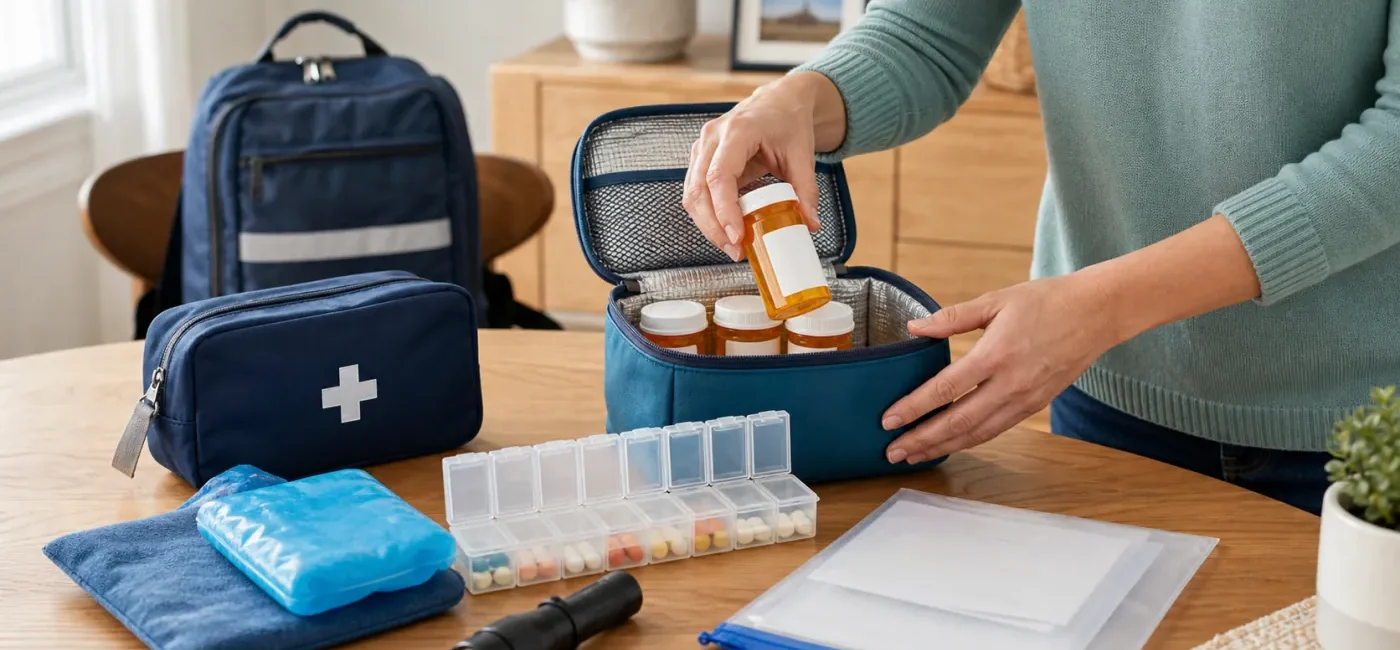
A power outage, flood, wildfire evacuation, winter storm, or other disruption can turn a routine prescription refill into a difficult task. Roads may close, pharmacies may shorten their hours, a refrigerated medicine may lose power, or a family member may need to explain your medical needs when your phone is unavailable. A useful emergency medication kit is not a stockpile assembled by guessing. It is a current record of what you take, a safe supply plan made with your pharmacist and prescriber, and a way to access essential information on paper as well as digitally.
This guide walks U.S. households through the process: creating a medication list, asking about emergency refills, planning for temperature-sensitive medicine, building a medical information card, and maintaining the kit. Rules and clinical needs vary by medicine, insurance plan, and state. Never share prescriptions, change a dose, stop treatment, or improvise a storage method based only on a general article.
1. Put “who, what, and when” on one page
Start with information, not containers. A photo of a pill bottle or the name of a diagnosis may not be enough. Similar-looking medicines can have different strengths and formulations, and a clinician may need to know when the last dose was taken or whether you have a serious allergy.
Create a separate sheet for every household member. Include:
- Legal name, date of birth, and emergency contact
- Medicine name, including the generic name when possible
- Strength and form, such as a 10 mg tablet, liquid, inhaler, or patch
- Usual schedule and a place to note the most recent dose
- The reason it was prescribed or the related diagnosis
- Prescriber’s name and phone number
- Primary pharmacy’s name, phone number, and address
- Medication, food, and latex allergies, especially severe past reactions
- Required supplies, such as syringes, test strips, spacers, or batteries
- Only the insurance information that would actually be needed
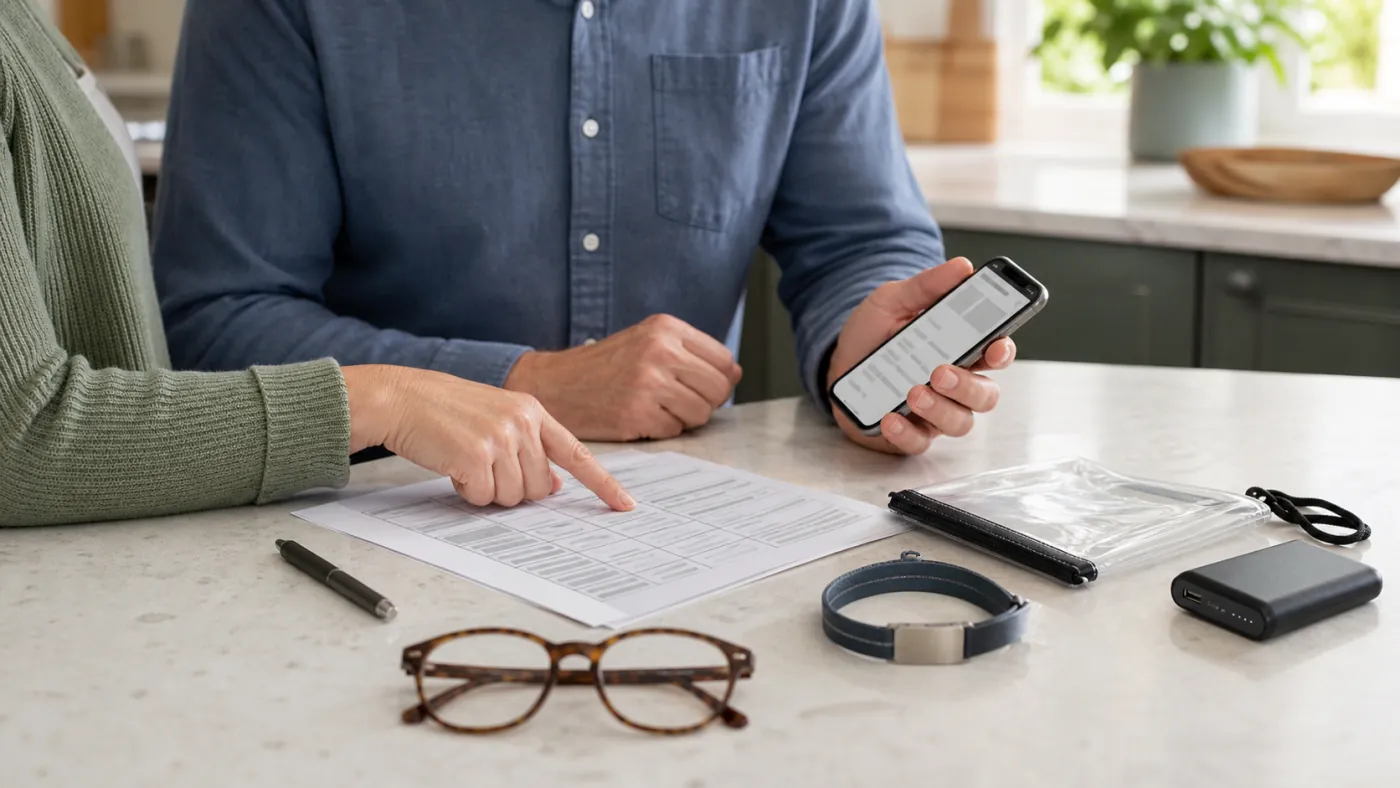
Date the list clearly and replace it whenever a prescription changes. A phone photo is convenient, but it depends on power and access to the device. Keep a wallet-size card, a printed copy in a waterproof pouch, and a protected digital copy. Redundancy matters: one failed device should not erase the only accurate record of your care.
2. Check every container without mixing medications
Review the patient name, drug name, strength, directions, prescription number, pharmacy contact, and expiration or use-by date on each container. Do not combine multiple prescriptions in one bottle or move unidentified pills into an unmarked bag. That creates opportunities for dosing errors and can make identification harder at a shelter, airport, pharmacy, or medical facility.
If you normally use a weekly organizer, keep the original labeled containers or a current pharmacy printout available. Ask a pharmacist about any pill whose appearance, odor, packaging, or label seems different. A discontinued prescription, leftover antibiotic, or medicine bearing another person’s name does not become appropriate simply because it is placed in an emergency bag. The kit should reflect current prescriptions and current needs.
Set aside expired, unidentified, or no-longer-needed medicine for proper disposal. Use an FDA-authorized take-back option or local pharmacy program when available, and follow current official disposal guidance. Do not leave loose pills where children, visitors, or pets can reach them.
3. Ask your pharmacist about an emergency supply before a disaster
CDC and Ready.gov recommend discussing an emergency supply of medicine with a doctor or pharmacist. There is no universal number of extra days that applies to every person. Early-refill limits, remaining refills, insurance authorization, state emergency-refill law, controlled-substance rules, and the practical shelf life of the product may all affect the answer.
Use these questions to get a plan specific enough to act on:
- Can this medicine be refilled early for emergency or evacuation readiness?
- Would my insurer need to approve an override?
- Does my prescriber need to issue a new prescription or change the quantity?
- What emergency-refill rules apply in this state after an official declaration?
- Could another location in the same pharmacy chain access the record and fill it?
- How should this product be protected from heat, freezing, light, or moisture?
- If power is unavailable, is there a clinically appropriate alternative form or backup plan?
Write down the date, the person you spoke with, and the instructions. Doing this in ordinary conditions gives the pharmacy time to resolve insurance or prescription issues. During a widespread emergency, phone lines, staff, and inventory may all be strained. Controlled substances and specialty medications can follow additional rules, so a generic online tip should never substitute for advice from the dispensing pharmacy and prescriber.
4. Plan carefully for refrigerated or temperature-sensitive medicine
Insulin, some injections, and other biologic products may need controlled temperatures. “Keep it cold” is not a complete instruction. Some medicines can be damaged by freezing, especially when placed directly against an ice pack. Others can degrade in a hot car or in direct sunlight. Review the product label and ask the pharmacist about the exact storage range, allowable time outside refrigeration, and in-use expiration for each product.
A plan may include an insulated pouch or cooler, cold packs, a barrier between the packs and medicine, a waterproof inner bag, and a small thermometer. Those supplies do not automatically make every product safe. If an outage may last, minimize unnecessary opening of the refrigerator and ask local pharmacies, health facilities, or your utility about appropriate options. If a medicine froze, overheated, or spent an unknown amount of time outside its permitted range, do not judge potency by appearance. Contact the pharmacist or manufacturer before using it.
Label the cooler as medical supplies without displaying more personal information than necessary. Keep it with the person responsible for the medicine during travel, and never place an irreplaceable supply in checked baggage or an unattended vehicle without verifying the relevant travel and storage requirements.
5. Use both paper and digital medical records
Emergency access and privacy need to coexist. A locked phone can become unusable if you are unconscious or its battery dies. A detailed paper file left in plain view can expose unnecessary personal information. Divide records by purpose.
- Wallet card: name, major allergies, critical conditions, key medicines, and emergency contact
- Waterproof pouch: complete medication list, clinicians and pharmacies, device information, and necessary insurance copies
- Phone: emergency medical ID visible from the lock screen plus a protected detailed document
- Trusted contact: the location of the current copy and clear instructions for emergency access
Our lost or stolen phone response checklist explains how to prepare device security and recovery settings. Do not put a full Social Security number, banking credentials, or account passwords in a medical information file. Use device locks and encryption for sensitive material, and make sure a trusted person understands how to obtain what is actually needed.
6. Adapt the kit to each household member
Children
Keep the child’s current weight, allergies, dose, caregiver contacts, and pediatrician information up to date. Pack the medicine’s correct dosing device; a kitchen spoon is not a reliable measuring tool. Check the location and expiration of rescue medicine stored at school or camp. Never substitute a sibling’s prescription, even when symptoms seem similar.
Older adults and people taking several medicines
When prescriptions come from multiple clinicians, using one primary pharmacy or sharing a complete list with every clinician can help professionals screen for duplication and interactions. Prepare a large-print version when small labels are difficult to read. Add hearing-aid batteries, glasses, mobility-device details, and any communication needs. If a family member has cognitive impairment, identify in advance who will track and administer doses during an evacuation.
People who rely on powered medical equipment
For an oxygen concentrator, power wheelchair, CPAP, or another powered device, record its wattage, battery duration, approved backup options, model, and supplier contact. Do not assume a random extension cord, inverter, or generator is suitable. Confirm the plan with the equipment manufacturer and health professional. A portable generator must never operate inside a home, garage, basement, or near doors and windows because of carbon monoxide risk.
People with communication, vision, or hearing needs
Include large-print, Braille, pictogram, or plain-language instructions as appropriate. Store extra hearing-aid batteries and write down the preferred way for first responders to communicate. Ready.gov recommends building a support network and keeping its contact list in a watertight container or on electronic devices. The plan should work for the person who will use it, not merely look complete to the person assembling it.
7. A practical scenario: a storm may cause a 48-hour outage
Imagine a household that uses a daily blood-pressure medicine, a refrigerated injection, and a rescue inhaler. After receiving a credible warning, the household first reviews the medication list and remaining quantities. If a routine refill is approaching, it calls the pharmacy during normal hours to confirm operations, inventory, and any available refill process.
For the refrigerated injection, the caregiver confirms the product-specific outage instructions with a pharmacist. Cold packs are prepared, but the medicine is separated from direct contact so it does not freeze. All original labeled containers go into a waterproof pouch. The inhaler and spacer stay in an immediately accessible pocket rather than at the bottom of a bag.
One paper list goes in the pouch and another stays in the caregiver’s wallet. Phones and power banks are charged, while pharmacy, prescriber, insurer, and emergency contacts are also written offline. If evacuation becomes necessary, one named person carries the medication kit. Nobody doubles a dose simply because the schedule was disrupted. For weather-specific action, combine this preparation with current local instructions such as the steps in our severe thunderstorm safety guide.
8. Break the work into 15 minutes, one hour, and monthly checks
Do these in 15 minutes today
- List every current prescription and over-the-counter medicine by person.
- Save the pharmacy and prescriber’s phone numbers.
- Write major allergies, conditions, and an emergency contact on a wallet card.
- Flag expired products and containers with damaged or missing labels.
Use one hour this week
- Ask the pharmacist about emergency supply and early-refill procedures.
- Confirm exact outage instructions for every temperature-sensitive product.
- Obtain a waterproof pouch, an appropriate insulated carrier, cold packs, and a power bank.
- Create two paper copies and one access-controlled digital copy.
- Tell the household where the kit is and assign who carries it during evacuation.
Review monthly and whenever a prescription changes
- Update drug names, strengths, schedules, and expiration dates.
- Check batteries, cold packs, and temperature-monitoring supplies.
- Replace used over-the-counter medicine and medical supplies.
- Update contact, insurance, and equipment information.
- Remove unneeded medicine through a safe disposal channel.
9. Common mistakes that weaken a medication plan
Mistake 1: Hiding an aging “emergency-only” supply. Items stored out of sight are easy to forget until they have expired. Rotate supplies within the normal prescription process as permitted, and schedule a recurring review.
Mistake 2: Applying one internet storage tip to every medicine. Products in the same broad class may still have different temperature and in-use rules. Use the label and product-specific guidance from a pharmacist or manufacturer.
Mistake 3: Keeping critical prescriptions in a vehicle. Cars can become dangerously hot or cold. Unless a pharmacist confirms that the product can tolerate those conditions, do not make the car its default storage location.
Mistake 4: Taking pictures without reviewing them. A blurry image of an old label on a locked phone is a weak backup. Maintain a readable, dated paper list as well.
Mistake 5: Doubling the next dose after one was missed. Missed-dose instructions vary. Read the prescription information and contact a pharmacist or clinician when the direction is unclear.
Mistake 6: Sharing prescriptions within the family. A similar symptom does not establish the same diagnosis, dose, or safety profile. Prescription medicine should be used only by the person for whom it was prescribed.
Mistake 7: Treating the kit as a one-time shopping project. A bag full of supplies can still fail when the medication list is outdated or nobody knows where the bag is. Maintenance and household practice are part of the kit.
10. Frequently asked questions
Exactly how many days of prescription medicine should I keep?
No single number works for every medicine, state, insurance plan, and patient. Ready.gov advises households to prepare to be self-sufficient for several days, but obtaining additional prescription doses depends on the drug, prescription, coverage, state rules, and clinical suitability. Ask the dispensing pharmacist and prescriber what is allowed and appropriate for you.
Can I travel with only a weekly pill organizer?
An organizer is convenient, but labeled original containers or a current pharmacy record can help identify the medication and verify the prescription. Travel and evacuation rules vary. Keep the medication list and labeled packaging available, especially for controlled or specialty medicine.
My refrigerated medicine sat at room temperature. Can I put it back?
The allowable temperature and time are product-specific. Note the highest likely temperature, length of exposure, and whether the product froze, then ask a pharmacist or the manufacturer. Do not assume that normal appearance means full potency.
Should I store a photo of my insurance card on my phone?
It can be useful if the device and account are secured. Enable a strong device lock and remote-loss protections. Do not add unrelated sensitive data, such as full Social Security numbers or account passwords, to the same file. A paper copy in a waterproof pouch provides an offline option.
What if I run out while the pharmacy is closed?
The appropriate response depends on the medicine and your condition. Check the prescriber’s after-hours number, the insurer’s 24-hour line, nearby open pharmacies, and local public-health or emergency-management information. Use 911 for life-threatening symptoms. Do not take another person’s medicine or change your dose on your own.
Where should the kit be stored?
Choose a dry, accessible location known to the household and consistent with each medicine’s storage instructions. Keep it away from children and pets. If part of the plan must remain refrigerated, place the information sheet and transport supplies where they can be found quickly, and clearly assign who retrieves the medicine during evacuation.
The best kit begins with accurate information
Emergency medication readiness is not just buying an insulated bag or requesting extra pills. It combines a current medication list, original labels, a supply plan approved by the relevant professionals, product-specific temperature control, paper and digital backups, and clear household roles. Start with one accurate page today. Ask the pharmacy focused questions this week. Update the kit whenever treatment changes. That routine can help families and medical professionals make faster, safer decisions when travel, power, and communication are disrupted.