
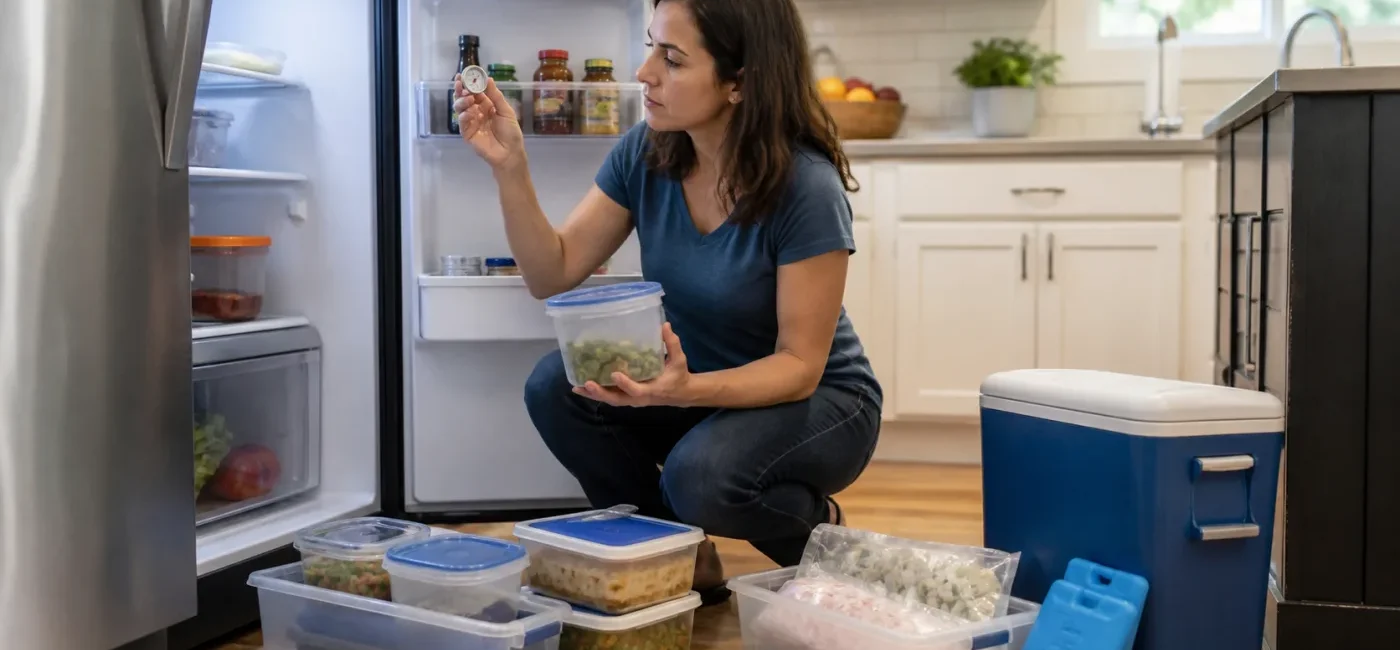
A power outage does not make every refrigerated item unsafe immediately. The real problem is losing track of how long food was warm and how often the refrigerator or freezer was opened. Smell and appearance cannot settle that question. Time and temperature are the useful evidence.
The U.S. Department of Agriculture says an unopened refrigerator generally keeps food cold for about four hours. A full freezer can hold its temperature for about 48 hours, while a half-full freezer may hold it for about 24 hours, provided the door stays closed. Those are planning estimates, not guarantees. Room temperature, appliance condition, starting temperature, and door openings all matter, so a refrigerator/freezer thermometer is the best household tool for the decision.
This guide provides general food-safety information for U.S. households. It is not individualized medical advice. Pregnant people, adults 65 and older, children younger than 5, and people with weakened immune systems can face a higher risk of severe foodborne illness. When the safety history of a perishable food is unknown, those households should be especially conservative.
The four rules to remember
- Keep refrigerator and freezer doors closed. Each inspection releases cold air and shortens the useful holding time.
- Record when the outage began. Use a phone note, paper, or a photo of a clock. If power returns briefly and fails again, record that too.
- Use 40°F (4°C) as the key threshold. Perishable food that has been above 40°F for two hours or more should generally be discarded. If the surrounding temperature is above 90°F (32°C), use a one-hour limit.
- Never taste food to test it. Harmful bacteria may not change the smell, color, texture, or flavor.
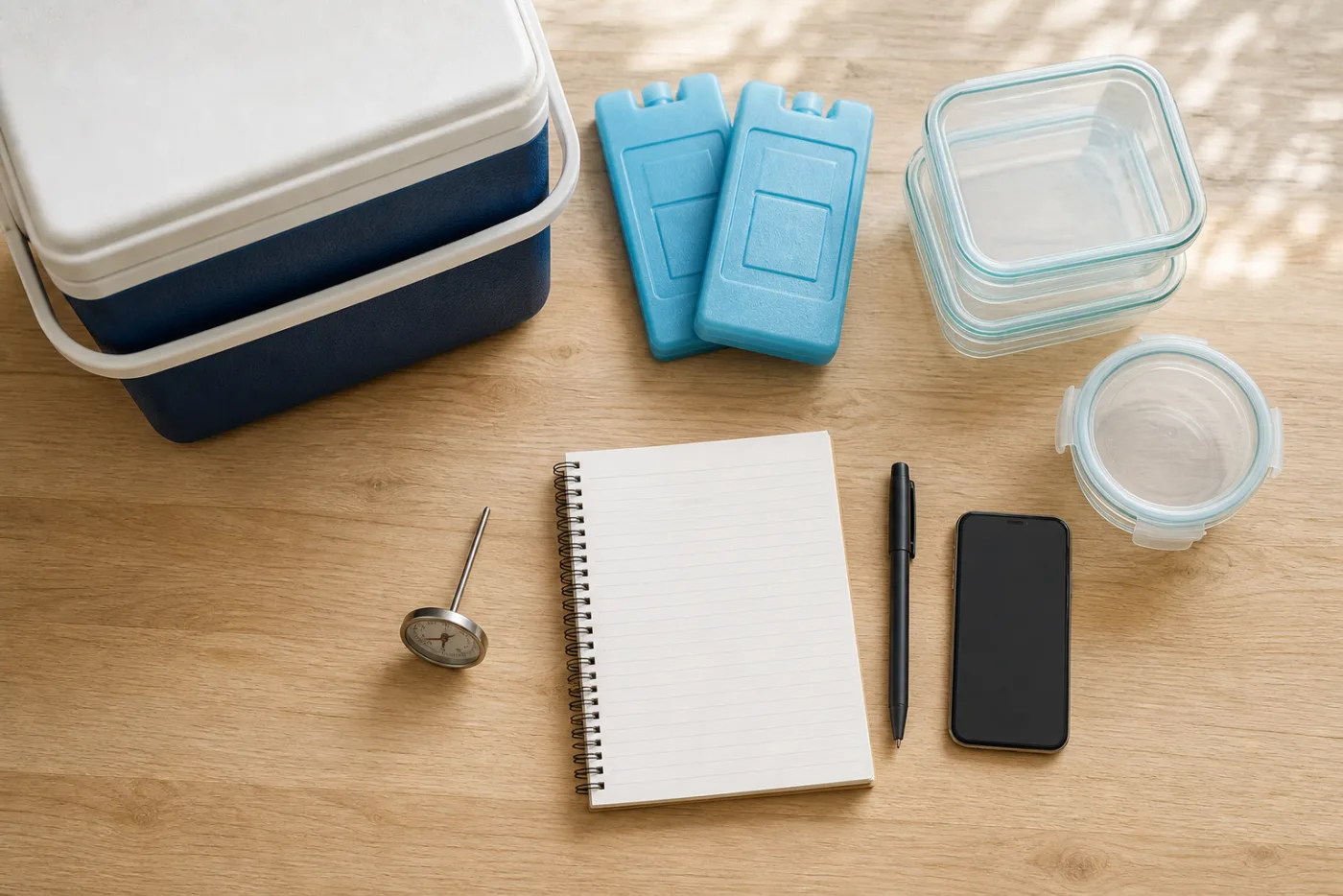
A small preparation kit makes decisions easier
Start with an appliance thermometer in both the refrigerator and freezer. The refrigerator should normally stay at 40°F or below; the freezer should stay at 0°F (-18°C) or below. A digital thermometer that records a high temperature can preserve useful evidence after power returns, but a basic analog appliance thermometer is still much better than guessing.
- One refrigerator thermometer and one freezer thermometer
- A clean probe-style food thermometer
- One or two insulated coolers
- Frozen gel packs or containers of ice
- Leakproof containers or zipper bags
- A notepad for outage and food-transfer times
- A flashlight with spare batteries
You can freeze containers filled about three-quarters full with water and use them as cold mass later. Leave room for expansion. Frozen water bottles and gel packs also help fill unused freezer space, although air still needs room to circulate while the freezer is operating.
Power loss often arrives with another emergency. Review a broader emergency medication and medical information kit, and if heavy rain is the likely cause, use the basement flood prevention checklist to treat electrical safety, water damage, and food safety as separate tasks.
The first 30 minutes after power goes out
1. Confirm the time and check for immediate danger
Determine, without taking unnecessary risks, whether the whole home is without power or a circuit breaker has tripped. Smoke, sparks, a burning smell, or wet electrical equipment takes priority over saving groceries. Do not approach electrical equipment in standing water. Follow instructions from the utility and local emergency officials.
2. Stop unnecessary door openings
Put a visible note on the refrigerator so family members do not open it automatically. If someone needs water, temperature-sensitive medicine, or another essential item, plan one quick opening and remove everything needed at once. Explain to children that every opening releases the stored cold air.
3. Decide whether to leave food in place
For a short outage, moving food can warm it faster than leaving the doors closed. If the outage is expected to pass four hours, or the refrigerator was already close to 40°F, prepare to move the highest-risk foods—meat, poultry, seafood, eggs, milk, and leftovers—to a cooler with enough ice. A cooler is useful only if it keeps food at 40°F or below. Put a thermometer inside rather than relying on how cold the lid or ice pack feels.
Refrigerated food: what becomes risky first
If refrigerated food has been above 40°F for two hours or more, discard perishable items such as:
- Raw or cooked meat, poultry, fish, and shellfish
- Milk, cream, yogurt, and soft cheese
- Eggs and cooked egg dishes
- Cooked rice, pasta, potatoes, and vegetables
- Leftovers, soup, stew, and casseroles
- Cut melon, cut tomatoes, leafy greens, and cooked fruit
- Opened products labeled “keep refrigerated,” especially creamy dressings and sauces
Whole uncut produce, hard cheeses, butter, and certain shelf-stable condiments may be less vulnerable. That does not mean every jar is automatically safe. Read the product label and use the USDA’s item-by-item chart. Two shortcuts are equally unreliable: throwing away everything simply because it was in the refrigerator, or keeping everything because it smells normal.
Frozen food: look for ice crystals and measure 40°F
Food that still contains ice crystals or measures 40°F or below can generally be refrozen or cooked. Refreezing may reduce quality because thawing allows moisture to escape, so texture can become softer or drier. If a perishable item fully thawed and remained above 40°F for two hours or more, discard it.
The familiar 48-hour figure applies to a full, unopened freezer under typical conditions. It is not an automatic safety warranty for every freezer. A half-full unit warms faster, and every door opening matters. Ice cream and similar products can soften, melt, and later look deceptively normal after the compressor restarts. When you have no reliable time or temperature history, treat high-risk items conservatively.
How to move food into a cooler safely
- Clean the cooler first. Create separate areas for raw animal products and ready-to-eat foods.
- Use enough ice. Place cold packs under, around, and above food rather than putting one pack at the bottom.
- Double-bag raw meat and keep it low. Prevent thawing juices from dripping onto produce or prepared food.
- Put the thermometer near the center. A thermometer touching the cooler wall or an ice pack may read colder than the food around it.
- Limit openings. A separate beverage cooler keeps people from repeatedly opening the perishable-food cooler.
- Log each transfer. Note when food left the refrigerator and when ice was added or replaced.
If you use dry ice, protect your skin and provide ventilation. Dry ice can cause frostbite and releases carbon dioxide gas, so never store or use it in a sealed room or unventilated vehicle. Separate it from food with cardboard or towels and follow the supplier’s handling instructions. Do not let curiosity about the freezer override carbon-monoxide or electrical safety.
When power returns: a 15-minute triage
1. Reconstruct the timeline
Write down the total outage length, significant door openings, when food moved to a cooler, and whether ice was replaced. Power restoration does not erase the time food spent in the danger zone.
2. Read and photograph temperatures
Take a photo of the refrigerator and freezer thermometers so everyone in the household uses the same evidence. Air inside an appliance can cool quickly once the compressor restarts, while a thick container of food may remain warmer. Check questionable perishable foods with a sanitized probe thermometer.
3. Sort into four groups
- Keep: foods with a confirmed safe temperature history
- Cook soon: safe thawed foods whose quality may deteriorate
- Refreeze: frozen foods that still have ice crystals or measure 40°F or below
- Discard: perishables that exceeded the time-temperature limit or have an unknown safety history
4. Clean leaks before restocking
Move safe food aside and clean shelves or drawers contaminated by meat juices or meltwater. Follow the cleaner label, including dilution and surface-contact time, and never mix cleaning chemicals. If floodwater touched the appliance or food packages, the problem is broader than a routine outage; follow FDA and local health-department instructions for contaminated food and water.
Four realistic examples
Example 1: Three-hour outage, doors stayed closed
Power returns and the refrigerator thermometer reads 38°F. Packages are intact, and no one opened the door. The refrigerated food can remain in use. Record the event and use leftovers promptly according to their original storage time.
Example 2: Seven-hour outage, no thermometer
Even if the door stayed closed, the outage passed the general four-hour refrigerator estimate and there is no temperature record. Discard high-risk refrigerated foods such as milk, eggs, meat, fish, leftovers, and cooked rice regardless of smell. Check the official item-by-item chart before deciding about lower-risk items such as jam, whole fruit, butter, or hard cheese.
Example 3: Full freezer, 20-hour outage
The door stayed closed, ice crystals remain, and sampled foods are at or below 40°F. Those foods may be cooked or refrozen, though quality may decline. Discard melted ice cream and any item whose history cannot be established.
Example 4: Two-and-a-half-hour outage during extreme heat
Some food sat in a car while the kitchen was being reorganized. A vehicle can quickly exceed 90°F, so the one-hour rule applies to that period. Do not return milk or meat to the refrigerator just because the package still feels cool. Count all time in the hot environment.
Eight common mistakes
- Trusting the smell test: Disease-causing organisms may produce no obvious odor.
- Taking a small taste: Even a small exposure can cause illness.
- Applying “four hours” mechanically: Four hours is a general unopened-refrigerator estimate, not a measurement of how long each item was above 40°F.
- Assuming reheating fixes everything: Heat may kill many organisms, but it may not eliminate every toxin produced during unsafe storage.
- Using too little ice: A cooler must be verified at 40°F or below.
- Storing raw meat above ready-to-eat food: Thawing juices can create cross-contamination.
- Relying on memory: Start times are easy to confuse after power returns.
- Discarding food without documentation: Before a large disposal, photograph the food and receipts if available. Check whether homeowners or renters insurance covers food loss and compare the loss with the deductible. Coverage varies by policy and cause; reimbursement is not automatic.
One-page checklist
Before an outage
- Confirm refrigerator at 40°F or below and freezer at 0°F or below
- Place an appliance thermometer in each compartment
- Freeze gel packs and prepare coolers and leakproof bags
- Group foods so high-risk items can be found quickly
- Save utility alerts and local emergency contacts
During an outage
- Record the start time
- Keep refrigerator and freezer doors closed
- Obtain ice if the outage may exceed four hours
- Keep cooler contents at 40°F or below
- Never run a generator indoors, in a garage, or near doors, windows, or vents
After restoration
- Confirm the total outage and temperature history
- Sort perishable food by the time it spent above 40°F
- Never taste food to test safety
- Photograph and list discarded food
- Clean contaminated shelves and drawers before restocking
Frequently asked questions
Do I have to throw out everything after four hours?
No. Four hours is the general period an unopened refrigerator may keep food cold. The actual temperature, time above 40°F, and type of food control the decision. If the history of a high-risk perishable food is unknown, discarding it is the safer choice.
If the refrigerator is cold again, is the food safe?
Not necessarily. The current temperature does not reveal how warm the food became before power returned. Reconstruct the outage and apply the time-temperature rule.
Can thawed frozen food be refrozen?
Generally, yes, if it still contains ice crystals or measures 40°F or below. Quality may suffer. Discard perishable food that fully thawed and stayed above 40°F for two hours or more.
Can I store food outside in snow or winter air?
That is not dependable. Sunlight and changing outdoor temperatures can warm food, while animals, dirt, and contaminated water can reach it. Use a closed cooler with a thermometer so storage stays controlled.
Can a portable generator run just the refrigerator?
Follow the generator manufacturer’s capacity and connection instructions and consult a qualified electrician when appropriate. A generator creates lethal carbon monoxide. Never operate one inside a home, garage, basement, shed, or near a door, window, or vent. Prevent unsafe extension-cord use and backfeeding.
What should I do if food poisoning is possible?
Replace fluids and monitor symptoms. Contact a healthcare professional for bloody diarrhea, high fever, repeated vomiting, severe dehydration, prolonged diarrhea, or illness in a higher-risk person. Call 911 for emergency symptoms. Record what was eaten, when it was eaten, and any package or lot information that remains.
The bottom line
Food safety after a power outage depends on a short record, not a hunch. Keep doors closed, record the start time, verify 40°F, and never taste questionable food. Two appliance thermometers, a cooler, and frozen cold packs can prevent both unnecessary waste and risky guesswork during the next outage.
[…] Read this guide in English → […]