
When gasoline costs make a long drive feel expensive, the first move should not be chasing the cheapest station across town. A better plan starts with the miles you will actually drive, your car’s realistic fuel economy, and a safe price range. Then check the vehicle, remove unnecessary drag and weight, plan sensible fuel stops, and drive smoothly. Those steps are repeatable, and they do not depend on a price app being perfectly current.
This guide is for U.S. drivers preparing a gasoline or hybrid vehicle for a road trip, commute, or family visit. It does not predict where fuel prices will go or promise the same savings for every vehicle. Weather, traffic, elevation, cargo, tires, climate control, and the car itself all affect fuel use. Follow the owner’s manual, the tire-pressure label, posted traffic laws, and current road conditions. A warning light, fuel odor, damaged tire, overheating, or braking problem takes priority over fuel economy.
This article provides general consumer and vehicle-care information, not individualized mechanical, insurance, legal, or financial advice. Maintenance requirements and warranty terms vary by make, model, and operating conditions. Consult the owner’s manual and a qualified technician when diagnosis or repair is needed.
The 10-minute fuel-saving plan
- Write down total mileage. Include the round trip, local driving, meal and sightseeing detours, and a reasonable buffer.
- Choose a realistic MPG figure. Use recent highway history, several fill-ups, or your vehicle’s information on FuelEconomy.gov. Do not budget with a one-time personal best.
- Estimate gallons. Divide total miles by expected MPG.
- Use a price range. Build low, base, and high scenarios instead of assuming today’s price at one station will apply everywhere.
- Check the car while it is cold. Inspect tire pressure and damage, warning lights, fluids, and due maintenance.
- Clear unused cargo. Remove an empty roof box or rack and unrelated heavy items while keeping emergency supplies.
- Plan safe stops. Pair fuel with restrooms, meals, and driver changes rather than waiting until the tank is nearly empty.
- Agree on driving rules. Follow speed limits, leave space, accelerate smoothly, and rotate rested drivers.
1. Calculate the trip total before comparing pennies per gallon
The basic formula is estimated fuel cost = total miles ÷ expected MPG × price per gallon. Treat the result as a planning range, not a guaranteed bill. Wind, temperature, elevation, congestion, air-conditioning use, passenger load, cargo, and construction detours can change real-world mileage.
Consider a hypothetical 600-mile trip. At 30 MPG, the car would use about 20 gallons. At an assumed $3.50 per gallon, that is $70. If real-world economy falls to 25 MPG, the same trip uses 24 gallons and costs $84 at the same assumed price. These numbers are an example, not a current price forecast or a promise about any particular vehicle. The point is that a realistic MPG assumption can matter more than a tiny advertised price difference.
Run at least three price scenarios. You might calculate the trip at 25 cents below your base assumption, at the base assumption, and 25 cents above it. Keep fuel separate from tolls, parking, charging, lodging, and food so you can see which decision actually saved money. If travelers are splitting the expense, agree in advance whether you will use receipts, actual gallons, or a mileage rate.
Is a detour for cheaper gas worthwhile?
Start with gallons you expect to buy × the price difference per gallon. Then subtract the fuel used on the detour and consider tolls, traffic, time, and safety. If you are buying 10 gallons and another station is five cents cheaper, the advertised difference is only 50 cents. Driving several extra miles or waiting in a long line may erase it.
A planned stop can still make sense when it is directly along the route, combines a restroom or meal break, and offers a meaningful price difference. Never operate a phone while driving. Ask a passenger to check or pull over safely. App prices may be stale, so confirm the grade and price on the station sign and pump before authorizing the sale.
2. Check the vehicle before buying gadgets or additives
Start with the basics before considering an add-on that promises dramatic savings. If the check-engine light is on, the car may appear to drive normally while a problem affects fuel economy, emissions, or reliability. The cause could be minor, such as a loose fuel cap, or it could require diagnosis. If the light is flashing, the engine is shaking, power is reduced, the temperature is rising, or you smell fuel, do not force the car through a long trip. Follow the manual and get qualified help.
Use the oil viscosity and specification the manufacturer calls for. Choosing a different oil because it sounds “thicker,” “stronger,” or “more efficient” can conflict with lubrication needs and warranty requirements. Follow the vehicle’s oil-life system and the normal or severe-service schedule in the manual. Do not open a hot cooling system or mix fluids based on a general online tip.
Use the vehicle’s tire-pressure number, not the sidewall maximum
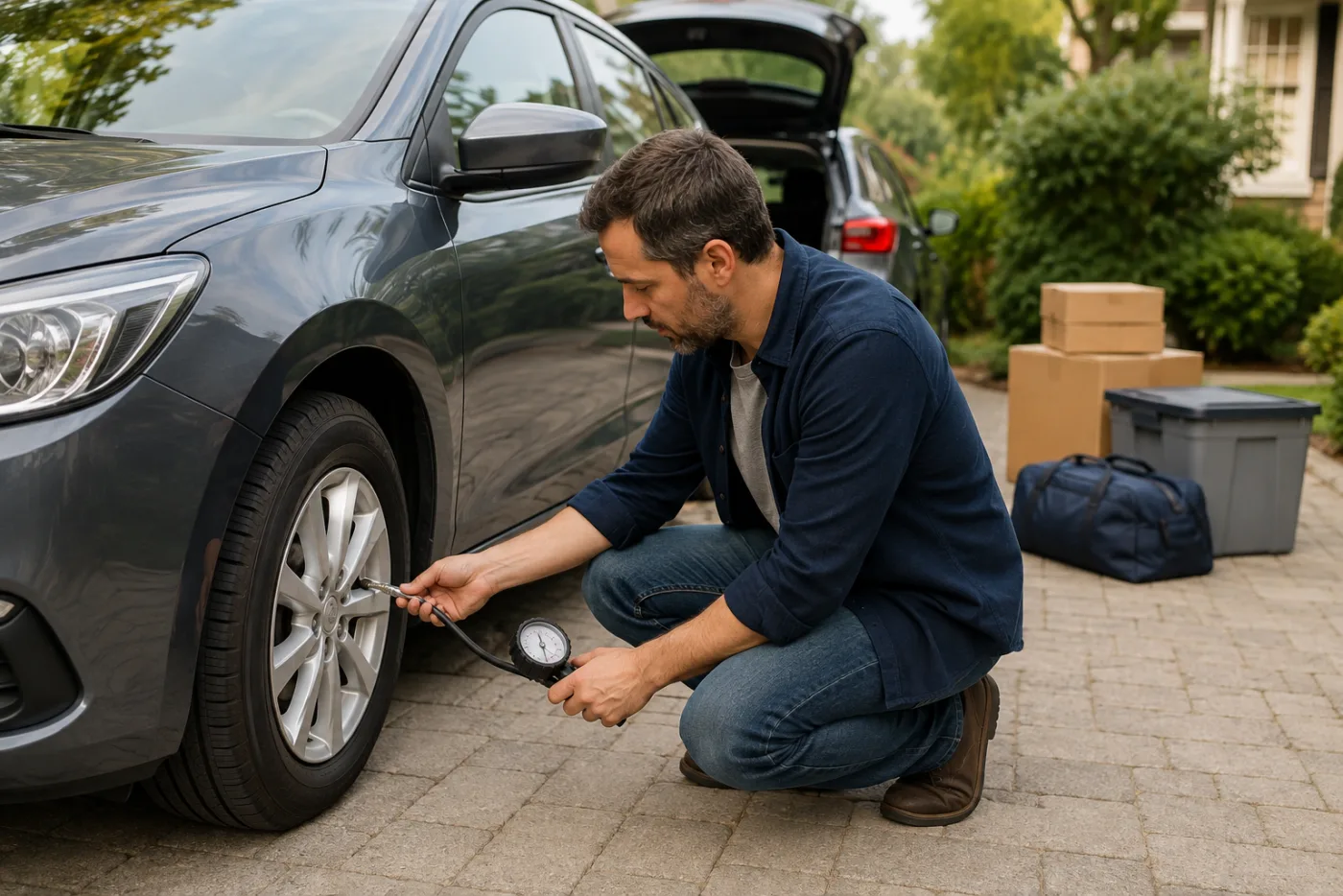
Check pressure before driving, when the tires are cold, unless the manual says otherwise. The target is normally on the driver-side door-jamb label and in the owner’s manual. The number molded into the tire sidewall is not the vehicle’s recommended inflation target. Front and rear specifications may differ, and some vehicles provide separate loaded-driving guidance.
While checking pressure, look for cuts, cracks, bulges, punctures, damaged valves, and uneven tread. A tire that repeatedly loses air needs more than another top-off. A TPMS light that goes out does not prove the tire has no physical damage. If the vehicle carries a spare, inspect its pressure and confirm that the necessary tools are present.
For a deeper inspection, use Smartor’s tire recall, pressure, and tread checklist. You can also follow the NHTSA VIN recall guide to check for unresolved safety recalls before departure.
3. Remove unnecessary drag and weight without removing safety gear
Do not leave behind water, a first-aid kit, seasonal gear, child restraints, medication, or other equipment needed for the people and conditions on the trip. Instead, unload unrelated heavy items that have been living in the trunk: old boxes, sports weights, unused tools, books, or camping gear you will not use. Secure smaller objects so they cannot become projectiles, block the driver’s view, or move into the pedal area.
Roof boxes and racks are useful, but they can increase aerodynamic drag, especially at highway speeds. Remove them according to the manufacturer’s directions when they are not needed. If you must use one, follow the vehicle and rack load limits, check all fasteners, and avoid loose straps. Do not move heavy cargo into the passenger area merely to reduce roof drag if that compromises visibility, seating, or airbag space.
Rear bicycle carriers and cargo trays can interfere with sensors, lamps, the license plate, the exhaust outlet, or liftgate operation. The exact effect on fuel economy varies, so avoid applying one percentage to every vehicle. A simple rule works better: remove external equipment when it is not in use, and inspect every attachment before highway travel.
4. Use national and regional prices for context, then plan for your route
The U.S. Energy Information Administration publishes national and regional retail gasoline data. It is useful for understanding the broader market and setting a budget range, but it does not guarantee the live pump price at a particular exit. Crude oil costs, taxes, refining and distribution conditions, local fuel requirements, and regional supply all contribute to price differences.
Save two or three candidate stops before leaving. Constantly comparing every station creates distraction and can lead to unsafe detours or a dangerously low tank. Check whether a stop is open, lighted, accessible, and near the route. In mountain, desert, severe-weather, or rural areas with long gaps between services, a safe location and sufficient fuel are more important than a small price advantage.
If your drive overlaps the holiday weekend, Smartor’s Labor Day schedule guide can help with federal offices, mail, banks, and transit. Verify the hours of individual gas stations and rest areas separately with their current official information.
Buy the fuel grade your vehicle specifies
Premium gasoline does not automatically improve every car’s mileage or performance. Check the owner’s manual and fuel-door label for the required or recommended octane. “Required” and “recommended” can have different implications depending on the model. Ignoring a required grade to save money may be inappropriate, while buying a more expensive grade for a car designed for regular may not produce a cost-effective benefit.
At the pump, verify the fuel type, grade, and price before starting. Stop when the nozzle shuts off automatically instead of repeatedly topping off. If you smell strong fuel vapors or see liquid on the ground, avoid ignition sources and alert the attendant. Follow posted fire-safety rules for fueling and approved portable containers.
Make one last tire check before departure
After loading, walk around the vehicle and look for a visibly low or damaged tire, missing valve caps, and an open door or liftgate. Set pressure to the vehicle specification while the tires are cold. Do not bleed pressure from tires simply because they became warm after highway driving.
5. Drive predictably, not unusually slowly
Fuel-efficient driving does not mean obstructing traffic or coasting downhill in neutral. It means following speed limits and conditions while looking ahead, leaving space, and connecting acceleration and deceleration smoothly. With enough following distance, you are less likely to alternate constantly between the accelerator and brake.
- Starting: Accelerate smoothly with traffic and avoid unnecessary hard launches.
- Cruising: Maintain a steady, legal speed when conditions allow. Aerodynamic resistance increases with speed, and many vehicles lose efficiency quickly at higher highway speeds.
- Slowing: Watch signals and traffic far enough ahead to ease off the accelerator early. Do not follow so closely that every slowdown requires hard braking.
- Hills: Avoid a burst of throttle just to hold an exact speed uphill. Keep the vehicle in gear and under control downhill.
- Lanes: Repeated passing and lane changes rarely justify the added acceleration and risk.
- Cruise control: It can help maintain a steady speed on a clear, dry, relatively flat highway. In rain, snow, ice, heavy traffic, or steep terrain, the manual and safe vehicle control come first.
If you miss an exit, continue to the next safe opportunity. Never reverse or cut across lanes to save a few miles. A navigation app’s “fastest” or “fuel-efficient” route may not reflect every closure, construction zone, vehicle-height limit, or towing restriction. Cross-check official traffic information and posted signs.
6. Handle idling, air conditioning, and open windows realistically
A parked engine can consume fuel without moving the vehicle. When waiting or taking a long break, consider local anti-idling laws, weather, the owner’s manual, and passenger safety before shutting down. Do not apply a simple fuel-saving rule when extreme heat or cold, a child, an older adult, a pet, or powered medical equipment is involved. Never leave a person or animal unattended in a parked vehicle.
There is no single rule that says air conditioning must always be off or windows must always be closed. Open windows create different drag at city and highway speeds, and climate systems vary. Keep the cabin safe enough for clear vision and driver concentration. Practical steps include parking in shade when lawful and safe, venting accumulated heat briefly before departure, and avoiding needless overcooling. Defogging and dehumidifying the windshield are safety functions; do not delay them for MPG.
If a drive-through line is long, parking and going inside may save time and fuel, but only when parking and walking are safe. At rail crossings, emergency scenes, evacuations, or controlled roadways, follow instructions from police, firefighters, and transportation officials.
7. Compare several tanks, not one MPG reading
The dashboard average is useful, but reset points and calculations vary. To keep your own record, fill to a consistent automatic-shutoff point, record the odometer, and at the next fill divide miles driven by gallons added. One result can be affected by pump angle, nozzle shutoff timing, and a short trip. Several tanks provide a better comparison.
Record the date, miles, gallons, calculated MPG, approximate price, city/highway mix, temperature, roof equipment, tire adjustment, and unusual congestion. That makes it possible to compare similar conditions instead of relying on memory. Fuel receipts can show partial payment-card information, so redact details before sharing a photo.
If fuel economy suddenly drops
- Confirm that the mileage and gallon entries are correct.
- Look for more short trips, cold weather, headwinds, mountain driving, or congestion.
- Check cold tire pressure against the vehicle label.
- Note a roof box, trailer, heavier load, or other added resistance.
- Record warning lights, odors, leaks, rough idle, weak power, or brake drag.
- Review maintenance requirements and seek qualified diagnosis if needed.
Do not overinflate tires, remove safety equipment, or modify emissions or engine systems to chase an online MPG number. A small difference between the dashboard display and a hand calculation does not prove a defect. Use several comparable fill-ups before drawing conclusions.
Worked example: a 600-mile family round trip
A family adds 520 highway miles, 60 miles of local driving, and a 20-mile buffer for a total of 600 miles. Their recent highway display is near 30 MPG, but they budget at 28 MPG because of passengers, luggage, and air-conditioning use. Dividing 600 by 28 produces an estimate of about 21.4 gallons. They calculate low, base, and high price scenarios rather than relying on one posted price.
The night before leaving, they unload unrelated items but keep water, medication, first-aid supplies, and child restraints. In the morning they check cold tire pressure against the door-jamb label, inspect the tires, review the oil-life display, and confirm that no check-engine, TPMS, or temperature warning is active. They also make sure no required service will come due in the middle of the trip.
They save three possible rest-and-fuel stops roughly along the route, but do not commit to running the tank low to reach one. A passenger monitors traffic and prices while the driver keeps the phone untouched. After the first fill, they record actual miles and gallons and update the return budget.
The useful result is not finding a mythical cheapest station. It is combining a realistic budget, safe stops, a prepared vehicle, and steady driving. If prices or traffic change, the family can adjust without taking a risky detour or running nearly empty.
14 common mistakes
- Chasing the lowest sign: Detour fuel and time can exceed the posted savings.
- Budgeting with a record-high MPG: Use a conservative figure that reflects load and conditions.
- Using the tire sidewall maximum: Follow the vehicle label and manual.
- Bleeding pressure from hot tires: Follow the cold-pressure procedure.
- Removing emergency supplies: Keep safety essentials and remove unrelated cargo.
- Leaving an empty roof box installed: Remove unused external equipment correctly.
- Assuming premium always saves fuel: Buy the grade the manufacturer specifies.
- Topping off after automatic shutoff: Stop when the nozzle shuts off.
- Coasting downhill in neutral: Maintain control and use the vehicle as designed.
- Driving abnormally slowly: Obey traffic laws and conditions.
- Using cruise control in every condition: Rain, snow, ice, congestion, and steep grades require judgment.
- Operating a price app while driving: Delegate it or stop safely.
- Diagnosing a failure from one low MPG result: Compare several similar tanks.
- Treating a warning light as only an economy problem: Flashing lights, heat, vibration, or fuel odor need prompt safety attention.
One-page pre-trip checklist
- Total the round trip, local driving, and a reasonable detour buffer.
- Calculate low, base, and high fuel-cost scenarios with realistic MPG.
- Locate the owner’s manual and driver-door tire-pressure label.
- Check cold tire pressure, tread, and visible damage.
- Review check-engine, TPMS, oil, and temperature indicators.
- Check official vehicle and tire recall tools.
- Remove an unused roof box, rack, and unrelated heavy cargo.
- Keep water, medication, child restraints, and emergency supplies.
- Confirm the required fuel grade and a safe fuel reserve.
- Save two or three safe fuel-and-rest candidates.
- Keep the driver’s phone untouched while moving.
- Share expectations for speed, following distance, smooth driving, and breaks.
- Choose a method for recording receipts, miles, and gallons.
- Check official weather, construction, closure, and emergency-route information.
FAQ
What highway speed gives the best gas mileage?
There is no single best speed for every vehicle. FuelEconomy.gov notes that each vehicle has a different efficient range and that mileage generally falls quickly at higher speeds. On public roads, obey the speed limit, minimum speed, traffic flow, weather, and safety needs. Smooth acceleration and a steady legal speed are more useful rules than targeting one universal number.
Does turning off the A/C and opening the windows always save gas?
No. The result depends on speed, vehicle shape, weather, and the climate system. Open windows can add drag at highway speed, while excessive heat can impair concentration. Use enough climate control for visibility and safety, avoid needless overcooling, and vent a hot cabin before departure when practical.
Will premium gasoline improve MPG?
Not in every vehicle. Check the manual and fuel-door label for the required or recommended octane. Paying more for premium in a vehicle designed for regular does not guarantee a cost-effective efficiency gain.
Should I inflate tires above the label to reduce rolling resistance?
No. Overinflation can affect ride, traction, wear, and safety. Check cold tires and use the pressure on the driver-door label or in the manual, not the maximum molded into the tire sidewall.
Can I take a trip if the check-engine light is on but the car feels normal?
The cause cannot be judged from a general article. Review the manual and obtain diagnosis. If the light flashes or the vehicle shakes, loses power, overheats, or smells like fuel, stop the long drive and get help from a safe location.
Should I avoid filling the tank because fuel adds weight?
Fuel has weight, but a road trip also requires a safe reserve. Do not run dangerously low or risk missing services to chase a tiny theoretical saving. Consider the route, distance to the next station, weather, and the vehicle’s remaining-range estimate conservatively.
Do fuel-saving devices and additives work?
Evidence and compatibility vary. Be skeptical of universal, dramatic savings claims, and check warranty and emissions-system implications before installing or adding anything. Address tire pressure, warning lights, cargo, speed, idling, and required maintenance first.
Do these tips apply to hybrids?
Tire care, lighter unnecessary cargo, reduced drag, smooth driving, and safe route planning generally apply. Regenerative braking, battery temperature management, and drive modes vary by model, so follow the manufacturer’s instructions rather than forcing the engine off or manipulating modes.