Emergency Financial Records Kit: Insurance, Accounts and Document Backup
Smartor 편집팀
September 5, 2026

When a hurricane, wildfire, flood, earthquake, or long power outage forces you to leave home quickly, money alone may not solve the first problems. You may need an insurance policy number, proof of identity, a medication list, a mortgage servicer’s contact information, or evidence of what was in your home. If those records exist only in a desk drawer or on a phone that is lost or out of power, recovery can slow down. Putting every original document in one grab bag is not the answer either: losing that one bag could create a second emergency.
A useful emergency financial records kit divides information among a portable paper packet, protected originals, and secure off-site or encrypted digital backups. This guide shows how a U.S. household can build a practical first version in 60 to 90 minutes, decide what to take during an evacuation, and protect its identity while contacting insurers, banks, employers, and official assistance programs after a disaster.
FEMA and Ready.gov recommend gathering personal identification, financial and legal documents, medical and insurance information, and household contacts before an emergency. A current home inventory and a clear contact log can also make it easier to explain a loss and reconstruct missing records.
This article provides general U.S. financial, insurance, tax, legal, and disaster-preparedness information. It is not personalized financial, tax, insurance, medical, or legal advice. Coverage, tax treatment, government assistance, eligibility, and deadlines vary by location, declaration, contract, and household. Check current instructions from the responsible agency, insurer, bank, or qualified professional before making a claim or application.
Starting with a scanner often produces a pile of files and no usable system. Begin with a one-page index of the people, property, accounts, policies, providers, and obligations your household would need to reconnect after an emergency. This index is not a master sheet containing every secret. It is a map that tells a household member what exists, where the protected details are stored, and which verified organization to contact.
Verify phone numbers using a policy, the back of a payment card, a statement, or the organization’s known official website. Search ads and fake support numbers can appear when many people are trying to recover. Writing the official domain next to each organization gives the family one more way to avoid an impostor.
FEMA’s Emergency Financial First Aid Kit, or EFFAK, identifies records such as photo identification, birth certificates, Social Security cards, military service records, and pet identification. Not every application requires every document. The goal is to preserve enough information to prove identity, household relationships, residence, or ownership and to identify the agency that can replace an original.
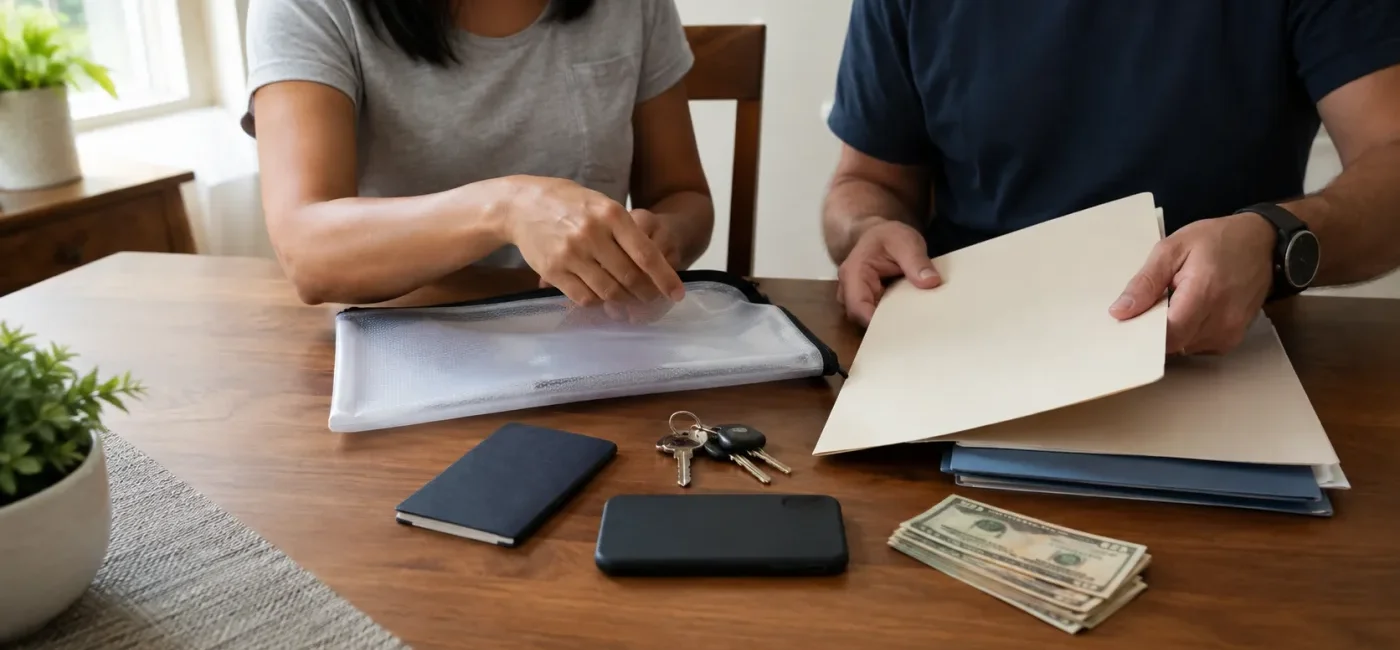
Mark photocopies as copies so they are not mistaken for originals. Do not leave highly sensitive identifiers exposed in an unlocked bag or vehicle. A locked, water-resistant pouch is better for a portable packet, but the people who may need it must know where it is and who takes it. If originals are kept in a bank safe-deposit box or another off-site location, remember that access may be unavailable during a holiday, evacuation, transportation shutdown, or temporary branch closure.
You do not need ten years of statements in an evacuation packet. You need enough verified information to report a lost card, protect an account, understand upcoming automatic payments, maintain housing, document income, and contact the right organization. A recent statement, the first and signature pages of a contract, an official phone number, and a secure path to the complete electronic document are usually more useful than an overstuffed binder.
Do not place a plain-text password list next to the account index. If you use a password manager, review its unique master password, multifactor authentication, recovery method, and emergency-access feature. Keep recovery codes separate from the corresponding passwords. A lost phone should not block every account, so consider a backup authentication method that is still secure. A trusted household member may need instructions for requesting emergency access, but that does not mean everyone needs a printed copy of every password.
A company name and policy number are only the beginning. After a loss, the household needs to know which causes of damage are covered, the deductible, personal-property limits, whether additional living expenses may apply, how quickly notice should be given, and what evidence the insurer requests. Save the current declarations page and important endorsements after each renewal. Keep a PDF or paper copy outside the insurer’s app in case the app, phone, or network is unavailable.
Renters should document their own property and review liability and temporary-living coverage. The rental move-in inspection checklist explains how to create dated condition records and repair requests when a lease begins. Those records do not replace insurance, but the same habit of photographing a property before a problem makes later explanations much clearer.
After a disaster, memory is a poor inventory system. It is difficult to recall every kitchen item, tool, coat, book, appliance, and object stored in a closet. The IRS recommends using photographs, videos, receipts, canceled checks, and bank or card statements when reconstructing records. When photographs do not exist, it even suggests sketching a room, including drawers and shelves, to trigger memory. A short inventory made before a loss is far easier than rebuilding the list afterward.

For a bedroom, for example, record the view from the doorway, each wall, the inside of the closet, and drawer contents. Make separate restricted photos for valuables or serial numbers. A complete three-minute walk-through of the home is a better starting point than an unfinished spreadsheet for one room. You can improve one room a month by adding receipts and details without turning preparedness into a weekend-long project.
The most resilient arrangement uses three layers with different jobs. The first is a thin portable packet for evacuation. The second is protected storage for originals and formal copies at home. The third is an encrypted digital or physical backup available away from the home. Do not duplicate every page blindly; decide what risk each copy creates and what problem it solves.
A normal phone photo roll, a chat message to yourself, and an email inbox are convenient but are not automatically secure document vaults. Check device encryption, screen lock, account recovery, shared albums, forwarding rules, and automatic backups. The important questions are who can access the files, how the owner can recover the account, and whether essential offline information remains available during a service or power outage.
Medical records affect both safety and finances. A prescription replacement, interrupted treatment, insurance verification, caregiving gap, or unpaid leave may quickly become a household expense. FEMA’s preparedness materials include clinicians, health insurance, immunizations, and medication information. Record the medication name, dose, schedule, prescriber, pharmacy, allergies, and a backup contact rather than writing only the name of a pill.
If someone uses electricity-dependent medical equipment, refrigerated medication, mobility equipment, or home health support, add the supplier and outage plan. Identify who may make decisions and who can pick up or accompany a child, older adult, or disabled family member. The list supports communication; it does not replace a clinician’s advice and should never be used to stop or change medication without appropriate guidance.
There is no time to reorganize records after an evacuation warning. Life safety and official instructions always come first. Take a prepared pouch only if it is immediately accessible, and never re-enter a dangerous building for documents.
For safety after severe weather, the storm recovery guide for outages, roads, and downed lines reinforces principles that apply well beyond one region: do not drive into floodwater, stay away from power lines, and wait for a safe re-entry decision.
Once everyone is safe, prioritize medical needs, temporary shelter, account security, insurance notice, housing payments, and income disruption. Keep one contact log with the date and time, representative’s name, confirmation number, documents requested, action promised, and next follow-up date. This prevents repeated explanations and makes conflicting instructions easier to resolve.
Emergency pressure makes messages such as “pay a processing fee to release your grant,” “send your password so we can file the claim,” or “pay the utility immediately by gift card” sound more believable. The Federal Trade Commission describes a common pattern: scammers impersonate a familiar organization, claim there is a problem or prize, pressure the target to act immediately, and demand a specific payment method.
Consider two adults, one child, and a dog in an apartment. During the first 15 minutes, they list identity documents, insurance cards, medications, an out-of-area contact, school information, and the veterinarian. During the next 20 minutes, they map their renters and auto policies, lease, bank and card accounts, payroll contacts, recurring bills, and verified customer-service information. The paper index shows only the last four digits of accounts.
They spend 25 minutes recording the entry, each room, closets, kitchen cabinets, electronics, bicycles, and pet supplies. During the next 15 minutes, they save selected PDFs in an encrypted folder, turn off public sharing, verify multifactor authentication, and make a separate backup. During the final 15 minutes, they place selected paper copies, medication information, small-bill cash, and a charging cable in a water-resistant pouch. Every household member who is old enough learns the pouch location, outside meeting place, and out-of-area contact.
The first version does not need a professional appraisal or a complete legal review. The household can ask the insurer about flood exclusions, deductibles, and additional living expenses the following week, then connect receipts for high-value property the following month. A small maintenance routine is more useful than a perfect binder that is never finished.
Copies can support recovery and communication, but there is no reason to duplicate every page automatically. Select the pages that serve a clear purpose and decide how they will be encrypted, accessed, backed up, and eventually deleted. Whether an electronic copy can legally substitute for an original depends on the document and receiving organization.
It can separate important originals from the home, but immediate access may be unavailable during a holiday, evacuation, branch closure, or transportation disruption. Do not assume protection for the contents is the same as deposit insurance for a bank account. Read the agreement and keep the minimum emergency information somewhere else.
Ready.gov recommends considering a small amount in a safe place and small bills because ATMs and card services may fail, but it does not prescribe one nationwide amount for every family. Consider household size, essential purchases, the likely outage period, theft and fire risk, and what can be stored safely.
Insurance and assistance programs have different purposes, eligibility rules, coverage, and documentation. Do not assume a payment amount in advance. Check DisasterAssistance.gov for the address, declaration, available programs, and actual deadlines, and follow the insurer’s reporting process separately.
Model and serial numbers can help identify property, but detailed images do not belong in a public album or general family chat. Store sensitive close-ups in a restricted folder and keep them separate from the general walk-through video.
The IRS describes ways to obtain prior information through Get Transcript, phone service, or the appropriate forms. Property records may also be reconstructed from an insurer, bank, card issuer, title or escrow company, contractor, government office, photographs, and videos. Disaster-loss tax rules are detailed and change with the circumstances, so consult current IRS instructions and qualified advice before claiming a deduction.
A short quarterly check works for many households, with an immediate update after a move, household change, insurance renewal, new vehicle, major purchase, bank change, diagnosis, or prescription change. Put the review date on the first page so an old copy is easy to spot.
A good emergency financial records kit is not the thickest binder. It is a small, secure system that helps a household leave safely and contact the right organization with reliable information the next day. Start with the index and the home video, then improve insurance and legal records during the next review. Distribution, controlled access, and current information matter more than perfection.
브라우저 메뉴에서 앱 설치 또는 홈 화면에 추가를 선택해 주세요.
[…] Read this emergency financial records guide in English → […]