
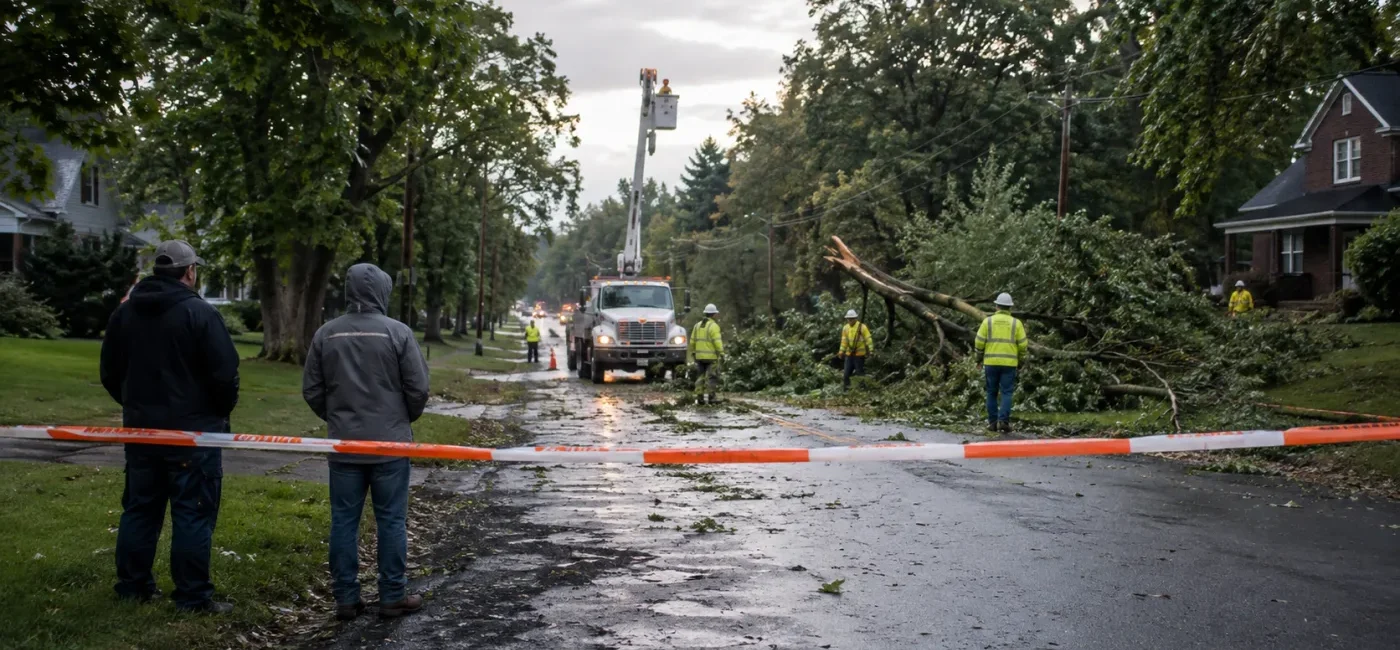
After a severe storm in western Pennsylvania, the most useful question is not simply whether the rain has stopped. It is which hazards to check first: downed wires, flooded roads, outages, school schedules or refrigerated food. Thunderstorms that crossed the Pittsburgh region on September 3 left wind damage, fallen trees and power lines, road flooding and widespread outages. NOAA’s preliminary storm reports include trees and wires down across Allegheny and Westmoreland counties, a 74 mph measurement near New Stanton and a 75 mph report near Braddock. WTAE reported that outages at one point affected about 55,000 Duquesne Light customers and 50,000 West Penn Power customers. Those totals change quickly as service is restored, so use the steps below with live official information for your address.
Key Takeaways
- Treat every fallen wire as energized. Stay away from the wire and anything touching it, including trees, fences, vehicles and standing water. Report it to 911 and the utility.
- Never judge floodwater by appearance. A shallow-looking roadway may hide a washout, debris or electrical danger. Do not drive or walk through it.
- Check outages by service address. Use Duquesne Light or FirstEnergy’s official outage map, and treat every restoration time as an estimate.
- Keep refrigerator and freezer doors closed. Federal guidance says an unopened refrigerator can keep food cold for about four hours; a full freezer for about 48 hours; and a half-full freezer for about 24 hours.
- Check 511PA and institution alerts before leaving. Road detours, transit service, and school or child-care schedules can change by the hour.
- Run generators outdoors only. Keep them at least 20 feet from the home, windows, doors and attached garages. Never heat a home with a gas oven or stovetop.
What Happened
Severe thunderstorms moved through western Pennsylvania on Thursday evening, September 3, producing more than a routine travel inconvenience. NOAA’s preliminary reports list trees or wires obstructing roads and transit infrastructure around Oakmont, Edgewood, Castle Shannon, Irwin, Youngwood, New Stanton and Ligonier. Preliminary reports can be corrected after later review, but they establish that damaging wind and access problems occurred across more than one neighborhood and county.
Local reporting said winds exceeded 70 mph at some locations and heavy rain made some roads impassable. Schools also changed schedules in areas with storm damage and flash flooding. Outage totals were very high shortly after the storms, but utility counts fall and sometimes rise again as crews isolate circuits, remove trees and discover additional damage. For an immediate decision, the historical peak is less important than your address-level outage status, the utility’s latest estimated restoration time and local road-closure notices.
At 6 a.m. Eastern on September 4, the National Weather Service active-alert feed showed no active alerts for Pennsylvania. That does not mean every hazard from the previous evening has been cleared. Weather warnings, utility restoration, road reopening and building safety operate on different timelines. A new alert can also be issued later, so check the NWS Pittsburgh page and enabled emergency alerts again before traveling.
Who Is Affected
Residents in Allegheny and Westmoreland counties may face outages, fallen trees, unstable communications and detours. A wire may be tangled below branches or energizing a metal fence even when it is not easy to see. Do not rush into yard cleanup. Renters should report damage to the landlord or property manager with photos and should not touch a wet electrical panel, furnace or other flooded equipment.
Households with powered medical equipment or refrigerated medication have a higher-priority decision. Check the remaining battery time for oxygen concentrators, dialysis equipment, mobility-device chargers or similar equipment, and identify a powered backup location. Each refrigerated medicine has its own temperature limits. Do not automatically discard it or keep using it without advice; call a pharmacist, prescriber or the manufacturer’s official support line. If life-sustaining equipment lacks adequate backup, call 911 or the local emergency management agency.
Parents, students and commuters should not assume the usual route and schedule are operating. Closures and delays differ by school district, while a reopened road may take time to appear in a navigation app. Compare the district website or alert message with employer notices and 511PA. If standing water, branches or wires are near a bus stop, keep children away and ask the school transportation office for a safe alternative.
Restaurants, grocers, remote workers and small businesses should check cold-storage temperature logs, payment terminals, internet service, security systems and employee routes. Commercial food-disposal and reopening rules can differ from household guidance, so follow the jurisdictional health department, such as the Allegheny County Health Department. If a business-interruption or spoilage claim may be filed, preserve outage start and restoration times, temperature logs, discarded inventory, photos and receipts.
What to Do Now
1. Check for electrical hazards before stepping outside
From a safe indoor position, look for wires, leaning poles, roof damage, hanging limbs and water around electrical equipment. Stay well away from any fallen line, and do not attempt to rescue a person or move a vehicle that is touching one. Give the location to 911 and the utility, then warn neighbors from a safe distance. If a wire falls on an occupied vehicle and there is no fire or smoke, occupants generally should remain inside and follow 911 instructions. If fire makes exit unavoidable, avoid touching the vehicle and ground at the same time; jump clear with both feet together and shuffle away. That is an emergency last resort, not a routine way to leave.
2. Report the outage and save the utility estimate
Do not assume a neighbor has already reported the problem. Submit the outage for the account address. Duquesne Light customers should use its Current Outages page; West Penn Power customers should use FirstEnergy’s Pennsylvania Storm Center. Customer counts and estimated restoration times can change after field inspection. Save the confirmation or take a screenshot. Be alert for repair scams: no legitimate line crew needs payment by gift card, cash or instant transfer at your door to restore storm service.
3. Start the refrigerator and freezer clock
Write down when power failed and keep appliance doors closed. If a refrigerator has been without power for about four hours, or perishable food has been above 40°F for two hours or longer, meat, seafood, eggs, milk and leftovers generally should be discarded. Do not taste food to test its safety. Frozen food that still contains ice crystals or remains at 40°F or below may be safely refrozen or cooked. Use the FoodSafety.gov chart for item-specific decisions. Smartor’s food safety after a power outage guide provides a time-and-temperature checklist.
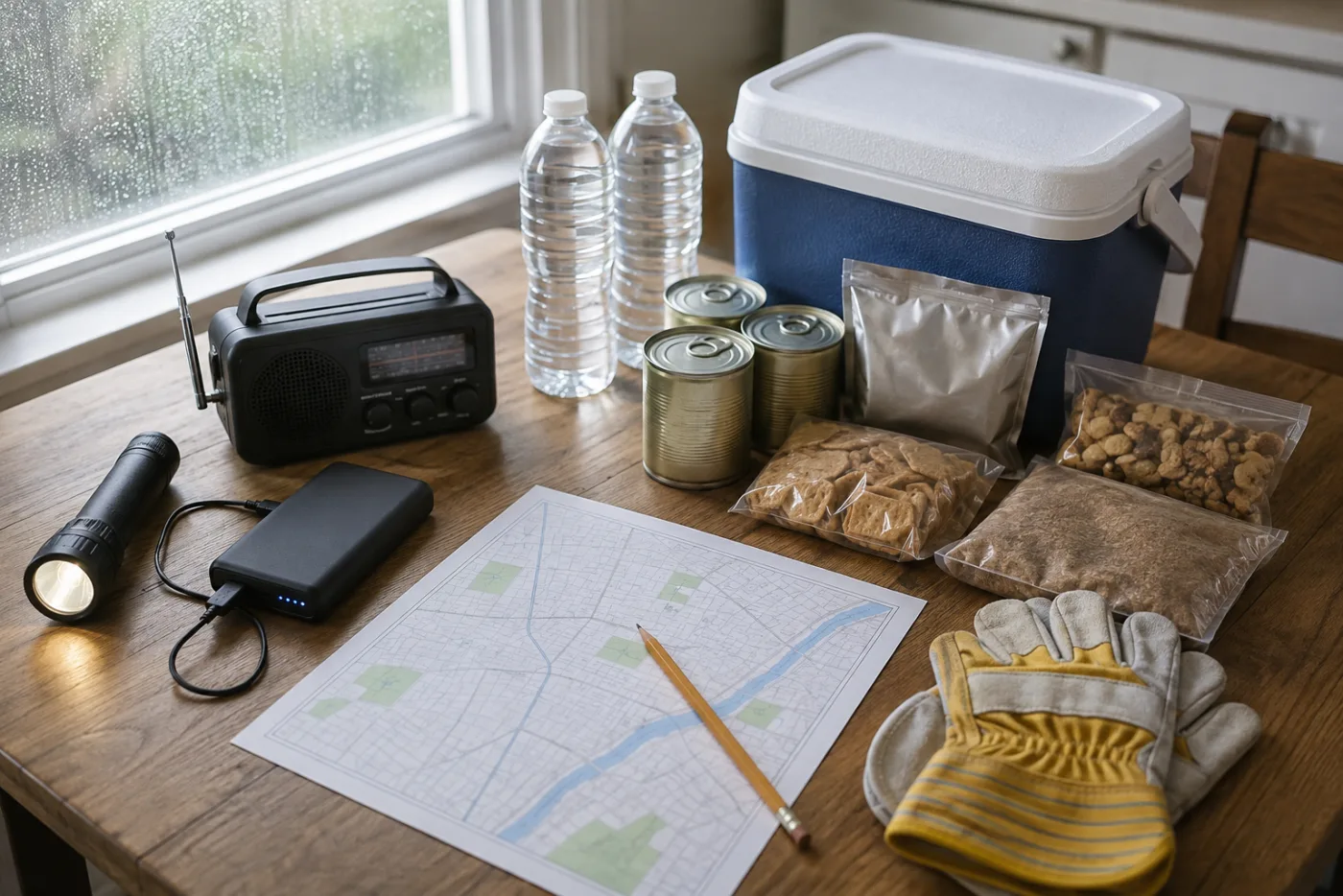
4. Keep generators and fuel-burning devices far from the house
Never run a generator inside a garage, even with the garage door open. Ready.gov advises operating generators, camp stoves and charcoal grills outdoors and at least 20 feet from windows, doors and attached garages. Protect a generator from rain and standing water without enclosing it, and follow the manufacturer’s ventilation instructions. Let it cool before refueling. Prevent dangerous backfeed by using an approved transfer switch installed by a qualified electrician instead of connecting a generator directly to household wiring. Confirm that battery-backed carbon monoxide alarms work on every occupied level.
5. Enter a flooded space only after electricity and structure are cleared
If water entered a basement or first floor, stay away from submerged outlets, the electrical panel, furnace and gas equipment. If you cannot shut off power from a dry, safe location, wait for the utility or a qualified electrician. Floodwater may contain sewage, chemicals, sharp debris and displaced animals. Keep children and pets away, and use waterproof boots, gloves and eye protection when officials say entry is safe. Mold can begin growing quickly. Photograph conditions first, then follow insurer guidance while removing water and drying materials. Smartor’s basement flooding checklist explains drainage and documentation basics.
6. Recheck roads, schools and transit immediately before departure
A navigation app’s fastest route may not reflect a new barricade. Use 511PA for incidents, closures and construction, then compare it with county emergency management and local police notices. Never follow another vehicle into water covering a roadway. Turn around, choose another route and do not move a barricade. Check each school district’s official site or notification system for schedule changes. For transit, use Pittsburgh Regional Transit’s official service alerts rather than relying only on a third-party trip planner.
7. Document damage after immediate hazards are controlled
Take wide shots of the property and vehicle, then photograph each damaged room, water line, fallen tree and item that may need to be discarded. Preserve original timestamps and save receipts for reasonable temporary repairs. Take steps to prevent additional damage, but avoid extensive demolition before the insurer can advise or inspect. Standard homeowners insurance often excludes surface-water flooding, and coverage for fallen trees depends on the cause and what was damaged. Read the policy and request important answers from the insurer in writing.
8. Manage batteries, communications and charging safely
Put phones in low-power mode and use text messages when networks are congested. Reserve one charged device for emergency calls. Do not charge a phone in a vehicle parked inside a garage, because an idling engine creates carbon monoxide. Inspect power banks for swelling, heat, odor or damage before use, and keep them on a hard, dry surface. Download or photograph essential phone numbers, insurance details, prescriptions and route information so they remain available if cellular data fails.
9. Separate cleanup urgency from cleanup safety
It is reasonable to want branches and wet belongings removed quickly, but the order matters. Utility crews must clear electrical hazards before an arborist cuts a tree entangled with wires. A structural professional may need to assess a shifted wall or damaged roof before volunteers enter. Avoid unsolicited contractors who demand a large cash deposit, refuse a written scope or pressure you to sign over insurance benefits. Verify licensing or registration where applicable, get multiple written estimates and photograph the condition before and after temporary work.
How to Verify Official Information
- Weather and new alerts: Use NWS Pittsburgh or the NWS Pennsylvania active-alert feed.
- Observed storm damage: Review the NOAA Storm Prediction Center’s September 3, 2026 preliminary reports. Preliminary data can be revised.
- Power: Check Duquesne Light Current Outages or FirstEnergy Storm Center PA for the service address.
- Roads: Use 511PA for official incident and closure information.
- Schools and child care: Give priority to the institution’s own website, calls and text alerts. A news outlet’s consolidated list is only a backup.
- Emergencies: Call 911 for a fallen power line, rescue situation, fire, carbon monoxide alarm or imminent loss of power to life-sustaining medical equipment.
Frequently Asked Questions
Should I report my outage if my address is not shown on the map?
Yes. Submit a report for your account address. A utility map may combine several customer reports into one incident, delay a map marker or temporarily omit a small outage. Save the report confirmation and restoration estimate for follow-up.
Can I remove a branch touching a wire if there are no sparks?
No. A line can be energized without visible sparks or noise, and current can travel through a tree, metal fence or standing water. Stay away, report it to 911 and the utility, and wait for trained crews.
Is refrigerated food safe if it smells normal?
Smell and taste cannot detect every dangerous organism. Base the decision on elapsed time, measured temperature and the type of food. When in doubt, throw it out, and never taste food as a safety test.
Can I enter the basement as soon as the water recedes?
Not until electrical and structural hazards are addressed. Confirm that power is safely disconnected and look for movement in walls, foundation or stairs. If you smell gas, do not operate a switch or phone inside; leave and call 911 and the gas utility from outdoors.
Does the lack of an active weather alert mean roads are safe?
No. An expired warning does not clear fallen trees, damaged signals, floodwater, wires or repair zones. Check 511PA and local closure notices just before departure.
Why does the estimated restoration time keep changing?
Utilities first assess substations, major circuits and critical facilities, then repair smaller lines. Tree removal, replacement equipment and newly discovered damage can change the estimate. Treat the time as a field-based projection, not a guaranteed appointment.
Who removes a tree that is tangled with power lines?
The utility must make the electrical hazard safe before a private tree contractor begins work around the line. Do not hire someone to cut an energized or potentially energized tree. Report the location, keep people away and ask the utility or local emergency officials who has responsibility for the next step.
What should I do if a contractor appears immediately after the storm?
Verify the business, insurance and any required state registration before signing. Ask for a written scope, price, payment schedule and cancellation terms. Avoid large cash deposits, rushed decisions and requests to sign over insurance proceeds. Emergency temporary work should be documented with photos and receipts.
Official Sources
- NOAA Storm Prediction Center — September 3, 2026 preliminary storm reports
- National Weather Service Pittsburgh — official forecasts and alerts
- Ready.gov — power outage and generator safety
- CDC — flood preparedness and safety
- FoodSafety.gov — food safety during a power outage
- WTAE — western Pennsylvania outage and storm reporting
Smartor Editorial Team · Updated September 4, 2026. Weather, utility and road conditions can change quickly.
[…] Read this guide in English → […]