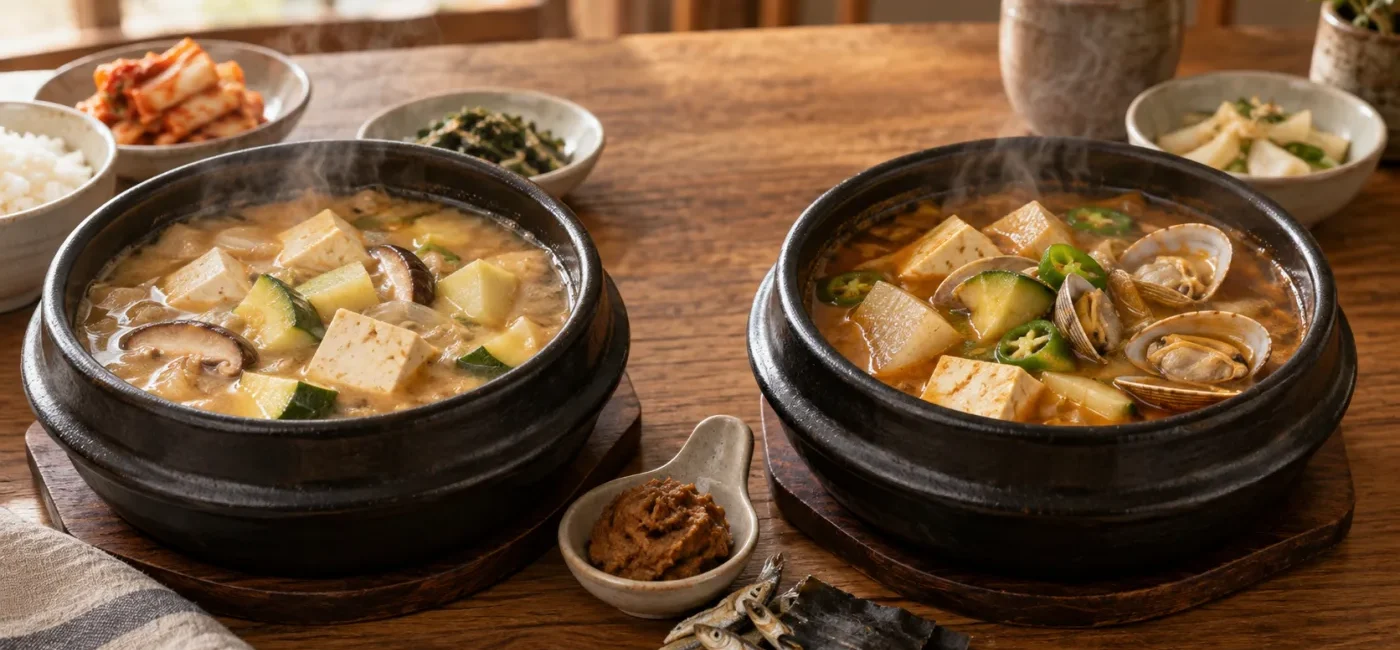
How to Make Doenjang Jjigae: 28-Minute Quick vs Traditional Stock
Smartor 편집팀
September 16, 2026

The key to great doenjang jjigae is not adding more soybean paste. It is connecting the paste’s earthy aroma to vegetable sweetness before the broth becomes too salty. Both recipes below make 4 servings. The quick version uses anchovy stock powder and prepared ssamjang for rounded savoriness in 28 minutes. The traditional version builds a 67-minute broth with dried anchovies, kelp, dried shiitake and radish, then briefly blooms doenjang over low heat. Convenience ingredients are fast and consistent; homemade stock offers more aromatic layers and control. The results point in the same direction, but they do not taste identical.
| Factor | 28-minute quick version | Traditional homemade-stock version |
|---|---|---|
| Yield | 4 servings (about 1.4 L) | 4 servings (about 1.4 L) |
| Prep / cook / total | 10 / 18 / 28 minutes | 20 / 47 / 67 minutes |
| Active time | About 17 minutes | About 27 minutes |
| Difficulty | Easy | Moderate |
| Estimated U.S. Korean-market cost | About $10–13 | About $13–17 |
| Flavor | Salt, sweetness and umami settle quickly into a smooth broth | A longer anchovy-shiitake finish followed by radish sweetness and fermented soybean aroma |
| Umami sources | Doenjang, anchovy stock powder, prepared ssamjang and shiitake | Doenjang, dried anchovies, kelp, dried shiitake and radish |
| Main failure risk | Stacking salt from doenjang, ssamjang and stock powder | Boiling kelp or scorching doenjang over high heat, which can turn the broth bitter |
| Best for | Weeknights, using refrigerator vegetables and repeatable flavor | Weekend meals, guests and a broth with a longer, cleaner finish |
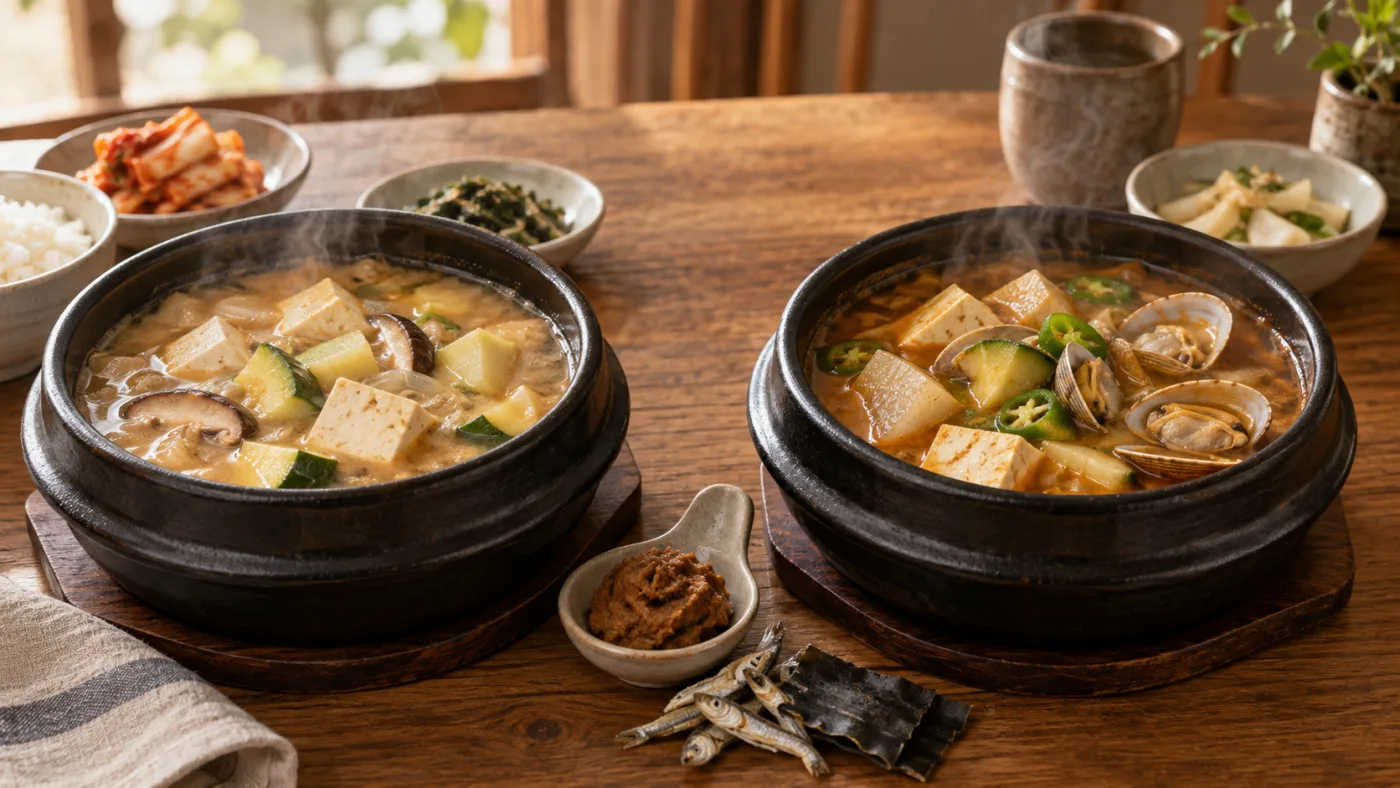
Prep 10 minutes · Cook 18 minutes · Total 28 minutes · Active time about 17 minutes
Why it tastes this way: Anchovy stock powder establishes salinity and savory intensity quickly. Ssamjang combines soybean paste with chile paste, garlic and sweetness, rounding the broth without a long simmer. Potato starch adds a little body during the 8-minute boil. The method does not fully reproduce the seafood aroma of freshly infused anchovy-kelp stock or the long finish of dried shiitake.
Prep 20 minutes · Cook 47 minutes · Total 67 minutes · Active time about 27 minutes
Why it tastes this way: Glutamate-rich kelp and shiitake reinforce the nucleotide-driven savoriness of dried anchovies, while radish adds gentle sweetness. Stirring doenjang in perilla oil over low heat for just 1 minute softens the raw-paste edge and develops a nutty aroma. Longer or hotter frying can scorch both paste and oil, so do not extend that step.
| Quick-version shortcut | Traditional replacement | Function and real difference |
|---|---|---|
| 6 g anchovy stock powder + 900 ml water | 28 g anchovies + 12 g kelp + 12 g dried shiitake + 100 g radish infused in 1,300 ml water to yield 950 ml stock | Powder sets salt and umami immediately. Homemade stock unfolds through seafood, mushroom and radish aromas but does not taste identical to the powder. |
| 18 g prepared ssamjang | 10 g additional doenjang + 1 g additional gochugaru + 12 g garlic + 15 g fresh chile | Ssamjang adds sweetness, heat and garlic in one spoonful. Separate ingredients make a leaner broth and let you control heat independently. |
| Dissolving doenjang directly in water | Stirring 90 g doenjang in 10 ml perilla oil over low heat for 1 minute, then deglazing with stock | Direct mixing is fast and clean. Low-heat blooming adds nutty aroma but can become bitter if overheated. |
| 100 g fresh shiitake | 12 g dried shiitake soaked in the stock, then returned to the stew | Fresh shiitake emphasizes tender texture. Dried mushrooms flavor both their soaking liquid and the stew, leaving a longer finish. |
Stock powder and ssamjang are not inherently inferior ingredients. The quick version saves time and reduces variation. The traditional version gives you separate control over stock strength, soybean aroma and chile heat. Because salinity varies by brand and batch, do not add extra salt at the beginning; correct only after the stew is fully cooked.
Do not leave the finished stew at room temperature for more than 2 hours. Divide it into shallow, covered containers and refrigerate within that window. Eat within 3 to 4 days. For longer storage, freeze single portions of the broth without tofu or potato and use within 2 months. Frozen tofu becomes porous and firm; frozen potato can turn mealy.
For one refrigerated serving, about 350 ml, add 30 ml water or reserved unsalted stock. Cover and reheat over medium heat for 5 to 7 minutes, stirring once, until the whole serving bubbles steadily. In a covered 700W microwave, heat for 2 minutes, stir, then continue in 30-second intervals. Reheat only what you plan to eat.
Yes. In the quick version, replace anchovy powder with 5 g unsalted vegetable stock powder. For the traditional stock, omit anchovies, increase dried shiitake to 20 g and kelp to 15 g, and add 40 g clean onion skin. The broth loses seafood aroma but keeps mushroom-kelp savoriness.
No. Its starch makes the broth slightly opaque and soft, but very cloudy rinsing water can mute the soybean aroma. To use it, replace the quick version’s 900 ml water with 300 ml second-rinse rice water plus 600 ml plain water.
For brisket, sear 150 g for 2 minutes before beginning step 2 of the quick recipe. For clams, add 400 g purged clams for the final 5 to 7 minutes, cook only until the shells open, and discard any that remain closed. Either adds fat or seafood intensity, so begin with 10 g less doenjang.
Yes. Use the same weight of radish, slice it 5 mm thick and keep the cooking time unchanged. The broth will be clearer and less thick, with gentler sweetness.
Strain it for a smooth broth, or simply whisk it if you enjoy soybean pieces and a rustic texture. This is a texture choice, not a quality ranking. You can return up to 20 g of the strained soybean solids to the pot.
Aromas become less vivid as the stew cools, making salt seem more prominent, and potato and tofu absorb broth. There is no need to make it watery at first; adding 30 ml water per serving during reheating restores the original balance.
Compare another everyday stew with 28-minute quick vs traditional-stock kimchi jjigae, or make 20-minute quick vs traditional-stock tteokbokki.
브라우저 메뉴에서 앱 설치 또는 홈 화면에 추가를 선택해 주세요.
[…] Read this recipe in English […]