
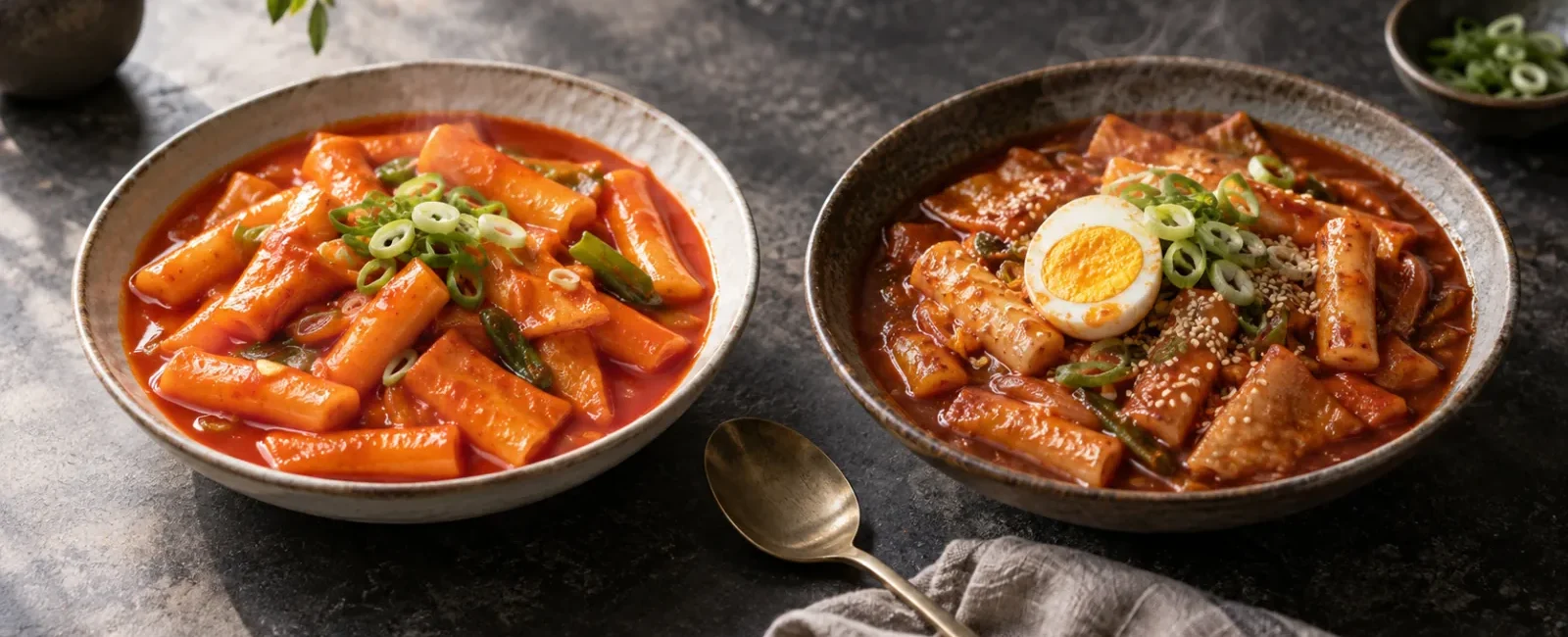
The key to great tteokbokki is not simply making it hot. The sauce must thicken at the same rate that the rice cakes soften, without becoming too salty. Both recipes below make 4 servings. The quick version uses Korean beef soup-stock powder to deliver a bold snack-bar flavor in 20 minutes. The traditional version builds a longer, rounder finish with anchovy, kelp, dried shiitake and Korean radish stock. Neither method is inherently better, and they do not taste identical; choose according to your time and the flavor you want.
Quick comparison
| Category | 20-minute quick version | Traditional anchovy-kelp stock version |
|---|---|---|
| Yield | 4 servings | 4 servings |
| Prep / cook / total | 8 / 12 / 20 minutes | 20 / 35 / 55 minutes |
| Active time | About 12 minutes | About 25 minutes |
| Difficulty | Easy | Moderate |
| Estimated U.S. Korean-market cost | About $13–$15 | About $16–$19 |
| Flavor | Immediate savory impact, clear sweetness and a direct Korean snack-bar profile | Gentle seafood aroma, a longer finish and a rounder transition from sweet to spicy |
| Umami source | Korean beef stock powder, gochujang and fish cake | Dried anchovy, kelp, dried shiitake, radish and fish cake |
| Failure risk | Too much powder can make it salty; high heat can scorch the thick sauce | Boiled kelp can taste bitter; over-reduced stock makes the final seasoning too strong |
| Best for | Weeknights, late-night snacks and consistent results | Weekends, guests and cooks who want to layer the stock themselves |
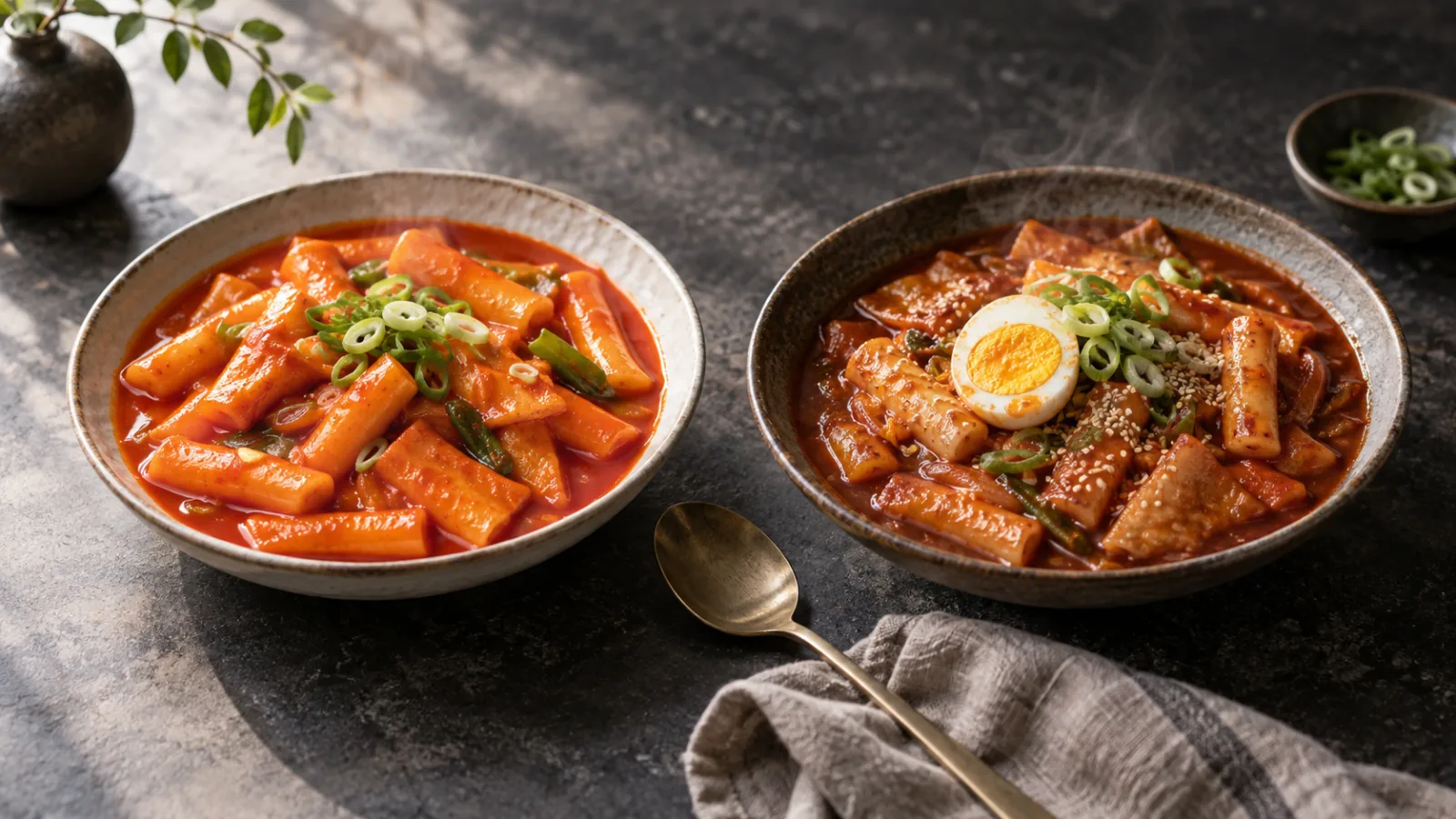
Quick version: 20-minute tteokbokki with stock powder
Exact ingredients — 4 servings
- 500 g (17.6 oz) Korean cylindrical wheat or rice cakes
- 200 g (7 oz) Korean flat fish cake, cut into 3 cm (1.2-inch) strips
- 700 ml (2.96 cups) water
- 5 g Korean beef soup-stock powder, such as Dashida
- 60 g (3 tablespoons plus 1 teaspoon) gochujang
- 12 g (2 tablespoons) fine Korean gochugaru
- 15 ml (1 tablespoon) Korean soup soy sauce or regular soy sauce
- 25 g (2 tablespoons) sugar
- 20 g (1 tablespoon) corn syrup or oligosaccharide syrup
- 10 g (2 teaspoons) minced garlic
- 100 g (3.5 oz) onion, sliced 5 mm thick
- 50 g (1.8 oz) scallions, cut into 4 cm lengths
- 3 g (1 teaspoon) toasted sesame seeds
Prep 8 minutes · cook 12 minutes · total 20 minutes · active time about 12 minutes
Preparation
- If refrigerated cakes are firm, soak them in cold water for 5 minutes, separate them and drain. Do not soak freshly made soft cakes. Thaw frozen cakes in the refrigerator first.
- In a small bowl, mix the gochujang, gochugaru, soy sauce, sugar, syrup and garlic. Blending the sauce while cold prevents pockets of unmixed gochujang.
- For a cleaner sauce, pour boiling water over the fish cake, wait 10 seconds and drain. Skip this optional step if you prefer its fuller fried flavor.
Cooking order and heat level
- Add 700 ml water and 5 g stock powder to a wide 26 cm (10-inch) pot. Bring to a full boil over high heat, about 3 minutes.
- Add the mixed sauce and 100 g onion. Whisk for 20 seconds to dissolve the paste.
- Add 500 g rice cakes. Keep on high heat for 2 minutes, until the liquid returns to a boil. Scrape the base once to release any cakes that stick.
- Reduce to medium-high and cook for 5 minutes. Every minute, scrape the base and fold the cakes upward so their starch disperses evenly.
- Add 200 g fish cake. Cook over medium heat for 3 minutes, then add 50 g scallions and cook 1 minute.
- Turn off the heat when a 2-inch trail drawn across the pot stays visible for 1 second before the sauce closes. If too thick, add hot water 30 ml at a time. If thin, simmer in 1-minute increments. Finish with 3 g sesame seeds.
Why it tastes this way: The salt and flavor enhancers in stock powder quickly establish a savory center. Fermented gochujang, fish-cake savoriness and starch released by the cakes make the sauce taste full in a short time. Adding more powder cannot reproduce the aroma of long-extracted stock, so begin with 5 g and judge seasoning only at the final thickness.
Traditional version: anchovy, kelp and shiitake stock
Exact ingredients — 4 servings
- 500 g (17.6 oz) Korean cylindrical wheat or rice cakes
- 200 g (7 oz) Korean flat fish cake, cut into 3 cm strips
- 1,000 ml (4.23 cups) cold water
- 20 g (0.7 oz) large dried soup anchovies, heads and dark innards removed
- 10 g dried kelp
- 8 g dried shiitake mushrooms
- 150 g (5.3 oz) Korean radish, cut into 1 cm slabs
- 150 g (5.3 oz) onion — 75 g for stock and 75 g for the sauce
- 60 g gochujang
- 12 g fine Korean gochugaru
- 20 ml (4 teaspoons) soy sauce
- 20 g (1 tablespoon plus 2 teaspoons) sugar
- 15 g (2 teaspoons) Korean rice syrup
- 10 g minced garlic
- 50 g scallions, cut into 4 cm lengths
- 3 g toasted sesame seeds
Prep 20 minutes · cook 35 minutes · total 55 minutes · active time about 25 minutes
From stock to finished tteokbokki
- Combine 1,000 ml cold water, 10 g kelp and 8 g shiitake in a pot. Soak at room temperature for 20 minutes. Meanwhile, remove the anchovy heads and dark innards, cut the vegetables and prepare the cakes.
- Put 20 g prepared anchovies in a dry pot and toast over medium-low heat for 2 minutes to remove stale moisture. Do not brown or burn them.
- Pour in the soaking water with the kelp and shiitake. Add 150 g radish and 75 g onion. Heat over medium for 7 to 8 minutes. Remove only the kelp when small bubbles collect at the edge; a hard boil can make kelp slippery and bitter.
- Once boiling, reduce to medium-low and simmer uncovered for 12 minutes. Strain through a fine sieve. Measure 800 ml (3.38 cups), adding hot water if needed.
- In a wide pot, whisk the 800 ml stock with 60 g gochujang, 12 g gochugaru, 20 ml soy sauce, 20 g sugar, 15 g rice syrup and 10 g garlic. Add the remaining 75 g onion and bring to a boil over high heat.
- Add 500 g cakes and cook over medium-high for 7 minutes, scraping the entire base every minute.
- Add 200 g fish cake and cook over medium for 4 minutes. Add 50 g scallions for the final minute. Turn off the heat and rest 2 minutes; the starch will absorb more liquid.
- Taste at the finished thickness. If salty, add 30 to 50 ml hot water. If underseasoned, add soy sauce 2 ml at a time. Garnish with 3 g sesame seeds.
Why it tastes this way: Anchovies contribute inosinate-rich savoriness, kelp supplies glutamate-rich savoriness, and dried shiitake adds guanylate-rich depth. Radish and onion soften the sharp edges of gochujang and gochugaru with their sweetness. The finish unfolds more gradually than the stock-powder version, but it is not an exact copy of the familiar instant snack-bar profile.
What replaces each shortcut ingredient?
| Quick version | One-to-one traditional replacement | Function and difference |
|---|---|---|
| 5 g beef stock powder + 700 ml water | 20 g anchovies + 10 g kelp + 8 g shiitake + 150 g radish + 75 g onion extracted in 1,000 ml water to yield 800 ml stock | The powder delivers salt and savoriness quickly. The traditional method extracts several savory compounds and vegetable sweetness through 32 minutes of soaking, toasting and simmering. It is more layered, not identical. |
| 25 g sugar + 20 g clear syrup | 20 g sugar + 15 g rice syrup + sweetness from radish and onion | The shortcut has brighter immediate sweetness and gloss. The traditional sauce has less linear sweetness and softer body. |
| 12-minute direct reduction | 20-minute soak + 2-minute anchovy toast + 20-minute extraction + 12-minute sauce reduction | The quick pot relies on rice-cake starch for immediate body. The traditional pot creates stock aroma before building the same starch-thickened texture. |
Using stock powder or a concentrated seasoning does not make a dish inherently bad. The quick method is easy to measure and highly repeatable; the traditional one gives you more direct control over aroma and stock concentration. If you are salt-sensitive, reserve the final 5 ml soy sauce in either recipe and add it only after the sauce reaches its final thickness.
Adjust for the type of rice cake
- Wheat cakes: They absorb sauce readily and stay pleasantly resilient during a longer simmer. Use the timings as written.
- Rice cakes: They may need 1 to 2 extra minutes to soften at the center, but prolonged cooking can split the surface. Cut one; stop when no opaque white core remains.
- Frozen cakes: Thaw in the refrigerator, then soak in cold water for 10 minutes to separate. A frozen clump makes the outside cakes mushy before the inner cakes soften.
- Fresh, soft cakes: Do not soak. Add them only for the final 6 to 7 minutes to prevent over-softening.
Failure-prevention checklist
- The cakes stick: Use a wide pot instead of a tall narrow one. Once boiling, scrape the full base every minute.
- The sauce is too hot: Begin with 8 g gochugaru and add the final 4 g in stages. If diluting, adjust with 3 g sugar and 5 g gochujang as well as water so the flavor does not become hollow.
- It becomes gluey at the table: Cakes keep absorbing water after the heat is off. Finish slightly looser than your target and keep 30 ml hot water ready.
- The stock is bitter or slippery: Remove kelp when edge bubbles appear, before a full boil. Gut the anchovies and never toast them until dark.
- Only the sweetness stands out: Reduce granulated sugar first, then preserve gloss with a small amount of rice syrup. Simmer onion and radish fully so their sweetness integrates into the stock.
Storage and reheating
Do not leave cooked tteokbokki at room temperature for more than 2 hours. Transfer it to a shallow airtight container and refrigerate. Texture is best within 2 days; general food-safety guidance recommends using cooked leftovers within 3 to 4 days. Freezing finished tteokbokki is not ideal because thawed cakes can crack or turn mealy. The strained stock alone freezes well for 2 to 3 months.
For one 350 g serving, stir in 45 ml water or reserved stock, cover and reheat over medium-low for 4 to 6 minutes. Stir every 30 seconds and heat leftovers to 165°F (74°C). In a covered 700-watt microwave, heat 1 minute 30 seconds, stir, then continue in 30-second intervals. Reheat only the portion you will eat.
Frequently asked questions
Why does a sauce made with only gochujang taste heavy?
A large amount of gochujang can become pasty and salty because it contains fermented bean solids and starch. Using 60 g for body and 12 g gochugaru for cleaner heat and color gives a more balanced result.
Do rice cakes always need soaking?
No. Soak firm refrigerated cakes in cold water for 5 minutes and thawed frozen cakes for 10 minutes. Fresh soft cakes go straight into the pot. A long hot-water soak can dissolve the surface before cooking begins.
Can I replace Dashida with pure MSG?
Yes, but not gram for gram. MSG mainly adds savoriness, while soup-stock powder also contains salt and aromatics. Start with 1 g MSG in place of 5 g stock powder, then add salt or soy sauce in 2 ml increments at the end.
Can I omit dried shiitake from the traditional stock?
Yes. Keep the water and anchovies at the written amounts. The round mushroom finish will be lighter, but anchovy and kelp still create a solid stock.
Can I make tteokbokki without fish cake?
Yes. Reduce the quick version’s water by 50 ml or use only 750 ml of traditional stock. Because fish cake supplies salt and savoriness, adjust the finished pot with 2 to 5 ml soy sauce.
Why does the sauce solidify as it cools?
Starch released from the cakes binds water more firmly as it cools. Finish the hot sauce a little loose and add 45 ml water per serving during reheating.
Related recipes and references
Find Smartor’s growing collection of comparison-style Korean dishes in the recipe archive. The Korean edition linked above uses the same weights, heat levels and tested sequence.
[…] Read this recipe in English […]