
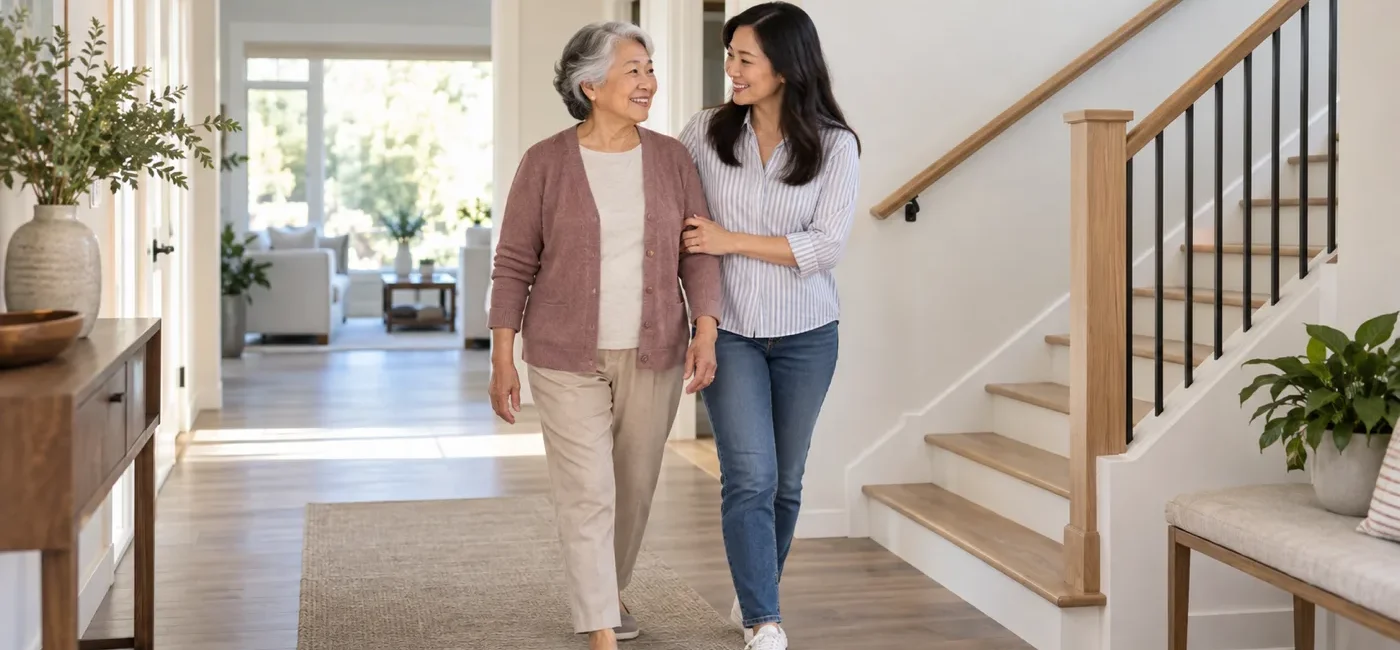
A fall at home is rarely caused by one dramatic hazard. More often, several small factors line up: a dim hallway, a curled rug, a rushed trip to the bathroom, loose footwear, dizziness, or a chair that moves when someone reaches for support. That is why an effective fall-prevention plan starts with everyday walking routes, lighting, stable handholds, frequently used items, and personal health—not necessarily with an expensive renovation.
The Centers for Disease Control and Prevention (CDC) reports that more than one in four adults age 65 and older falls each year, and more than 3 million are treated in emergency departments annually for fall injuries. Falls are serious, but they are not an inevitable part of aging. Finding and reducing modifiable risks can help an older adult remain active, confident, and independent at home.
This guide provides general health and home-safety information for U.S. residents. It is not a diagnosis or an individualized treatment plan. Discuss a recent fall, dizziness, fainting, a change in walking, or vision problems with a health professional. A fall involving a head impact, loss of consciousness, severe pain, heavy bleeding, breathing trouble, new confusion, one-sided weakness, or an inability to get up may require calling 911 or local emergency services.
Start with a 20-minute fall-risk walkthrough
You do not need a contractor’s estimate to begin. Walk the routes used most often during both daylight and nighttime, using a phone camera or notebook to document hazards. Prioritize four paths: bed to bathroom, living room to front door, kitchen to dining area, and garage to the inside of the home. If possible, invite a trusted relative or friend. A second person may notice obstacles that have become invisible through familiarity.
- Look down first. Mark cords, shoes, delivery boxes, pet toys, uneven thresholds, and carpet edges that can catch a foot.
- Check light at eye level. Find shadowed stairs, long hallways without convenient switches, and a dark bathroom entrance.
- Test support points. Identify a loose stair rail, a tub with no safe handhold, or a door handle being used for balance.
- Locate daily essentials. Note dishes, clothes, medicine, and cookware that require climbing, deep bending, or overreaching.
- Record physical symptoms. Write down when dizziness, leg weakness, urgency, or unsteadiness occurs so the pattern can be discussed during a medical visit.
Sort findings into “fix now,” “fix this week,” and “ask a professional.” Removing a box or cord from a walkway can happen immediately. Securing a rail or replacing a failed light belongs on this week’s list. Installing bathroom grab bars, changing a threshold, or building a ramp may require a qualified installer or an occupational therapist who understands structure, placement, and the resident’s movement.
A fall is not just a balance problem
Fall risk increases where a person’s condition meets the surrounding environment. Strength, balance, vision, foot sensation, blood-pressure changes, pain, fatigue, dehydration, medication effects, and rushing are personal factors. Dim stairs, wet floors, unstable furniture, high shelves, and clutter are environmental factors. The realistic goal is not to perfect one factor; it is to build several layers of protection.
Consider someone who gets up twice each night to use the bathroom. They rise quickly, leave their glasses in the kitchen, face a dark hallway, and step around a charging cable. That creates a chain of risk. A bedside light, clear path, well-fitting footwear, nearby glasses, and a safer sit-then-stand routine discussed with a clinician create backups. If one safeguard fails, another may still help.
Questions for the older adult and family
- Has there been a fall in the past year, even one without an injury? Record the number and circumstances.
- Has fear of falling led to less walking, bathing, shopping, or social activity?
- Is standing from a chair difficult without using the arms, or is furniture used for support while walking?
- Has a prescription drug, over-the-counter medicine, sleep aid, allergy product, or supplement recently been added or changed?
- Does standing cause dizziness, lightheadedness, or dim vision?
- Is an eye exam or glasses prescription overdue? Do bifocals or progressive lenses make stairs difficult to judge?
- Is there foot pain, numbness, reduced sensation, or loose footwear?
- Does nighttime bathroom urgency lead to rushing?
A “yes” is not a reason for embarrassment or complete inactivity. It is useful information for a health professional. The CDC’s STEADI framework uses three core steps: Screen for fall risk, Assess modifiable risk factors, and Intervene with appropriate strategies. Family members can support the process without taking over by documenting hazards, updating a medication list, preparing questions, and joining the appointment if invited.
Entryways, halls, and living rooms: clear the routes used every day
Open up the most frequently used paths and make sudden changes in floor level easier to see. Move low coffee tables, plant stands, fan bases, and charging cords toward walls and out of walking lanes. Do not hide electrical cords under rugs; route and secure them along a wall. Removing a small throw rug is often the simplest solution. If a rug must remain, verify regularly that the entire surface and every edge stay flat and secure.
A low, deep, or overly soft sofa may require extra forward momentum to stand. A practical seat lets the person place both feet on the floor and use stable armrests. Do not rely on a rolling desk chair, lightweight table, or decorative shelf for support. At the entry, provide a firm chair or bench for putting on shoes. Keep keys and bags between waist and shoulder height to reduce deep bending and reaching.
Quick entryway and hallway checklist
- Give packages, mail, umbrellas, and shoes a designated place outside the walking route.
- Consider motion-activated supplemental lights when a long hall lacks convenient switches.
- Improve the visibility of a low-contrast threshold without creating a loose strip of tape.
- Place pet bowls and toy baskets away from the main path.
- Keep a charged phone within reach and emergency contacts easy to find.
Stairs: two secure rails, even lighting, and empty steps
Stairs should not double as temporary shelves. Laundry, books, or packages left “to carry upstairs later” reduce usable tread space and block the view. Confirm that lights at the top and bottom work and that the middle of a long stairway is not shadowed. Ask for help when a high bulb needs replacement instead of climbing onto an unstable chair.
The National Institute on Aging (NIA) recommends secure handrails on both sides of a stairway and using the rails while going up or down. A rail is not decorative trim or a towel bar. It needs correct anchors and a structure capable of holding force. Repair loose carpet edges and worn sections. On wood or tile steps, make sure any nonslip treatment lies flat and remains firmly attached.
Keep one hand available and maintain a clear view of the steps when carrying an item. Divide a large laundry load rather than letting a basket block the feet, or ask someone else to move it. Put away the phone on stairs. In a home with pets, locate the animal before starting up or down so it does not unexpectedly cross in front.
Bathrooms: design the handhold before focusing on the wet floor
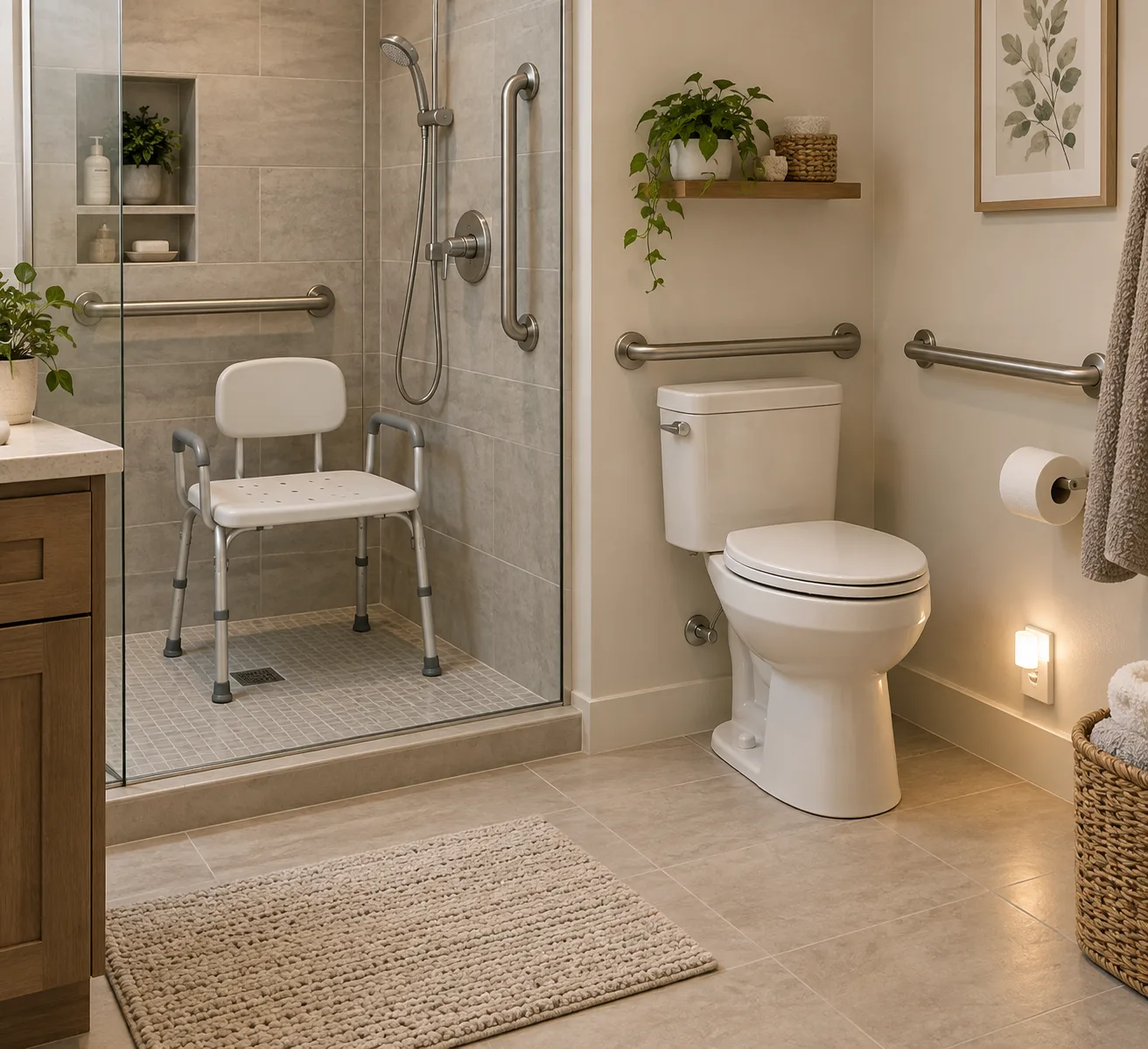
Bathrooms combine water, tight turns, a low toilet, and a tub edge, making them a high-priority area. Grab bars may be needed beside the toilet and both inside and outside a tub or shower. A towel bar, shower door, or sink is not a safety rail and may move or detach under sudden force. A qualified installer should verify wall structure, anchors, product requirements, and placement. Suction-mounted handles can release depending on moisture and surface conditions; do not automatically treat them as equivalent to permanently mounted grab bars.
Use a surface-appropriate nonslip mat or strips in the tub or shower and keep soap residue from building up. Keep a convenient way to wipe splashed water, but do not let the cleaning tool become another obstacle. If seated bathing would be safer, a properly sized shower chair with nonslip feet and a handheld shower may help. A clinician or occupational therapist can help match equipment to the person rather than to the room alone.
Create a continuous line of light from bed to bathroom. A bedside lamp, hall night-lights, and a bathroom night-light reduce the need to cross a dark area while the eyes are still adapting. If an inward-swinging bathroom door could be blocked by a person on the floor, ask a qualified professional about options compatible with the residence and local building requirements.
Bedrooms and nighttime routes: remove the reason to rush
Bed height should allow both feet to meet the floor and the hips and knees to move comfortably during transfers. A very high mattress or low bed can make getting in and out harder. Keep a reachable light switch, charged phone, glasses, and any prescribed mobility aid in a consistent place beside the bed. A flashlight should also be easy to reach during a power outage.
Someone who becomes lightheaded on standing can ask a clinician about a safer routine, such as sitting at the edge of the bed before walking. Recurring dizziness should not simply be dismissed as aging. Record when it happens, how long it lasts, medications taken near that time, and food or fluid intake. Frequent nighttime urination is also worth mentioning so possible causes and practical adjustments can be evaluated.
Choose sleepwear and robes that do not drag on the floor. Avoid walking across smooth floors in socks alone. Indoor footwear should fit, hold the heel, and have a sole suited to the surface. Route electric-blanket cords, oxygen tubing, and other necessary equipment according to manufacturer and clinical guidance while keeping them out of the path.
Kitchens and storage: eliminate the need to climb on a chair
Place everyday plates, cups, pans, and ingredients within comfortable reach, generally between waist and shoulder height. Heavy cookware should be stored low enough to control safely, not on a high shelf. Never climb onto a chair, folding table, or rolling stool. If something must be reached, a stable step stool with a handrail may be appropriate for some people, but requesting help is safer when balance is limited.
Wipe up water and grease promptly and keep the needed cleaning item nearby without blocking a walkway. Provide a seated prep option when fatigue or dizziness makes prolonged standing difficult. Keep the path between counter and table open so no one has to carry a hot pan around an obstacle. Give pets a separate place during meal preparation instead of allowing them underfoot.
Porches, garages, and yards: inspect weather and level changes
Check exterior steps for broken edges, loose rails, lifted pavement, and poor drainage. Consider a stable support near the door for balance while locking or unlocking it. If the resident will return after dark, turn on the porch light before leaving or use an automatic light. Leaves, algae, rain, snow, and ice can reduce both visibility and traction, so remove or treat them promptly or arrange help.
In the garage, organize hoses, tools, boxes, and changes in floor level around the vehicle. A moving car door may not be a reliable support when getting out. A physical or occupational therapist can teach transfer techniques and identify appropriate equipment. Build extra time into trips during bad weather. Arriving late is better than rushing across an icy or wet surface.
Medication, vision, hearing, and foot health belong on the checklist
A perfectly tidy home cannot fully offset drowsiness, dizziness, slowed reactions, or blood-pressure changes. Make a current list of prescriptions, over-the-counter cold and allergy products, sleep aids, pain relievers, herbs, and supplements. Ask a physician or pharmacist whether any item or combination could affect fall risk and whether timing should be reviewed. Do not stop or change a dose on your own.
An outdated prescription or a condition such as cataracts, glaucoma, or diabetes-related vision change may make steps and obstacles harder to judge. Keep up with eye examinations and use extra care on stairs while adapting to new lenses. A hearing change may reduce awareness of nearby warnings and sometimes occurs alongside balance concerns, so request an evaluation when a change is noticed.
Foot pain, calluses, numbness, reduced sensation, or nail problems can change gait. Replace loose slippers and worn soles. A cane or walker needs the right height and technique for the individual. Equipment inherited from a relative should not be used without checking fit and function with a clinician or physical therapist. Reaching for furniture is not a reliable substitute.
Use the emergency medication and medical information kit guide to organize an accurate health list. If a fall or another problem creates uncertainty about where to seek care, review the urgent care versus emergency room checklist.
Approach exercise systematically instead of simply moving less
Fear may cause someone to stop walking, shopping, or doing household tasks after a fall. Prolonged inactivity can further reduce leg strength and balance. The answer is not to attempt unsafe exercises alone. Tell a clinician about current conditions, pain, recent falls, and mobility-aid use, then choose strength and balance activities appropriate for the person.
An exercise area needs even light, a clear floor, and a stable support. A solid, nonrolling chair may be useful when recommended; a wheeled chair or lightweight furniture is not. Stop and seek appropriate care for chest pain, severe shortness of breath, a fainting sensation, or a new neurologic symptom. A physical therapist can assess gait, leg strength, balance, and device use, then build a gradual program.
Make a response plan before a fall happens
Trying to stand immediately after a fall can cause a second fall or worsen an injury. Pause, breathe, and check for pain in the head, neck, back, hips, and limbs, as well as bleeding or dizziness. Severe pain, an inability to move, concerning symptoms after a head impact, or other emergency signs may mean staying still and calling 911 or local emergency services rather than attempting to rise alone.
If the phone is out of reach, call out or use a personal alert device. Someone living alone may choose to carry a charged phone or consider a wearable alert or smartwatch feature. Check cellular or home coverage, battery life, monthly cost, privacy settings, and the exact call procedure. Test it with family. Technology can shorten the time needed to summon help, but it does not replace a clear path, sound rails, or a health evaluation.
Document the incident even if there is no obvious injury. Record time, location, activity, footwear, lighting, dizziness, recent medicine, and the body part that made contact. Report repeated falls or a new walking change to a health professional. Remove an immediate hazard such as a loose rug, but do not let fear end all activity; ask about a safe return plan.
A practical seven-day action plan
- Day 1—Map routes: Walk bedroom, bathroom, kitchen, and entry routes in daylight and darkness. Photograph hazards and remove obvious clutter.
- Day 2—Improve light: Replace failed bulbs, check night-lights and reachable switches, and get help with any high fixture.
- Day 3—Fix floors: Remove small rugs, route cords, put away shoes and pet toys, and mark carpet repairs.
- Day 4—Review the bathroom: Observe where support is needed and discuss correctly placed grab bars or equipment with a qualified professional.
- Day 5—Check stairs and outdoors: Test rails, stair lighting, thresholds, walks, and porch surfaces.
- Day 6—Prepare health information: List medicines, supplements, falls, dizziness, vision changes, and foot concerns for the next visit.
- Day 7—Practice communication: Test the phone or alert device and agree on who to contact and how responders can enter.
Mobility safety also matters when fire, smoke, or a power outage requires leaving quickly. Coordinate this review with the home fire escape plan checklist.
Three examples of setting priorities
Example 1: the risky nighttime bathroom route
A 78-year-old walks well during the day but uses the bathroom twice each night. The bedside switch is out of reach, glasses stay in the kitchen, and a charging cord crosses the hall. The first steps are to route the cord along the wall, install a reachable bedside light and continuous night-lighting, and keep glasses and a phone in the same bedside place. The resident also reports nighttime urgency and standing dizziness to a clinician. The repeated time and route are addressed before an expensive flooring project.
Example 2: using a towel rack as a grab bar
A 72-year-old routinely holds a towel rack when stepping out of the shower. It looks solid but was not installed to support body weight. The household observes the natural reach points inside and outside the shower, hires a qualified installer for appropriate fixed bars, and reviews nonslip surfaces and a shower chair. Changing a repeated action through better design is more effective than saying “be careful.”
Example 3: weakness after avoiding activity
An 80-year-old stops walking outdoors after one fall. Removing household obstacles does not restore confidence. A medical visit reviews medication, vision, gait, and other risk factors, and a physical therapist develops gradual strength and balance work. Family members do not take over every task; they help create a well-lit, level place to practice. Environmental changes and physical function are addressed together.
Ten common mistakes
- Assuming a thin pad makes every rug safe: A moving rug or curled edge still creates a hazard.
- Using a towel bar or shower door for support: It may not be anchored for a person’s weight.
- Hiding a fall: Even a no-injury fall provides valuable information about a pattern.
- Stopping medicine without advice: Ask a physician or pharmacist to review a suspected effect first.
- Inspecting only during a bright day: Check nighttime shadows, glare, and switch locations in real conditions.
- Planning to steady oneself on furniture: rolling chairs and lightweight tables move unexpectedly.
- Treating loose slippers as comfortable footwear: an open heel or worn sole can make walking less secure.
- Using an inherited walker without adjustment: incorrect height or technique can affect posture and balance.
- Stopping all activity because of fear: ask for an individualized safe movement and rehabilitation plan.
- Thinking a sensor or smartwatch completes the job: it can call for help but cannot replace lighting, clear paths, and health review.
Printable whole-home fall-prevention checklist
- □ The route from bed to bathroom is free of cords, shoes, and boxes.
- □ Stair lights can be controlled conveniently and every step is visible.
- □ Handrails on both sides of stairs are firmly secured.
- □ Small rugs and loose carpet edges have been removed or properly repaired.
- □ Correctly mounted grab bars are available at the tub, shower, and toilet where needed.
- □ Wet bathroom and kitchen floors can be cleaned promptly.
- □ A light, phone, glasses, and prescribed mobility aid are accessible from bed.
- □ Daily items are reachable without climbing on furniture.
- □ Porches, outdoor steps, and walks are free of damage, ice, and debris.
- □ Indoor and outdoor shoes fit, hold the heel, and have suitable soles.
- □ A current medication and supplement list is ready for a physician or pharmacist.
- □ Vision, hearing, foot problems, dizziness, and recent falls have been reported.
- □ Cane or walker fit and technique have been checked by a qualified professional.
- □ The resident knows how to reach emergency services and trusted contacts after a fall.
- □ A relative, friend, or neighbor has a schedule for appropriate safety check-ins.
Frequently asked questions
Do all rugs have to go?
Small throw rugs and curled edges are especially troublesome. NIA advises against small area rugs. Depending on the floor and room, remove them or choose a solution that stays completely flat and secure. Loose tape can become a tripping edge itself, so inspect any securing method regularly.
Is a suction-mounted bathroom handle enough?
Suction depends on wall material, moisture, cleanliness, and installation, and it can release without warning. Where a person needs weight-bearing support, discuss a product intended for that use and proper structural anchoring with a qualified professional. A towel rack or shower door should not be treated as a safety rail.
Should someone talk to a doctor even without a fall?
Yes, when fear is limiting activity, near-falls are common, furniture is used for support, or standing causes dizziness. A clinician can look for modifiable factors involving medication, blood pressure, vision, feet, strength, balance, or gait.
Does a no-injury fall need to be documented?
Yes. Location, time, light, footwear, dizziness, and medication timing may reveal a repeatable pattern. A head impact or a new symptom can require urgent individualized evaluation, so contact a health professional or emergency service as appropriate.
What if an older relative resists changes?
Frame the goal as maintaining independence, not taking control. Walk the uncomfortable route together and let the resident choose a small first change. For complicated needs, an occupational therapist’s home-safety assessment can provide practical, neutral recommendations.
Can public programs help pay for modifications?
Some state, county, city, Area Agency on Aging, and nonprofit programs provide home-safety or modification assistance. Availability, eligibility, and cost vary. NIA points residents to the federal Eldercare Locator to connect with local aging services. Confirm details directly with the official agency.
Where should the first dollars go?
The answer depends on the individual risk. Start with no- or low-cost decluttering and item relocation, then evaluate lighting and stable support along the route used repeatedly. For rails and grab bars that must bear weight, correct location and installation quality matter more than buying the least expensive product.
Official resources consulted
- CDC — About Older Adult Fall Prevention
- CDC — STEADI: Screen, Assess, Intervene
- National Institute on Aging — Preventing Falls at Home: Room by Room
- U.S. Administration for Community Living — Eldercare Locator
By: Smartor Editorial Team
[…] Smartor 편집팀 September 18, 2026 Read this guide in English → […]