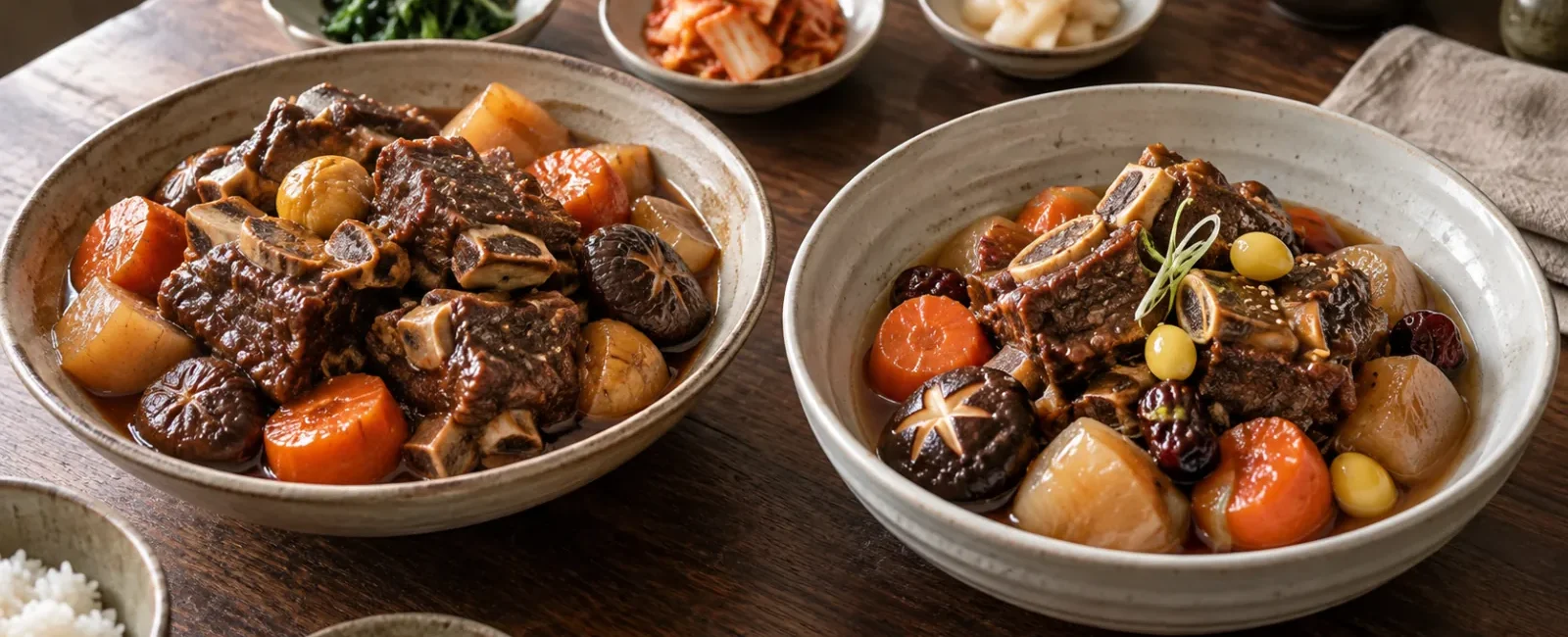
Galbijjim Recipe: 90-Minute Quick vs Traditional Braised Short Ribs
Smartor 편집팀
September 20, 2026

The key to a good galbijjim recipe is not merely the sauce. The short ribs need enough time for their connective tissue to soften, while the radish and carrots should go in late enough to hold their shape. Both recipes below make four servings with 1.6 kg (3.5 lb) of bone-in beef short ribs. The quick version uses bottled Korean short-rib marinade, low-sodium boxed beef broth, and an electric pressure cooker to finish in 90 minutes. The traditional version draws out excess blood, blanches the ribs, builds a broth from the beef, dried shiitake, and kelp, then slowly braises everything in a pear-onion sauce. The quick method delivers consistent sweet-savory flavor and tenderness; the traditional method develops more layers as beef broth, fruit, vegetables, and soy sauce reduce together.
| Category | 90-minute bottled-sauce pressure-cooker version | Traditional soaked-rib and homemade-sauce version |
|---|---|---|
| Yield | 4 servings; about 2.2 kg finished ribs and vegetables | 4 servings; about 2.2 kg finished ribs and vegetables |
| Prep / cook / total | 20 min / 70 min / 90 min | 120 min / 150 min / 270 min |
| Active time | About 30 minutes | About 55 minutes |
| Difficulty | Moderate; requires an electric pressure cooker | Moderate to advanced; requires heat and reduction control |
| Estimated U.S. cost | About $42–58 | About $48–66 |
| Flavor | Clear sweet soy flavor, consistent thickness, and quickly tenderized beef | Layered beef, pear, onion, mushroom-broth, and lightly toasted soy aromas |
| Umami sources | Short ribs, bottled galbi marinade, boxed beef broth | Short-rib broth, dried shiitake, kelp, soy sauce, and reduced aromatics |
| Likely failure points | Quick-releasing the pressure or stacking sodium from marinade and broth | Stopping before the beef is tender, adding vegetables too early, or scorching the final reduction |
| Best for | Weeknights, a rushed holiday eve, or a first attempt | Weekends, holidays, guests, or cooks who want control over sweetness and aroma |
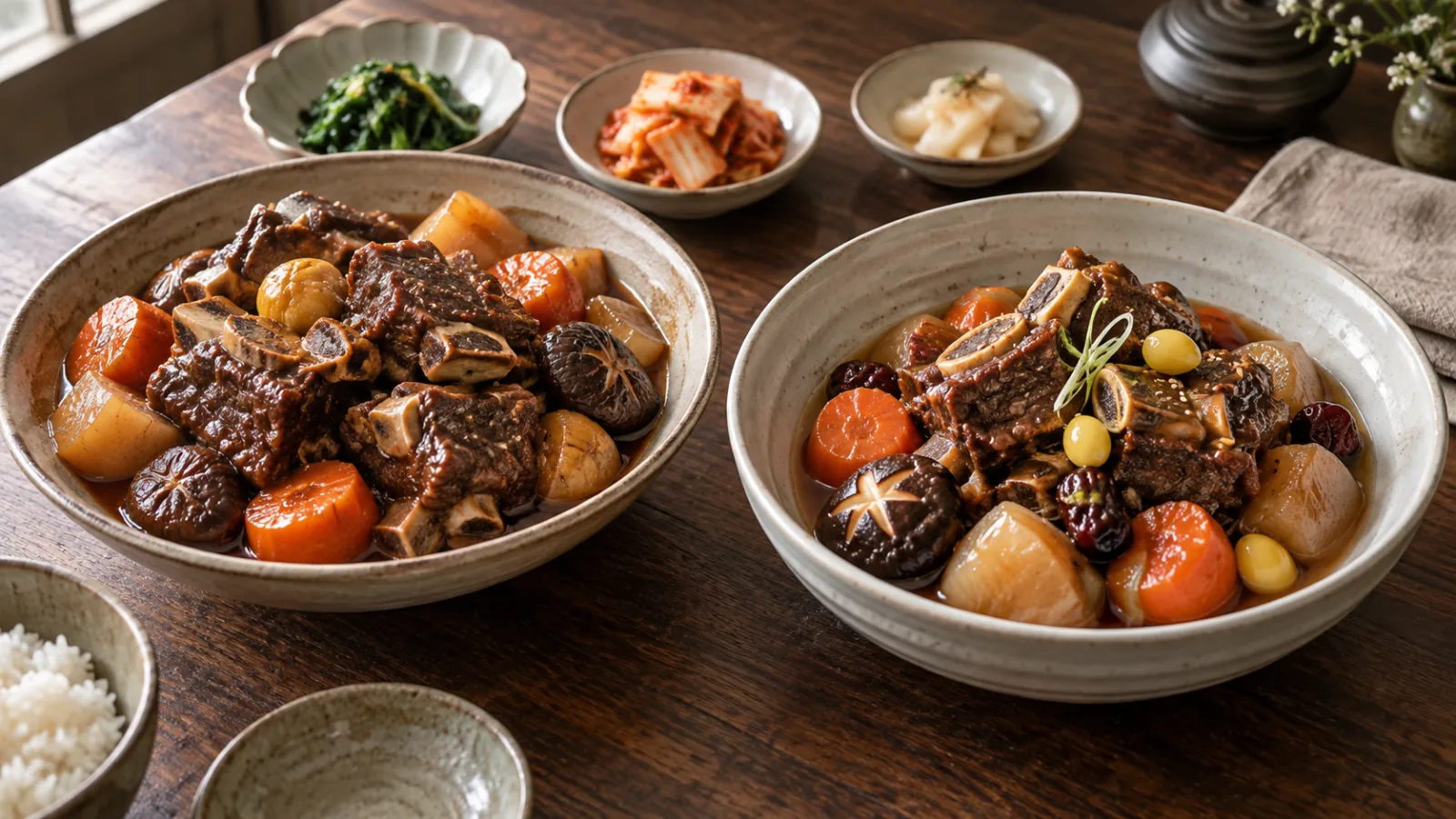
Prep 20 minutes · Cook 70 minutes · Total 90 minutes · Active time about 30 minutes
Why it tastes this way: Pressure raises the boiling point of water and speeds the conversion of collagen to gelatin. Bottled marinade combines soy sauce, sugar, fruit or vegetable extracts, aromatics, and savory ingredients, creating a reliable flavor center without a long marination. Low-sodium boxed broth reinforces beefiness more quickly than water alone. Because little evaporates under pressure, however, pressure-cooked sauce has less reduction aroma. The final 5–8 minutes of uncovered cooking is essential for the right sheen and concentration.
Prep 120 minutes · Cook 150 minutes · Total 270 minutes · Active time about 55 minutes
Why it tastes this way: Cold soaking and blanching make bone dust and surface proteins easier to remove, producing a cleaner-tasting liquid. The first simmer creates a gelatin-rich beef broth. Guanylate from dried shiitake overlaps with glutamate from kelp, while pear and onion sugars provide rounded sweetness and shine as they reduce. Heating one-third of the sauce for two minutes softens the raw soy-garlic edge and adds a lightly cooked aroma. This method takes longer than bottled sauce, but sweetness, soy aroma, and broth concentration can be adjusted at each stage.
| Quick version | Traditional replacement | Role and real difference |
|---|---|---|
| 300 g bottled beef short-rib marinade | 120 ml soy sauce + 180 g pear + 150 g onion + garlic, ginger, sugar, rice syrup, and cheongju | Bottled sauce gives repeatable sweetness and salinity. Homemade sauce retains fresh fruit and aromatic notes but needs final adjustment for the pear’s sweetness and the soy sauce’s sodium. |
| 500 ml low-sodium boxed beef broth | 700 ml broth produced by simmering the ribs for 45 minutes | Boxed broth adds immediate beef flavor. Rib broth carries gelatin and the actual ribs’ flavor, but it takes time to simmer and degrease. |
| 250 ml water plus savory ingredients in bottled sauce | 400 ml stock from 20 g dried shiitake and 10 g kelp | The quick version may rely on yeast extract or other flavoring in the sauce. Traditional stock adds distinct mushroom and kelp savoriness, but requires a 60-minute cold steep. |
| 35 minutes high pressure + 15-minute natural release | 45-minute initial simmer + 50-minute sauce simmer + 35 minutes with vegetables | Pressure rapidly tenderizes collagen. Stovetop cooking takes longer but allows visual control of beef tenderness, vegetable doneness, and evaporation. |
| Quick rinse and fat trimming | 90-minute refrigerated soak + 7-minute blanch | Quick cleaning retains robust beef flavor and saves time. Soaking and blanching create a cleaner broth, but soaking much beyond 90 minutes can also weaken beef flavor. |
This does not make bottled galbi marinade or boxed broth inherently bad or unhealthy choices. Check each product’s nutrition label for sodium and sugar, and avoid adding extra soy sauce at the beginning. Convenience ingredients offer speed and reliable results. The traditional recipe offers ingredient-by-ingredient control, but the pear’s sweetness, rib fat, and rate of evaporation can change the final concentration. The pressure-cooked and long-braised versions do not taste or feel exactly the same.
The USDA recommends cooking whole cuts of beef, such as steaks and roasts, to 63°C (145°F) followed by at least a 3-minute rest. Galbijjim becomes tender much closer to 90–95°C, well above that safety threshold, so treat safety and tenderness as separate measurements. Keep knives, boards, and bowls that touch raw beef separate from vegetables or wash them promptly in hot soapy water. Do not leave finished galbijjim at room temperature for more than 2 hours.
Divide the ribs and sauce among shallow airtight containers, cool promptly, and refrigerate for 3 to 4 days. Chilling also makes the solidified fat easy to lift away. Freeze the ribs in their sauce for 2 to 3 months; radish and carrots will soften after thawing, so use fewer vegetables in portions intended for the freezer.
To reheat, put only the amount needed in a saucepan with 50 ml water or broth. Cover and heat over medium-low for 12–15 minutes, turning once, until the thickest meat and sauce reach 74°C (165°F). For a 700W microwave, cover in a deep microwave-safe dish, heat 3 minutes, turn, then heat another 2–4 minutes and rest 1 minute.
Yes, but the same cooking time would make it fall apart and turn too salty. For 1,400 g of ribs sliced 8–10 mm thick, skip pressure cooking. Simmer in a wide pot over medium heat for 25 minutes, add the vegetables for 15 minutes, then reduce uncovered for 5 minutes. For the traditional version, skip the first simmer, marinate for 30 minutes, and cook for 45–50 minutes total.
Yes. Put the same ingredients in a heavy pot. Once boiling, partly cover and simmer over medium-low for 80–100 minutes. When the ribs are tender, add the vegetables for 20 minutes and reduce uncovered for 8 minutes. Total time will be about 2 hours 20 minutes.
Replace the 180 g pear with 160 g firm apple plus 20 ml water, not kiwi. Kiwi’s protease can make the rib surface mushy if it remains in contact for more than about 30 minutes. Apple is more acidic than pear, so you may reduce the cheongju by 10 ml.
Yes. Refrigerate it in shallow containers within 2 hours, remove solidified fat the next day, and reheat with 50 ml broth. If neat radish and carrot shapes matter, cook those vegetables only 80 percent on day one, refrigerate separately, and combine during reheating.
Galbijjim’s characteristic glaze comes from reducing gelatin and sugars. Remove the meat and vegetables first and boil only the sauce over medium-high for 5–10 minutes. In an emergency, mix 3 g potato starch with 10 ml cold water and add it gradually, but too much will make the cooled sauce set like gel.
For another comparison of beef flavor and stock-making, see 30-minute beef miyeokguk vs traditional brisket stock. For a spicy braise, compare bottled-sauce and homemade-sauce dakbokkeumtang. The interaction between fermented paste and handmade stock is covered in quick vs traditional-stock doenjang jjigae.
브라우저 메뉴에서 앱 설치 또는 홈 화면에 추가를 선택해 주세요.
[…] Read this recipe in English […]