
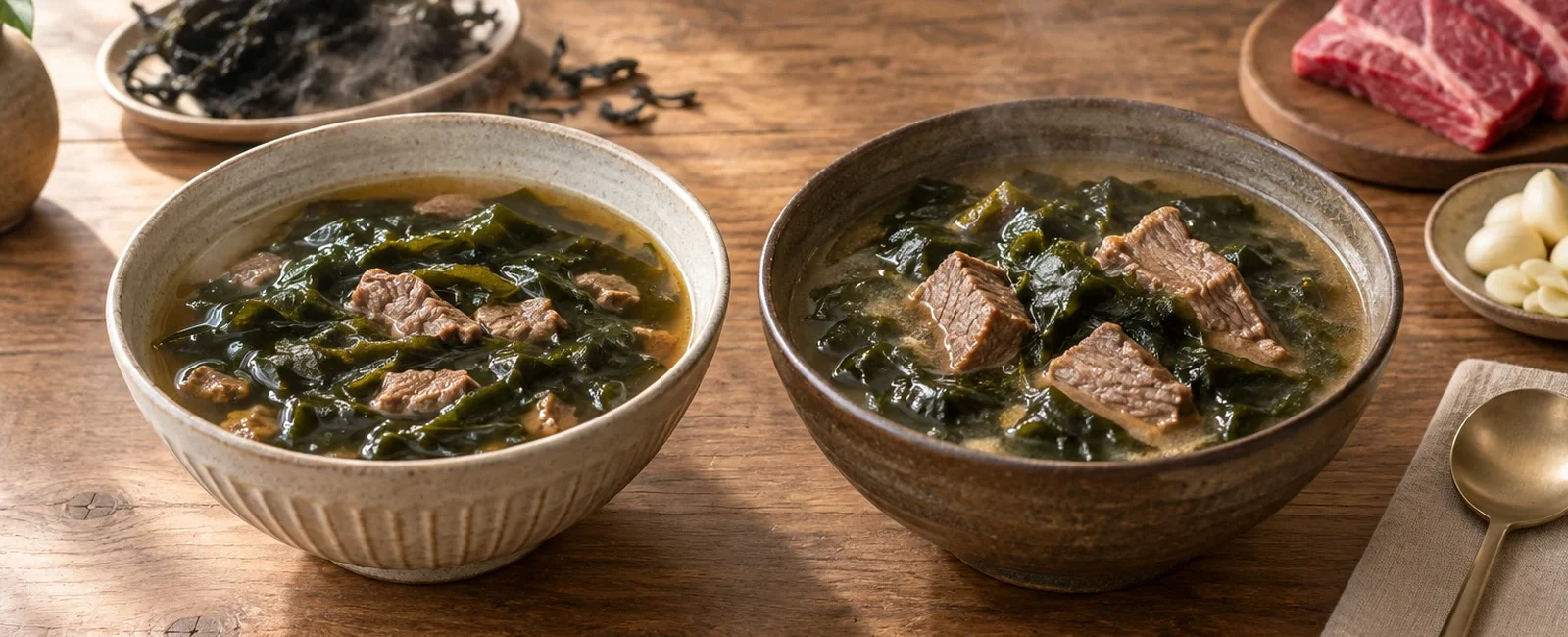
The key to beef miyeokguk, Korean seaweed soup, is draining the soaked seaweed thoroughly and sautéing it before adding liquid. Both complete recipes below make four servings. The quick version uses Korean beef stock powder and a small amount of MSG to build a savory base in 30 minutes. The traditional version soaks beef brisket to remove excess blood, then slowly simmers it with kelp, onion, and green onion. The shortcut is fast and consistent; the traditional method gives you more control over beef aroma, body, and vegetable sweetness. They aim in the same direction but do not taste identical.
Quick comparison of the two methods
| Category | 30-minute quick version | Traditional brisket-stock version |
|---|---|---|
| Yield | 4 servings, about 1.6 L | 4 servings, about 1.6 L |
| Prep / cook / total | 10 / 20 / 30 minutes | 25 / 80 / 105 minutes |
| Active time | About 18 minutes | About 35 minutes |
| Difficulty | Easy | Moderate |
| Estimated U.S. Korean-market cost | About $15–19 | About $20–26 |
| Flavor | Immediate, clearly seasoned beef savoriness | Clean brisket aroma followed by mild kelp and vegetable sweetness |
| Umami sources | Beef, Korean beef stock powder, MSG, soup soy sauce | Brisket stock, kelp, soup soy sauce, onion, green onion |
| Main failure risk | Stacking the salt in stock powder, soy sauce, and salt; under-sautéing the seaweed | Cloudy stock from residual blood or excessive evaporation over high heat |
| Best for | Weeknights, a rushed birthday breakfast, dependable results | Weekend prep, guests, or a long, clean beef-stock finish |
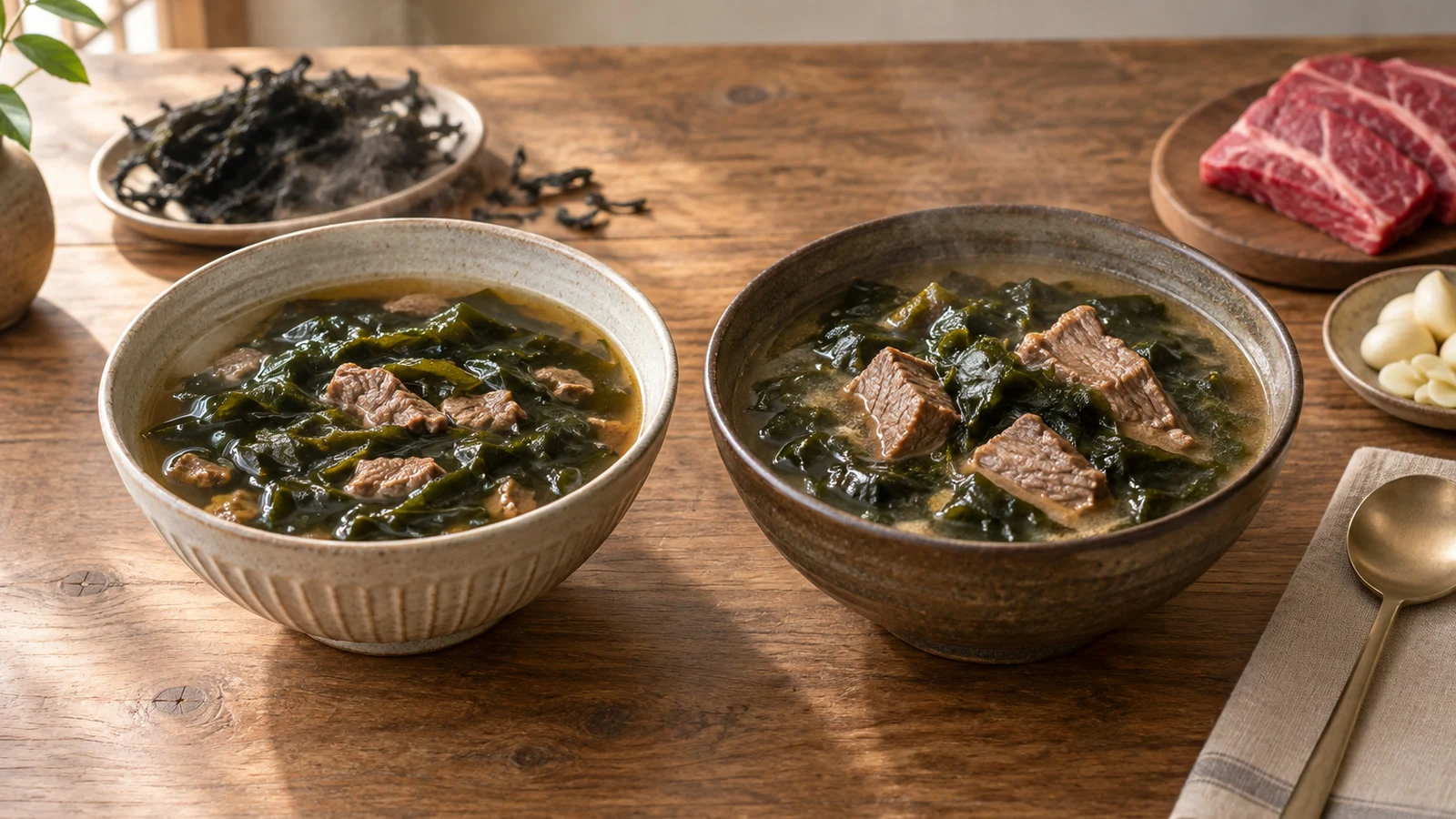
Quick version: 30-minute beef miyeokguk
Exact ingredients — 4 servings
- 20 g dried cut wakame or Korean miyeok
- 1 L cold water for soaking the seaweed
- 300 g beef brisket or chuck eye, sliced 3 mm thick into bite-size pieces
- 15 ml toasted sesame oil
- 24 ml Korean soup soy sauce
- 12 g minced garlic
- 1,800 ml water
- 8 g Korean beef stock powder, such as 쇠고기 다시다
- 1 g MSG
- Up to 2 g fine salt, for final seasoning
Prep 10 minutes · Cook 20 minutes · Total 30 minutes · Active about 18 minutes
Method
- Soak 20 g seaweed in 1 L cold water for 10 minutes. Rinse twice, press firmly in a strainer to remove water, and cut any long pieces to 4–5 cm. Over-soaking cut seaweed can weaken its aroma and make the texture too soft.
- Blot the beef with paper towels. Heat 15 ml sesame oil in a pot at least 22 cm wide over medium heat for 30 seconds. Add the beef and stir-fry for 4 minutes, separating the pieces, until almost no red remains on the surface.
- Add the drained seaweed and 12 ml soup soy sauce. Sauté over medium heat for 3 minutes. Add 30 ml water if the bottom becomes dry. Continue when the seaweed is glossy dark green and smells nutty rather than raw.
- Add 1,800 ml water, 8 g beef stock powder, 1 g MSG, and 12 g garlic. Heat on high for about 7 minutes, until fully boiling. Skim the surface once.
- Reduce to medium-low, leave the lid slightly ajar, and simmer for 10 minutes. Add the remaining 12 ml soup soy sauce. Taste, then adjust with salt in 0.5 g increments or water in 50 ml increments. Simmer 1 more minute and finish with roughly 1.6 L soup.
Why it tastes this way: Browning the beef moves its aroma into the sesame oil, while sautéing seaweed with soup soy sauce helps distribute its marine flavor during a short simmer. Beef stock powder adds concentrated meat-and-vegetable flavor plus salt; 1 g MSG reinforces glutamate-driven savoriness. These are practical tools for speed and repeatability, but they do not reproduce the gelatin-rich body and layered vegetable aroma of slowly simmered brisket stock.
Traditional version: brisket-and-kelp stock miyeokguk
Exact ingredients — 4 servings
- 20 g dried cut wakame or Korean miyeok
- 1 L cold water for soaking the seaweed
- 450 g whole beef brisket
- 1 L cold water for soaking the beef
- 2,300 ml cold water for the stock
- 10 g dried kelp
- 150 g onion, halved
- 40 g white part of green onion
- 20 g whole garlic cloves
- 15 ml toasted sesame oil
- 25 ml Korean soup soy sauce
- 10 g minced garlic
- Up to 3 g fine salt, for final seasoning
Prep 25 minutes · Cook 80 minutes · Total 105 minutes · Active about 35 minutes
From stock to finished soup
- Soak 450 g brisket in 1 L cold water for 20 minutes, changing the water at the 10-minute mark. Remove and rinse the surface. At the same time, soak the seaweed in a separate 1 L cold water for 15 minutes. Rinse twice, squeeze dry, and cut to 4–5 cm.
- Put the brisket, 2,300 ml cold water, 10 g kelp, 150 g onion, 40 g green onion, and 20 g whole garlic in a stockpot. Heat over medium for about 12 minutes. Remove the kelp when bubbles gather around the edge, before a full boil.
- When the stock begins to boil, skim thoroughly and reduce to low heat. Leave the lid open by about 2 cm and maintain a gentle simmer for 50 minutes. Add hot water in 100 ml increments if the liquid drops quickly.
- Remove the brisket and cool it for 10 minutes. Pull it along the grain or slice 4 mm thick. Strain the stock through a fine sieve and measure 1,700 ml, adding hot water if necessary. Discard the cooked onion, green onion, and garlic.
- In a clean pot, sauté 15 ml sesame oil and the drained seaweed over medium heat for 4 minutes. Add 15 ml soup soy sauce and sauté 1 minute more, until the seaweed is glossy and its raw marine edge has softened.
- Add 1,700 ml stock, all the cooked brisket, and 10 g minced garlic. Boil over high heat for 6 minutes, reduce to medium-low, and simmer for 18 minutes. Add the remaining 10 ml soup soy sauce.
- Taste and add salt in 0.5 g increments, using no more than 3 g. If the broth is too concentrated, add water in 50 ml increments. Simmer 1 final minute and finish at about 1.6 L.
Why it tastes this way: A low simmer gradually releases beef flavor and gelatin from brisket. Removing kelp before boiling retains its savoriness while reducing the risk of a slippery or bitter finish. Onion, green onion, and whole garlic round the stock without concentrated seasoning. Sautéing the seaweed first dissolves its aroma in fat so it integrates with the beef stock.
One-to-one traditional replacements for each shortcut
| Quick-version shortcut | Traditional replacement | Role and real difference |
|---|---|---|
| 8 g Korean beef stock powder | 1,700 ml stock made by simmering 450 g brisket in 2,300 ml water for 50 minutes | Powder supplies consistent salt and concentrated meat-and-vegetable flavor. Homemade stock has natural beef aroma and body but varies with the cut and evaporation. |
| 1 g MSG | 10 g kelp heated from cold and removed before boiling | Both strengthen the savory center. Kelp also brings a marine aroma and less standardized concentration. |
| Stir-fry 300 g sliced beef for 4 minutes | Soak 450 g brisket for 20 minutes, then gently simmer it for 50 minutes | Stir-frying quickly develops browned-beef aroma; simmering produces cleaner stock and tender meat. |
| Dissolve seasonings directly in 1,800 ml water | Simmer 150 g onion, 40 g green onion, and 20 g whole garlic, then measure the strained stock to 1,700 ml | The shortcut makes volume easy to control. Whole vegetables add mild sweetness and aroma, but the final stock volume must be corrected. |
| 10-minute finishing simmer | Combine sautéed seaweed and brisket stock for an 18-minute finishing simmer | The longer finish connects the stock with the seaweed, but timing matters so the seaweed does not become mushy. |
Beef stock powder and MSG are not inherently inferior choices. The quick recipe is useful when you need reliable soup in 30 minutes; the traditional recipe lets you control the proportions and aroma of beef, kelp, and vegetables. Because stock powders vary in sodium, do not increase the powder and soup soy sauce at the same time. Season only after the final simmer.
Failure prevention: clear broth and clean seaweed flavor
- The seaweed tastes harsh: Squeeze soaked seaweed firmly and sauté it for the full 3–4 minutes over medium heat. Adding water while it is still dripping effectively skips the sauté.
- The broth is cloudy: Soak the brisket, skim as the stock reaches a boil, and do not keep stirring over high heat.
- The broth tastes bitter or slippery: Remove kelp before a full boil. Old, poorly stored seaweed can taste rancid, so check the package date and aroma.
- The soup is too salty: Do not add stock powder and soy sauce together at the end. Add hot water 100 ml at a time, simmer with the solids for 2 minutes, and taste again.
- The beef is tough: For the quick method, slice across the grain and sauté only 4 minutes. For the traditional method, gently simmer 50 minutes, cool 10 minutes, then pull along the grain.
- The seaweed is mushy: Soak cut seaweed only 10–15 minutes and do not hold the finished soup hot for hours. Salted fresh seaweed requires different weights and timing.
Food safety, storage, and reheating
Beef simmered in soup for these times cooks beyond the usual minimum. If you verify separately with a thermometer, the USDA minimum for whole beef cuts is 63°C (145°F), followed by a 3-minute rest. Do not leave finished soup at room temperature for more than 2 hours.
Cool the soup quickly in shallow airtight containers and refrigerate for 3 to 4 days. For best quality, freeze individual portions for up to 2 months and avoid repeated thawing. Frozen seaweed may become slightly softer.
Reheat refrigerated soup over medium heat for 7 to 10 minutes, until bubbling throughout. Reheat leftovers to 74°C (165°F). If the broth has reduced, add water in 50 ml increments and check the salt only after it boils.
Frequently asked questions
What kind of seaweed should I buy?
Use a package labeled dried miyeok, dried sea mustard, or cut wakame. Salted fresh seaweed contains water and salt, so the 20 g measurement does not apply. Thick, long Korean postpartum-style miyeok may need the package’s longer soaking time.
Can I replace soup soy sauce with regular soy sauce?
Yes, but the broth will be darker and may taste sweeter. Start with 15 ml regular soy sauce instead of 24–25 ml soup soy sauce, then add fine salt to finish the seasoning.
Can I omit sesame oil?
Replace it with 10 ml neutral oil. You lose some toasted aroma, but keep the sautéing step because it softens the seaweed’s raw edge. Perilla oil is stronger, so begin with 10 ml.
Can I prepare the traditional stock one day ahead?
Yes. Strain the brisket stock, transfer it to shallow containers, and refrigerate within 2 hours. Remove any solidified fat the next day. Sauté and combine the seaweed on serving day for the clearest aroma.
Does miyeokguk improve the longer it boils?
One cooling and reheating cycle can integrate the flavors, but constant simmering makes the broth salty and the seaweed overly soft. Finish on schedule and reheat only the portion you need.
Related Korean recipes and references
For another clear-stock comparison, see 27-minute quick vs traditional-stock janchi guksu. For a fermented-paste broth, compare 28-minute quick vs traditional-stock doenjang jjigae. The sautéing and broth tradeoffs in quick vs traditionally developed kimchi jjigae are also useful.
[…] Read this recipe in English […]