
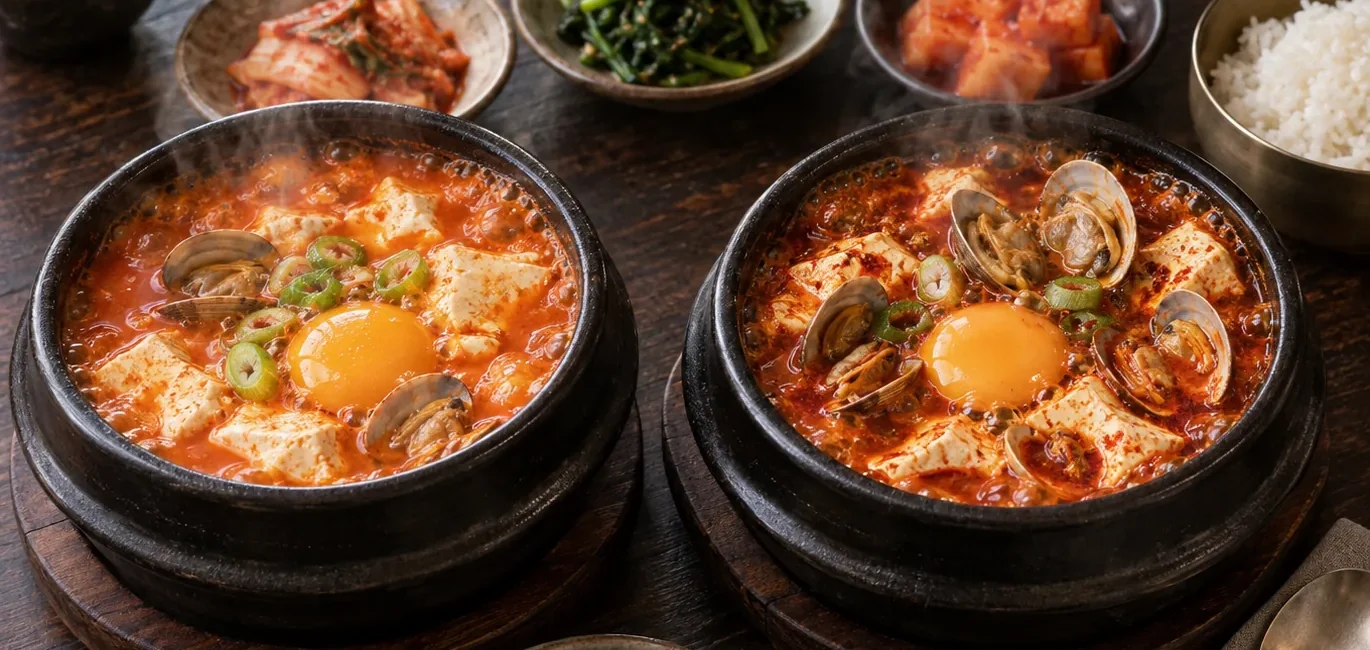
The key to flavorful sundubu jjigae is balancing fragrant chile oil, the savory depth of pork and shellfish, and the water released by soft tofu. Both recipes below make four servings, or about 1.9 kg of finished stew. The 30-minute version uses prepared sundubu seasoning, boxed anchovy broth, and cleaned frozen clam meat. The traditional version purges fresh clams, makes anchovy-kelp-shiitake stock, and blooms Korean chile flakes in rendered pork fat. The quick pot is boldly seasoned and highly repeatable; the traditional pot has a cleaner clam finish and a longer-lasting freshly toasted chile aroma.
Quick comparison of the two methods
| Category | 30-minute quick version | Traditional fresh-clam version |
|---|---|---|
| Yield | 4 servings, about 1.9 kg | 4 servings, about 1.9 kg |
| Prep / cook / total time | 10 / 20 / 30 minutes | 45 / 35 minutes / 1 hour 20 minutes |
| Active time | About 20 minutes | About 40 minutes |
| Difficulty | Easy — monitor seasoning strength and final salt | Moderate — purge clams, standardize stock, control chile-oil heat |
| Estimated U.S. Korean-market cost | About $18–24 | About $22–30 |
| Flavor | Immediate chile, garlic, and salt with consistent broth intensity | Sweet-briny fresh clams, layered dried-seafood umami, and fresh chile oil |
| Umami sources | Prepared sundubu sauce, boxed anchovy broth, pork, frozen clam meat | Fresh clams, dried anchovies, kelp, dried shiitake, pork, soup soy sauce, fish sauce |
| Most likely failure | Over-salting by stacking products, or thinning the broth with tofu liquid | Gritty clams, scorched chile flakes, or bitter stock from overcooked kelp and anchovies |
| Best occasion | A weeknight meal when dinner needs to be ready within 30 minutes | A weekend or guest meal when you want to control the shellfish and chile aromas |
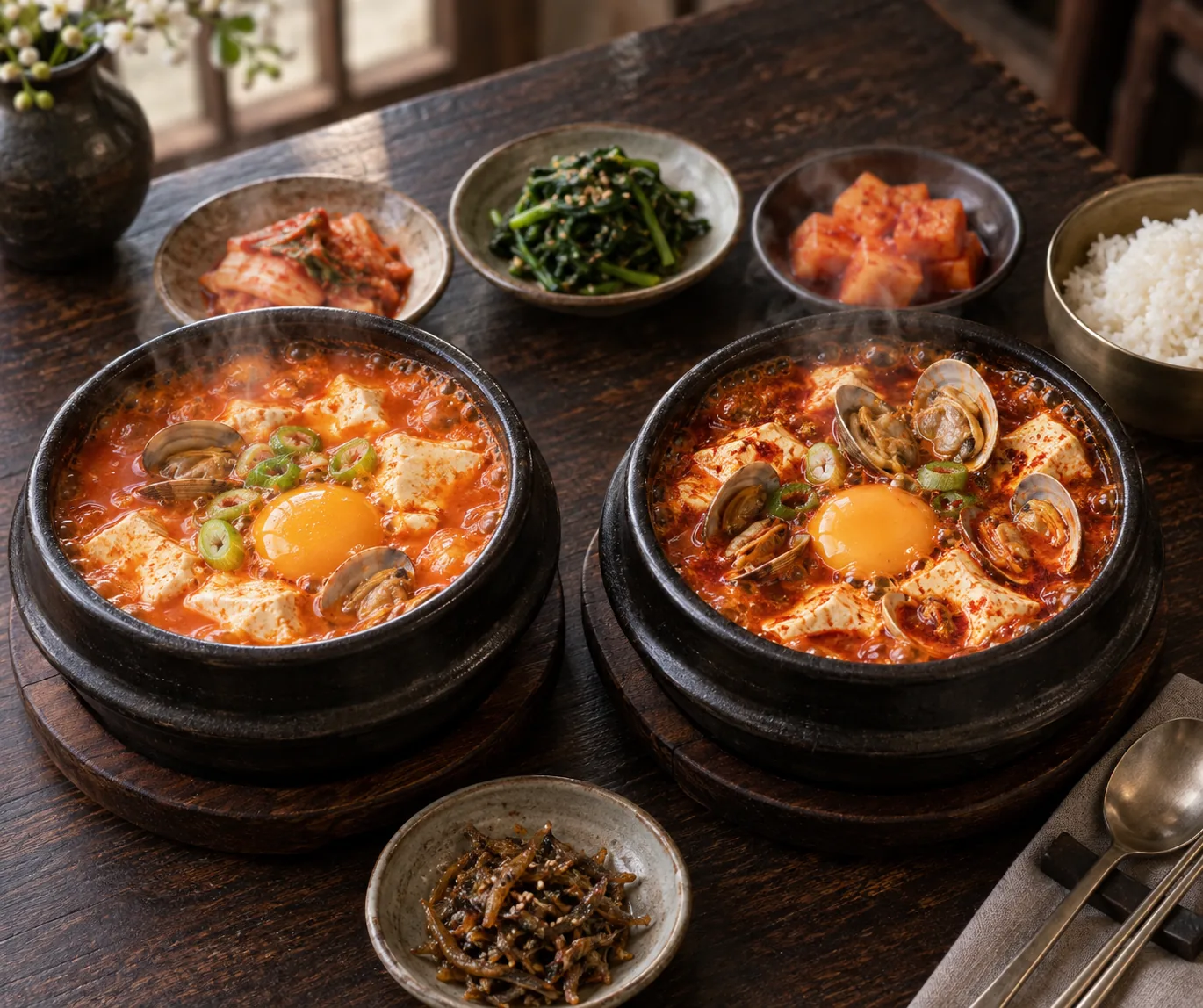
Quick version: 30-minute sundubu jjigae with prepared sauce
Exact ingredients — 4 servings
- 700 g Korean extra-soft tofu, two 350 g tubes or packs
- 200 g ground pork
- 120 g thawed frozen clam meat
- 120 g prepared sundubu-jjigae seasoning sauce
- 500 ml low-sodium boxed anchovy broth
- 700 ml water
- 150 g Korean zucchini, cut into 5 mm half-moons
- 120 g onion, cut into 8 mm dice
- 100 g enoki mushrooms, root end removed
- 50 g scallions, thinly sliced
- 4 large eggs, about 200 g without shells
- 10 ml neutral cooking oil
- 1 g ground black pepper
- 0–2 g fine salt, only if needed at the end
Prep 10 minutes · Cook 20 minutes · Total 30 minutes · Active time about 20 minutes
Preparation and cooking
- Thaw the clam meat overnight in the refrigerator or in a sealed bag submerged in cold water for 15 minutes, then drain it well. Cut each tofu package across the middle and empty it into a wide bowl. Prepare the zucchini, onion, enoki, and scallions. Check the dilution guidance on your sauce package, but keep the combined broth and water at 1.2 L here because the tofu will release additional liquid.
- Heat 10 ml oil in a heavy 4 L pot over medium-high heat for 30 seconds. Spread in 200 g ground pork and leave it undisturbed for 2 minutes; crumble and cook for another 2 minutes. No pink should remain, and the pork must reach 71°C (160°F) in the center.
- Reduce to medium heat. Add 120 g prepared sundubu sauce and stir-fry for 60 seconds. Briefly frying even a finished sauce dissolves its garlic and chile aroma into the fat before it enters the water. If the bottom looks dry, add 30 ml of the boxed broth to prevent scorching.
- Pour in 500 ml low-sodium anchovy broth and 700 ml water. Add 120 g onion and 150 g zucchini. Bring to a full boil over high heat, about 4–5 minutes, then reduce to medium and simmer for 4 minutes. At this point, the broth should taste slightly stronger than the finished stew because the tofu has not released its water yet.
- Spoon in the 700 g tofu in pieces about 5 cm across and place 100 g enoki on top. Do not break the tofu into small curds; gently push it under the broth once. Return to a boil over medium-high heat, cook for 4 minutes, then add 120 g clam meat and cook for 2 minutes.
- Crack the four eggs into separate areas of the pot. Add scallions and pepper, cover, and cook over medium-low heat for 3 minutes, until both whites and yolks reach 71°C (160°F). The clam meat must reach 63°C (145°F); remove the pot from heat as soon as it does so it does not toughen. Taste, then add salt only if needed, 1 g at a time and no more than 2 g.
Why it tastes this way: Prepared sundubu seasoning concentrates chile, garlic, salt, sweetness, and umami in one measured ingredient, so the broth becomes cohesive after a short simmer. Boxed anchovy broth supplies a consistent savory foundation, while pork and clam meat contribute inosinate and marine aroma. Frying the sauce in pork fat for one minute gives it a clearer aroma than simply dissolving it in water. It still will not fully reproduce the clean sweetness released by shell-on fresh clams or the aroma of chile flakes bloomed moments before serving.
Traditional version: sundubu jjigae with purged clams and homemade stock
Exact ingredients — 4 servings
- 600 g live littleneck or Manila clams in their shells
- 1 L cold water plus 30 g salt for purging
- 700 g Korean extra-soft tofu, two 350 g tubes or packs
- 200 g ground pork
- 1.7 L water for the stock
- 30 g large dried anchovies, heads and dark innards removed
- 12 g dried kelp, approximately a 10 × 10 cm piece
- 12 g dried shiitake mushrooms, about 2 medium caps
- 150 g Korean zucchini, cut into 5 mm half-moons
- 120 g onion, cut into 8 mm dice
- 100 g enoki mushrooms, root end removed
- 50 g scallions, thinly sliced
- 4 large eggs, about 200 g without shells
- 20 ml neutral cooking oil
- 5 ml toasted sesame oil
- 24 g Korean red pepper flakes (gochugaru), about 3 tablespoons
- 20 g minced garlic
- 20 ml Korean soup soy sauce
- 15 ml fish sauce
- 1 g ground black pepper
- 0–3 g fine salt, only if needed at the end
Prep 45 minutes · Cook 35 minutes · Total 1 hour 20 minutes · Active time about 40 minutes
From clam purging and stock to the finished pot
- Discard cracked clams and any open clam that does not close when tapped. Dissolve 30 g salt in 1 L cold water to make an approximately 3% brine. Arrange the 600 g clams in one layer in a wide bowl, cover with the brine, block the light with a lid or dark towel, and leave for 30 minutes. Purge them in the refrigerator if the room is warm. Lift the clams out of the dirty water, rub the shells together, and rinse three times under cold running water.
- While the clams purge, combine 1.7 L water, 12 g kelp, and 12 g dried shiitake in a pot and soak for 15 minutes. Toast the prepared anchovies in a dry pan over low heat for 2 minutes. Heat the soaking pot over medium; after 8–10 minutes, when small bubbles form at the edge but before a full boil, remove the kelp. Add the anchovies and simmer uncovered over low heat for 10 minutes. Strain and adjust the stock to exactly 1.25 L by briefly reducing it or adding hot water.
- Heat 20 ml neutral oil and 5 ml sesame oil in a 4 L pot over medium heat for 30 seconds. Add 200 g ground pork and cook, crumbling, for 4 minutes; verify 71°C (160°F). Add 120 g onion and 20 g garlic and cook for 2 more minutes to remove moisture and begin developing sweetness.
- Reduce the heat to medium-low. Add 24 g gochugaru and stir for 45 seconds. When the oil is red and fragrant, pour 20 ml soup soy sauce and 15 ml fish sauce around the hot edge of the pot and let them bubble for 30 seconds. If the chile shows black specks or produces harsh smoke, it has burned; discard this base and restart with fresh oil.
- Add the measured 1.25 L stock and 150 g zucchini. Bring to a full boil over high heat, about 4–5 minutes, then reduce to medium and cook for 5 minutes. Spoon in the 700 g tofu in 5 cm pieces, top with 100 g enoki, and simmer for 4 more minutes.
- Add the purged clams, cover, and cook over medium-high heat for 4–6 minutes. Starting at 4 minutes, check every 30 seconds and move opened clams toward the top. When nearly all have opened, crack in the four eggs, then add scallions and pepper. Cook over medium-low heat for 3 minutes, until the eggs reach 71°C (160°F) and the clam meat reaches 63°C (145°F). Discard any clam that remains closed rather than forcing it open.
- Turn off the heat and rest the stew for 2 minutes before tasting. Clams and fish sauce may provide enough salt; otherwise add only 1 g at a time, up to 3 g. Divide the clams and tofu evenly among four bowls. The short rest lets the chile oil collect at the surface while carryover heat moves through the tofu.
Why it tastes this way: Glutamate from kelp and shiitake combines with inosinate from anchovies and pork and succinic acid from clams, giving the broth breadth that differs from one concentrated seasoning. Removing kelp before the boil limits a slippery texture and bitter notes; removing the dark anchovy innards and simmering briefly keeps the stock clean. Blooming gochugaru in pork fat for only 45 seconds extracts fat-soluble color and aroma without scorching. Cooking the clams at the end preserves their briny sweetness and keeps the meat more tender.
One-to-one traditional replacements for the shortcuts
| Quick-version shortcut | Traditional replacement | Function and real difference |
|---|---|---|
| 120 g prepared sundubu seasoning | 24 g gochugaru + 20 g garlic + 20 ml soup soy sauce + 15 ml fish sauce, bloomed in pork fat | Prepared sauce arrives with salt and chile intensity already balanced. The homemade base offers independent control of aroma and salinity, but the flakes can scorch over excessive heat. |
| 500 ml low-sodium boxed anchovy broth | 1.25 L stock made from 30 g anchovies + 12 g kelp + 12 g dried shiitake | Boxed broth provides an immediate, repeatable base. Homemade stock layers three umami sources but requires timed removal and final-volume adjustment. |
| 120 g cleaned frozen clam meat | 600 g shell-on clams purged in 3% brine | Frozen meat minimizes prep and waste. Fresh shell-on clams release more clam liquor and succinic acid but require sorting, purging, and rinsing. |
| Fry finished sauce with pork for 1 minute | Brown pork, onion, and garlic, then bloom dry chile flakes for 45 seconds over medium-low heat | The finished sauce carries less scorching risk. Fresh chile oil is more aromatic and visually clear, but the temperature and short timing matter. |
| Measure 500 ml broth + 700 ml water | Strain homemade stock and standardize it to exactly 1.25 L | Commercial broth begins at a consistent concentration. Homemade stock evaporates differently with each pot and burner, so measuring the finished volume stabilizes seasoning after the tofu releases water. |
Prepared sauce and boxed broth are not inherently inferior choices. They efficiently combine several flavors when time and prep space are limited. Because sodium and chile strength vary by brand, hold all extra salt until the finished stew is tasted. The traditional version allows finer control over clam quality, stock, and chile aroma, but it demands purging and heat management. Both methods can produce a satisfying stew; their shellfish clarity, texture, and length of aroma are not identical.
Sundubu-specific failure prevention
- The bottom tastes burned: Reduce to medium-low before adding gochugaru and bloom it for only 45–60 seconds. Add 30 ml stock immediately if the pot dries. Black specks and acrid smoke cannot be corrected by adding broth.
- The broth is watery: Depending on the package, 700 g tofu may release 80–150 ml liquid. Draining it aggressively damages the texture, so instead cap the initial liquid at 1.2–1.25 L and return the stew to a full simmer uncovered after adding the tofu.
- The stew is too salty: Prepared sauce, boxed stock, fish sauce, and clams can stack sodium. Add no extra salt until the end. If it is already salty, add 150 ml unsalted stock or hot water plus 175 g extra tofu and simmer for 3 minutes, increasing the total yield.
- The clams are gritty: Purge them in roughly 3% brine, block the light, then lift them out rather than pouring the dirty water over them. Rub the shells and rinse three times so sediment from the bottom does not return to the pot.
- The clam meat is rubbery: Add clams only after the tofu is simmering and cook for the 4–6 minutes needed for them to open. Move open clams upward and stop cooking once the safe temperature is reached.
- The tofu disintegrates: Cut the unopened tube across the middle and slide in large sections, or spoon 5 cm pieces from a bowl. Do not stir after adding it; gently shake the pot to circulate the broth.
- The broth smells fishy: Remove the anchovy heads and dark innards, dry-toast the fish for 2 minutes, and remove the kelp before a full boil. Discard dead clams before cooking.
Food safety, storage, and reheating
The USDA safe-temperature chart calls for ground pork and egg dishes to reach 71°C (160°F). The U.S. FDA advises cooking finfish and shellfish to 63°C (145°F), cooking shell-on clams until they open, and discarding those that do not open. If you prefer a runny yolk, pasteurized eggs can reduce but do not erase risk; cook both whites and yolks to 71°C for pregnant people, young children, older adults, and anyone with a weakened immune system.
Do not leave the finished stew at room temperature for more than 2 hours. Remove leftover clam meat from the shells and refrigerate it with the broth and tofu in shallow airtight containers for 3–4 days. For the best texture, freeze for no more than 1 month: tofu becomes sponge-like after thawing, and clam meat grows tougher even when longer frozen storage might still be safe.
Reheat only the amount you will eat in a saucepan over medium heat for 5–7 minutes, stirring gently from the bottom, until every portion reaches 74°C (165°F); simmer for 1 minute after that point. Add 20–30 ml water per serving if the broth has reduced. In a microwave, loosely cover a deep container, heat for 2 minutes at 900 W, stir top to bottom, then heat 1–2 minutes more and verify 74°C.
Frequently asked questions
Can I make seafood sundubu without pork?
Yes. Omit the 200 g pork and prepare 160 g shrimp plus 160 g squid. Increase the neutral oil by 10 ml and sauté the onion and garlic before blooming the chile. Add the shrimp and squid with the clams for the final 4–5 minutes and verify 63°C (145°F). Keep the traditional stock at 1.25 L and do not automatically increase the fish sauce; the seafood will add its own savory flavor.
Can I replace the clams with mussels?
Use 700 g shell-on mussels. Remove the beards, scrub the shells, and add them at the same stage as the clams; cook 5–7 minutes until they open. Mussels produce a sweeter, stronger sea aroma, so reduce the fish sauce from 15 ml to 10 ml and adjust only after tasting.
Can I use silken or firm tofu?
You may substitute 700 g silken tofu, but cut it into 6 cm pieces and simmer for only 3 minutes because it breaks more easily. For firm tofu, use 600 g cut into 2 cm cubes and increase the stock by 100 ml. The result will be less delicate and the tofu will absorb less broth, so it is a different texture rather than a perfect replacement.
May I leave the egg yolks runny?
That is a flavor and texture choice, but the tested safety target in this recipe is 71°C (160°F) for both yolks and whites. If choosing softer yolks, use pasteurized eggs, do not serve them to higher-risk diners, and do not store runny eggs in leftover stew. Portion out the amount to be stored before adding eggs to the pot you will eat immediately.
Should I use coarse or fine gochugaru?
A mix of 18 g medium-coarse and 6 g fine gochugaru gives both aroma and saturated red color. If you have one type, use 24 g medium-coarse flakes. Very fine powder scorches more quickly and can make the broth dusty, so reduce its blooming time to 30 seconds.
How do I make it milder or hotter?
For a milder pot, reduce gochugaru from 24 g to 16 g but keep the oil unchanged so the garlic and chile aroma still have enough fat. For more heat, add 20 g sliced Cheongyang or serrano chile with the scallions instead of increasing gochugaru enough to thicken the broth. In the quick version, do not add extra prepared sauce solely for heat because that also increases salt.
Related Korean recipes and references
For another look at fermented seasoning and homemade stock, see quick vs traditional doenjang jjigae. For pork in a spicy broth, compare quick vs traditional kimchi jjigae. If you want a beef-based spicy soup, try 45-minute vs brisket-stock yukgaejang; for a gentler soup, use the quick vs brisket-stock beef miyeokguk guide.
[…] Read this recipe in English […]