
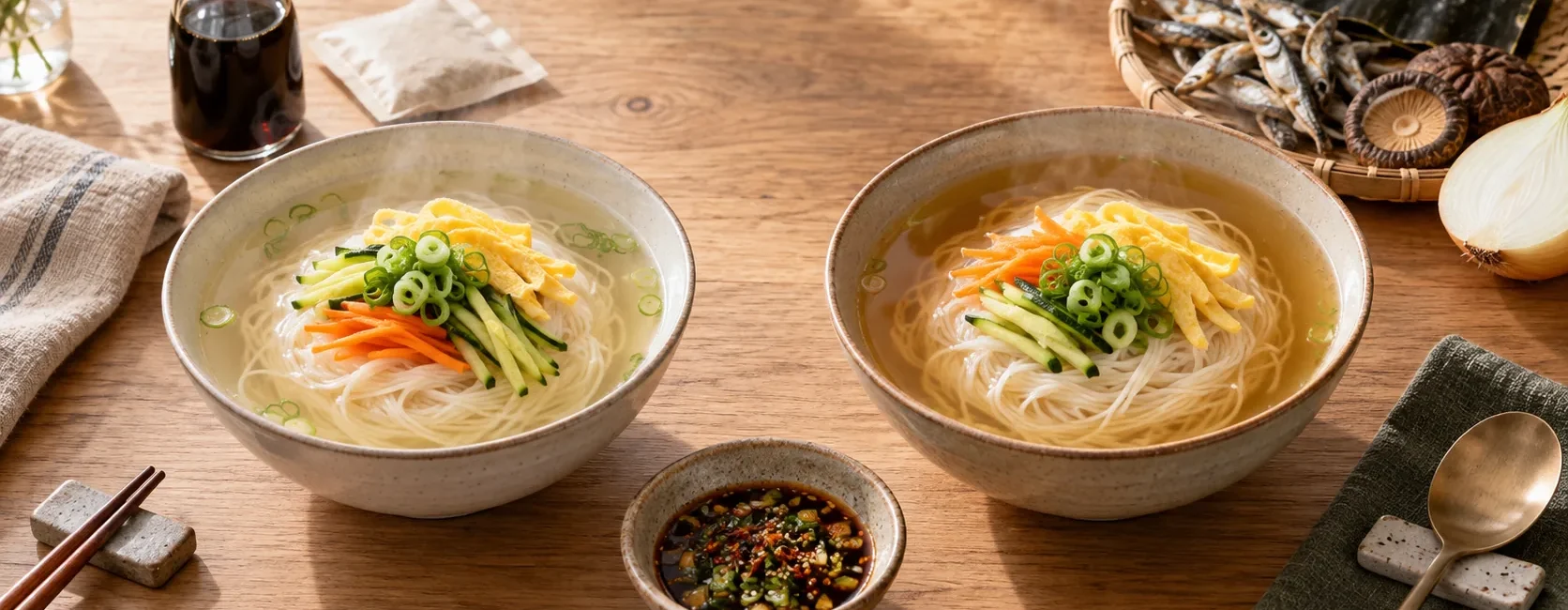
The key to great janchi guksu is balancing clear broth, thoroughly rinsed somyeon and the dilution that occurs when cold noodles meet hot stock. Both recipes make 4 servings. The quick version uses bottled anchovy-kelp concentrate and a small amount of MSG for a focused broth in 27 minutes. The traditional version spends 70 minutes extracting dried anchovies, kelp, dried shiitake, radish and onion in stages. Convenience seasoning is fast and consistent; homemade stock gives you separate control over seafood aroma and vegetable sweetness. The results point in the same direction but do not taste identical.
Quick and traditional janchi guksu at a glance
| Factor | 27-minute quick version | Traditional homemade-stock version |
|---|---|---|
| Yield | 4 servings (100 g noodles and about 350 ml broth each) | 4 servings (100 g noodles and about 350 ml broth each) |
| Prep / cook / total | 10 / 17 / 27 minutes | 20 / 50 / 70 minutes |
| Active time | About 22 minutes | About 37 minutes |
| Difficulty | Easy | Moderate |
| Estimated U.S. Korean-market cost | About $9–12 | About $13–17 |
| Flavor | Clear salinity and consistent savoriness | Anchovy aroma followed by kelp-shiitake depth and vegetable sweetness |
| Umami sources | Anchovy-kelp concentrate, MSG and soup soy sauce | Anchovies, kelp, shiitake, soup soy sauce, radish and onion |
| Main failure risk | Excess sodium or cloudy stock from noodle starch | Bitterness from anchovy innards or boiled kelp; over-reduction |
| Best for | Weeknights and meals under 30 minutes | Weekend lunch, guests and a longer, clearer finish |
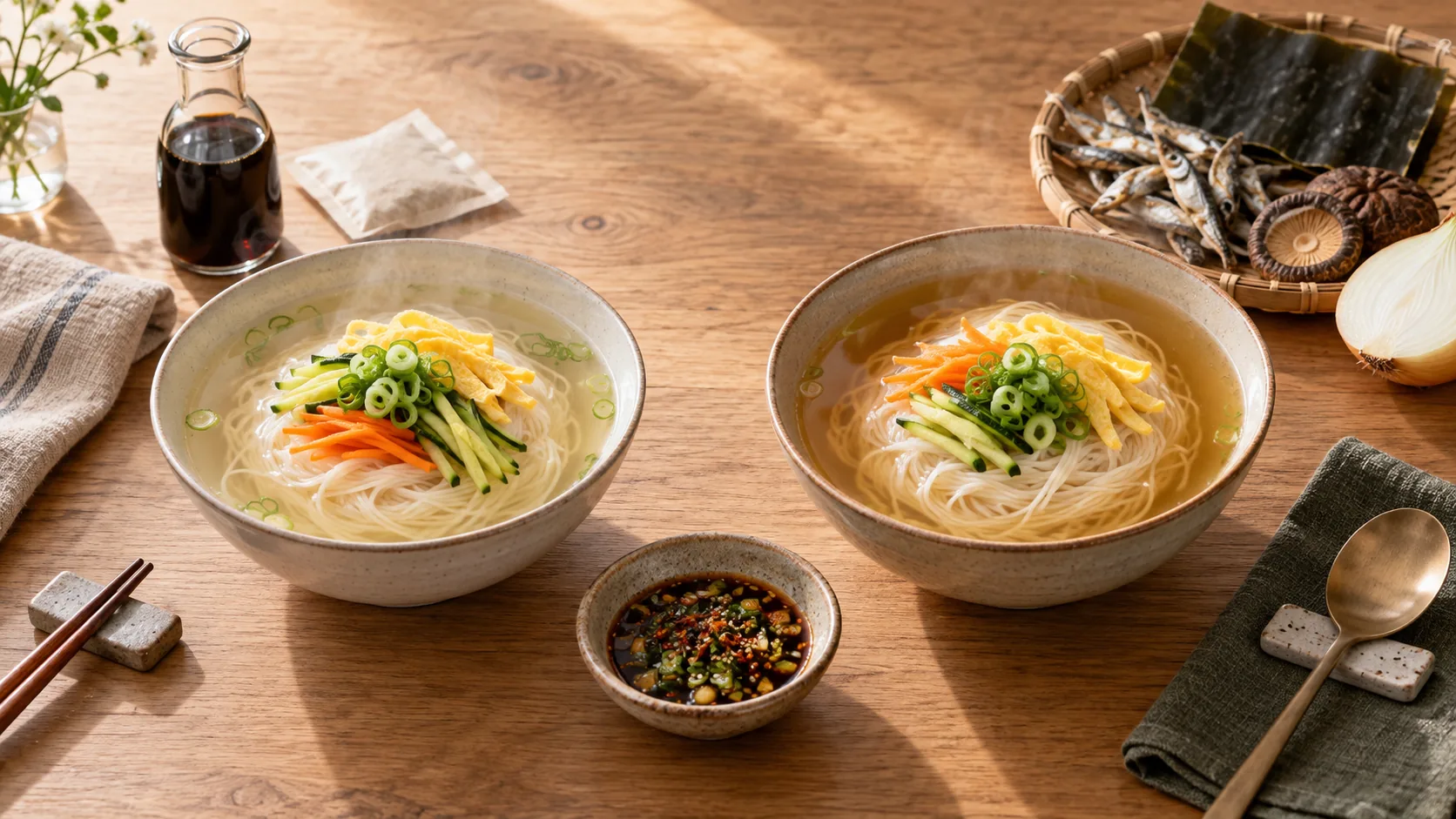
Quick version: 27-minute janchi guksu
Exact ingredients — 4 servings
- 1,650 ml water
- 45 ml bottled anchovy-kelp broth concentrate
- 18 ml Korean soup soy sauce
- 1 g MSG
- 400 g dried somyeon
- 160 g Korean zucchini, matchsticks
- 80 g carrot, matchsticks
- 2 large eggs (about 100 g without shells)
- 3 g fine salt
- 15 ml neutral oil
- Sauce: 45 g scallions, 45 ml regular soy sauce, 15 ml water, 8 g garlic, 4 g gochugaru, 4 g sugar, 10 ml sesame oil and 6 g sesame seeds
Prep 10 minutes · Cook 17 minutes · Total 27 minutes · Active about 22 minutes
- Mix all sauce ingredients. Serve 15 ml per bowl to start.
- Combine water, concentrate, soup soy sauce and MSG in a 22 cm (9-inch) or larger pot. Cover and boil over high heat for 7 minutes, then hold over low heat for 5 minutes. If the label calls for stronger than 1:30 dilution, start with 30 ml concentrate and add 5 ml at a time.
- Beat eggs with 1 g salt and strain. Cook in 5 ml oil over medium-low heat for 90 seconds on the first side and 20 seconds on the second. When fully set, cool and cut into 5 mm strips.
- In the same skillet, cook carrot with 10 ml oil and 1 g salt over medium heat for 90 seconds. Add zucchini and 1 g salt; cook 2 minutes and spread on a plate.
- Boil at least 3 L water over high heat. Add noodles, stir for 30 seconds and add 100 ml cold water each time foam rises, twice total. Cook 3 minutes 30 seconds and check that no white core remains.
- Rub noodles under cold water for 40 seconds, shake very dry and divide. Pour 100 ml hot broth over each portion and return it to the pot to warm the noodles. Add about 350 ml broth and garnishes to each bowl.
Why it tastes this way: Concentrate supplies pre-extracted anchovy-kelp flavor and salt in one pour. One gram of MSG reinforces glutamate savoriness in a short cooking time. This is a choice for speed and consistency, not an inherently unsafe or inferior method. It does not fully reproduce fresh anchovy aroma, shiitake’s long finish or sweetness slowly drawn from radish and onion.
Traditional version: anchovy-kelp-shiitake stock
Exact ingredients — 4 servings
- 2,100 ml cold water
- 35 g dried soup anchovies, heads and dark innards removed
- 15 g dried kelp
- 12 g dried shiitake
- 220 g radish, sliced 5 mm thick
- 150 g onion, quartered
- 25 g scallion roots or white sections
- 20 ml soup soy sauce
- 4 g fine salt
- 400 g dried somyeon
- 160 g Korean zucchini
- 80 g carrot
- 2 large eggs (about 100 g)
- 15 ml neutral oil
- Sauce: 45 g scallions, 45 ml regular soy sauce, 15 ml water, 8 g garlic, 4 g gochugaru, 4 g sugar, 10 ml sesame oil and 6 g sesame seeds
Prep 20 minutes · Cook 50 minutes · Total 70 minutes · Active about 37 minutes
- Soak kelp and shiitake in cold water for 20 minutes. Clean the anchovies and prepare vegetables.
- Dry-toast anchovies over medium-low heat for 3 minutes. Add soaking water, kelp and shiitake before they brown.
- Add radish, onion and scallion. Heat over medium heat for 10 minutes. Remove kelp when small bubbles gather at the edge, around 80°C/176°F.
- Reduce to medium-low heat and infuse uncovered for 20 minutes. Remove shiitake at 10 minutes for optional garnish. Fine-strain and measure 1,500 ml stock, adding hot water if needed.
- Add soup soy sauce and 1 g salt; simmer over medium heat for 3 minutes. Add water in 50 ml increments if salty, or soup soy sauce 3 ml at a time if bland.
- Make the same sauce. Cook strained egg with 1 g salt in 5 ml oil over medium-low heat, 90 seconds plus 20 seconds. Cook carrot with 1 g salt for 90 seconds, then zucchini with 1 g salt for 2 minutes in the remaining oil.
- Boil noodles in at least 3 L water over high heat for 3 minutes 30 seconds, adding 100 ml cold water twice as foam rises.
- Rub under cold water for 40 seconds, drain well, divide and temper each portion with 100 ml broth. Add about 350 ml broth and garnishes per bowl.
Why it tastes this way: Glutamate- and guanylate-rich kelp and shiitake reinforce inosinate-driven savoriness from anchovies. Radish and onion contribute aroma and sweetness that sugar alone cannot duplicate. Removing kelp before boiling and holding a moderate simmer protects a clear finish.
One-to-one traditional replacements
| Quick shortcut | Traditional replacement | Function and real difference |
|---|---|---|
| 45 ml concentrate + 1,650 ml water | 35 g anchovies, 15 g kelp, 12 g shiitake, 220 g radish, 150 g onion and 25 g scallion in 2,100 ml water, yielding 1,500 ml | Concentrate sets salt and savoriness immediately. Homemade stock unfolds through several aromas but is not identical. |
| 1 g MSG | 15 g kelp + 12 g shiitake, soaked 20 minutes and extracted in stages | MSG raises glutamate efficiently. Whole ingredients add umami with marine and mushroom aromas and natural variation. |
| 12 minutes of direct heating | 3-minute anchovy toast + 20-minute soak + early kelp removal + 20-minute infusion | Direct heating is fast and predictable. The staged method controls stale fish aroma and kelp bitterness. |
| Using 1,650 ml water directly | Starting with 2,100 ml and correcting strained stock to 1,500 ml | Whole ingredients absorb water, so final volume must be measured for consistent salinity. |
Concentrate and MSG are not inherently lesser choices. The quick version saves time and reduces variation; the traditional version gives direct control over each aroma. Check the product’s dilution and sodium label before adjusting soy sauce.
Failure prevention
- Cloudy broth: Never boil noodles in the serving stock. Use a fine sieve and avoid an aggressive anchovy boil.
- Soft noodles: Test before 3 minutes 30 seconds, rinse for 40 seconds and do not hold them in hot broth.
- Clumping: Use at least 3 L water for 400 g noodles and stir constantly for the first 30 seconds.
- Bitter or fishy broth: Remove anchovy innards, dry-toast for 3 minutes and remove kelp before boiling.
- Diluted bowl: Shake noodles very dry and adjust one bowl with 5 ml sauce before seasoning the whole pot.
- Torn egg garnish: Strain the egg, keep medium-low heat and cool before slicing.
Food safety, storage and reheating
Cook egg garnish until no liquid remains. If using a thermometer, the U.S. FDA safe center temperature for egg dishes is 71°C/160°F. Do not leave finished food at room temperature longer than 2 hours.
Refrigerate broth, noodles and garnishes separately in shallow covered containers. Use broth and cooked garnish within 3 to 4 days and boiled somyeon within 1 to 2 days for best texture. Freeze broth up to 2 months; do not freeze cooked noodles.
Reheat broth over medium heat for 5 to 7 minutes until bubbling throughout. Dip cold noodles in boiling water for 15 to 20 seconds, drain well and bowl them. Long reheating together makes noodles soft and stock cloudy.
Frequently asked questions
Can I make vegetarian janchi guksu?
Use vegetable concentrate for the quick version. Traditionally, omit anchovies, increase kelp and shiitake to 20 g each, use 300 g radish and 200 g onion, remove kelp before boiling and simmer the rest 25 minutes.
Can I substitute jungmyeon or udon?
Check medium wheat noodles 30 seconds before the package time. Warm frozen udon only until loosened, 1 to 2 minutes. Use 110 g dried jungmyeon or 200 g frozen udon per person.
Can I add kimchi garnish?
Lightly squeeze and chop 120 g fermented kimchi; mix with 5 ml sesame oil and 2 g sugar. Reduce soup soy sauce by 5 to 6 ml because kimchi and table sauce add salt.
Can stock be made one day ahead?
Yes. Cool quickly, refrigerate within 2 hours and use within 3 to 4 days. Cook noodles just before serving.
How do I make a child-friendly sauce?
Omit gochugaru and mix 35 ml soy sauce, 25 ml water, 3 g sugar, 8 ml sesame oil, 30 g scallion and 4 g sesame seeds.
Related Korean recipes and references
Compare anchovy-kelp stock in 20-minute quick vs traditional-stock tteokbokki, or make 28-minute quick vs traditional-stock doenjang jjigae.
[…] Read this recipe in English […]