
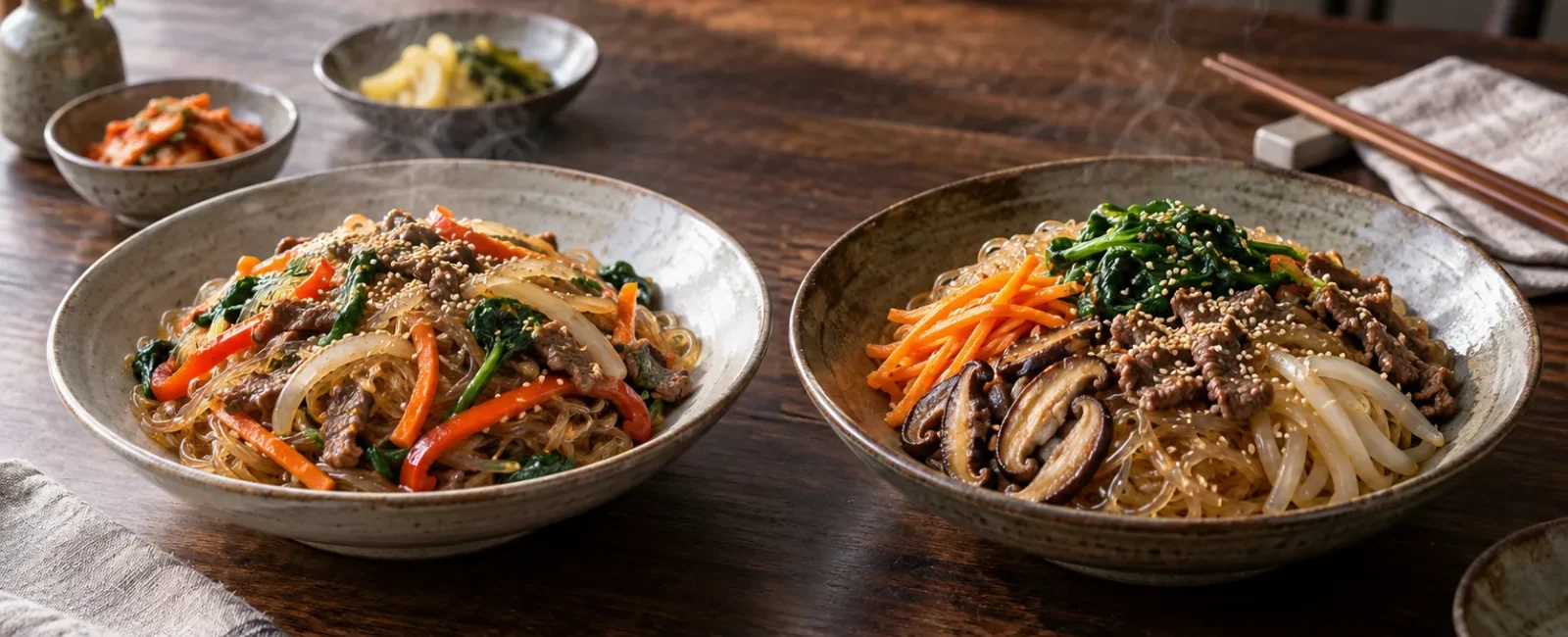
The key to a good japchae recipe is letting the sweet potato noodles absorb enough seasoning without turning swollen or sticky while cooking each vegetable only as long as it needs to keep its color and texture. Both recipes below make four servings with 300 g dried Korean sweet potato starch noodles. The 30-minute version uses bottled bulgogi marinade and packaged beef broth to combine steps. The traditional version uses shiitake soaking liquid and homemade soy seasoning, then cooks the beef, mushrooms, and vegetables separately before tossing everything together. The quick version gives consistent sweet-savory flavor with less cleanup; the traditional method keeps the aroma and texture of each ingredient more distinct.
Quick and traditional japchae at a glance
| Comparison | 30-minute bottled-sauce version | Traditional separate stir-fry version |
|---|---|---|
| Yield | 4 servings, about 1.25 kg finished | 4 servings, about 1.25 kg finished |
| Prep / cook / total time | 12 / 18 / 30 minutes | 35 / 40 / 75 minutes |
| Active time | About 25 minutes | About 60 minutes |
| Difficulty | Easy — one large skillet and one pot | Intermediate — heat and timing change by ingredient |
| Estimated U.S. Korean-market cost | About $18–24 | About $21–29 |
| Flavor | Even sweet-savory bottled-bulgogi flavor, noticeable garlic, and moist noodles | Distinct layers of shiitake, beef, vegetable sweetness, toasted sesame, and light browning |
| Umami sources | Bottled bulgogi marinade, packaged beef broth, beef, and soy sauce | Dried-shiitake soaking liquid, beef, brewed soy sauce, and browning from separate stir-frying |
| Main failure risks | Stacking sodium from the sauce and broth, or leaving noodles in the hot skillet until they clump | Crowding ingredients so they steam, underseasoning the noodles, or dulling the vegetables |
| Best for | Weeknight dinner, lunch-box sides, and first-time japchae cooks | Holidays, birthdays, guests, and cooks who want distinct color and texture |
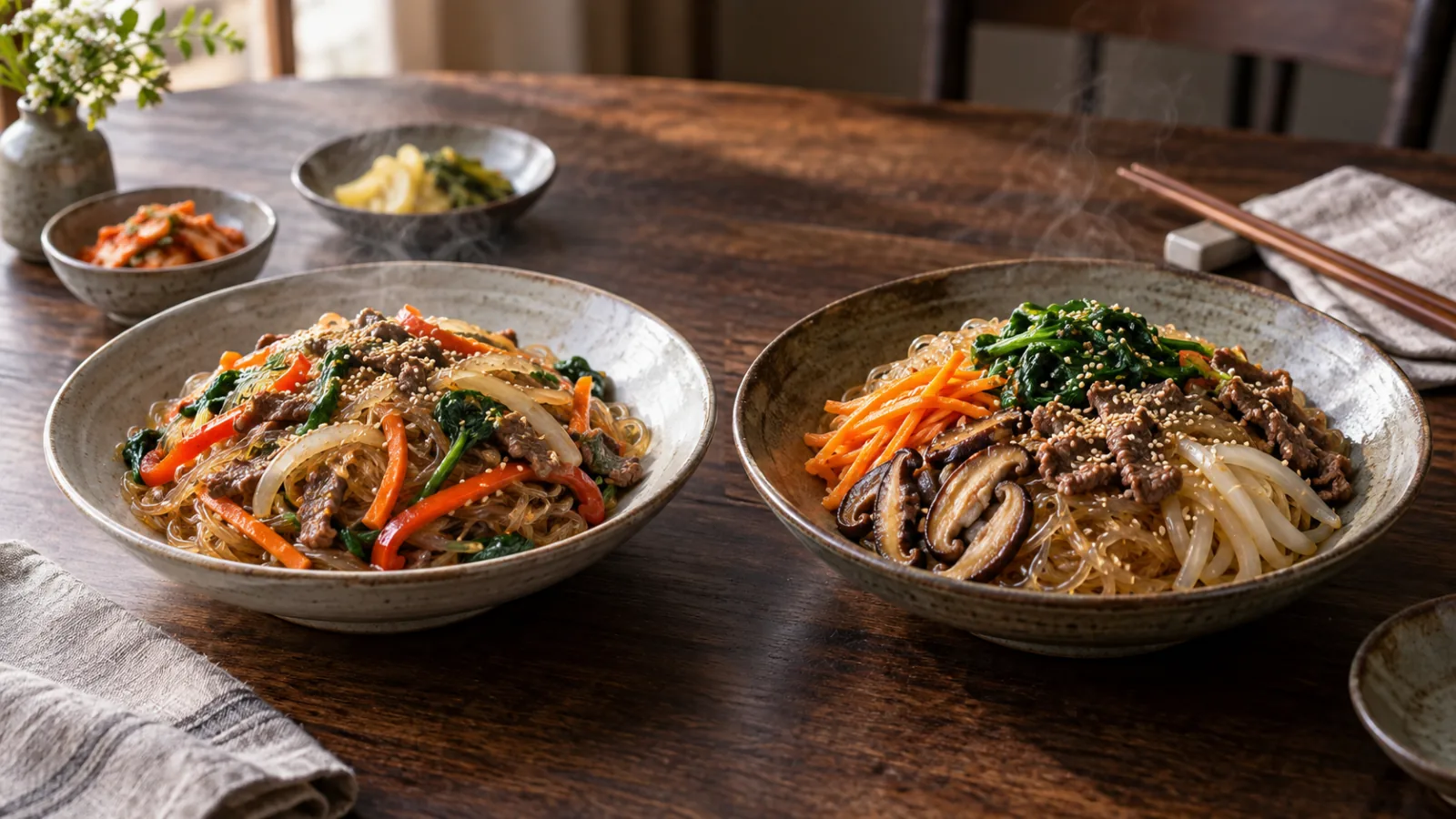
Quick version: 30-minute japchae with bottled bulgogi sauce
Exact ingredients — 4 servings
- 300 g dried Korean sweet potato starch noodles (dangmyeon)
- 3 L water, for boiling noodles
- 250 g beef sirloin or eye of round, cut across the grain into 5 mm strips
- 120 g bottled bulgogi marinade
- 120 ml low-sodium packaged beef broth
- 15 ml brewed soy sauce
- 8 g brown sugar
- 10 g minced garlic
- 20 ml toasted sesame oil
- 0.5 g ground black pepper
- 150 g onion, cut into 5 mm strips
- 120 g carrot, cut into 3 mm matchsticks
- 120 g red bell pepper, cut into 5 mm strips
- 120 g fresh shiitake mushrooms, sliced 5 mm thick
- 180 g spinach, washed and dried
- 40 g scallions, sliced diagonally
- 20 ml neutral cooking oil
- 8 g toasted sesame seeds
Prep 12 minutes · Cook 18 minutes · Total 30 minutes · Active about 25 minutes
Preparation and cooking
- Bring 3 L water to a boil over high heat. Meanwhile, combine 120 g bottled bulgogi marinade, 120 ml low-sodium beef broth, 15 ml soy sauce, 8 g brown sugar, 10 g garlic, 10 ml sesame oil, and 0.5 g pepper. Toss 60 ml of this mixture with the 250 g beef and set aside for 5 minutes.
- Add 300 g noodles to the boiling water. Cook over medium-high heat for 6 minutes, or one minute less than the package time. Test one strand at four minutes. When no hard core remains but the noodle is not completely soft, drain for only 20 seconds. Do not rinse.
- Preheat a deep skillet at least 30 cm wide over medium-high heat for one minute. Add 10 ml neutral oil. Spread the marinated beef in one layer, cook for 90 seconds, turn, and cook 60 to 90 seconds more. When no raw red surface remains and the thickest pieces reach 63°C/145°F, transfer the beef to a clean plate and rest for three minutes.
- Add the remaining 10 ml neutral oil to the same skillet. Add the 150 g onion, 120 g carrot, and 120 g fresh shiitake; stir-fry over medium-high heat for three minutes. Add the 120 g bell pepper for 90 seconds, then add the 180 g spinach and 40 g scallions for one minute. As soon as the spinach wilts, push the vegetables to the edge.
- Put the drained noodles and remaining seasoning mixture in the center. Toss from the bottom with two tongs over medium heat for three to four minutes. When little liquid remains and the noodles look glossy, return the beef and toss for one minute. Turn off the heat; mix in the remaining 10 ml sesame oil and 8 g sesame seeds.
- Immediately transfer the japchae to a wide platter and cool for five minutes. Leaving it in the hot skillet makes the noodles absorb too much liquid and stick together. Taste after five minutes; only then add another 5 ml soy sauce if needed.
Why it tastes this way: Bottled bulgogi marinade already balances soy sauce, sugar, garlic, onion or fruit extracts, and savory flavoring, so a short marinade gives the beef and noodles a clear flavor base. Low-sodium beef broth supplies both moisture for the noodles and extra beef flavor. Stir-frying the boiled noodles in that liquid for three to four minutes draws seasoning between the starch chains; moving them out of the hot pan promptly prevents excessive absorption and clumping. The vegetable aromas blend more than in the traditional version, but the method is fast and repeatable.
Traditional version: japchae with shiitake stock and separately cooked ingredients
Exact ingredients — 4 servings
- 300 g dried Korean sweet potato starch noodles
- 3 L water, for boiling noodles
- 250 g beef sirloin or eye of round, cut into 5 mm strips
- 25 g dried shiitake mushrooms
- 400 ml lukewarm water, for soaking shiitake
- 180 g spinach
- 2 L water, for blanching spinach
- 150 g onion, cut into 5 mm strips
- 120 g carrot, cut into 3 mm matchsticks
- 120 g red bell pepper, cut into 5 mm strips
- 40 g scallions, sliced diagonally
- 30 ml neutral cooking oil, divided into six 5 ml portions
- 5 g fine salt, divided among the vegetables
- 8 g toasted sesame seeds
- Beef and shiitake seasoning: 30 ml brewed soy sauce, 60 g grated Asian pear, 8 g brown sugar, 8 g minced garlic, 5 ml toasted sesame oil, and 0.5 g pepper
- Noodle seasoning: 45 ml brewed soy sauce, 80 ml strained shiitake soaking liquid, 25 g brown sugar, 5 g minced garlic, and 15 ml toasted sesame oil
- To finish: 10 ml toasted sesame oil
Prep 35 minutes · Cook 40 minutes · Total 75 minutes · Active about 60 minutes
From preparation to final toss
- Soak 25 g dried shiitake in 400 ml lukewarm water for 25 minutes, keeping the mushrooms submerged with a small plate. Gently squeeze when pliable, remove the stems, and slice the caps 4 mm thick. Strain the soaking water through a coffee filter or damp cloth and measure 80 ml.
- Combine 30 ml soy sauce, 60 g grated pear, 8 g sugar, 8 g garlic, 5 ml sesame oil, and 0.5 g pepper. Toss two-thirds with the 250 g beef and the rest with the shiitake; marinate separately for 15 minutes. Keep raw-beef marinade and mushroom marinade in separate bowls from the start.
- Bring 3 L water and 2 L water to a boil in separate pots over high heat. In the smaller pot, lower the stems of the 180 g spinach into the boiling water for 15 seconds, then submerge the leaves for 15 seconds more. Chill in cold water for 20 seconds. Squeeze a handful at a time without crushing it, cut to 6 cm if needed, and season with 1 g salt plus 2 ml of the 10 ml finishing sesame oil.
- Add 300 g noodles to the 3 L pot and boil over medium-high heat for seven minutes. When one strand has no hard core but still feels springy, drain for 20 seconds. Cut the noodles two or three times with kitchen scissors if they are unwieldy.
- In a wide skillet, bring 45 ml soy sauce, 80 ml shiitake liquid, 25 g sugar, and 5 g garlic to a simmer over medium heat for 30 seconds. Add the noodles and toss from the bottom for five to six minutes, until no liquid is visible. Turn off the heat, mix in 15 ml sesame oil, and transfer to a large mixing bowl.
- Wipe the skillet and preheat it over medium-high heat for one minute. Stir-fry 150 g onion with 5 ml neutral oil and 1 g salt for two minutes, until translucent but not brown; transfer to the bowl. Repeat with 120 g carrot, 5 ml oil, and 1 g salt for two minutes; 120 g bell pepper, 5 ml oil, and 1 g salt for 90 seconds; then 40 g scallions with 5 ml oil for 45 seconds. Transfer each ingredient immediately.
- Add 5 ml oil and cook the marinated shiitake over medium heat for two minutes; transfer to the bowl. Raise the heat to medium-high, add the final 5 ml oil, and spread the marinated beef in one layer. Cook for 90 seconds, turn, and cook 60 to 90 seconds more. When the thickest pieces reach 63°C/145°F, turn off the heat and rest them on a clean plate for three minutes.
- When the noodles are still warm but manageable, about 60°C/140°F, add the spinach, all stir-fried vegetables, shiitake, beef, and the final 1 g salt. Wearing food-safe gloves or using two tongs, toss upward from the bottom for 90 seconds. Mix in the remaining 8 ml finishing sesame oil and 8 g sesame seeds. Rest five minutes before tasting.
Why it tastes this way: Guanylate from dried shiitake moves into the soaking liquid; it combines with glutamate from soy sauce and inosinate from beef for layered umami. Pear sugar and enzymes gently tenderize the surface of the beef during the short marinade while adding a mild fruit aroma. Cooking water-rich vegetables separately keeps the skillet from cooling sharply, so each ingredient retains sweetness and light browning instead of a steamed flavor. The noodles absorb their shiitake-soy seasoning on their own, while the final toss preserves the vegetables’ color and spring.
One-to-one traditional replacements for the shortcuts
| Quick-version shortcut | Traditional replacement | Role and real difference |
|---|---|---|
| 120 g bottled bulgogi marinade | 30 ml soy sauce + 60 g pear + 8 g sugar + 8 g garlic + 5 ml sesame oil + pepper | Bottled sauce provides consistent salt, sweetness, and aroma after a short marinade. Homemade seasoning has fresher pear and garlic notes but needs adjustment for the pear’s sweetness and the soy sauce’s salinity. |
| 120 ml low-sodium packaged beef broth | 80 ml liquid strained from soaking 25 g dried shiitake | Packaged broth immediately adds beefy savoriness. Shiitake liquid does not imitate beef, but it supplies guanylate and concentrated mushroom aroma after a 25-minute soak. |
| Cooking beef and vegetables consecutively in one skillet | Stir-frying onion, carrot, pepper, scallion, shiitake, and beef separately | The consecutive method is quicker and uses fewer dishes, but moisture accumulates. Separate batches add 15 to 20 minutes while preserving ingredient-specific doneness and color. |
| 120 g fresh shiitake | 25 g dried shiitake, rehydrated | Fresh shiitake is fast to prepare and tender. Dried shiitake has a concentrated aroma and yields useful soaking liquid, but it requires soaking and careful straining. |
| Tossing noodles, remaining sauce, and vegetables together for 3–4 minutes | Seasoning noodles alone for 5–6 minutes, then combining everything off heat | The one-pan method distributes sauce evenly but continues cooking the vegetables. Seasoning noodles separately puts flavor inside them while preserving the already-cooked vegetables’ color and bite. |
This comparison does not mean bottled bulgogi sauce or packaged broth is inherently bad. Sodium and sugar vary by brand, so check the nutrition label, choose low-sodium broth, and wait until tasting before adding extra soy sauce. Convenience ingredients can produce consistent results quickly. The traditional method gives more control over individual flavors, but skillet temperature, shiitake strength, and pear sweetness all change the outcome. Both can make excellent japchae; their aroma layers and vegetable textures will not be identical.
Failure-prevention tips for springy noodles and bright vegetables
- The noodles are hard: Brands vary in thickness. Start testing one minute before the package time and add 30 seconds at a time if the center is hard. If finished japchae is still firm, add 30 ml hot water, cover, and warm over low heat for two minutes.
- The noodles clump: Do not leave drained noodles standing; move them into the seasoning skillet within one minute. Transfer finished japchae out of the hot skillet immediately and distribute the sesame oil thoroughly.
- The japchae is too salty: Bottled marinade and broth can stack sodium, so use low-sodium broth. To correct an already salty batch, add 100 g onion stir-fried without salt, 100 g blanched spinach, and 20 ml noodle cooking water.
- Liquid pools at the bottom: Dry washed vegetables well and preheat a skillet at least 30 cm wide. In the traditional version, remove each batch promptly so its steam does not cook the next ingredient.
- The colors look dull: Blanch spinach for only 30 seconds and chill it immediately; limit the bell pepper to 90 seconds. Do not leave all ingredients together in a hot skillet—complete the final toss off heat.
- The beef is tough: Slice across the grain to 5 mm and cook in one layer. If the skillet is small, use two batches so the beef does not steam, then rest it for three minutes.
Food safety, storage, and reheating
The USDA recommends cooking whole cuts of beef such as steaks and roasts to 63°C/145°F followed by at least a three-minute rest. For thin strips, check several of the thickest pieces together, or cook until no raw red surface remains and rest them on a clean plate for three minutes. If substituting ground beef, cook it to 71°C/160°F. Never reuse marinade, tongs, a board, or a bowl that touched raw beef for cooked ingredients.
Do not leave finished japchae at room temperature for more than two hours. Divide it into shallow, single-meal airtight containers and refrigerate for three to four days. Freezing is possible for one month, although spinach and bell pepper soften and some noodles may break after thawing. For portions you intend to freeze, slightly undercook the vegetables and cool everything completely before pressing out air and sealing.
To reheat one 300 g refrigerated serving, sprinkle with 15 ml water, cover in a skillet, and warm over medium-low heat for four to five minutes. Loosen the noodles once midway. When everything reaches 74°C/165°F, mix in 2 ml sesame oil. In a 900-watt microwave, cover and heat for 90 seconds, stir, then heat another 60 to 90 seconds. Reheat only the amount you will eat.
Frequently asked questions
Can I make japchae the day before?
Yes, although its best texture is on the day it is made. Boil the noodles 30 seconds less and reduce each vegetable’s cooking time by 20 seconds. Refrigerate within two hours. The next day, reheat with 15 ml water and add fresh sesame oil and sesame seeds.
Can I make it without beef?
Yes. In the quick version, replace the 250 g beef and 120 ml beef broth with 300 g firm tofu and 120 ml low-sodium vegetable broth. Cut pressed tofu into 2 cm batons, dry them, and brown each side for two minutes over medium-high heat in 10 ml oil; return it only at the end. In the traditional version, add 15 g dried shiitake and season it separately with 10 ml soy sauce, 40 g pear, and 5 g garlic.
Should I rinse the noodles in cold water?
Not for these methods. Hot noodles absorb seasoning more readily, and moving them directly to the skillet lets surface starch lightly thicken the sauce. If they must wait longer than five minutes, rinse for just five seconds in lukewarm water and drain thoroughly to prevent sticking.
Can I substitute mung bean noodles or rice noodles?
Not with the same timing. Mung bean noodles may cook in three to five minutes and break more easily, while rice noodles absorb soy seasoning differently. Korean sweet potato starch noodles are the best choice for japchae’s characteristic spring and reheating stability.
How do I keep japchae from becoming too dark?
Use brewed soy sauce rather than the darker soup soy sauce, and concentrate soy sauce in the noodle seasoning instead of adding it to every vegetable. Season vegetables with salt to preserve their colors. If your bottled marinade is very dark, omit the 15 ml soy sauce initially and add it in 5 ml increments only after tasting.
Related Korean recipes and references
For another holiday-table comparison, see 90-minute bottled-sauce galbijjim vs traditionally soaked braised short ribs. Pair japchae with 30-minute beef miyeokguk vs brisket-stock miyeokguk, or add a spicy main with bottled-sauce dakbokkeumtang vs homemade-sauce dakbokkeumtang.
[…] Read this recipe in English […]