
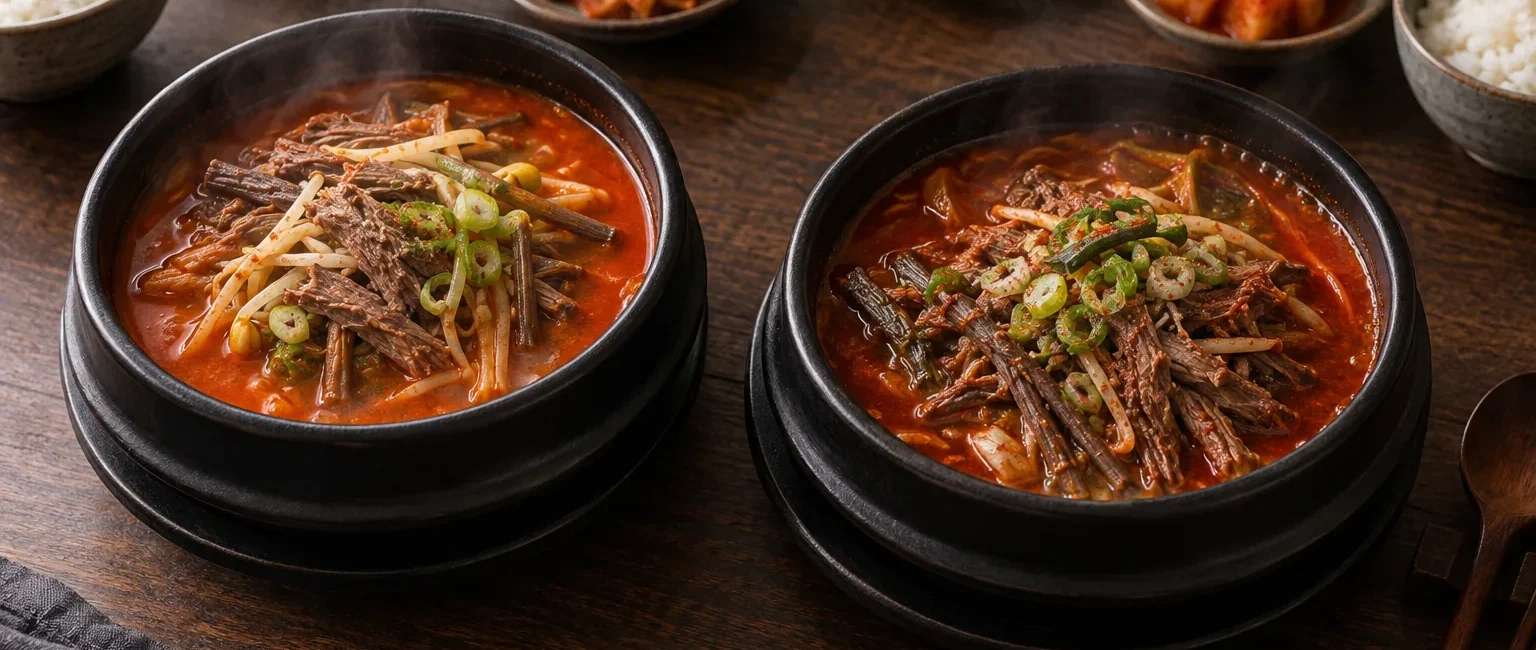
The key to a deeply flavored yukgaejang recipe is blooming Korean red pepper flakes without scorching them, then connecting beefy stock with the sweetness of scallions and the earthy character of gosari. Both recipes below make four servings and about 1.8 liters of broth. The 45-minute quick version uses low-sodium boxed beef broth and Korean beef stock powder with thinly sliced beef. The traditional version soaks a whole piece of brisket, slowly simmers it with radish and aromatics, then shreds the meat. The first is fast, consistently savory, and sharply spicy; the second has cleaner beef flavor and more distinct layers.
Quick comparison: two ways to make yukgaejang
| Category | 45-minute quick version | Traditional brisket-stock version |
|---|---|---|
| Yield | 4 servings, about 2.5 kg soup and solids | 4 servings, about 2.5 kg soup and solids |
| Prep / cook / total time | 15 / 30 / 45 minutes | 40 minutes / 1 hour 55 minutes / 2 hours 35 minutes |
| Active time | About 25 minutes | About 50 minutes |
| Difficulty | Easy — one large pot | Moderate — manage stock concentration and chile-oil heat |
| Estimated U.S. grocery cost | About $20–26 | About $24–32 |
| Flavor | Immediate beef savoriness with a clear, bright chile profile | Clean brisket stock followed by radish sweetness, scallion, and earthy gosari |
| Umami sources | Boxed beef broth, Korean beef stock powder, beef, and soup soy sauce | Inosinate from brisket, fermented soup soy sauce, fish sauce, and sautéed aromatics |
| Likely failure point | Excess salt from overlapping seasonings or scorched red pepper flakes | Cloudy stock, excessive reduction, or red pepper flakes burned over high heat |
| Best for | Weeknight dinner or a fast soup made with frozen sliced beef | Weekend cooking, guests, or a clean stock with long flavor |
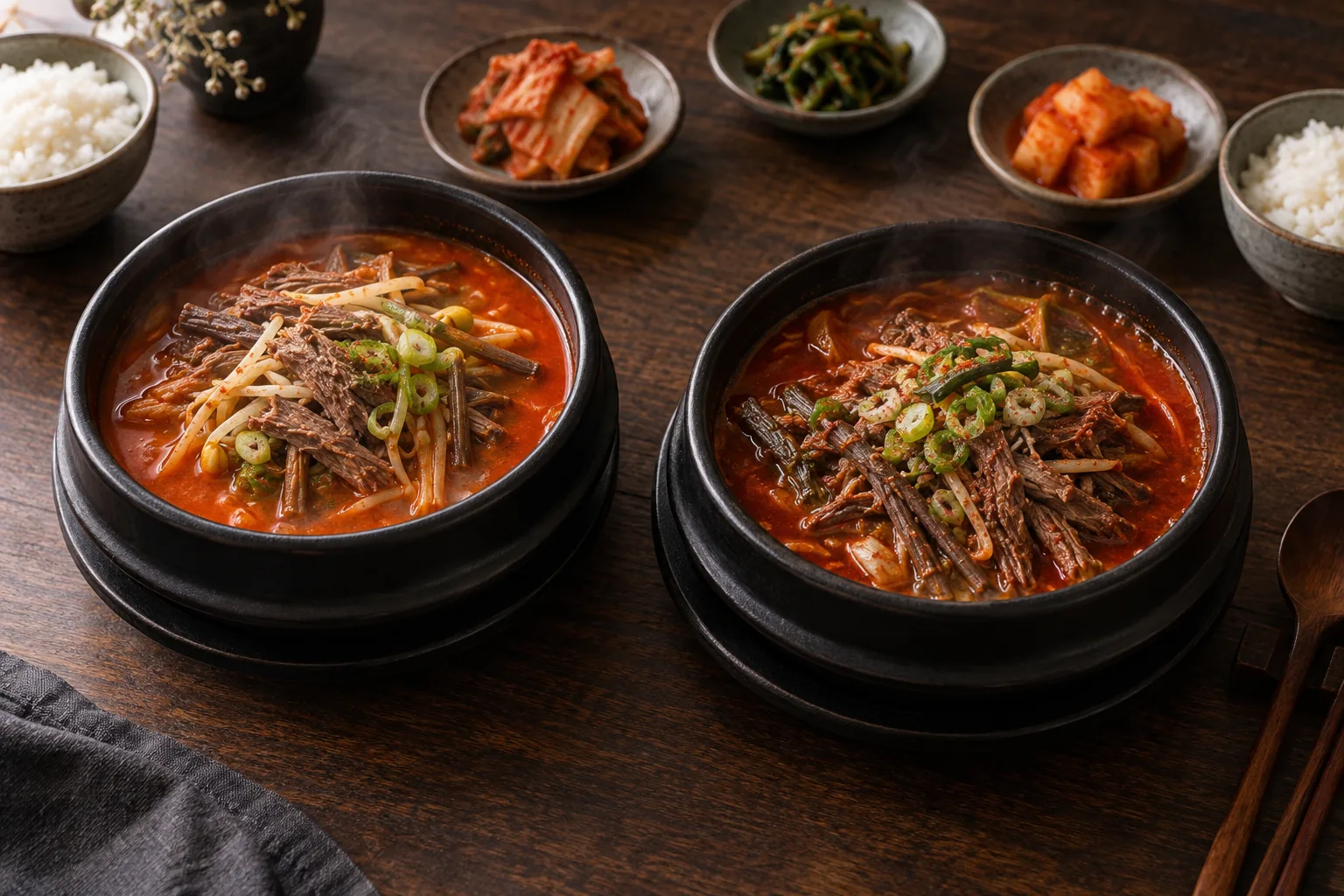
Quick version: 45-minute yukgaejang with boxed broth
Exact ingredients — 4 servings
- 400 g beef brisket or chuck eye, sliced 5 mm thick across the grain
- 500 ml low-sodium boxed beef broth
- 1.25 L water
- 180 g cooked gosari (bracken fern stems), tough ends removed, cut into 7 cm lengths
- 240 g mung bean sprouts
- 180 g oyster mushrooms, torn into thick strips
- 180 g large Korean scallions or leeks, white and green parts split and cut into 7 cm lengths
- 150 g onion, sliced 8 mm thick
- 20 ml neutral cooking oil
- 10 ml toasted sesame oil
- 28 g Korean red pepper flakes (gochugaru), about 4 tablespoons
- 24 g minced garlic
- 25 ml Korean soup soy sauce (guk-ganjang)
- 8 g Korean beef stock powder, such as Dashida
- 1 g ground black pepper
- 0–3 g fine salt, only after tasting
Prep 15 minutes · Cook 30 minutes · Total 45 minutes · Active time about 25 minutes
Step-by-step method
- Rinse the cooked gosari once in cold water. Press the thickest stems for one minute and discard any that remain rigid, then cut to 7 cm. Rinse and drain the sprouts, tear the oyster mushrooms into 1.5 cm strips, and blot the beef dry before slicing it 5 mm thick across the grain.
- Add neutral oil and sesame oil to a heavy 5-liter pot and warm for 30 seconds over medium-low heat. Add half the scallion whites, the gochugaru, and garlic. Stir for exactly 60 seconds, until the oil is red and aromatic. If black flecks or a burned smell appear, discard the oil and restart; scorched gochugaru cannot be repaired.
- Add the beef and soup soy sauce, raise the heat to medium-high, and stir-fry for 3 minutes. When most raw red surfaces are gone, add the gosari and onion and cook for 2 minutes. This coats both meat and fern stems with aromatic chile oil before any liquid is added.
- Pour in the boxed broth and 1.25 liters water, then dissolve the beef stock powder completely. Bring to a full boil over high heat, 6–8 minutes. Skim only the foam, lower to medium, and simmer for 10 minutes with the lid open by about 2 cm.
- Add mushrooms, the remaining scallions, and sprouts. Return to a boil over medium-high, then simmer over medium heat for 7 minutes. Add black pepper and taste. Add no salt if the broth and stock powder are sufficient; otherwise dissolve salt 1 g at a time, using no more than 3 g.
- Check that the center of the thickest beef piece has reached at least 63°C (145°F). Turn off the heat, cover, and rest for 3 minutes. Divide the solids evenly and ladle about 450 ml broth into each bowl.
Why it tastes this way: Boxed beef broth and Korean beef stock powder already combine beef flavor, salt, and savory compounds, so they establish the soup’s center quickly. Blooming scallion, garlic, and gochugaru in fat captures fat-soluble aromas in the red oil that reaches the nose first. Stir-frying the thin beef and gosari in that oil prevents the solids from tasting separate even after a short simmer. The result does not have the same clear, lingering beef character as slowly made stock, but it is bold, fast, and highly repeatable when the same products are used.
Traditional version: yukgaejang with soaked brisket and homemade stock
Exact ingredients — 4 servings
- 400 g whole beef brisket
- 2 L cold water, for soaking
- 2.5 L water, for the stock
- 250 g Korean radish or daikon, in 3 cm chunks
- 180 g onion, halved
- 80 g scallion greens and cleaned roots
- 30 g whole garlic cloves
- 2 g black peppercorns
- 180 g cooked gosari, cut into 7 cm lengths
- 240 g mung bean sprouts
- 180 g oyster mushrooms, torn into thick strips
- 180 g large Korean scallions or leeks, split and cut into 7 cm lengths
- 30 ml neutral cooking oil
- 10 ml toasted sesame oil
- 28 g gochugaru
- 24 g minced garlic
- 45 ml Korean soup soy sauce
- 15 ml fish sauce
- 0–4 g fine salt
- 1 g ground black pepper
Prep 40 minutes · Cook 1 hour 55 minutes · Total 2 hours 35 minutes · Active time about 50 minutes
From stock to finished soup
- Soak the brisket in 2 liters cold water for 30 minutes, changing the water once at 15 minutes, then rinse for 10 seconds. Place it in a 5-liter pot with 2.5 liters fresh water, radish, onion, scallion greens and roots, whole garlic, and peppercorns.
- Heat over high for 12–15 minutes. Once boiling, skim gray foam for 3 minutes. Lower to low heat so the surface moves gently and simmer for 70 minutes with the lid open by 2 cm. A rolling boil emulsifies fat and protein into the liquid, making the stock cloudy and increasing evaporation.
- Transfer the brisket to a clean plate and cool for 10 minutes. Strain the stock through a fine sieve. Reserve 100 g cooked radish and slice it 5 mm thick. Measure the stock: reduce over medium-high if it exceeds 1.8 liters, or add hot water if it falls short. Pull the brisket with the grain into 7 cm strands about 5 mm thick.
- Combine shredded brisket, gosari, mushrooms, and scallions in a large bowl. Add 30 ml of the soup soy sauce, all the fish sauce, minced garlic, and gochugaru. Massage for 1 minute with a gloved hand and rest for 10 minutes. Reserve the remaining 15 ml soy sauce for final seasoning.
- Warm neutral oil and sesame oil in the empty pot for 30 seconds over medium-low. Add the seasoned beef and vegetables and stir-fry for 4 minutes. If the bottom becomes dry, add 50 ml strained stock to prevent the gochugaru from scorching. When the scallions soften and red oil appears, add the reserved radish and 1.8 liters stock.
- Bring to a boil over high heat, 8–10 minutes. Lower to medium-low, cover halfway, and simmer for 20 minutes. Add sprouts and simmer 7 minutes more. Stir in black pepper. If needed, add the reserved soy sauce 5 ml at a time, followed only then by salt 1 g at a time, up to 4 g.
- Turn off the heat and rest for 5 minutes. The aromatic red oil carries flavor, so remove only 15–30 ml excess clear beef fat rather than skimming every red droplet. The brisket will have cooked beyond the minimum during its long simmer, but verify 63°C (145°F) at the center when it leaves the stock and rest at least 3 minutes before shredding.
Why it tastes this way: Gentle simmering moves inosinate and water-soluble beef flavor into the stock while collagen becomes gelatin, giving the broth a rounder body. Radish and onion soften the edges of the beef flavor with restrained sweetness. Re-frying shredded meat, gosari, mushrooms, and scallions in chile oil removes surface moisture and attaches the aromatic oil to each solid, making broth and garnish taste connected. Fermented soup soy sauce and fish sauce reinforce the homemade stock; they do not replace its beef character.
One-to-one traditional replacements for each shortcut
| Quick-version shortcut | Traditional replacement | Function and actual difference |
|---|---|---|
| 500 ml low-sodium boxed beef broth | Stock from 400 g brisket simmered 70 minutes with radish, onion, scallion, and garlic, adjusted to 1.8 L | Boxed broth supplies immediate, consistent beef flavor. Homemade stock has natural gelatin and integrated vegetable sweetness but requires soaking and simmering. |
| 8 g Korean beef stock powder | Brisket stock + 45 ml soup soy sauce + 15 ml fish sauce | Stock powder supplies salt and savory intensity at once. The traditional combination layers beef inosinate with fermented glutamates and must be seasoned gradually. |
| Thin beef stir-fried immediately | Whole brisket soaked 30 minutes, gently simmered 70 minutes, then pulled with the grain | Thin slices cook within minutes but can firm up. Simmered brisket also makes the stock and its strands absorb seasoning, though it takes much longer. |
| Beef and gosari fried for 5 minutes, then simmered | Shredded beef, gosari, mushrooms, and scallions seasoned for 10 minutes, then fried for 4 minutes | Immediate frying is faster and gives bright heat. Resting the seasoned solids distributes soy sauce and gochugaru more evenly before they meet the broth. |
| Premeasured boxed broth and water | Strained stock reduced or diluted to exactly 1.8 L | Commercial broth starts at a predictable concentration. Homemade stock evaporates differently with each pot and burner, so final volume must be standardized before seasoning. |
Using stock powder or boxed broth is not inherently inferior or unhealthy. Both are practical tools for consistent flavor when time is short. Sodium varies by brand, so choose low-sodium broth and postpone extra salt until the soup is finished. The traditional method gives more control over beef flavor, vegetable sweetness, and body, but it also demands time and careful evaporation. The two soups can share a spicy profile without having identical texture or finish.
Yukgaejang-specific failure prevention
- The broth tastes bitter and the chile flecks are black: Add gochugaru before the oil smokes and keep it over medium-low for no more than 60 seconds. Once burned, it cannot be corrected; discard that oil and start again.
- The stock is cloudy or smells overly gamey: Soak the whole brisket, skim the first foam, then lower the heat so large bubbles do not continually break the surface. For the quick version, blot sliced meat dry and sear it over medium-high before adding liquid.
- The soup is too salty: Boxed broth, stock powder, and soup soy sauce overlap. Hold all salt until the end. If already salty, add 150 ml unsalted hot water and 100 g additional sprouts, simmer for 5 minutes, and slightly increase each serving.
- The gosari is stringy: Even packages labeled cooked contain stems of different maturity. Bend and press the thickest pieces, discarding those that stay rigid. If starting with dried fern, soak and boil it fully, then weigh 180 g cooked—not 180 g dry.
- The beef is dry: In the quick version, slice across the grain and keep the simmer near 20 minutes. In the traditional version, simmer gently for 70 minutes and pull with the grain after resting so the strands stay intact.
- The soup feels greasy: Pure sesame oil burns easily and can dominate. Mix it with neutral oil, then skim only 15–30 ml clear beef fat after cooking while preserving the aromatic red oil.
Food safety, storage, and reheating
The USDA advises cooking whole beef steaks and roasts to 63°C (145°F), followed by at least a three-minute rest. Check the thickest quick-version slice and the center of the traditional brisket with a food thermometer. A sustained soup simmer generally exceeds that threshold, but color alone is not a reliable safety test. Do not reuse a board or tongs that touched raw beef for cooked meat or vegetables.
Do not leave finished yukgaejang at room temperature for more than two hours. Divide it among shallow containers, cool promptly, and refrigerate for three to four days. Freeze for two to three months; the sprouts will soften, so for planned freezer portions, omit them and add fresh sprouts during reheating.
Reheat only the amount needed in a saucepan over medium heat for 6–8 minutes, stirring until every part reaches 74°C (165°F), then boil for one additional minute. If reduced, add 30 ml water per serving and check seasoning only after it boils. For a 900-watt microwave, loosely cover a deep bowl, heat 2 minutes, stir, then heat 1–2 minutes more and verify 74°C.
Frequently asked questions
Do I need taro stems in yukgaejang?
No. If you want them, use 150 g fully cooked and rinsed taro stems and reduce the gosari to 100 g. Preparation varies by product; cook and rinse according to its directions. If the stems still cause an acrid or prickly sensation, boil longer and change the water before adding them to soup.
Can I substitute soybean sprouts for mung bean sprouts?
Yes. Replace with the same 240 g weight and extend the final simmer from 7 to 10 minutes. To avoid a beany aroma, keep the lid either open from the beginning or closed throughout; repeatedly opening and closing it is more likely to trap an unpleasant odor.
Can I add eggs?
It is not essential to the classic appearance, but you may lightly beat two eggs, about 100 g, stream them into the boiling soup, leave undisturbed for 30 seconds, then stir once. Continue cooking until both white and yolk have set, the center reaches the USDA safe minimum of 71°C (160°F), and the broth has boiled for at least one minute.
Why does yukgaejang often taste better the next day?
As it cools, aromas dissolved in chile oil redistribute between the broth and solids, while gosari and shredded beef absorb more seasoned liquid. That does not make room-temperature storage safe: refrigerate within two hours and reheat to 74°C the next day.
How can I make it less spicy?
Reduce gochugaru from 28 g to 18 g but keep the oil quantity unchanged so it can still extract scallion and garlic aromas. Use mild Korean gochugaru for color without as much heat. Gochujang is not a one-to-one substitute because it adds sweetness, salt, and thickness.
Related Korean recipes and references
For another beef-stock comparison, see 30-minute vs traditional brisket-stock beef miyeokguk. For a different spicy soup, compare the quick and traditional-stock kimchi jjigae. A holiday beef main is covered in the bottled-sauce vs soaked-short-rib galbijjim recipe, while 30-minute vs separately stir-fried japchae makes a fitting side.
[…] Read this recipe in English […]