


Losing a phone, wallet, laptop, passport, carry-on, or checked bag at an airport creates two problems at once: you need to recover the item, and you may need to protect accounts, payment cards, or travel plans. The fastest response is not to send the same report everywhere. First determine where you last saw the item and who controlled it at that moment.
An item left in a security bin generally goes to the TSA lost-and-found operation for that airport. A bag left in an aircraft seat pocket is normally handled by the operating airline. A checked bag that never appears on the carousel is an airline baggage claim, not a general airport lost-property case. Something left in a terminal restroom, public seating area, or parking facility may belong with the airport or its contractor. Using the right channel early gives staff a clearer time-and-location trail to search.
This guide provides general information about U.S. airport lost-property and airline consumer procedures. Airports, airlines, and transportation contractors may use different retention, identification, shipping, and reimbursement rules. This is not legal or insurance advice; verify the current rules with the organization involved and review your own insurance coverage.
Choose the right reporting channel in one minute
- TSA security checkpoint: Contact the airport-specific TSA Lost and Found if the item was left in a screening bin, shoe-removal area, pat-down area, or repacking table immediately after screening.
- Aircraft, gate, jet bridge, or airline lounge: Use the operating airline’s lost-item process. On a codeshare, the carrier whose crew actually operated the flight may control the cabin-cleaning and station records.
- Checked bag missing from the carousel: Go to the airline’s Baggage Service Office and file a mishandled baggage report. Do not rely only on the airport’s general lost-and-found desk.
- Contents missing after you received the checked bag: Notify the airline in writing as soon as possible and document the bag’s condition. Also consider whether the item could have been lost after baggage claim.
- Public terminal area: For a restroom, restaurant, check-in hall, public baggage-claim seating area, or concourse, use the airport operator’s Lost and Found. If it happened inside a store, report it to both the store and airport.
- Shuttle, parking, rental car, taxi, or rideshare: Report separately to the transportation or parking operator, rental company, or the ride app’s lost-item function.
Write the location as a short timeline: “At about 7:20 a.m. on September 17, I removed the laptop at Terminal A checkpoint 3. At 7:35 a.m., I noticed it was missing at gate B12.” That is much more useful than “I lost it somewhere at the airport.” Include the terminal, checkpoint or gate, time window, and the last action you remember.
The first 10 steps after you notice the loss
- Stop and reconstruct the previous 20 minutes. List the check-in counter, security bin, store register, charging seat, restroom, gate, jet bridge, and aircraft seat in order.
- Search your belongings once, methodically. Check small pockets, laptop sleeves, jackets, and a companion’s bag. Avoid losing time by repeatedly searching the same compartment.
- If you are still airside, ask nearby staff for help. Do not try to walk backward through a checkpoint or enter a controlled area.
- If boarding is close, tell the airline. Missing a flight while searching can create a separate rebooking problem. Ask staff what can be checked without jeopardizing boarding.
- Use the device’s official locator. Turn on lost mode and display a safe alternate contact number. Do not display your home address or unnecessary personal information.
- Protect cards and accounts. Lock cards in the issuer’s app. If an unlocked phone or authentication device is missing, review sessions and passwords for high-value accounts.
- Select the primary organization. Choose TSA, airline, airport, or ground transportation based on the last known location. File with a second adjacent organization only when the boundary is genuinely unclear.
- Save the case number. Capture the submission confirmation, email, contact time, department, and phone number.
- Record identifying details. Give enough detail to match the property, but keep one nonpublic characteristic for ownership verification.
- Schedule follow-ups. Check at reasonable intervals such as 24 hours, three days, and seven days instead of creating duplicate reports every hour.
If you left the item at a TSA checkpoint
TSA states that items left behind at checkpoints are held for at least 30 days or until reunited with their owner. The contact method varies by airport; the TSA Lost and Found directory provides a phone number or online form for each airport. A report to the airport’s general lost-property office may not search the checkpoint inventory, so use the airport code to locate the TSA channel.
Include the three-letter airport code, date, narrow time window, terminal or checkpoint, item type, color, make, model, and case description. For a laptop, do not paste passwords or recovery keys into a public notes field. Provide a serial number only through the channel and format requested for verification. TSA encourages travelers to place contact information on the outside of electronics. Its current guidance also says unclaimed electronics may have their memory removed and destroyed—or the entire device may be destroyed if memory is not removable—after the retention period to protect personal data.
If TSA says the item was found, confirm the release method. TSA says an owner may return to pick it up, authorize another person in writing to retrieve it, or arrange shipping at the owner’s expense. TSA is not authorized to spend government funds to return property. If an unexpected message asks you to pay through an unfamiliar link, independently open the official TSA or airport website and call the listed number before paying.
If the item was on the aircraft or at the gate
For something left in a seat pocket, overhead bin, aircraft lavatory, jet bridge, gate area, or airline lounge, start with the operating airline. Prepare the ticket number, flight number, date, origin, destination, seat, and gate. A flight number alone may not be enough because an aircraft can fly several segments in one day. If your seat changed, include both the assigned seat and where you actually sat.
For a codeshare, look for “operated by” in the itinerary. If the ticket carries Airline A’s flight number but Airline B flew the aircraft, Airline B’s station or cabin-cleaning contractor is more likely to have the item record. You can still notify the ticketing airline, but make the operating carrier the primary report for property left onboard.
If you have already reached another city, ask whether the item must be collected at the discovery airport, can be released to an authorized person, or can be shipped. Shipping fees, storage rules, and identity checks vary. Never send a card number, account password, or one-time code in an ordinary email reply.
If your checked bag did not arrive
A checked bag that never reaches the carousel follows a different process from ordinary lost property. Before leaving the airport, report it at the airline’s baggage-service desk and obtain a Property Irregularity Report or equivalent case number. Keep the baggage-tag receipt, boarding pass, a photo of the bag, and the delivery address. Even if a tracker shows the bag at another airport, file the official airline report.
The U.S. Department of Transportation says airlines must reimburse reasonable, verifiable, actual incidental expenses caused by delayed baggage, subject to applicable liability limits. DOT also states that an airline may not impose an arbitrary daily cap, such as a blanket amount per day, on interim expenses. This does not make every purchase reimbursable. Buy necessities that fit the destination and length of delay—basic toiletries, underwear, or essential clothing—and keep itemized receipts and payment records.
DOT says most airlines declare a bag lost between five and 14 days after the flight, although policies and circumstances differ. Once a bag is declared lost, compensation for contents can be affected by depreciation, proof of value, exclusions, and domestic or international liability rules. Use the current DOT page and the airline’s contract of carriage rather than guessing a payout.
Also check whether the checked-bag fee must be refunded. Under current DOT guidance, a reported checked bag may meet the “significantly delayed” threshold when it is not delivered within 12 hours after a domestic arrival. For an international itinerary between a U.S. and foreign airport, the threshold is 15 or 30 hours depending on flight duration. Exceptions apply, and the airline needs a mishandled baggage report. If baggage trouble is part of a larger disruption, see Smartor’s flight delay and cancellation rebooking checklist.
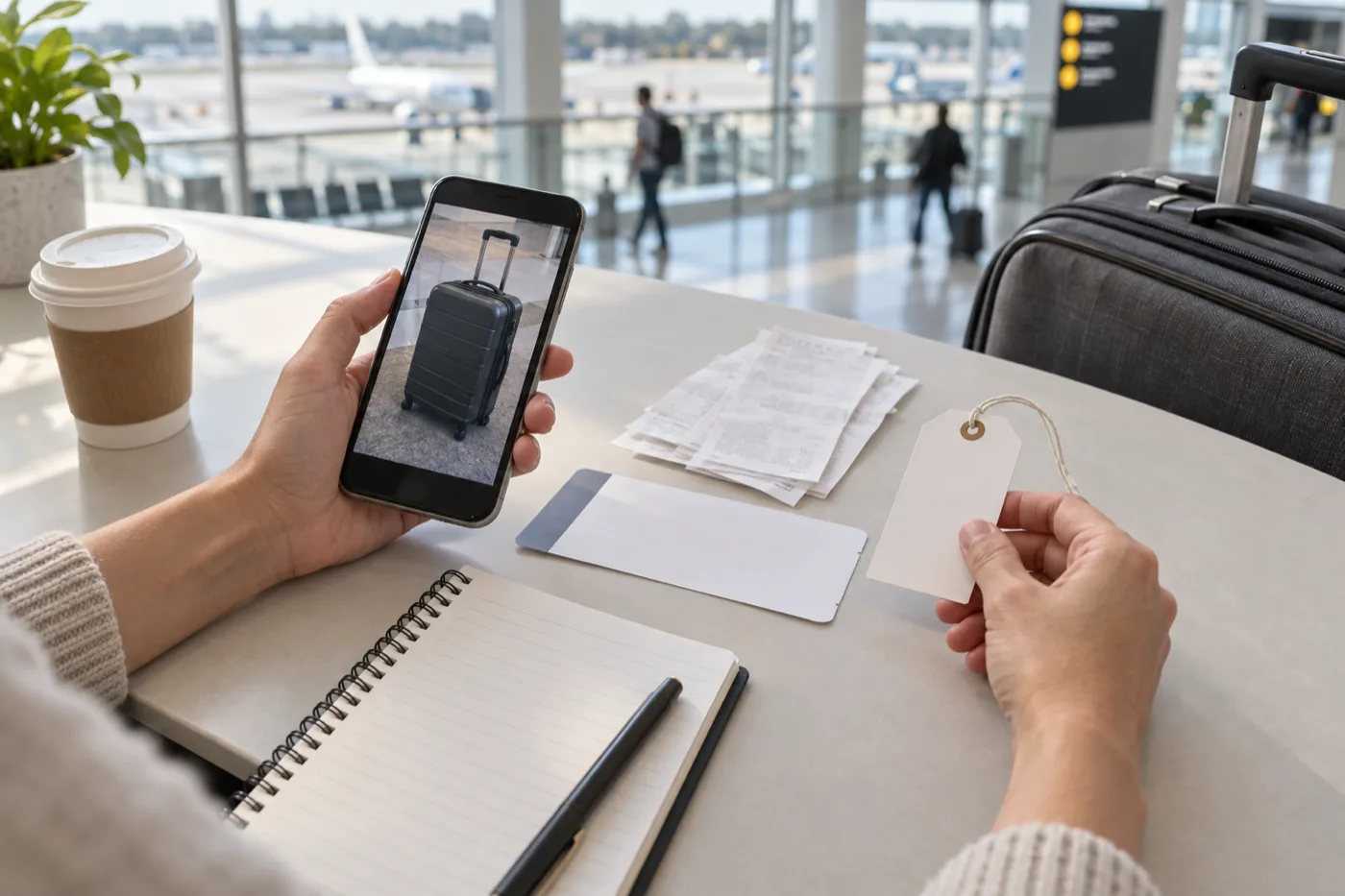
Secure a missing phone, wallet, or laptop
Phone
- Open the official Apple Find My or Google device-finding service you already use.
- Play a sound, enable lost mode and a screen lock, and display only a safe alternate contact number.
- Do not chase a moving location or enter a staff-only area. Show airport police or staff the map and update time.
- If recovery is uncertain, contact the carrier about SIM/eSIM protection and review active sessions for email, banking, password-manager, and authentication apps.
- Remote erasure may protect data but can affect later tracking or recovery. Weigh the security risk against the realistic chance of return.
Recovering the hardware and protecting accounts are separate jobs. If financial or authentication apps were on the phone, follow the account sequence in Smartor’s lost or stolen phone 30-minute and 24-hour checklist.
Wallet and payment cards
- Use the issuer’s app to lock cards temporarily, then report them lost and request replacement if they are not found or unauthorized activity appears.
- List everything that was inside: cash, driver’s license, insurance card, workplace badge, transit card, and keys.
- Enable transaction alerts and review recent approved and pending charges.
- If a Social Security card or other high-risk identity document was inside, use official identity-theft resources such as IdentityTheft.gov.
Laptop or tablet
- Lock and locate the device, then notify an employer or school security team if it contains organizational data.
- End browser and app sessions and change passwords for sensitive accounts.
- Follow the organization’s incident-reporting policy. Do not assume there is no impact simply because the screen was locked.
- Describe the case, color, size, and sticker placement in the property report, but never provide the login password or recovery key.
Can you fly after losing your ID or passport?
If your ID disappears before a U.S. domestic checkpoint, tell the airline and TSA immediately and allow extra time. TSA’s current identification page says that, beginning February 1, 2026, a passenger who cannot present an acceptable ID may pay a $45 fee to use TSA ConfirmID so TSA can attempt to verify identity. Payment does not guarantee entry; if TSA cannot verify identity, the passenger cannot enter the checkpoint. Recheck the TSA page before travel because the fee and process can change.
If the ID is lost after you have cleared security, ask the airline about the immediate flight and the risk to your return trip. An international passport loss requires more than a local lost-property report. A U.S. citizen should follow Department of State and nearest U.S. embassy or consulate procedures; another national should contact the appropriate embassy or consulate. Do not assume a photo or photocopy of a passport is enough to board an international flight.
What to include in a useful lost-item report
- Date and the narrowest reasonable time window
- Airport code, terminal, checkpoint, gate, store, parking area, or shuttle route
- Flight number, origin, destination, seat, and operating airline
- Item type, color, approximate size, material, and case
- Visible characteristics plus one additional detail reserved for ownership verification
- Serial number, IMEI, or baggage-tag number when the official process requests it
- A photo and proof of purchase that do not expose unnecessary personal data
- A working email address and alternate phone number
Example: “Black 13-inch laptop in a dark-gray fabric sleeve with a small white circular sticker at the lower right. Last seen between 7:15 and 7:35 a.m. on September 17 at the Terminal 4 checkpoint at JFK. Flight and gate are provided in the form’s separate fields.” This gives staff enough information to classify the property without exposing account credentials.
Verify a recovery message before you pay
Your report contains contact information and a travel timeline, which can make a convincing impersonation message. A real recovery process should not require your account password, card PIN, one-time authentication code, or device recovery key. A text that links to a fake device-locator login page can be an attempt to steal the very account needed to secure your phone.
- Do not use the incoming message’s link. Open the TSA, airport, or airline website yourself.
- Call the official number and verify the original case number and department.
- Before paying shipping, confirm the recipient, payment domain, amount, and refund terms.
- An organization may need an item detail or limited identity document, but do not provide a full Social Security number, bank login, or one-time code.
- Report suspicious email or text using FTC guidance and review account security.
Nine common mistakes
- Reporting only to the airport: TSA, airlines, airports, and contractors can maintain separate inventories.
- Leaving before filing a checked-bag report: Creating the airline case at the arrival airport makes later tracking and documentation easier.
- Making repeated calls without a case number: A written confirmation lets staff continue the same file.
- Changing the description: Different times, colors, or models can defeat automated and manual matching.
- Oversharing private information: A password, PIN, recovery key, or full card number is not needed to identify property.
- Relying only on a tracker: Location may be stale or imprecise, and staff may need an official report before releasing anything.
- Buying essentials without receipts: A delayed-baggage claim needs proof of actual expense and reasonable need.
- Posting a full boarding pass or baggage tag online: Reservation information and barcodes can expose travel details.
- Using an unknown recovery service: Confirm that any shipping or pickup vendor is authorized by the airport or airline.
Build a prevention kit for the next trip
- Put an email address or alternate phone number inside and outside the bag; minimize home-address exposure.
- Photograph the front, back, and contents of checked bags and save the baggage-tag receipt.
- Place contact information on the outside of a laptop or tablet, not only on the locked screen.
- Count security bins and perform a four-item check—phone, wallet, ID or passport, and laptop—immediately after screening.
- Use a bright cable pouch or connect a charging cable to the bag handle so it is harder to leave behind.
- Keep passports, medication, keys, cash, and electronics in the personal item rather than checked baggage.
- If you must submit a report on airport Wi-Fi, use Smartor’s airport and hotel public Wi-Fi security checklist to confirm the official site and encrypted connection.
Frequently asked questions
Are TSA Lost and Found and airport Lost and Found the same office?
Not necessarily. TSA may hold property found at the checkpoint, while the airport or a contractor holds items from public terminal areas. If the boundary is unclear, submit the same consistent timeline to both and record the two separate case numbers.
Can I report an item after leaving the airport?
Yes. TSA, airports, and airlines commonly provide online or phone reporting. However, if a checked bag did not arrive or was damaged, filing at the airline baggage desk before leaving is the strongest first step.
Can someone else pick up my property?
TSA says an owner can authorize another person in writing to retrieve an item. Airports and airlines may have different requirements, so ask which identification, authorization language, and case number the representative must bring.
Who pays to ship a recovered item?
TSA says shipping is at the owner’s expense. Airlines and airports may use similar rules, but verify each policy. Delivery of a delayed checked bag is a different airline-responsibility process from shipping ordinary lost property.
Should I enter a staff area if my tracker shows the item there?
No. Give airport police, airline staff, or lost-property staff the location screen, update time, item description, and case number. Tracker locations can be imprecise, and entering a controlled area creates security and safety issues.
What if an airline rejects my delayed-baggage expense claim?
First ask the airline to review the claim in writing with the receipts, baggage case number, delay length, and why each purchase was necessary. If the dispute remains unresolved, review the DOT Aviation Consumer Protection complaint process. A complaint does not guarantee an individual payment.
How long should I keep checking?
Retention and processing times vary. Because TSA states that checkpoint property is held for at least 30 days, follow up on the existing case after submission and at reasonable intervals. Add useful information to the same case instead of repeatedly creating new reports.
Final checklist before you leave
- I wrote the last known time and location in one sentence.
- I separated TSA, airline, airport, and ground-transport responsibilities.
- For checked baggage, I obtained an airline case number.
- I locked devices and cards and reviewed important accounts.
- I saved photos, tag numbers, boarding passes, and receipts together.
- I recorded each report number and a reasonable follow-up date.
- I will verify recovery messages through official websites and phone numbers.
Official sources consulted
- Transportation Security Administration — Lost and Found
- U.S. Department of Transportation — Lost, Delayed, or Damaged Baggage
- U.S. Department of Transportation — File a Consumer Complaint
- Transportation Security Administration — Acceptable Identification at the TSA Checkpoint
- Federal Trade Commission — How To Recognize and Avoid Phishing Scams
[…] 편집팀 September 17, 2026 Read this guide in English → 공항에서 물건을 잃어버렸다면 마지막으로 본 장소와 물건이 누구의 관리 […]