
NVIDIA Fiscal 2027 Q2 Results: AI Infrastructure Buyer Checklist
Smartor 편집팀
August 30, 2026

If your organization is considering AI servers or a GPU cloud commitment, start with measured workload, power and cooling limits, contract length, data-transfer costs, and an exit plan—not a headline benchmark. NVIDIA’s fiscal 2027 second-quarter results, released August 26, 2026, show exceptionally rapid growth in AI computing infrastructure. The company’s SEC filing also describes customer concentration, major supply and capacity commitments, and export-control risks that buyers should consider outside the sticker price.
This is not a stock forecast or a recommendation to buy a particular product. It translates the company’s release and its filing with the U.S. Securities and Exchange Commission into questions that small businesses, developers, IT leaders and cloud customers can use. Do not turn one supplier’s growth rate into your expected productivity gain. Compare the public numbers with your own usage data, security requirements and final contract.
NVIDIA’s second quarter of fiscal 2027 ended July 26, 2026. The company reported $96.2 billion in quarterly revenue and said both GAAP and non-GAAP gross margins were 75.0%. Data Center revenue reached $89.0 billion. The company’s newly presented Edge Computing category produced $7.2 billion in revenue, up 13% from the previous quarter and 27% from a year earlier.
Those figures show the scale at which AI infrastructure is expanding. They do not show that every customer is earning a comparable return. Semiconductor revenue combines purchases by large cloud providers, AI labs, server manufacturers, enterprises and public-sector organizations with very different economics. A supplier can grow quickly even while an individual buyer overprovisions capacity or struggles to turn a pilot into a reliable service.
NVIDIA guided to $108.0 billion in third-quarter revenue, plus or minus 2%, while assuming no Data Center compute revenue from China. The 10-Q describes a complicated mix of U.S. export licenses, Chinese restrictions, inspection and tariff requirements. It says licensed H200 shipments represented less than 1% of Data Center revenue in the most recent quarter. The practical lesson is that regional availability may depend on regulation, inspections and customer eligibility as well as technical supply.
Revenue growth is not customer ROI. Supplier revenue measures the scale of products and services sold. It does not measure how much labor a customer saved, how many errors it prevented, or whether a new AI feature earned money. Your proposal should replace broad claims such as “better productivity” with measures you can test within 30 days: processing time, staff review minutes, error rate, support wait time or completed cases.
Corporate gross margin is not your discount. A 75.0% company gross margin does not translate into a retail discount or an expected decline in cloud pricing. It is an accounting relationship between company-wide revenue and cost of revenue. A buyer still needs separate estimates for compute time, storage, network transfer, software, support, power, cooling, installation and operations.
Guidance is conditional. A quarterly outlook depends on demand, supply, product transitions, regulation and customer schedules. It does not guarantee that your preferred system will ship on a particular date or that capacity will remain available in a specific cloud region. Ask the seller to distinguish an estimated date from a committed ship date, identify substitute configurations, and explain your cancellation rights if delivery changes.
Small businesses adding generative AI often have unstable demand during the first few months. A long fixed-capacity commitment can leave resources idle outside peak periods. On-demand service may have a higher unit price but can preserve the ability to observe demand and change models or providers. Measure requests, tokens or images processed, concurrent users, retries and failure rates across at least two real business cycles before committing.
IT teams considering on-premises servers need more than an available wall outlet. Include rack space, circuits, cooling, noise, fire safety, redundant networking, remote management, replacement time and insurance requirements. Rated device power and sustained real-world load may differ. Have qualified facilities personnel verify the proposed location, then compare options on a three-year total-cost basis rather than purchase price alone.
Finance and procurement teams managing cloud cost should pair any reservation discount with unused-commitment risk and data-egress expense. Moving a workload can require data copies, a new security review, API changes and repeat performance testing. A low contracted unit price may reduce flexibility if termination and migration costs are high.
Organizations handling regulated information should put data location and access control ahead of speed. Healthcare, financial, education, government-contract and child data may carry different obligations. Verify whether customer data is used for training, how long logs are retained, which subprocessors are involved, whether deletion can be documented and how quickly incidents must be reported. Also review file and email permissions using a dedicated workplace AI agent security checklist before connecting an AI system.
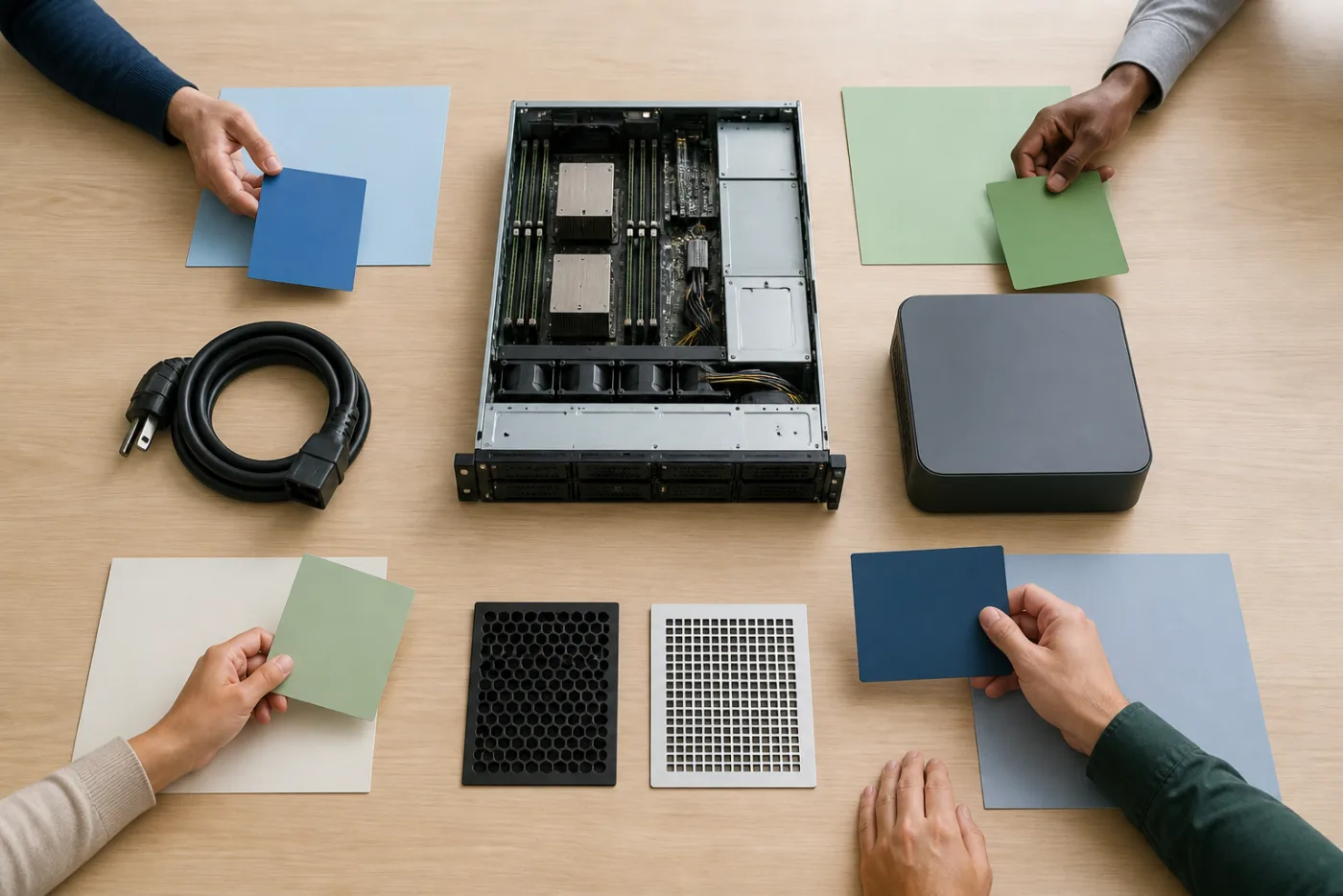
Choose the comparison period first. Comparing a monthly cloud bill directly with a server purchase price mixes operating and capital costs. Set a 12- or 36-month window, then model low, expected and high usage. Include a declining-demand case instead of assuming every pilot will grow. Show both total cash outlay and the internal staff time required.
In the cloud column, list instance charges, reservations or commitments, storage, snapshots, network transfer, managed services, monitoring and premium support. In the on-premises column, list hardware, tax and freight, racks, switches, cabling, electrical work, cooling, software, maintenance, labor, post-warranty repair and estimated residual value. Put security review and disaster-recovery exercises in both columns.
Test performance with representative work, not a single vendor peak benchmark. Use the same input set, quality threshold and concurrency to record throughput, latency, failure rate, out-of-memory events and cost per completed unit. Preserve the model version, framework, driver, numerical precision, batch size and test date so another team can reproduce the result.
The right choice is not automatically the fastest one. It is the option that meets the required quality while preserving enough flexibility for change. Highly variable demand may favor cloud capacity. Sustained high utilization, appropriate facilities and experienced operations staff may support an on-premises case. If sensitive data appears to require local hardware, also test whether de-identification or a dedicated cloud environment can meet the requirement more simply.
NVIDIA’s 10-Q says its revenue is concentrated among a limited number of direct and indirect customers and that the trend may continue. One direct customer accounted for 16% of total revenue in the second quarter. This does not imply wrongdoing by any customer. It means the investment schedule of a few very large buyers can influence supply-chain activity and market capacity. Smaller buyers should not treat broad statements about demand as a confirmed delivery date.
The filing says NVIDIA enters arrangements with suppliers and capacity providers to support long-term demand. It warns that the company may be unable to reduce some commitments if demand does not meet expectations. It also describes support for customer and partner AI infrastructure where the company may not have sufficient demand or the operational ability to use or resell all committed capacity. For buyers, this is a reason to plan for both shortage and a rapid increase in supply that changes prices or product generations.
Review price-protection language, upgrade or substitution rights after a new generation arrives, cancellation fees, partial delivery and acceptance tests. A phrase such as “equivalent or better” can be ambiguous. Specify the minimum memory capacity, bandwidth, interconnect, power ceiling and supported software your workload requires.
Export controls are not relevant only to a company physically shipping hardware overseas. A provider may need to consider the cloud region, customer headquarters, ultimate user, remote-access location and resale structure. If you serve users outside the United States or have multinational staff accessing the system, ask the provider for current written availability and use restrictions before signing.
NVIDIA’s 10-Q discusses U.S. export licenses, Chinese government restrictions, U.S. inspections and tariffs affecting data-center products for China. The company said it recognized a $0.4 billion charge related to H200 excess inventory and purchase obligations during the first half of fiscal 2027. That statement does not mean a particular consumer product is unsafe. It illustrates how fast-changing rules can affect inventory, price and support paths.
Do not rely only on a sales presentation for a current legal determination. Product model, performance, destination, end use and ultimate user can change the answer. Ask the organization’s contract owner, export-control professional or legal counsel to verify the current requirements. This article is not export-control legal advice.
No such conclusion follows from the release. Company-wide revenue and gross margin do not directly predict a particular model’s retail price, cloud-instance rate or local inventory. Price varies with product generation, provider, commitment, region, support and facility requirements. Obtain at least two comparable quotes with the same specifications and date.
If the workload has not been measured, a limited cloud pilot may preserve flexibility. Sustained high demand, strict data-location requirements, experienced operations staff and suitable facilities can strengthen an on-premises case. Decide from demand stability, total cost, security and recovery capability—not company size alone.
Consider it after baseline demand has remained stable for several months, the chance of changing the model, region or provider is low, and the business can absorb unused capacity. Read minimum use, prepayment, automatic renewal, capacity guarantee, transferability and early-termination terms together with the discount.
No. Public benchmarks are a starting point, but your model, context length, batch size, precision, framework and latency target can change the outcome. Run a short proof with representative work and measure quality, throughput, cost and power together.
This article is not investment advice. Earnings materials combine current results and forward-looking statements, while a security’s price reflects expectations, risk, interest rates, competition, regulation and many other factors. Review the full filing and your own financial circumstances, and consult a qualified professional if needed.
Keep the requirements sheet, representative benchmark, three usage scenarios, total-cost model, security review, data-flow diagram, power and cooling approval, quotes, contract, support terms and exit plan. Record the final rationale, approver and date so a renewal can be evaluated against the original assumptions.
The Smartor Editorial Team organizes public, official information into steps readers can verify and use. This article does not replace investment, legal or tax advice.
브라우저 메뉴에서 앱 설치 또는 홈 화면에 추가를 선택해 주세요.
[…] Read this AI infrastructure guide in English → […]