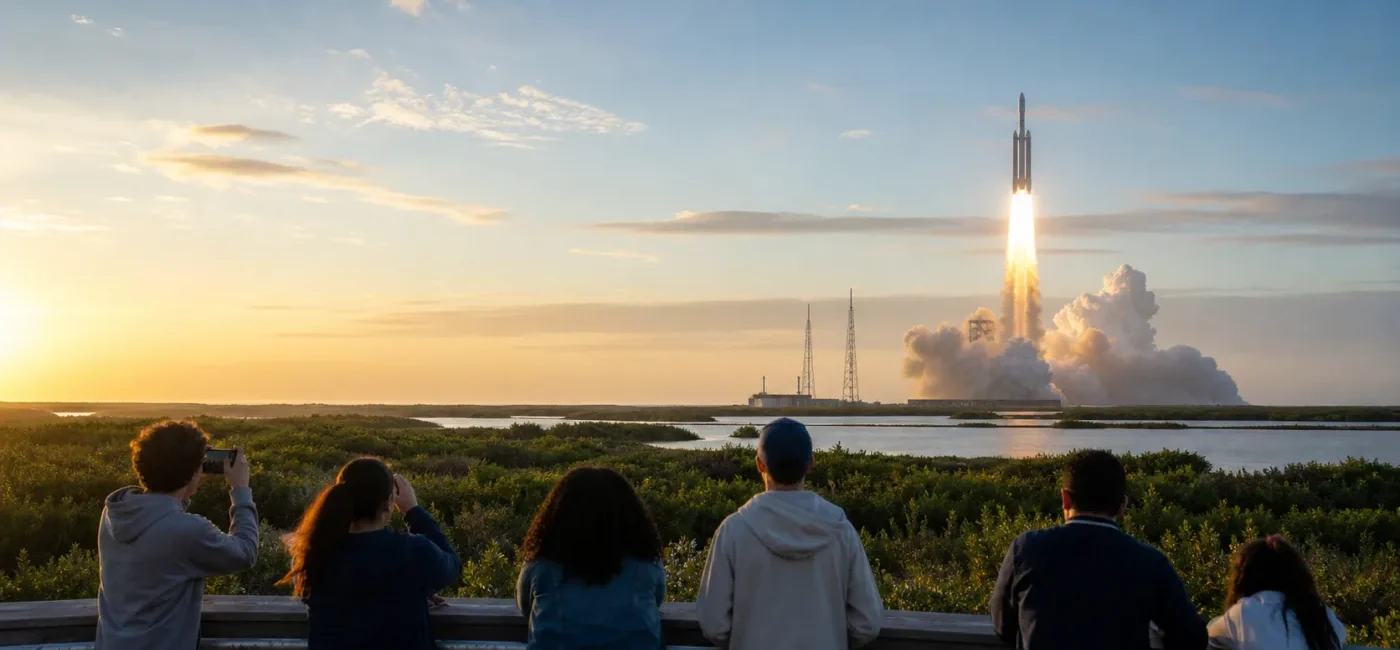
Roman Space Telescope Launch: Time, Livestream and Viewing Guide
Smartor 편집팀
August 25, 2026

NASA’s Nancy Grace Roman Space Telescope is scheduled to launch from Florida on Sunday, August 30, 2026. NASA is targeting 7:26 a.m. EDT for liftoff, with live coverage beginning at 6:20 a.m. The observatory will ride a SpaceX Falcon Heavy from Launch Complex 39A at NASA’s Kennedy Space Center. The time is a target, not an immutable appointment: NASA describes it as “no earlier than,” and weather, technical work, or range operations could move the time or date.
Roman is an uncrewed, next-generation infrared observatory built to investigate dark energy, dark matter, exoplanets, galaxies, black holes, and many other targets. Its defining advantage is a field of view at least 100 times larger than Hubble’s while retaining sharp imaging. This guide explains when to watch in every major U.S. time zone, how to find the authentic livestream, how to interpret a hold or scrub, what happens after liftoff, and why the mission matters.
On August 24, NASA released its coverage plan for Roman’s prelaunch briefings, launch broadcast, and postlaunch news conference. A mission science briefing is scheduled for 9 a.m. EDT on Saturday, August 29, followed by a prelaunch news conference at 10:30 a.m. On Sunday, NASA plans to begin launch coverage at 6:20 a.m., target liftoff at 7:26 a.m., and hold a postlaunch news conference at 9:30 a.m. All of those times are Eastern and remain subject to real-time operations.
The observatory is named for Nancy Grace Roman, NASA’s first chief astronomer and a central advocate for what became the Hubble Space Telescope. Roman combines sharp infrared vision with a much wider field of view. NASA says it can see an area of sky at least 100 times larger than Hubble can in a single view. That makes it particularly well suited to consistent, large-scale surveys rather than only close studies of one target at a time.
Roman’s principal science hardware includes the Wide Field Instrument and a Coronagraph Instrument technology demonstration. The wide-field camera will collect infrared images across large regions for studies of cosmic expansion, galaxy structure, gravitational lensing, stellar populations, and exoplanets. The coronagraph is designed to suppress the glare of a star so much fainter planets and disks near it can be studied. Roman should not be treated like a consumer camera that sends down a finished picture on demand; observing plans, transmission, calibration, processing, and scientific validation all come before a polished data product.
The time-zone conversion matters most for viewers in the western United States. A 7:26 a.m. Eastern target is 4:26 a.m. Pacific. In South Korea, the same target falls at 8:26 p.m. KST on August 30. NASA’s broadcast is scheduled to begin 66 minutes before liftoff, so anyone who wants the commentary and final countdown should save both the coverage time and the launch target instead of setting a single alarm.
A launch may be visible from many miles away, but that does not make every roadside shoulder, private lot, beach access, or wildlife area a legal viewing location. In-person viewers should use a designated public site and verify its opening time, parking rules, ticket requirements, and restrictions with the venue or local authority. Delays are a normal possibility in launch operations, so flexible lodging, transportation, and refund plans are sensible. Never cross a security boundary or police closure, and do not stop abruptly on a highway to take a photo.
The launch provides a timely way to explain infrared astronomy, cosmic expansion, gravitational lensing, exoplanet detection, and Lagrange points. It is important, however, to separate launch success from mission success. Safe separation from the rocket is an essential first milestone; navigation, communications, deployment, thermal stabilization, optical alignment, calibration, and commissioning follow. A classroom explanation should distinguish the dramatic launch from the much longer process that makes accurate science possible.
Roman’s broad survey archive is intended to become a resource beyond the teams that planned its headline investigations. NASA says the mission’s science data will be publicly available after processing. Large, uniform data sets can support research on galaxy evolution, stellar populations, moving objects in the solar system, and time-variable phenomena in addition to dark energy and exoplanets. Public availability does not mean the archive will be complete immediately after launch; researchers must follow the mission’s official observation and data-release schedules.
Set one alert for 10 minutes before coverage begins and another for 10 minutes before the launch target. The coverage and launch times are 6:20 and 7:26 a.m. Eastern; 5:20 and 6:26 a.m. Central; 4:20 and 5:26 a.m. Mountain; and 3:20 and 4:26 a.m. Pacific. In South Korea they are 7:20 and 8:26 p.m. KST. If you are traveling or have manually changed your phone’s time zone, check the calendar setting before relying on the alert.
Use NASA Live, the NASA Roman mission page, and the launch blog linked by NASA. Going directly to the source reduces the risk of landing on a rebroadcast wrapped in intrusive ads or a fake stream that asks for credentials, payment, cryptocurrency, or a browser extension. NASA’s public launch coverage does not require an investment account or a crypto transfer.
Launch operations do not always follow a television listing. Confirm that the date and time remain current the night before, then look for official language such as “on schedule,” “hold,” “scrub,” or “new launch opportunity” on launch morning. A hold may be a temporary pause and does not necessarily mean cancellation. A scrub means that day’s attempt has ended. If that happens, wait for NASA to announce the next target rather than assuming the rocket will try again exactly 24 hours later.
Verify whether the designated viewing site requires a reservation or ticket, when its parking lot opens, what items are prohibited, whether reentry is allowed, and what accessibility services are available. Bring water, sun protection, insect repellent, and a charged battery pack. Families should choose a meeting point in case they become separated. Arrive with enough time to avoid the temptation to park on a shoulder, but do not camp near a secure facility earlier than the responsible agency permits.
NASA plans to make on-demand video and launch photos available after liftoff. If an early alarm or unreliable connection prevents live viewing, there is no need to download a questionable recording. For classroom, blog, or presentation use, check the usage terms attached to each NASA asset and provide the requested credit. SpaceX and third-party media may have separate terms. The two visuals in this Smartor article are original AI-generated illustrations created for this topic, not copied press photographs.
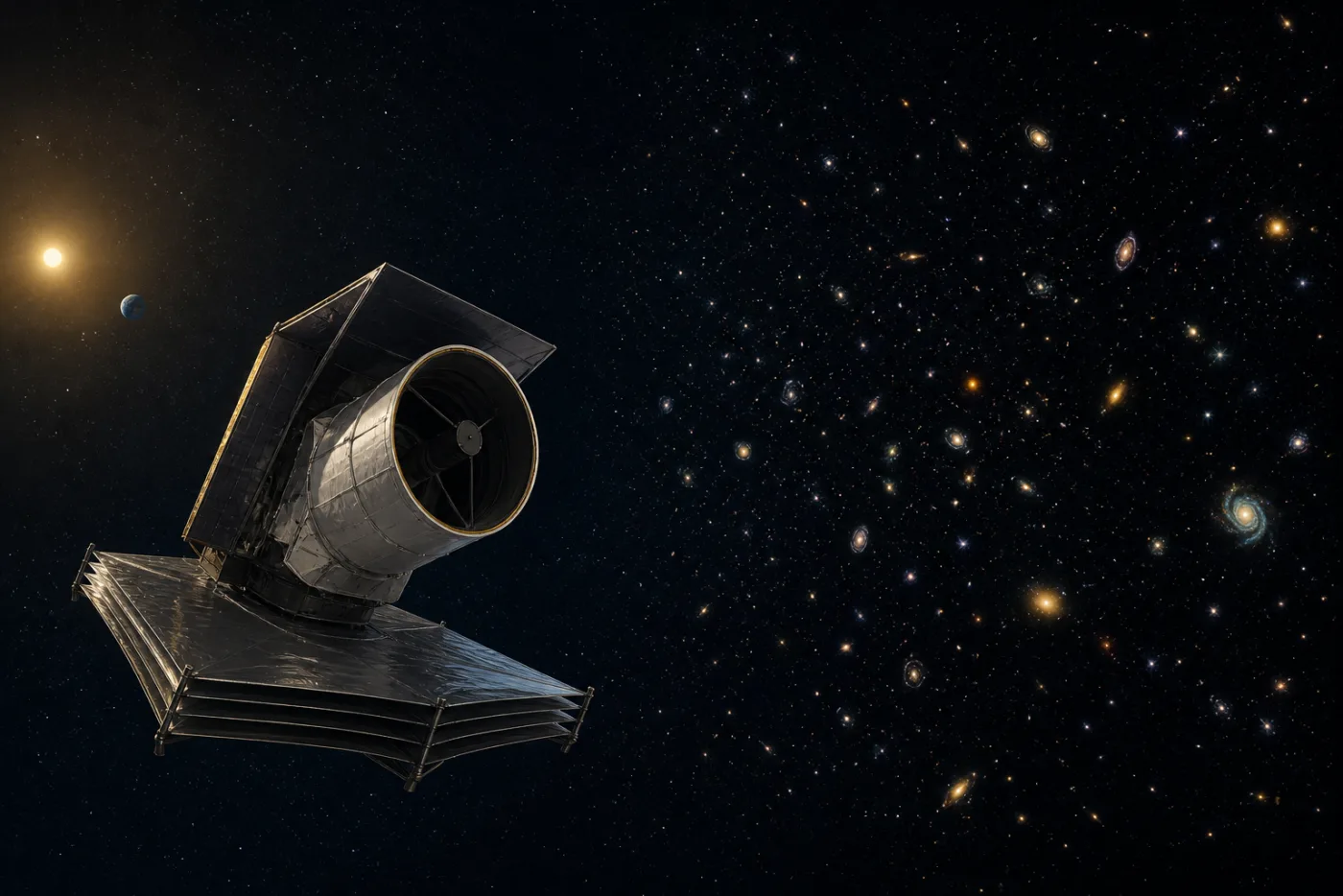
For viewers, the most visible stages are liftoff, the burn of the booster cores, upper-stage flight, payload-fairing separation, and deployment of the observatory. Not every milestone will necessarily have a live camera view. Mission controllers rely on telemetry from the rocket and spacecraft, not only on broadcast images. A temporary video interruption or loss of a ground-camera view is not evidence of failure; wait for confirmation from NASA and the launch provider.
After separation, Roman will head toward the second Sun-Earth Lagrange region, or L2, about one million miles from Earth. L2 offers a useful combination of thermal stability, communications geometry, and access to the sky. The spacecraft will not simply sit motionless on a mathematical point; it will operate in a planned orbit around the L2 region. During the trip and early operations, controllers will monitor communications, power, attitude control, and observatory health.
Before science operations, teams must bring the telescope and detectors into their intended operating state, verify focus and optical performance, and calibrate the instruments. A finished cosmic map should not be expected within days of launch. NASA will announce milestones such as commissioning progress and first observations through mission updates. If the launch date changes, downstream milestones may move as well.
Roman has a five-year primary mission and a goal of operating for 10 years. Actual longevity will depend on spacecraft health, consumables, instrument performance, and future operational decisions. The mission should not be judged only by a single spectacular image. Its major scientific value comes from repeated, consistent measurements across large areas of the sky—data that can reveal statistical patterns in cosmic expansion, galaxy structure, and planetary populations.
Hubble is famous for extremely sharp observations of relatively narrow fields. Roman is designed to combine comparable sharpness with a field of view at least 100 times larger, allowing it to survey the sky far more efficiently. That does not mean Roman simply replaces Hubble or the James Webb Space Telescope. Wide Roman surveys can identify compelling objects and patterns that Webb, Hubble, ground-based facilities, or future missions can examine in greater detail.
Roman also plans to use gravitational microlensing to build a statistical picture of planets in the Milky Way. When the gravity of a foreground object briefly magnifies a more distant star, the resulting light curve can reveal planets—including worlds in orbits that other techniques may miss and candidates that travel without a host star. Its coronagraph technology demonstration will test ways to suppress starlight and isolate much fainter nearby planets and disks, helping prepare techniques for future direct-imaging missions.
For dark energy and dark matter studies, Roman will measure evidence encoded in galaxy distributions, supernovae, and the way gravity distorts light. It would be misleading to say the telescope will simply “photograph dark matter.” A more accurate description is that scientists will use the positions, brightness, distances, and distorted shapes of visible objects to constrain the properties of components that cannot be seen directly.
When checking a social account, look beyond the display name and verify that its links lead to nasa.gov or science.nasa.gov. A shared schedule graphic can become outdated, especially if its posting date or time-zone label has been cropped away. After a delay, old August 30 graphics may continue circulating; rely on the newest primary-source update.
NASA is currently targeting August 30, 2026, at 7:26 a.m. EDT. That is 6:26 a.m. Central, 5:26 a.m. Mountain, 4:26 a.m. Pacific, 11:26 UTC, and 8:26 p.m. KST. Coverage is scheduled to begin at 6:20 a.m. EDT. Recheck NASA’s official page before the broadcast because the target can change.
Yes. NASA provides official online programming through NASA Live and NASA+. A page demanding a payment, crypto transfer, special investment account, or suspicious browser extension is not necessary for NASA’s public coverage. Going directly to nasa.gov/live is the simplest route.
Not necessarily. Teams must reassess vehicle readiness, spacecraft requirements, range availability, weather, and trajectory constraints before announcing another opportunity. After a scrub, replace your calendar alert only when NASA publishes the new date and coverage time.
No. Roman is optimized for wide infrared surveys, while Webb offers extraordinary sensitivity and detailed imaging and spectroscopy for narrower targets. Roman, Webb, Hubble, and ground-based observatories can complement one another by discovering, characterizing, and following up different aspects of the same cosmic populations.
No. Roman must travel toward L2, establish stable operations, and complete commissioning and calibration before routine science. The first-observation schedule cannot be determined from the launch broadcast alone. Follow NASA’s mission updates for confirmed milestones.
A sharp, repeated survey of large areas can create samples that are impossible to build efficiently from one narrow field at a time. Those data can support research into cosmic expansion, dark energy, the distribution of dark matter, exoplanet populations, galaxies, stars, and changing objects. NASA’s plan to make processed science data public should allow the archive to support investigations well beyond the mission’s original headline questions.
브라우저 메뉴에서 앱 설치 또는 홈 화면에 추가를 선택해 주세요.
[…] Read this guide in English → […]