
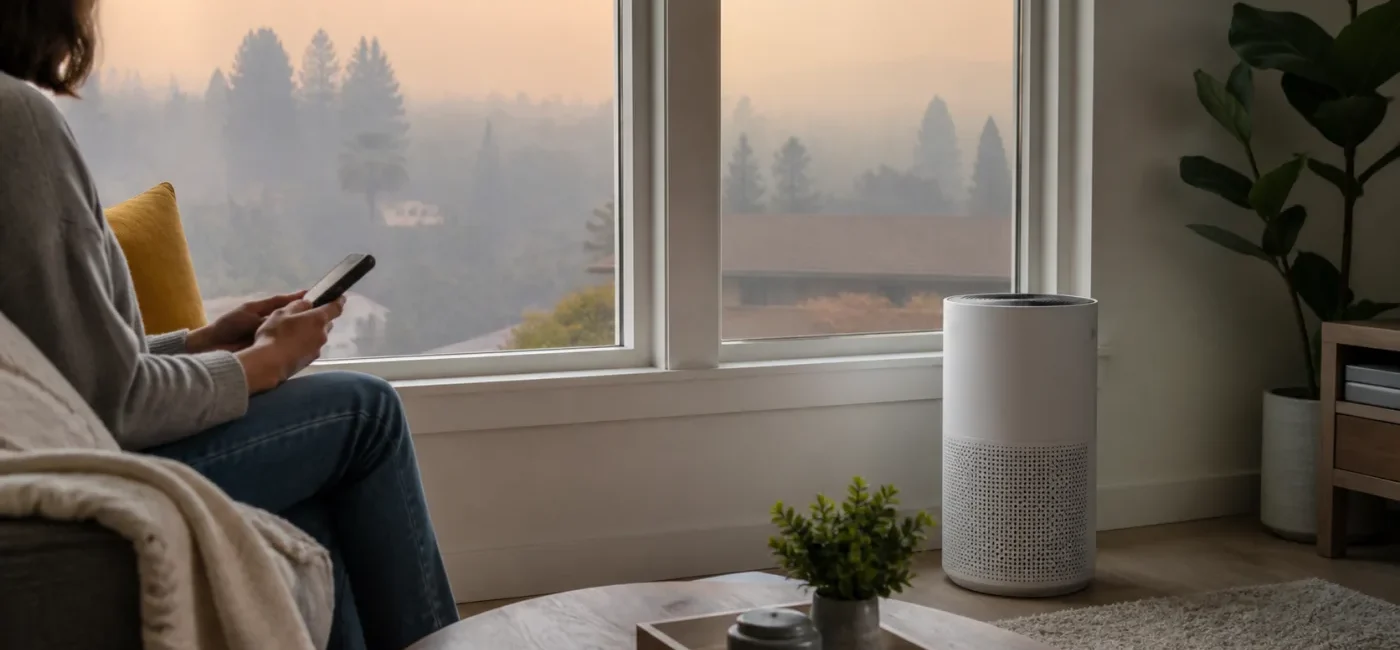
Wildfire smoke can cross state lines and affect communities hundreds of miles from the flames. When the view outside turns hazy or the air smells smoky, the practical questions arrive quickly: Are closed windows enough? Should the air conditioner stay on? Does every home need a portable air cleaner? The right answer depends on how your home is cooled, whether outdoor air enters through the HVAC system, the filter your equipment can handle, and the health needs of the people in your household.
The basic strategy is consistent: check official local air-quality information, create a cleaner-air room, reduce particles generated indoors, and move to a cleaner and cooler location if your home cannot remain safe. The U.S. Environmental Protection Agency advises households to keep doors and windows closed during a smoke event, use recirculation when the system allows it, and consider a MERV 13 filter—or the highest-efficiency filter the system can accommodate. AirNow’s Fire and Smoke Map is a useful starting point for current fire, smoke, and air-quality conditions.
The first 10 minutes after a smoke alert
- Check your exact location on AirNow. Use your ZIP code or the map rather than relying on a national headline. Smoke conditions can vary within the same county.
- Check local emergency alerts too. Local authorities and fire officials provide evacuation, road, power, and shelter instructions. An air-quality map does not replace those notices.
- Close doors and windows. If the home begins to overheat, do not treat sealing the house as the only goal. Prepare to move to a cleaner, air-conditioned location.
- Review the HVAC or air-conditioner setting. Use “recirculate” and close an outdoor-air damper when the equipment is designed to allow it. Do not improvise by blocking components contrary to the manufacturer’s instructions.
- Choose a cleaner-air room. A room with fewer exterior openings, enough space for the household, and safe cooling is usually easier to manage.
- Run an appropriate air cleaner or compatible filter. Avoid devices intentionally designed to generate ozone.
- Stop making extra particles indoors. Avoid smoking, candles, incense, fireplaces, frying, high-heat cooking, and unnecessary vacuuming while smoke is severe.
- Limit trips outside. If you must go out, consider a well-fitting N95 respirator. Do not assume a loose face covering provides the same particle protection.
How to read the AQI and smoke map without overinterpreting it
The Air Quality Index turns several pollutants into a public-health communication scale. Fine particles are often the main concern during wildfire smoke, but one outdoor number cannot tell you exactly what the air is like in every room of your home. Regulatory monitors and lower-cost sensors can use different methods and corrections, and conditions can shift with wind and time. Treat the current health guidance and the hourly trend as more useful than a screenshot taken hours ago.
Smell is not a complete monitor either. Particle levels may remain elevated after the odor becomes less obvious, while people who are especially sensitive may notice odors at lower levels. Use official data, observe whether anyone develops coughing, wheezing, throat or eye irritation, or shortness of breath, and follow individual medical plans. If you own an indoor particle monitor, it can be most useful for comparing changes—after a door opens, a filter starts, or cooking occurs—rather than treating one consumer-device reading as a medical verdict.
Build a cleaner-air room step by step
Step 1: Choose the room
Select a bedroom or living area with relatively few windows and exterior doors, enough space for the household, and a safe source of cooling. Reducing obvious gaps can help, but do not blindly seal every vent or anything related to a fuel-burning appliance. Interfering with required combustion air or exhaust can create a different hazard. If you do not understand the equipment, ask the building manager or a qualified HVAC professional.
Step 2: Reduce outdoor-air intake
For central HVAC, learn whether the system has a fresh-air intake and use the normal recirculation setting or outdoor-air damper as the instructions allow. For a window air conditioner, close the outdoor-air damper if possible and check the seal around the window. A single-hose portable air conditioner can exhaust indoor air and draw replacement air through other leaks, so it deserves extra caution during heavy smoke. Evaporative coolers bring substantial outdoor air inside; consult EPA guidance for the equipment and consider another cooling option when feasible.
Step 3: Filter particles
A portable air cleaner should be sized for the room where it will operate. Check the manufacturer’s recommended room size, filter replacement process, and ozone information rather than relying only on marketing language. Leave open space around the intake and outlet instead of hiding the unit behind furniture or curtains. Prioritize the room where people spend the most time instead of assuming one small unit can clean an open-plan home.
With a central system, the highest number is not automatically the best filter. EPA recommends considering MERV 13 or the highest rating the system fan and filter slot can accommodate. A filter that creates too much resistance can reduce airflow in some systems. Confirm compatibility, make sure the filter fits without large gaps, and inspect it more often during smoke events because it may load faster than it does in ordinary conditions.
When a commercial air cleaner is unavailable: a DIY box-fan filter
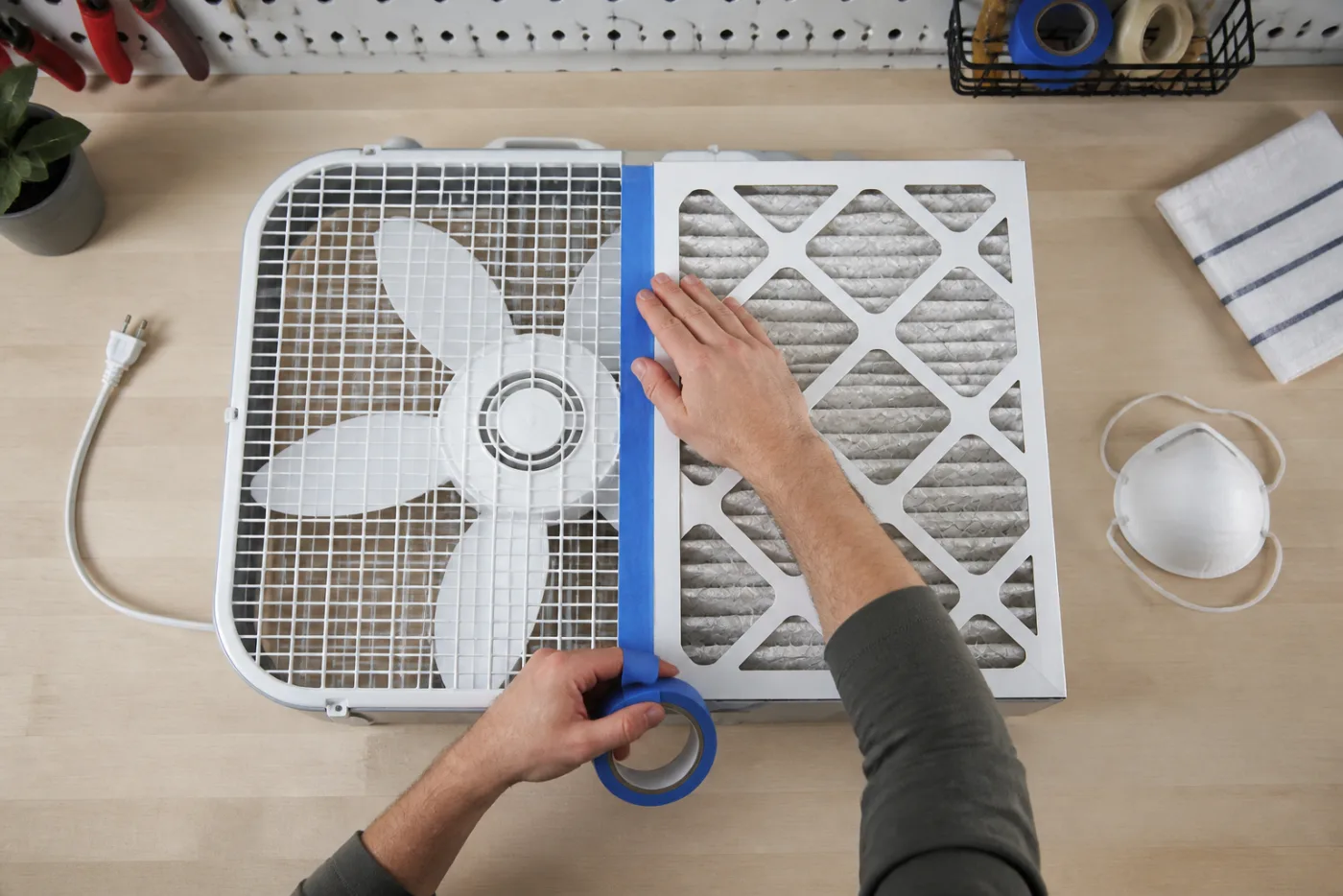
EPA describes a do-it-yourself air cleaner as a temporary option when a known-performance commercial unit is unavailable or unaffordable. A basic design attaches a same-size high-efficiency furnace filter to the back of a box fan. Designs with multiple filters arranged as a triangle or cube can provide more filter area. DIY units vary in performance with construction quality and are not recommended as a permanent substitute for tested commercial products.
- Use a normally functioning box fan made in 2012 or later when possible, and look for a UL or ETL safety mark.
- Choose a filter that matches the fan dimensions, preferably MERV 13 or higher when available and suitable for the design.
- Place the filter so its airflow arrow points in the direction air moves through the fan.
- Seal the filter to the fan with tape, brackets, or a secure strap without blocking the cord or required motor ventilation.
- Follow the fan manufacturer’s instructions. Do not use a damaged fan or extension cord, and do not leave children unattended with the device.
- Replace a visibly dirty filter or one that begins releasing smoke odors. There is no single replacement interval because smoke concentration and run time vary.
Whether to run a DIY device while sleeping or away from home depends on the fan manufacturer’s instructions and EPA safety guidance. EPA advises that an older pre-2012 fan, if it must be used, should not operate unattended or during sleep. Stop the fan and unplug it if it becomes unusually hot or develops a strange sound or odor. A DIY filter does not make it safe to open smoky windows or generate additional smoke indoors.
When an N95 helps—and what it cannot do
If an essential trip outside cannot wait, a well-fitting N95 respirator can reduce exposure to the fine particles in wildfire smoke. Mold the nosepiece, cover the nose and chin, and check for obvious gaps. Facial hair and loose straps can compromise the seal. Adult respirators may not fit children properly. People with heart or lung conditions should follow medical advice about respirator use, and anyone who becomes dizzy or has difficulty breathing while wearing one should move to cleaner air and seek appropriate help.
An N95 does not eliminate every wildfire hazard. A standard particulate N95 is not designed to remove all hazardous gases and vapors, provide oxygen, or protect a person close to flames. It is not firefighting equipment and should never be treated as permission to enter a smoke-filled area. Minimize time outdoors, follow evacuation orders, and comply with instructions from responders.
Extra planning for children, older adults, pregnancy, and chronic conditions
CDC identifies children, pregnant people, and people with chronic conditions—including heart and lung disease—as groups that can face greater risk from wildfire smoke. Prepare before the sky turns hazy: know where medications and inhalers are, keep medical contacts available, and identify a place with cleaner air and safe cooling. Do not increase or decrease prescription medication on your own. Follow the asthma or condition-specific action plan provided by the person’s clinician. Smartor’s emergency medication and medical information kit guide can help organize those supplies.
- Does the household recognize each person’s usual symptoms and warning signs?
- Are inhalers, spacers, medicines, and other essential supplies easy to find and not expired?
- Are clinician, pharmacy, insurance, and emergency contacts stored on paper as well as on a phone?
- If the home becomes hot or filtration is not enough, is there a library, community clean-air or cooling center, or trusted home you can use?
- Can pets come with you, and are their carriers and supplies ready?
Practical example: a four-person household faces worsening evening smoke
Consider two parents, a middle-school student with asthma, and an older adult living together. When the smoke map worsens in the afternoon, they close exterior openings, review the kitchen ventilation, and choose an air-conditioned bedroom with one door as their cleaner-air room. They set central HVAC to recirculate according to the system instructions, verify that the compatible filter is seated correctly, and run a room-sized portable air cleaner at a higher setting. Dinner changes from frying to a simple microwave meal to avoid adding particles.
They place the student’s inhaler and action plan, the older adult’s medicines, water, chargers, and N95s in one location. One adult checks AirNow and local emergency notices every hour or two; another watches the indoor temperature and symptoms. Before bedtime, the family agrees that inadequate cooling or worsening respiratory symptoms will trigger a move to a relative’s cleaner home or an officially listed clean-air or cooling space. In the car, they use recirculation when appropriate and minimize stops.
The most valuable part of the plan is not an expensive device. It is the decision made in advance about roles, thresholds, and a backup location. “We will decide if it gets worse” leaves each person with a different standard. Decide who gathers medication, who monitors official alerts, and what will trigger a move. For broader disaster documentation, the home inventory and insurance recovery checklist can help record belongings and essential documents before an emergency.
Nine common indoor-air mistakes
- Assuming weak odor means safe air: Use official air-quality data and the current health guidance.
- Keeping the house sealed while it dangerously overheats: Heat is also a hazard. Have a cleaner, cooler backup location.
- Treating every air conditioner the same: Central, window, single-hose, dual-hose, and evaporative systems move outdoor air differently.
- Installing the highest-MERV filter without checking compatibility: Confirm airflow, fan capacity, slot size, and a snug fit.
- Running an ozone-producing air-cleaning mode: Ozone can irritate the lungs. Avoid devices intentionally designed to generate it.
- Expecting one small purifier to clean an open house: Start with a closed priority room and match the unit to that space.
- Building a DIY unit from an old or damaged fan: Safety marks, an intact cord, supervision, and manufacturer instructions matter.
- Wearing an N95 loosely or treating it like any cloth mask: Fit is essential, and a particle respirator still has limits.
- Watching only the air-quality map and missing an evacuation notice: Monitor local emergency management and fire authorities too.
A one-day household operating checklist
- Recheck the AirNow Fire and Smoke Map and local emergency alerts throughout the day.
- Inspect the cleaner-air room’s doors, windows, temperature, and air-cleaner intake.
- Confirm HVAC recirculation and look for a wet, damaged, or heavily loaded filter.
- Avoid smoking, candles, incense, fireplaces, high-heat cooking, and unnecessary vacuuming.
- Stay hydrated, reduce strenuous outdoor activity, and watch for changes in symptoms.
- Keep medications, action plans, contacts, N95s, chargers, and pet supplies ready to move.
- Leave if the home becomes too hot, symptoms worsen, or officials direct you to evacuate.
FAQ
Should I tape every window and vent shut?
Reducing obvious leaks may help, but blindly blocking every vent or anything around fuel-burning equipment can create other safety problems. Use normal HVAC recirculation settings when available, follow equipment instructions, and keep smoke and carbon-monoxide alarms working.
Will an ionizer or ozone setting clean smoke faster?
EPA advises against air cleaners that intentionally generate ozone. The safer objective is to filter particles, limit outdoor-air entry, and reduce indoor particle sources. Review tested performance, recommended room size, filter type, and ozone information before using a device.
Can I run the air conditioner?
Cooling can prevent dangerous overheating, but systems handle outdoor air differently. Check recirculation and dampers on central systems, the outdoor-air setting and window seal on window units, hose configuration on portable units, and the high outdoor-air intake of evaporative coolers. Ask a building manager or HVAC professional if you are unsure.
What should I do in a car?
Close the windows, use recirculation when appropriate, and minimize time in the smoke. A vehicle cabin filter does not turn a parked car into a long-term shelter. Follow official routes and evacuation instructions.
When should I seek medical help?
Follow the individual’s medical action plan. Contact a healthcare provider for worsening cough, wheezing, shortness of breath, or other concerning changes. Use emergency services for severe breathing difficulty, chest pain, confusion, or another immediate danger. An online guide cannot diagnose the cause of symptoms.
Can I open the windows as soon as the smell fades?
Check AirNow and local trends rather than relying only on smell or sky color. Consider ventilation when outdoor air is clearly better, inspect the filters, and clean settled residue carefully with methods that do not send dust back into the air.