
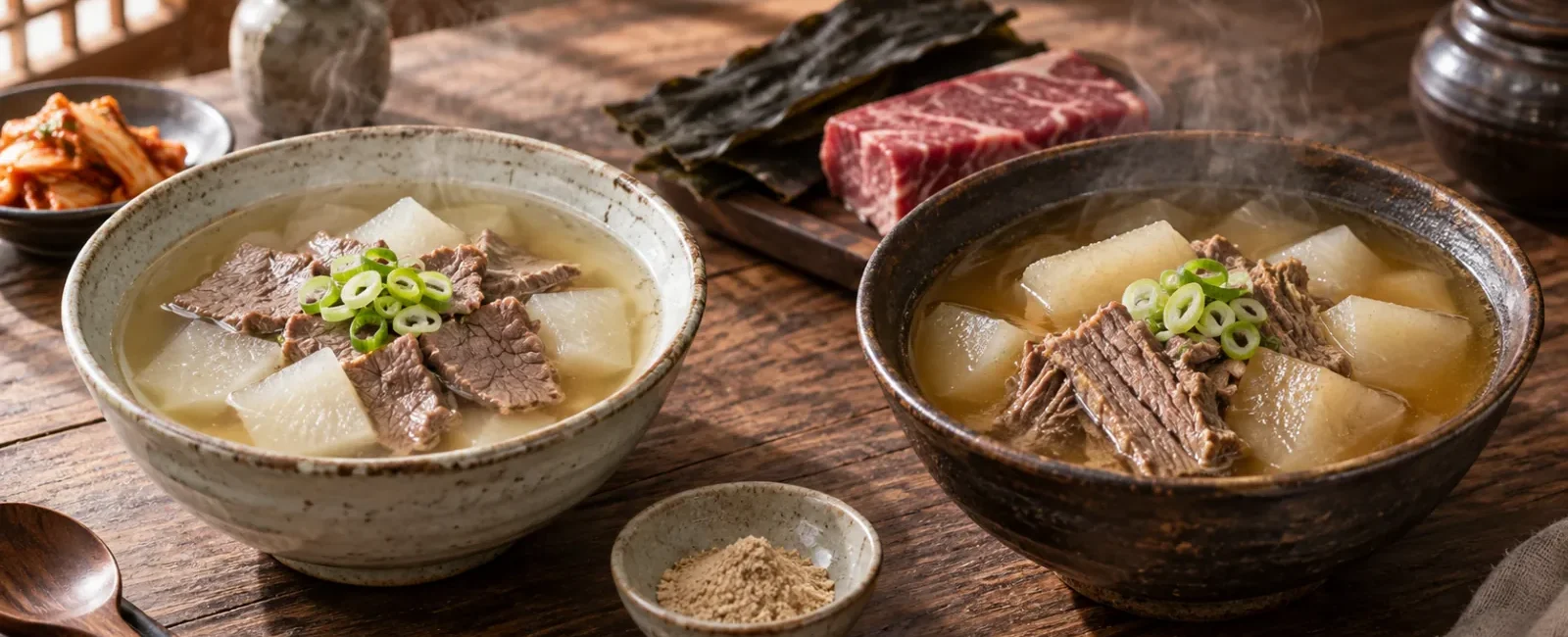
Sogogi muguk is a clear Korean beef and radish soup, but the process behind its flavor is anything but vague. Stir-frying thin beef and radish produces a nutty, focused soup in 30 minutes. Slowly simmering brisket, skimming the surface, and straining the stock creates a clearer broth with flavor that lingers. Both complete recipes below make four servings, or about 1.8 L of finished soup. The quick version shortens stock-making with Korean beef soup powder. The traditional version divides that job among soaking the brisket, steeping kelp and shiitake, gentle simmering, and fine straining. They point in the same savory direction, but they do not taste identical.
Quick comparison: two ways to make sogogi muguk
| Measure | 30-minute quick version | Traditional brisket-stock version |
|---|---|---|
| Yield | 4 servings, about 1.8 L | 4 servings, about 1.8 L |
| Prep / cook / total time | 8 / 22 / 30 minutes | 35 minutes / 1 hour 55 minutes / 2 hours 30 minutes |
| Active time | About 18 minutes | About 45 minutes |
| Difficulty | Easy — control the boil and seasoning concentration | Moderate — skimming, gentle heat, and measuring the stock matter |
| Estimated U.S. Korean-market cost | About $14–18 | About $21–28 |
| Flavor | Immediate beef seasoning with a pronounced toasted sesame aroma | Clear broth in which brisket, radish, kelp, and shiitake unfold in sequence |
| Umami sources | Beef soup powder, soup soy sauce, and browned beef | Brisket inosinate, kelp glutamate, shiitake guanylate, and soup soy sauce |
| Most likely failure | Becoming too salty when the powder and soy sauce are overused together | Cloudy stock from a hard boil or unstable seasoning from unmeasured stock |
| Best occasion | Weeknight breakfast or dinner, last-minute soup, minimal cleanup | Weekend meals, guests, or whenever the stock can be prepared ahead |
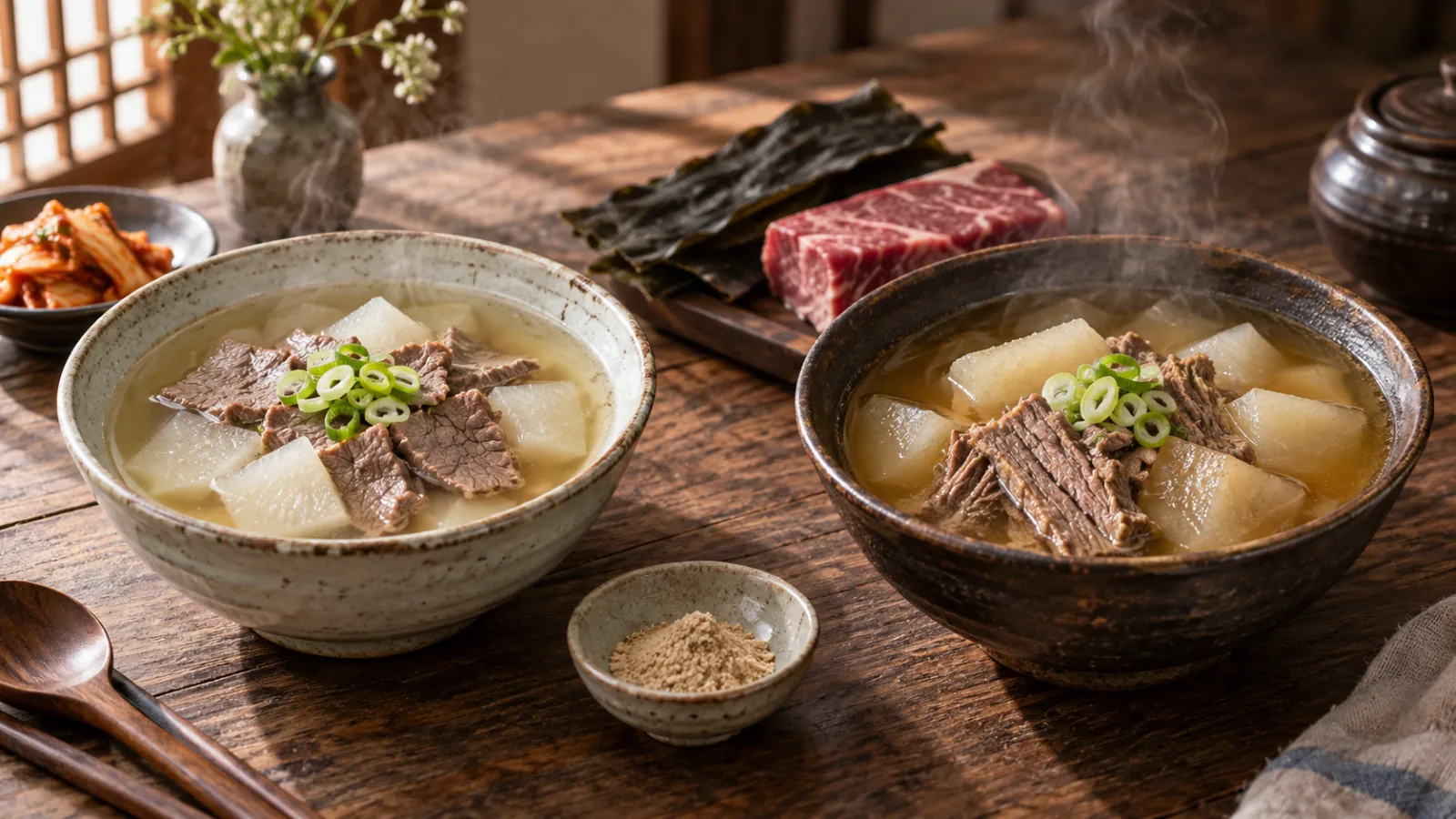
Quick version: 30 minutes with Korean beef soup powder
Exact ingredients — 4 servings
- 300 g thinly sliced beef for bulgogi or shabu-shabu, about 3 mm thick
- 500 g Korean radish, cut into 3 × 4 cm rectangles 3 mm thick
- 1.6 L water
- 12 g Korean beef soup powder, such as Dashida
- 30 ml Korean soup soy sauce
- 15 g minced garlic
- 10 ml toasted sesame oil
- 60 g scallions, sliced 5 mm on the diagonal
- 2 g fine salt
- 0.5 g ground black pepper
Prep 8 minutes · Cook 22 minutes · Total 30 minutes · Active time about 18 minutes
Preparation and cooking
- Do not wash the beef. Blot its surface with paper towels and cut it into 5 cm lengths. Slice the radish to an even 3 mm thickness. Separate the white and green scallion sections.
- Heat a 4 L pot over medium-high heat for 90 seconds. Add 10 ml sesame oil and 300 g beef. Spread the meat out, leave it undisturbed for 1 minute, then stir for 2 more minutes until almost no pink remains on the surface.
- Add 500 g radish and 15 ml soup soy sauce. Stir-fry over medium-high heat for 3 minutes, until the radish edges begin to turn translucent and the browned bits on the pot dissolve.
- Add 1.6 L water and 12 g beef soup powder, then raise the heat to high. When it begins boiling after 6–7 minutes, skim the surface once.
- Reduce to medium-low heat. Leave the lid open by 2 cm and simmer for 10 minutes. Maintain a steady stream of small bubbles rather than a violent boil.
- Add 15 g minced garlic, the remaining 15 ml soup soy sauce, and the white scallion sections. Simmer over medium-low heat for 3 minutes. Check that the broth and beef are at least 74°C/165°F.
- Add the green scallion sections, 2 g salt, and 0.5 g pepper. Simmer for 1 minute, turn off the heat, and rest for 2 minutes. If excessive evaporation occurred, add hot water to restore the finished volume to 1.8 L.
Why it tastes this way: Stir-frying thin beef and radish first dissolves browned beef aromas and radish sweetness into the oil. Korean beef soup powder supplies concentrated savoriness and salinity without a long stock simmer. Because both the powder and soup soy sauce contain salt, the final 2 g salt should not go in early. The result is fast and consistent, but it has less of the gelatin texture and layered mushroom-kelp finish found in the traditional stock.
Traditional version: 2 hours 30 minutes with brisket, kelp, and shiitake stock
Exact ingredients — 4 servings
- 500 g whole beef brisket
- 2 L cold water for soaking the brisket
- 2.2 L fresh water for the stock
- 700 g Korean radish, cut into 3 × 4 cm rectangles 5 mm thick
- 200 g onion, quartered
- 80 g scallions: 50 g white sections for stock and 30 g for finishing
- 20 g whole peeled garlic cloves
- 12 g minced garlic
- 10 g dried kelp, about a 10 × 10 cm sheet
- 15 g dried shiitake mushrooms
- 400 ml water at 50°C/122°F for soaking the shiitake
- 30 ml Korean soup soy sauce
- 15 ml Korean anchovy fish sauce
- 10 ml toasted sesame oil
- 4 g fine salt
- 0.5 g ground black pepper
Prep 35 minutes, including the 20-minute soaks · Cook 1 hour 55 minutes · Total 2 hours 30 minutes · Active time about 45 minutes
Making the stock and soup
- Soak 500 g brisket in 2 L cold water for 20 minutes, changing the water after 10 minutes. At the same time, pour 400 ml water at 50°C/122°F over 15 g dried shiitake and soak for 20 minutes. Thinly slice the mushrooms. Pass their soaking liquid through a coffee filter or damp cheesecloth.
- Place the brisket, 2.2 L fresh water, 200 g onion, 50 g white scallion sections, 20 g whole garlic, and 10 g kelp in a large pot. Heat on high for 12–15 minutes, removing the kelp at 90–95°C/194–203°F, just before a full boil.
- When boiling begins, skim the gray foam thoroughly for 3 minutes. Reduce to low heat, leave the lid open by 3 cm, and simmer for 55 minutes. Keep the stock at 88–92°C/190–198°F, with only small bubbles and a gently moving surface.
- Transfer the brisket to a clean plate, cover, and rest for 10 minutes. Pass the stock first through a fine sieve and then damp cheesecloth to remove aromatics and particles. Add 300 ml filtered shiitake liquid, then enough hot water to measure exactly 1.8 L.
- Slice the brisket 4 mm thick across the grain. Dry the cleaned pot, warm it over medium heat for 1 minute, and add 10 ml sesame oil, 700 g radish, and 15 ml soup soy sauce. Stir-fry for 5 minutes.
- Add the measured 1.8 L stock and sliced shiitake. Bring to a boil over high heat in 6–7 minutes. Reduce to medium-low, leave the lid open by 2 cm, and simmer for 18 minutes. The radish centers should be translucent while the corners remain intact.
- Add the sliced brisket, remaining 15 ml soup soy sauce, 15 ml anchovy fish sauce, and 12 g minced garlic. Simmer over medium-low heat for 7 minutes. Confirm that the thickest beef pieces reach at least 63°C/145°F and remain in the hot broth for at least 3 minutes.
- Add 30 g scallions, 4 g salt, and 0.5 g pepper. Simmer for 2 minutes. Turn off the heat and let the soup stand for 5 minutes so particles settle before dividing the clear broth and solids evenly.
Why it tastes this way: Gentle brisket simmering extracts inosinate and gelatin without emulsifying fat into the broth. Removing kelp before boiling adds clean glutamate without a slippery texture. Shiitake guanylate broadens the savoriness of the beef and kelp; filtering its soaking liquid keeps sand and fine particles out. Stir-frying radish with soup soy sauce for 5 minutes attaches seasoning to its surface and opens its sweetness. These layers linger differently from the immediate impact of soup powder, but they require more time and tighter volume control.
One-to-one traditional replacements for the shortcuts
| Quick ingredient or process | Traditional replacement | Function and real difference |
|---|---|---|
| 12 g Korean beef soup powder | 500 g gently simmered brisket + 10 g kelp + 15 g shiitake and filtered soaking liquid | Powder delivers focused, consistent savoriness quickly. The traditional combination leaves meat, sea vegetable, and mushroom notes in sequence, but does not duplicate the same flavor. |
| 300 g thin beef cooked immediately | 500 g whole brisket soaked 20 minutes + simmered 55 minutes + sliced across the grain | Thin beef cooks quickly and has a stronger stir-fried aroma. Whole brisket flavors the stock and becomes a moist garnish when sliced properly. |
| Powder dissolved directly in 1.6 L water | Skim brisket and aromatics + strain through cloth + measure 1.8 L finished stock | Direct mixing is convenient but offers less control over fat and concentration. Strained, measured stock stays clearer and makes the final seasoning repeatable. |
| 3 mm radish simmered 10 minutes | 5 mm radish stir-fried in soup soy sauce for 5 minutes + simmered 18 minutes | Thin radish softens quickly. Thicker radish releases sweetness gradually while retaining its corners and bite. |
| 15 g minced garlic added for the final 3 minutes | 20 g whole garlic in the stock + 12 g minced garlic for the final 7 minutes | One late addition tastes distinctly garlicky. Dividing it supplies both a rounded stock aroma and a fresher finish. |
Commercial soup powder is a practical way to reduce variation when time is short; it is not inherently inferior. Because it delivers concentrated seasoning and umami together, accurate measuring is essential. The traditional method trades time for direct control over clarity, fat, and the order in which aromas appear.
Failure-proofing sogogi muguk
- The broth is cloudy: Do not maintain high heat after the stock boils. Hold 88–92°C/190–198°F and skim carefully during the first 3 minutes.
- The radish is soft outside but sharp inside: Mixed slice thickness is usually responsible. Use 3 mm for the quick recipe or 5 mm for the traditional one, and cook until the center is translucent.
- The soup is too salty: Measure the quick version’s 12 g powder and 30 ml soy sauce, adding salt only at the end. To correct it, add 200 ml hot water and 100 g radish and simmer for 8 minutes.
- The beef is tough: Limit thin beef to 3 minutes of stir-frying. Simmer brisket for 55 minutes, rest it for 10, and slice firmly across the grain.
- The sesame oil tastes bitter: Do not heat an empty pot until smoking. Preheat over medium for only 1 minute, then add the beef or radish immediately to lower the oil temperature.
- Shiitake overwhelms the soup: Keep dried shiitake at 15 g and use only 300 ml soaking liquid. An earthy, gritty result usually means the liquid was not filtered.
Food safety, storage, and reheating
USDA guidance sets 63°C/145°F followed by a 3-minute rest for whole cuts of beef. Thin beef and simmered brisket exceed that threshold in hot soup, but checking the thickest piece prevents both undercooking and needless overcooking. Do not wash raw beef, which can splash bacteria around the sink. Blot it instead, then wash the cutting board, knife, and tongs with hot soapy water before they touch cooked food.
Do not leave the finished soup at room temperature longer than 2 hours. Divide it among shallow containers no deeper than 5 cm/2 inches and cool promptly to 4°C/40°F or below. Refrigerate for 3–4 days or freeze for 1 month. Frozen radish becomes softer after thawing; for a firmer texture, freeze only the broth and beef, then add fresh radish and simmer for 15 minutes.
Reheat only what you will eat. Stir in a saucepan over medium heat for 5–7 minutes until every part reaches 74°C/165°F. In a 900 W microwave, cover loosely and heat for 2 minutes, stir, then heat 1–2 minutes more. Repeated cooling and reheating works against both flavor and safe temperature control.
Frequently asked questions
Can I use daikon instead of Korean radish?
Yes, at the same 500 g or 700 g weight. Daikon is often wetter and less peppery than Korean mu, so extend the traditional stir-fry from 5 to 7 minutes to evaporate extra surface moisture.
Can regular soy sauce replace Korean soup soy sauce?
Yes, although the broth will be darker and may taste slightly sweeter. Replace 30 ml soup soy sauce with 20 ml regular soy sauce plus 2 g salt. Taste before adding no more than another 2 g salt at the end.
Can I keep the quick version simple without beef soup powder?
Replace the water and powder with 1.2 L unsalted bottled beef broth plus 400 ml water. If the broth is salted, begin with 15 ml rather than 30 ml soup soy sauce. This version will not taste identical to the powder-based one.
How do I remove excess fat?
For immediate serving, chill a ladle in cold water, wipe it dry, and touch its bottom lightly to the surface so fat clings to it. When making ahead, chill the soup fully and lift off the solid fat for the most precise result.
Can I make the traditional stock a day ahead?
Yes. Complete step 4, cool the stock in shallow containers, and refrigerate. The next day, remove solid fat, measure 1.8 L, and continue with the radish stir-fry. Use refrigerated stock within 3 days.
The broth needs more savoriness, not just more salt. What should I do?
For the traditional soup, boil 50 ml additional filtered shiitake liquid for 3 minutes before adding it. For the quick soup, dissolve soup powder in 1 g increments in 30 ml hot broth before stirring it back in. Adding salt first raises salinity much faster than savoriness.
Related Korean recipes and sources
For another application of brisket stock, see quick vs traditional beef miyeokguk. You may also like bottled-sauce vs pear-shiitake bulgogi, quick vs anchovy-kelp doenjang jjigae, and 45-minute vs brisket-stock yukgaejang.