
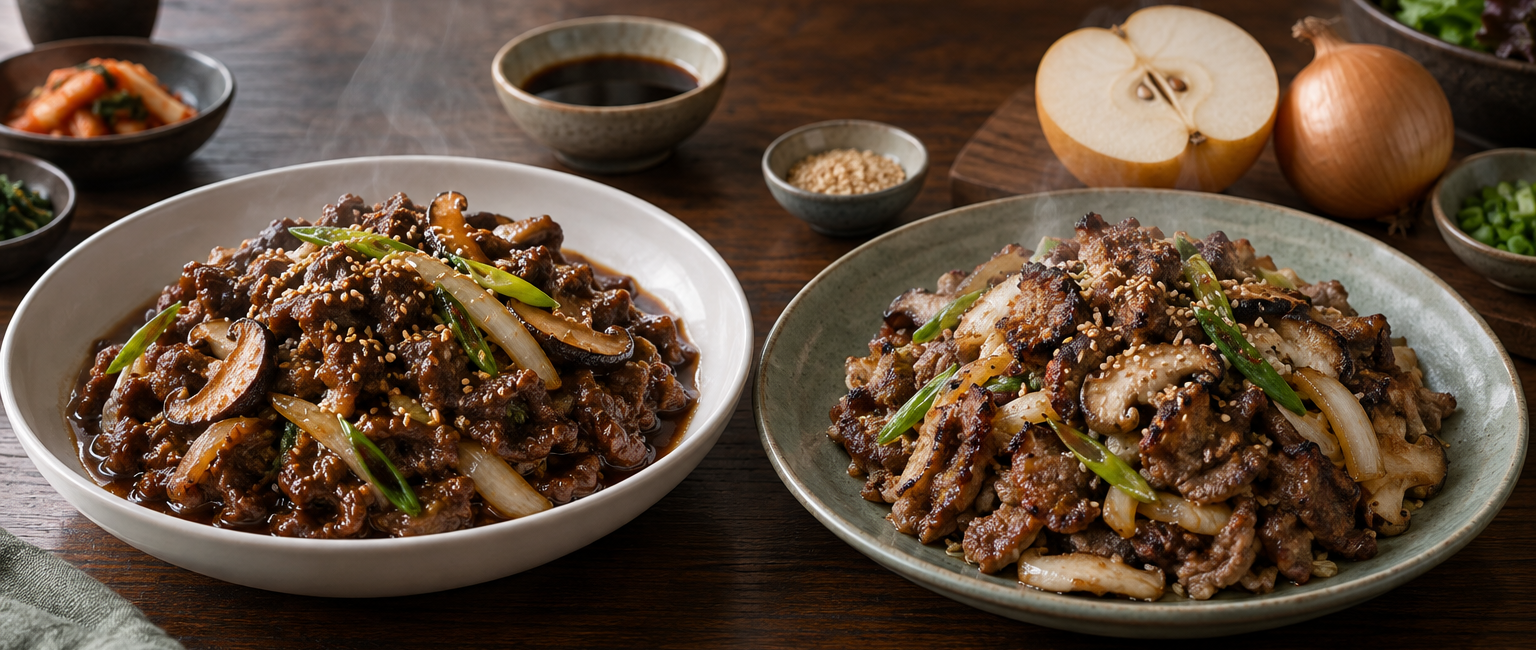
The key to flavorful bulgogi is not just the marinade. A thoroughly heated skillet and uncrowded batches let moisture escape before paper-thin beef turns gray and steamed. Both recipes below make four servings with 800 g beef. The 30-minute quick version uses bottled bulgogi marinade and a small amount of beef-flavor soup stock powder for fast, repeatable seasoning. The traditional version builds its sauce with fresh Asian pear and onion, dried shiitake soaking liquid, a 50-minute refrigerated rest, and three small batches. The quick version is glossy, distinctly sweet-savory, and consistent; the traditional version has gentler fruit sweetness with clearer mushroom and browned-beef aromas.
Quick comparison
| Category | 30-minute quick version | Traditional pear-shiitake version |
|---|---|---|
| Yield | 4 servings, about 1.2 kg finished | 4 servings, about 1.2 kg finished |
| Prep / cook / total | 10 min / 10 min / 30 min, including a 10-minute rest | 20 min / 20 min / 1 hr 30 min, including soaking and marinating |
| Active time | About 20 minutes | About 40 minutes |
| Difficulty | Easy — monitor product salinity and pan moisture | Moderate — strain aromatics, marinate, and cook three batches |
| Estimated U.S. Korean-market cost | About $22–30 | About $25–35 |
| Flavor | Immediate sweet-savory soy flavor and a consistent glaze | Rounded pear sweetness, shiitake aroma, and nutty browned beef |
| Umami sources | Prepared sauce, beef-flavor powder, soy sauce, and beef | Fermented soy sauce, shiitake, browned beef, onion, and garlic |
| Most likely failure | Excess sauce and vegetables steam the beef or make it salty | Fruit pulp burns or an overcrowded pan prevents browning |
| Best situation | Weeknights when measuring and marinating time must be short | Weekend meals or guests when you want direct control of sweetness and browning |
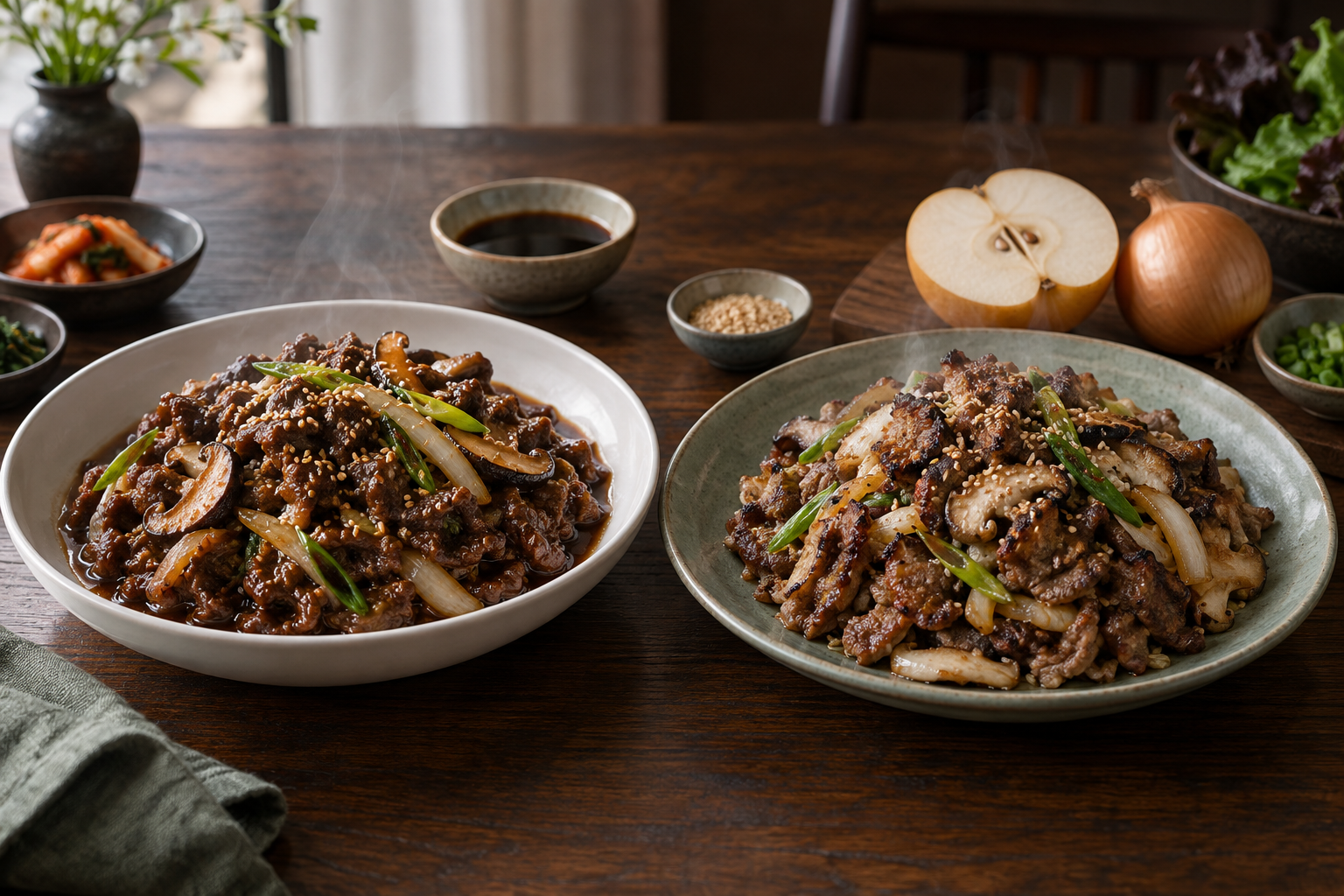
Quick version: 30-minute bulgogi with bottled marinade
Exact ingredients — 4 servings
- 800 g ribeye or sirloin sliced 2 mm thick for bulgogi
- 240 g bottled Korean bulgogi marinade
- 3 g beef-flavor soup stock powder
- 30 ml warm water
- 200 g onion, sliced 7 mm thick
- 160 g king oyster mushrooms, sliced 5 mm thick
- 80 g carrot, cut into 3 mm matchsticks
- 60 g scallions, cut diagonally into 5 cm lengths
- 20 ml neutral cooking oil
- 10 ml toasted sesame oil
- 8 g toasted sesame seeds
- 1 g ground black pepper
Prep 10 minutes · refrigerate 10 minutes · cook 10 minutes · total 30 minutes · active time about 20 minutes
Preparation and cooking
- Blot the beef dry, separate slices that are stuck together, and cut long pieces into 6 cm lengths. Prepare the vegetables to the sizes listed.
- Dissolve 3 g beef-flavor powder in 30 ml warm water and combine it with 240 g prepared marinade. Toss with the beef for 1 minute, cover, and refrigerate for 10 minutes. Do not add salt or sugar; the product already contains both.
- Heat a 30 cm cast-iron skillet or heavy stainless-steel pan over high heat for 2 minutes. Add 10 ml oil. Lift out half the beef with tongs and spread it in one layer, reserving the sauce left in the bowl.
- Leave the beef untouched for 90 seconds, flip, and cook 60 seconds. Add 100 g onion, 80 g mushrooms, and 40 g carrot and stir-fry over high heat for 90 seconds. When several of the thickest pieces reach 63°C (145°F), move the batch to a clean plate and rest it for 3 minutes.
- Use tongs and a damp paper towel to remove only blackened sugar residue. Add the remaining 10 ml oil and cook the second half of the beef and vegetables the same way for 4 minutes. Verify 63°C and rest for 3 minutes.
- Pour the marinade that touched raw beef into the skillet and bring it to a full boil over high heat. Boil for 2 minutes, until a spatula trail stays visible for 1 second. Return both batches and add the scallions; toss over medium-high heat for 45 seconds.
- Turn off the heat and fold in 10 ml sesame oil, 8 g sesame seeds, and 1 g pepper. Divide among four plates after 1 minute. If it genuinely needs more seasoning, add only 10 g prepared sauce and boil for another 30 seconds.
Why it tastes this way: Prepared bulgogi sauce combines soy sauce, sweetener, fruit concentrate, garlic, and savory ingredients at a fixed concentration, so a short rest produces a balanced glaze. Three grams of beef-flavor powder reinforces savoriness, but more can overlap with the sauce’s salt. Two batches preserve skillet heat; separately boiling the marinade left by the raw beef preserves both concentration and food safety.
Traditional version: pear, onion, and shiitake bulgogi
Exact ingredients — 4 servings
- 800 g ribeye or sirloin sliced 2 mm thick for bulgogi
- 12 g dried shiitake mushrooms
- 150 ml water at 60°C/140°F for soaking; use 40 ml after soaking
- 160 g peeled and cored Asian pear
- 120 g onion, finely grated
- 70 ml brewed soy sauce
- 30 ml mirim or Korean cooking wine
- 18 g brown sugar
- 20 g rice syrup
- 25 g minced garlic
- 4 g grated ginger
- 12 ml toasted sesame oil
- 1 g ground black pepper
- 200 g onion, sliced 7 mm thick
- 80 g carrot, cut into 3 mm matchsticks
- 60 g scallions, cut diagonally into 5 cm lengths
- 24 ml neutral cooking oil
- 8 g toasted sesame seeds
Prep 20 minutes · soak shiitake 20 minutes concurrently · refrigerate 50 minutes · cook 20 minutes · total 1 hour 30 minutes · active time about 40 minutes
From soaking shiitake to three-batch browning
- Pour 150 ml water at 60°C (140°F) over 12 g dried shiitake and soak for 20 minutes. Squeeze, slice 5 mm thick, and strain the soaking liquid through a coffee filter or fine sieve. Measure 40 ml.
- Finely grate 160 g pear and 120 g onion. Press through cheesecloth or a fine sieve to collect 180–200 ml juice. Removing coarse pulp reduces the chance that it will burn before the beef browns.
- Whisk the pear-onion juice with 70 ml soy sauce, 30 ml mirim, 40 ml shiitake liquid, 18 g sugar, 20 g rice syrup, 25 g garlic, 4 g ginger, 12 ml sesame oil, and 1 g pepper for 1 minute, until the sugar dissolves.
- Blot and separate the beef and cut it into 6 cm lengths. Coat it with the marinade, cover, and refrigerate at or below 4°C (40°F) for exactly 50 minutes. Thin beef in fresh pear marinade can become too soft on the surface if held longer than 4 hours.
- Drain the beef in a sieve for 5 minutes, catching the marinade in a clean saucepan because it must be boiled after touching raw meat. Divide the beef into three portions. Preheat a 30 cm skillet over high heat for 3 minutes and add 8 ml oil.
- Spread one-third of the beef in a single layer. Leave it untouched for 90 seconds, flip, and cook 60 seconds. Add one-third each of the sliced onion, carrot, and soaked shiitake and toss for 90 seconds. Verify 63°C in several thick pieces, transfer to a clean plate, and rest 3 minutes. Repeat twice with 8 ml fresh oil per batch.
- Bring the reserved marinade to a complete boil over high heat, reduce to medium, and simmer for 4–6 minutes. When about 120 ml remains and a spatula trail lasts 1 second, transfer it to the skillet. Add all three beef batches and the scallions and toss over medium-high heat for 1 minute.
- Turn off the heat and sprinkle with 8 g sesame seeds. Rest for 1 minute before dividing among four plates. If the finished sauce is too concentrated, loosen it with 15 ml boiling water at a time, using no more than 30 ml.
Why it tastes this way: Pear and onion contribute rounded natural sweetness. Fermented components in soy sauce and guanylate in shiitake broaden the beef’s inosinate-driven savoriness. Draining and cooking the beef in three portions prevents marinade moisture from collapsing skillet temperature, which allows browned aromas to develop. Separately boiling and reducing the marinade concentrates the fruit and soy flavors, but it does not taste exactly like the standardized sweetness of bottled sauce.
One-to-one traditional replacements for the shortcuts
| Quick ingredient or process | Traditional replacement | Function and real difference |
|---|---|---|
| 240 g bottled bulgogi marinade | 70 ml soy sauce + 160 g pear + 120 g grated onion + 18 g sugar + 20 g rice syrup + 25 g garlic | The bottled product gives fixed sweetness and salinity. Mixing from scratch permits separate adjustment of fruit and sweetness but requires measuring and reducing. |
| Fruit concentrate in the prepared sauce | Strained fresh pear-onion juice + 50-minute refrigerated rest | Concentrate works quickly. Fresh fruit gives gentler aroma, but an overly long rest can soften thin beef too far. |
| 3 g beef-flavor soup stock powder | 12 g dried shiitake + 40 ml soaking liquid + fermented soy + beef browning | The powder supplies immediate savory depth. Mushroom and browning create a broader, not identical, flavor profile. |
| 10-minute refrigerated rest | Separate slices and marinate 50 minutes under refrigeration | Prepared sauce is convenient for immediate use. Freshly mixed sauce benefits from more time to coat and season every surface. |
| Stir-fry in two batches | Drain, cook three batches, and reduce the raw-meat marinade separately | Two batches are efficient on a weeknight. Three preserve heat and spacing more reliably for stronger browning. |
Prepared marinade and flavoring powder are not inherently bad or inferior. They are practical tools for reliable sweetness and salinity when time is short. The traditional method needs more prep and pan management but gives direct control over fruit aroma, mushroom savoriness, and the degree of browning.
Bulgogi-specific failure prevention
- The skillet fills with broth: Never add all 800 g at once. Use two batches for the quick method or three for the traditional one. Separate beef from excess sauce and brown the meat first.
- The beef stays gray while the sauce burns: Preheat thoroughly and let excess marinade drip from each portion. Wipe black sugar residue between batches and add fresh oil.
- It is too salty: Add no salt to the quick recipe. Stir-fry 150 g unsalted onion and 150 g mushrooms for 3 minutes and fold them into the finished dish. A large amount of water weakens both glaze and browned aroma.
- The beef is tough: Use ribeye or sirloin sliced 2 mm thick across the grain. Remove each batch when several thick pieces reach 63°C, then rest for 3 minutes.
- The surface turns mushy: Hold the fresh-pear rest to 50 minutes and never exceed 4 refrigerated hours. Kiwi and pineapple are more aggressive tenderizers and are not equal-weight substitutes.
- The sauce will not cling: Reduce the reserved marinade separately for 4–6 minutes to about 120 ml, then combine it with the beef only for the final minute.
Food safety, storage, and reheating
USDA guidance lists 63°C (145°F) followed by at least a 3-minute rest for whole cuts of beef such as steaks and roasts. For thin bulgogi, insert the thermometer sideways into the thickest area made by stacking several pieces. If using ground beef, cook it to 71°C (160°F). Bring any marinade that touched raw beef to a complete boil before tasting, and do not use unwashed raw-meat tongs on cooked food.
Keep marinating beef at or below 4°C (40°F), and do not leave it at room temperature for 2 hours. Refrigerate cooked bulgogi in shallow containers within 2 hours and eat within 3–4 days. Freezing for up to 2 months best preserves the vegetables’ texture.
For one refrigerated serving, add 15 ml water, cover, and heat in a skillet over medium heat for 3 minutes. Uncover and toss for 1–2 minutes, until everything reaches 74°C (165°F). In a 900-watt microwave, loosely cover and heat for 90 seconds, stir from bottom to top, then heat another 30–60 seconds.
Frequently asked questions
Which cut of beef works best?
Moderately marbled ribeye or sirloin sliced 2 mm thick stays tender and browns well. For top round, slice 1.5–2 mm thick across the grain and extend the traditional marinade rest to 70 minutes.
What can replace Asian pear?
Use 140 g firm Bosc pear plus 20 ml water. For Fuji apple, use 120 g apple plus 30 ml water and reduce the brown sugar from 18 to 10 g.
Can I omit the mushrooms?
Yes. Omit the dried shiitake and soaking liquid and use 40 ml unsalted kombu infusion. The type of savoriness changes, but the cooking time remains the same.
What if my skillet is only 26 cm?
Divide the quick version into three batches and the traditional version into four. Cover no more than 70% of the pan bottom and reheat the empty pan for 30 seconds between batches.
Can I add glass noodles?
Soak and separately cook 80 g dry sweet-potato noodles, then add them at the end. Because they absorb sauce, add 60 ml boiling water mixed with 10 ml soy sauce and toss for 1 minute.
Do I need a torch for charcoal flavor?
No. A thoroughly preheated heavy skillet and uncrowded batches produce browned aroma. Blackening a sweet marinade makes bitterness, not pleasant charcoal flavor.
Related Korean recipes and references
Compare another use of prepared beef sauce in 30-minute vs separately stir-fried japchae. You can also explore quick vs traditionally prepared galbijjim, bottled-sauce vs pear-marinated jeyuk bokkeum, and quick-broth vs traditionally sautéed beef miyeokguk.
[…] Read this recipe in English […]