
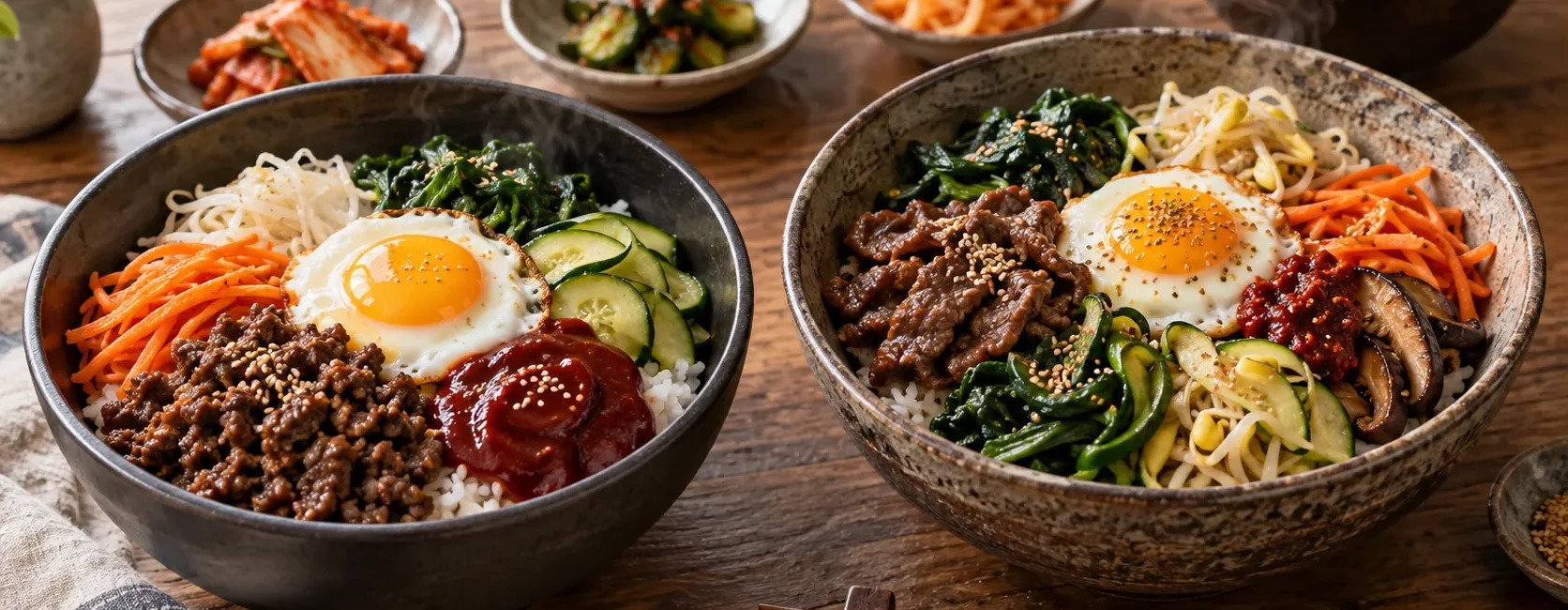
Great bibimbap depends less on the number of toppings than on controlling the moisture and temperature of the rice, vegetables, and sauce separately. Both recipes below make four servings with 800 g cooked rice. The 35-minute quick version uses frozen bibimbap vegetables, bottled bibimbap sauce, and beef seasoning to reduce prep. The traditional version blanches or sautés five toppings separately, seasons each one, marinates beef with fresh pear, and makes its own gochujang sauce. The quick bowl has a bold, consistent sweet-spicy flavor; the traditional bowl keeps each vegetable’s aroma and texture distinct even after mixing.
Quick comparison
| Category | 35-minute quick version | Traditional five-topping version |
|---|---|---|
| Yield | 4 servings, about 520 g each | 4 servings, about 540 g each |
| Prep / cook / total | 10 / 25 / 35 minutes | 35 / 45 / 100 minutes, including a 20-minute rice soak |
| Active time | About 30 minutes | About 80 minutes |
| Difficulty | Easy — manage thawed moisture and sauce quantity | Intermediate — cook and season each topping separately |
| Estimated U.S. Korean-market cost | About $18–24 | About $24–32 |
| Flavor | Bold sweet-spicy sauce with evenly blended vegetables | Distinct spinach, sprout, shiitake, and zucchini flavors and textures |
| Umami sources | Bottled sauce, beef seasoning, soy sauce, browned beef | Fermented gochujang, shiitake, soy sauce, browned pear-marinated beef |
| Most likely failure | Frozen-vegetable water makes the rice soggy, or too much sauce overwhelms it | Cooking toppings together blurs their flavors and leaves excess moisture |
| Best for | Weeknights, leftover rice, or quick lunch-box prep | Weekend meals, guests, or precise control of every topping |
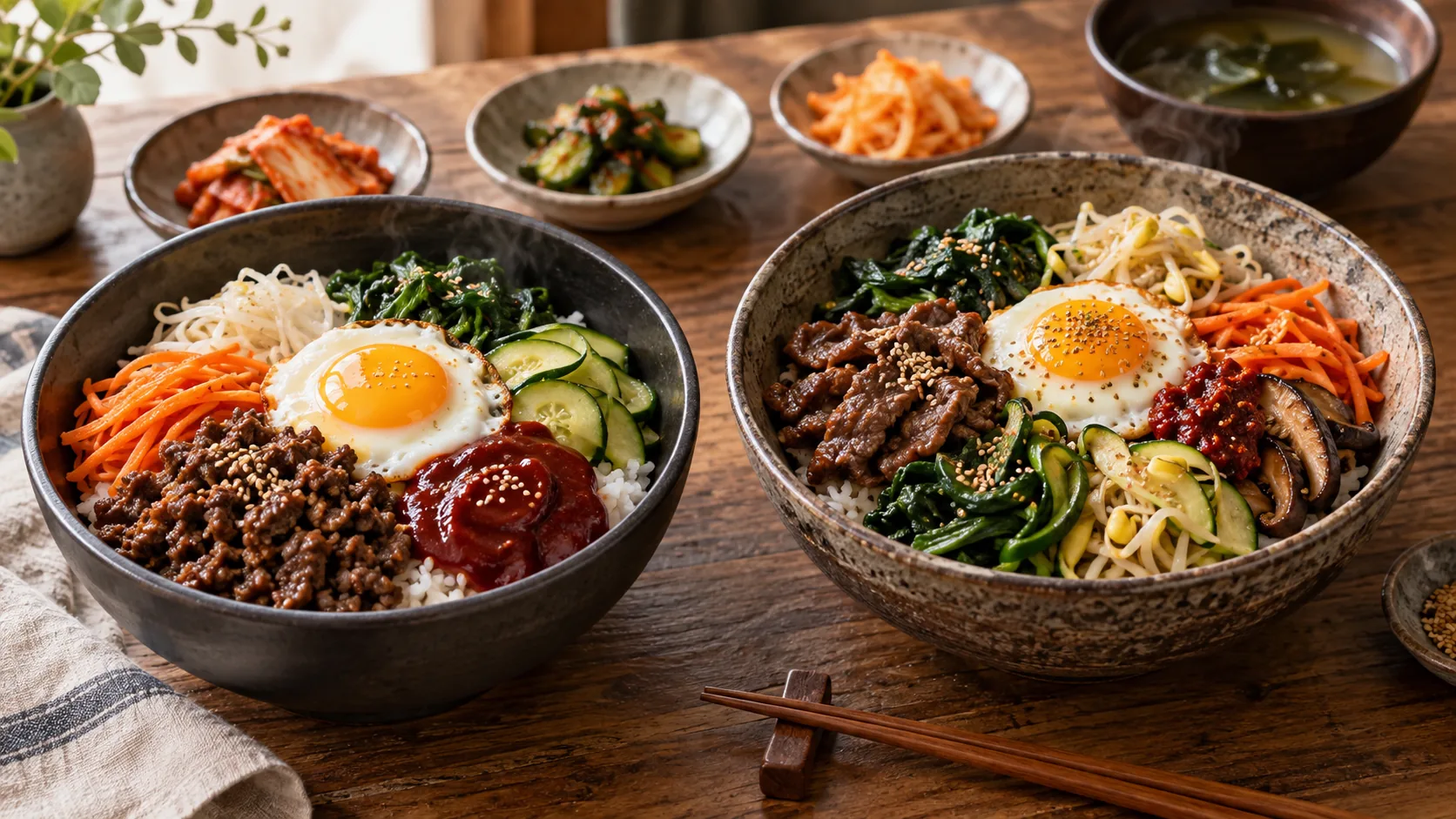
Quick version: frozen vegetables and bottled sauce in 35 minutes
Exact ingredients — 4 servings
- 800 g warm cooked rice, 200 g per serving
- 600 g frozen bibimbap vegetable mix
- 250 g ground beef, no more than 15% fat
- 160 g bottled bibimbap sauce
- 3 g beef-flavor seasoning powder
- 20 ml warm water
- 20 ml Korean brewed soy sauce
- 12 g minced garlic
- 20 ml toasted sesame oil
- 20 ml neutral cooking oil
- 4 large eggs, about 200 g without shells
- 8 g toasted sesame seeds
- 8 g roasted seaweed flakes
Prep 10 minutes · cook 25 minutes · total 35 minutes · active time about 30 minutes
Method
- Put the frozen vegetables in a colander, rinse under cold water for 30 seconds, and drain for 5 minutes. Press with a clean towel to remove surface water. If the rice is cold, sprinkle it with 20 ml water, cover, and microwave for 3–4 minutes until it reaches 165°F (74°C).
- Dissolve the beef seasoning in 20 ml warm water. Mix with the soy sauce and garlic, then knead into the ground beef for 1 minute.
- Preheat a 12-inch (30 cm) skillet over high heat for 2 minutes and add 10 ml oil. Spread the beef thinly and leave it untouched for 2 minutes. Break it up and cook another 3–4 minutes. When several spots reach 160°F (71°C), transfer it to a clean plate.
- Add 5 ml oil to the same skillet and add the vegetables. Stir-fry over high heat for 6–8 minutes, until no water is visible on the bottom. Mix in 8 ml sesame oil and turn off the heat. Do not add salt; the sauce will supply it.
- Preheat a separate nonstick pan over medium heat for 1 minute and add 5 ml oil. Fry the four eggs for 3–4 minutes, until the whites set. For fully cooked yolks, flip and cook 1 minute more, checking for 160°F (71°C).
- Place 200 g rice in each of four bowls. Top each with 150 g vegetables, about 62 g beef, and one egg. Start with 30 g bottled sauce per serving and serve the remaining 40 g on the side.
- Divide the remaining 12 ml sesame oil, sesame seeds, and seaweed among the bowls. Fold from bottom to top 20–25 times without mashing the rice. Taste before adding more sauce in 10 g increments.
Why it tastes this way: Bottled bibimbap sauce combines gochujang, sugar, vinegar, garlic, and savory ingredients at a consistent concentration, so it tastes balanced immediately. Three grams of beef seasoning strengthens the ground beef’s savory center, but the vegetables need no added salt because the sauce is already seasoned. Driving moisture out of the frozen vegetables and adding sauce only at the end are what keep the rice from becoming wet.
Traditional version: five toppings cooked separately
Exact ingredients — 4 servings
- 360 g Korean short-grain rice
- 1 L water for soaking rice, plus 430 ml for cooking
- 240 g soybean sprouts
- 240 g spinach
- 240 g Korean zucchini, cut into 4 mm matchsticks
- 160 g carrots, cut into 3 mm matchsticks
- 20 g dried shiitake mushrooms
- 300 ml water at 140°F (60°C), for soaking mushrooms
- 250 g thin-sliced beef, cut into 3 mm strips
- 60 g Korean pear, finely grated
- 42 ml brewed soy sauce: 18 ml for beef, 12 ml for shiitake, 12 ml for vegetables
- 20 g minced garlic
- 34 ml toasted sesame oil
- 24 ml neutral cooking oil
- 8 g salt
- 4 large eggs
- 12 g toasted sesame seeds
- 100 g gochujang
- 30 ml maesil-cheong (Korean green-plum syrup)
- 20 ml rice vinegar
- 30 ml strained shiitake soaking liquid
- 15 g honey
Prep 35 minutes · soak rice and mushrooms 20 minutes, overlapping with prep · cook 45 minutes · total 1 hour 40 minutes · active time about 1 hour 20 minutes
Cook the rice and each topping
- Rinse the rice three times, until the water is nearly clear. Soak it in 1 L water for 20 minutes and drain for 10 minutes. Combine with 430 ml water in a pot. Bring to a boil over high heat for 6–7 minutes, reduce to low once strong steam rises, and cook 12 minutes. Turn off the heat, rest covered for 10 minutes, and fluff gently.
- Cover the dried shiitake with 300 ml water at 140°F (60°C) for 20 minutes. Remove the stems and cut the caps into 4 mm strips. Filter the soaking liquid through a coffee filter and reserve 30 ml for the sauce.
- Mix the grated pear, 18 ml soy sauce, 6 g garlic, and 5 ml sesame oil. Marinate the beef in this mixture in the refrigerator for 20 minutes, then drain it in a strainer for 3 minutes.
- Bring 1.5 L water to a boil over high heat and add 4 g salt. Boil the soybean sprouts for 3 minutes 30 seconds and remove them. Blanch the spinach in the same water for 30 seconds. Cool each under cold water for 10 seconds and squeeze dry. Season the sprouts with 6 ml soy sauce, 3 g garlic, 4 ml sesame oil, and 2 g sesame seeds. Separately season the spinach with 1 g salt, 3 g garlic, 4 ml sesame oil, and 2 g sesame seeds.
- Preheat a 12-inch skillet over medium-high heat for 90 seconds. Sauté carrots with 6 ml oil and 1 g salt for 3 minutes; remove. Wipe the pan and sauté zucchini with 6 ml oil and 1 g salt for 3–4 minutes; remove. Wipe again and sauté shiitake with 4 ml oil, 12 ml soy sauce, and 3 ml sesame oil over medium heat for 4 minutes.
- Wipe the pan, heat it over high heat for 2 minutes, and add 4 ml oil. Spread the beef in one layer, leave it untouched for 90 seconds, then cook 2–3 minutes more. When several of the thickest pieces reach 145°F (63°C), transfer to a plate and rest for 3 minutes.
- Combine gochujang, maesil-cheong, vinegar, 30 ml strained shiitake liquid, honey, 8 ml sesame oil, 8 g garlic, and 4 g sesame seeds in a small saucepan. Stir over low heat for 3 minutes. Turn off the heat after one or two bubbles appear at the edge, then cool.
- Fry the eggs in the remaining 4 ml oil over medium heat for 3–4 minutes. Put 200 g rice in each bowl, arrange equal portions of all five toppings and the beef, and add one egg. Serve with 35–45 g sauce per person.
Why it tastes this way: Blanching the sprouts and spinach while sautéing zucchini, carrots, and shiitake lets you control moisture and doneness for each ingredient. Guanylate from shiitake, inosinate from beef, and fermented savoriness from gochujang and soy sauce reinforce one another. High-heat browning adds a roasted note to the beef. Fresh pear brings gentle sweetness, but it does not taste identical to the concentrated sweetness of bottled sauce.
One-to-one traditional replacements
| Quick ingredient or process | Traditional replacement | Function and actual difference |
|---|---|---|
| 600 g frozen bibimbap vegetables | Blanched sprouts and spinach, plus separately sautéed zucchini, carrots, and shiitake | Frozen vegetables minimize prep and give even softness. Separate cooking preserves each topping’s crunch and aroma but requires repeated pan cleanup. |
| 160 g bottled bibimbap sauce | 100 g gochujang + 30 ml maesil-cheong + 20 ml vinegar + 30 ml shiitake liquid + 15 g honey | Bottled sauce has fixed thickness and heat. Homemade sauce lets you tune acidity, sweetness, and viscosity but will not taste identical. |
| 3 g beef-flavor seasoning | 20 g dried shiitake and its liquid + browned pear-marinated beef + fermented soy sauce | Seasoning gives immediate, focused savoriness. The traditional combination builds a broader mushroom, meat, and fermented flavor. |
| Ground beef seasoned for 1 minute | Thin-sliced beef refrigerated 20 minutes in fresh pear marinade | Ground beef cooks quickly and holds sauce readily. Sliced beef retains a meatier grain and develops clearer browning. |
| Reheated instant or leftover rice | Short-grain rice soaked 20 minutes, pot-cooked, and rested 10 minutes | Reheated rice saves time. Fresh rice has more even hydration and stays distinct after sauce is mixed in. |
Bottled sauce and seasoning are not inherently bad or inferior choices. They are practical tools when time is limited and consistent balance matters. The traditional version creates more prep and dishes, but it gives you direct control over the moisture, texture, and seasoning of every topping.
How to prevent bibimbap mistakes
- Water pools at the bottom: Drain frozen vegetables for 5 minutes and stir-fry until the skillet is dry. Squeeze blanched greens by the handful until they no longer drip.
- The first bite is already too hot or salty: Start with 30–35 g sauce per person. Do not salt the quick vegetables, and measure each traditional topping’s seasoning.
- Every topping tastes the same: Do not add spinach to the pan after shiitake. Wipe the skillet between ingredients so soy and garlic do not migrate into everything.
- The rice turns gluey: Let fresh rice vent for 2 minutes. Fold rather than press. Reheat cold rice to 165°F (74°C) before assembling.
- The beef steams gray: Drain excess marinade and spread only 250 g beef in one layer in a 12-inch pan. Do not move it for the first 90 seconds.
- The colors look muddy: Blanch spinach for only 30 seconds, cool it immediately, and sauté carrots and zucchini separately. Mix in the sauce only when ready to eat.
Food safety, storage, and reheating
USDA guidance calls for ground beef to reach 160°F (71°C), while whole cuts of beef should reach 145°F (63°C) followed by a 3-minute rest. Apply 160°F to the quick version’s ground beef and 145°F plus the rest to the traditional version’s sliced whole-muscle beef. Cook eggs to 160°F (71°C) for pregnant, older, or immunocompromised diners or whenever a fully cooked yolk is preferred; use pasteurized eggs if serving soft yolks. Wash utensils and cutting boards that touched raw beef before they contact cooked toppings.
Do not leave rice or cooked toppings at room temperature for more than 2 hours. Cool them in separate shallow containers at 40°F (4°C) or below. Refrigerate rice, beef, and vegetables for 3–4 days; use fried eggs within 2 days. Refrigerate sauce in a clean container for up to 7 days. Keeping the components separate prevents the assembled bowl from becoming watery.
To reheat, cover only the rice and beef and microwave at 900 watts for 90 seconds; stir and heat another 30–60 seconds until everything reaches 165°F (74°C). Add the vegetables cold or warm them only for the final 20 seconds. A freshly fried egg has the best texture.
Frequently asked questions
Can I get a crisp rice crust without a stone bowl?
Heat 10 ml sesame oil in a 10-inch cast-iron skillet. Press 800 g rice into a 3/4-inch layer and cook over medium heat for 7–9 minutes. Once the bottom is golden, divide it among four bowls and add the toppings.
Can I make it vegetarian?
Replace the beef with 400 g firm tofu cut into 3/4-inch cubes. Pat dry and sauté in 15 ml oil for 8 minutes. Use only soy sauce, not fish sauce, and increase dried shiitake to 30 g in the traditional version.
Can I use prepared banchan instead of frozen vegetables?
Yes. Use 600 g well-drained seasoned vegetable side dishes. Because they are already salted, begin with 100 g bottled sauce instead of 160 g.
How can I reduce the heat?
For the traditional sauce, reduce gochujang to 70 g and add 10 g doenjang plus 20 ml pear juice. For the quick bowl, mix each 30 g portion of bottled sauce with 10 g plain yogurt or 10 ml pear juice.
Can I use brown rice?
Yes. Use 800 g cooked brown rice. If cooking it from dry, follow the package’s water ratio. If the finished rice is dry, mix in 10 ml warm water per serving before adding toppings.
Can I pack bibimbap for lunch?
Pack rice and beef separately from chilled vegetables and sauce, and keep everything at or below 40°F (4°C) with an ice pack. Reheat only rice and beef to 165°F (74°C), then add vegetables and sauce.
Related Korean recipes and references
See bottled-sauce vs pear-shiitake bulgogi for a deeper look at beef marinade and browning. You may also like quick-sauce vs separately stir-fried japchae, bottled-sauce vs pear-marinated jeyuk bokkeum, and quick-stock vs traditional-stock doenjang jjigae.
[…] Read this recipe in English […]