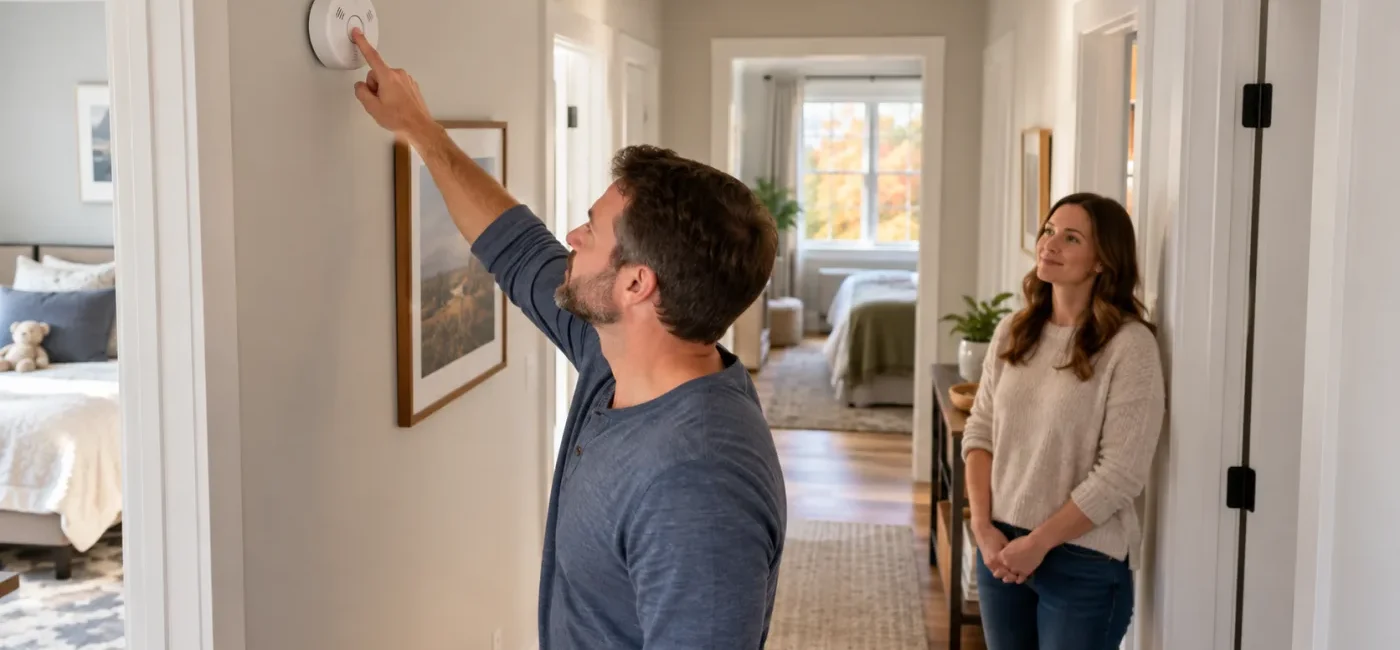
Homeowner checking a carbon monoxide alarm in the hallway outside sleeping areas

Carbon Monoxide Alarm Guide: Placement, Testing, and Home Safety

Smartor 편집팀 September 23, 2026

When cooler weather arrives and heating equipment goes back into service, carbon monoxide alarms deserve more than a quick glance. Carbon monoxide, or CO, has no color or odor. It can build up when fuel-burning equipment does not burn or vent properly, and people cannot reliably detect it with their senses. Buying an alarm is only one part of protection. Correct placement, routine testing, end-of-life replacement, appliance maintenance, and a practiced response plan all need to work together.

This guide provides general U.S. home-safety information, not medical, legal, or building-code advice for a specific property. State and local rules, lease terms, home layouts, fuel types, and manufacturer requirements vary. Follow the instructions packaged with each alarm and the directions of your fire department or building authority. If an alarm sounds or anyone has possible poisoning symptoms, do not use an online guide to diagnose the cause. Move to fresh air and call 911 or your local emergency number from outside.

Seven rules worth remembering

  1. An alarm does not replace prevention. Have furnaces, water heaters, fireplaces, chimneys, gas dryers, and other fuel-burning equipment maintained by qualified professionals.
  2. Protect every level and sleeping area. The U.S. Consumer Product Safety Commission recommends battery-operated CO alarms or alarms with battery backup on every level and outside sleeping areas.
  3. Follow the exact installation instructions. Approved wall or ceiling positions and required distances from appliances, moisture, and air vents differ by model.
  4. Use the test button regularly. The button checks power, electronics, and sound; it does not create CO or prove that the home’s appliances are safe.
  5. Record the manufacture and replacement dates. A fresh battery does not restore an expired sensor.
  6. Keep generators and charcoal outdoors. An open garage door or window does not make an enclosed location safe.
  7. Leave first if an alarm sounds. Get people and pets outside before trying to identify the source.

Where carbon monoxide comes from

CO is produced when fuel burns. Potential household sources include gas- or oil-fired furnaces, water heaters, gas ranges, fireplaces, wood stoves, gas dryers, and portable heaters. Vehicles in garages, charcoal grills, portable generators, and camping stoves are also important sources. Properly installed and maintained appliances send combustion gases outdoors. A blocked vent, damaged equipment, poor draft, or backdraft can allow CO to enter living areas.

“I do not smell gas” is not a safety test. Utilities add an odorant to natural gas so some leaks can be noticed, but CO itself is odorless. A fuel odor also does not have to trigger a CO alarm. If you suspect a gas leak, avoid electrical switches and flames, leave the area, and follow your gas utility’s and fire department’s emergency directions from outside.

How to estimate the number of alarms your home needs

Start with levels and sleeping zones, not only the number of bedrooms. Draw the basement, first floor, second floor, and any other occupied level. Mark sleeping areas that do not share a hallway, an attached garage, and floors with fuel-burning appliances. Then compare that sketch with local requirements and the manufacturer’s placement instructions.

  • One-story home: Prioritize the hallway outside bedrooms. A distant or separate sleeping zone may need additional coverage.
  • Multistory home: Make sure an alarm can be heard on every level, including the basement, and protect the area outside bedrooms.
  • Apartment or condo: A building-wide system may not replace required alarms inside the unit. Ask management in writing who tests and replaces each device.
  • Household members who are deaf, hard of hearing, or heavy sleepers: Discuss low-frequency sounders, strobes, vibrating accessories, or interconnected devices with the fire department or an appropriate accessibility professional.

Interconnected alarms can sound throughout a larger or multistory home when one unit detects danger. Hardwired models should have the required backup power. Plug-in units should not be hidden behind furniture or easy to unplug accidentally. Battery-powered models need a routine that the household will actually maintain.

Placement: near sleeping areas does not mean beside a fuel source

CPSC guidance calls for CO alarms on every level and outside sleeping areas. The correct height, wall-versus-ceiling option, and clearance from a furnace, stove, fireplace, vent, or window depend on the tested design of the specific model. The product instructions are the final placement authority. Do not rely on a blanket internet claim that every CO alarm belongs near the floor or that every model belongs at the ceiling.

Common locations to avoid, unless the manufacturer specifically says otherwise, include:

  • directly beside a range, furnace, boiler, or fireplace where normal operation could expose the sensor to transient combustion gases;
  • humid areas near showers, sinks, or humidifiers;
  • strong airflow from windows, exterior doors, ceiling fans, and supply or return vents;
  • places where curtains, furniture, boxes, paint, or dust block the sensor openings; and
  • spots where children can tamper with or remove the unit.

After installation, photograph the model number, manufacture date, and replacement instructions on the back or side. Add routine test dates and the manufacturer’s replacement date to a calendar. Recording only the most recent battery change can hide the age of the sensor itself.

A 30-minute check before heating season

Use one person to read the steps and another to verify them. That simple pairing makes skipped items easier to notice.
  1. Locate every CO alarm. Mark each device by level and sleeping zone on a phone note or simple floor plan.
  2. Inspect the exterior. Look for paint, tape, dust, insects, or furniture blocking the vents. Clean only with methods allowed by the manual, such as a dry cloth or gentle vacuuming.
  3. Read the dates and status indicators. Replace the entire unit if the end-of-life signal is active, the manufacturer’s replacement limit has passed, or required labeling is no longer readable.
  4. Press the test button. Confirm that household members can hear it and that interconnected units all activate. Prepare pets for the noise.
  5. Confirm power. Address low-battery warnings, loose plugs, or a hardwired circuit problem. Never finish the check with a battery removed or the unit disabled.
  6. Look around fuel-burning equipment. Remove paper, laundry, boxes, and other storage. Visually note loose, crushed, or corroded venting, but do not disassemble it or improvise a tape repair.
  7. Confirm professional service. CDC recommends yearly service by a qualified technician for heating systems, water heaters, and other gas-, oil-, or coal-burning appliances. Chimneys should also be checked for damage or blockage.
  8. Walk the escape route. Identify the nearest exit from each bedroom, who helps a child or person with limited mobility, how pets will be moved, and the outdoor meeting place.
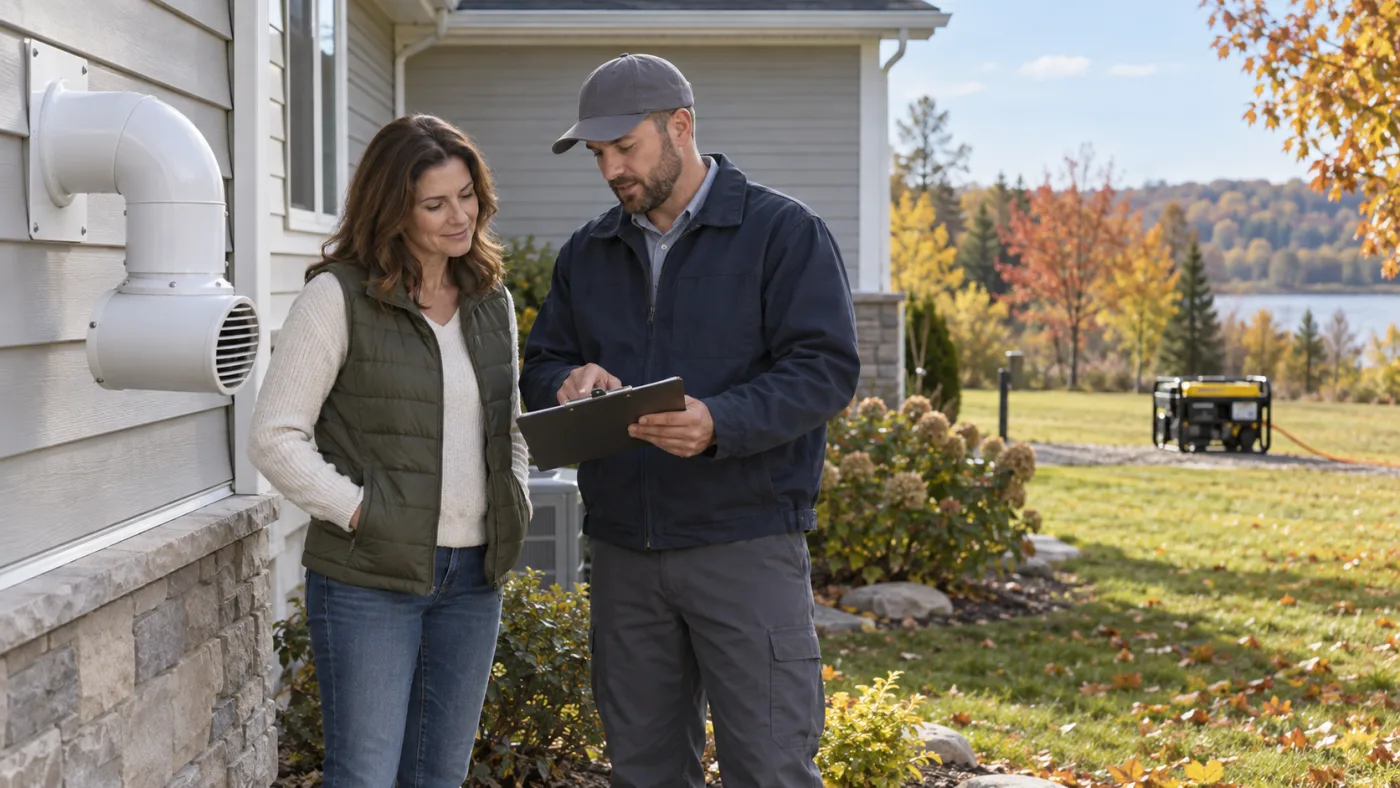
A homeowner and technician check furnace venting and safe generator distance outside a home
A single preseason check can cover alarms, fuel-burning equipment, vents, and the household’s evacuation route.

If an alarm sounds, evacuation comes before investigation

Alarm patterns differ among manufacturers. A full CO alarm, low-battery chirp, malfunction code, and end-of-life signal may sound different. Learn those patterns in advance, but treat an unfamiliar or repeating emergency alarm as real.

  1. Move everyone, including pets, to outdoor fresh air immediately. Use a safe exit and do not spend extra time searching for the source.
  2. Call 911 or the local emergency number and fire department from outside. Clearly report headache, dizziness, nausea, vomiting, weakness, chest pain, confusion, or unusual sleepiness.
  3. Do not reenter until emergency responders say the building is safe. Do not go back to open windows or shut down equipment.
  4. Do not restart suspected appliances until a qualified professional identifies and corrects the problem.
  5. After reaching safety, record the time, alarm model or pattern, operating appliances, and symptoms. Never delay evacuation to collect that information.

CDC lists headache, dizziness, weakness, upset stomach, vomiting, chest pain, and confusion among common symptoms. They can feel flu-like. A sleeping person or someone affected by alcohol or other substances may become seriously ill before recognizing symptoms. Infants, older adults, and people with chronic heart disease, anemia, or breathing problems can be more vulnerable. Do not wait to see which person feels worse; move everyone outside.

Portable generators: putting the 20-foot rule into practice

A common outage mistake is operating a generator in a garage, carport, basement, enclosed porch, or near a window. CPSC and CDC say generators belong outdoors, at least 20 feet from windows, doors, and vents, with exhaust directed away from the home. A garage is not safe even when its door and windows are open.

Measure from the generator to the nearest opening, not merely to the exterior wall. Consider a neighbor’s windows and shared walkways. Do not move the generator indoors to protect it from rain; follow the manufacturer’s approved outdoor operating and weather-protection instructions. Never improvise a connection to a household outlet, which can create electrocution and backfeed hazards. Have a qualified electrician install any transfer equipment. Add these steps to a broader storm and flood preparedness checklist.

Common risks involving garages, vehicles, and grills

  • Warming a vehicle in an attached garage: Do not leave an engine running, even with the garage door open. Exhaust can enter living space.
  • Remote start: Review app and key-fob settings so a vehicle cannot run unnoticed inside a garage.
  • Driving with a liftgate open: CDC warns that exhaust can be pulled into an SUV or vehicle when the rear hatch is open without adequate airflow.
  • Charcoal grills: Charcoal can produce CO even when it looks dim or ashy. Never use it inside a home, garage, tent, or recreational vehicle.
  • Camping stoves and portable heaters: Do not repurpose outdoor equipment for indoor heat.

What renters and property owners should document

In a rental, the first question is whether each required alarm works today. At move-in, photograph alarm locations and record test results. If the manufacture or replacement date is missing, ask management in writing. Do not remove a device that chirps or repeatedly alarms. A resident cannot safely assume the cause is humidity, dust, an expired sensor, or actual CO.

Owners and managers should verify state and local requirements, inspection records, and manufacturer instructions. Installing an alarm does not eliminate duties to maintain furnaces, chimneys, water heaters, and venting. While mapping alarms, also document emergency shutoffs with the home utility shutoff guide.

What to compare when buying an alarm

  • Certification: Check the package and device for the applicable current safety certification. EPA advises looking for units meeting the current UL 2034 or relevant approval standard.
  • Power source: Choose among replaceable battery, sealed long-life battery, plug-in, or hardwired with battery backup based on the property and maintenance plan.
  • Interconnection: Decide whether an alarm on one floor must trigger units elsewhere. Confirm wired or wireless compatibility with the manufacturer.
  • Display: A digital readout or peak-level memory may help responders and technicians, but a seemingly low number is not permission to ignore an alarm or symptoms.
  • Accessibility: Evaluate strobes, vibration, low-frequency sound, and other features needed by household members.
  • End-of-life warning: Read how the device distinguishes an expired sensor from a low battery or malfunction.

Combination smoke-and-CO alarms may be appropriate when they satisfy placement and replacement requirements for both hazards. Connected-app features are secondary. A device still needs an effective local alarm and backup power when a phone is off or internet service fails.

Example: a multilevel townhouse

Consider a townhouse with an attached garage and gas water heater on the lower level, a gas range on the main level, and three bedrooms upstairs. The household checks local rules and each device’s instructions, then maps coverage for every level and outside the upstairs sleeping area. Alarms go in approved living-space locations, not inside the garage or directly beside the range. The family tests whether an alarm downstairs can be heard upstairs and considers interconnected or accessibility equipment if it cannot.

Before heating season, a qualified technician services the furnace, water heater, and venting. The family chooses the mailbox area as its outdoor meeting point. Children practice leaving without searching for the cause, and everyone walks a second route in case the front exit is blocked. The protection plan combines equipment maintenance, alarm audibility, and evacuation instead of relying on one device.

Ten mistakes to avoid

  1. Assuming a new battery makes an aging sensor last indefinitely.
  2. Assuming a successful button test proves the furnace and chimney are safe.
  3. Removing a battery to stop chirping and forgetting to restore protection.
  4. Following one universal placement-height rule instead of the manual.
  5. Heating a home with a gas oven or using an outdoor grill or stove indoors.
  6. Running a vehicle or generator in a garage because the door is open.
  7. Placing a generator directly below a closed window.
  8. Sending only the person with a headache outside while others investigate.
  9. Relying on an app instead of a loud local alarm and escape practice.
  10. Allowing renters and owners to assume the other party handled an end-of-life warning.

Seasonal checklist

  • □ Locate alarms on every level and outside sleeping areas.
  • □ Test each unit and any interconnection.
  • □ Record manufacture dates, replacement limits, and battery status.
  • □ Remove obstructions around sensor openings without using paint or cleaners.
  • □ Confirm professional service for the heating system, water heater, and chimney.
  • □ Identify an outdoor generator location more than 20 feet from windows, doors, and vents.
  • □ Reinforce the rule against operating grills, camping stoves, or vehicles in enclosed or attached spaces.
  • □ Assign help for children, older adults, people with disabilities, and pets.
  • □ Choose an outdoor meeting point and call emergency services from outside.
  • □ Check an older relative’s home too; the room-by-room fall-prevention checklist can support the same visit.

Frequently asked questions

How many CO alarms do I need?

It depends on levels, separate sleeping zones, local rules, and the model’s instructions. CPSC’s baseline advice is to protect every level and the areas outside sleeping rooms. Draw a floor plan, look for gaps, and ask the local fire or building authority when uncertain.

Is a smoke alarm enough?

No. Smoke and CO are different hazards. A combination alarm can cover both only if it actually includes certified CO detection and is installed in a location that meets both sets of requirements.

Does one chirp mean carbon monoxide?

It may indicate a low battery, malfunction, or end of sensor life; sound patterns vary by product. Check the label and manual. If the meaning is unclear or an emergency pattern repeats, move outside and contact emergency services.

Can I run a generator in the garage if the windows are open?

No. CPSC says not to use a generator inside a home or garage even with doors and windows open. Operate it outdoors at least 20 feet from openings with exhaust pointed away.

The alarm stopped and I feel fine. Can I go back in?

CO is invisible, symptoms vary, and the concentration can change. Wait until emergency responders say the building is safe.

Do all-electric homes need CO alarms?

They may still have an attached garage, shared boiler, fireplace, neighboring unit, or emergency generator exposure. Check local requirements and the actual building layout.

Is a smart-alarm app enough?

No. Phones, networks, and cloud services can fail. A loud on-site alarm, backup power, routine tests, and an evacuation plan are primary; remote notifications are supplemental.

Official sources consulted

1 Comment

  1. […] Smartor 편집팀 September 23, 2026 Read this guide in English → […]

답글 남기기