Expired Medicine Disposal Guide: Take-Back, Mail-Back, and Home Safety
Smartor 편집팀
September 27, 2026

한국어판: 한국어로 이 가이드 읽기 →
When an old prescription, leftover pain medicine, expired cold syrup, or an unused antibiotic turns up in your medicine cabinet, the safest default is not to pour it down the sink or flush it. For most prescription and over-the-counter medicines, the U.S. Food and Drug Administration recommends using an authorized drug take-back location or a medication mail-back program first. Home trash disposal or flushing is appropriate only in specific circumstances after you check the product label and current FDA guidance.
There is no single disposal method for every product. Pills, liquids, inhalers, medicated patches, needles, and combination devices present different hazards. A used fentanyl patch may retain a dangerous amount of medicine. An inhaler can remain pressurized. A loose needle can injure a sanitation worker. This guide gives U.S. households a practical process for sorting medicines, finding a take-back option, protecting personal information, and handling products that require a separate disposal route.
Notice: This article provides general health and household-safety information, not individualized medical advice. Ask a pharmacist or clinician before stopping a current medicine, using an expired product, or deciding how to handle a product with special instructions. If a child, pet, or other person may have swallowed or been exposed to medicine, prioritize emergency help over disposal. Call 911 for severe symptoms or Poison Help at 1-800-222-1222 in the United States.
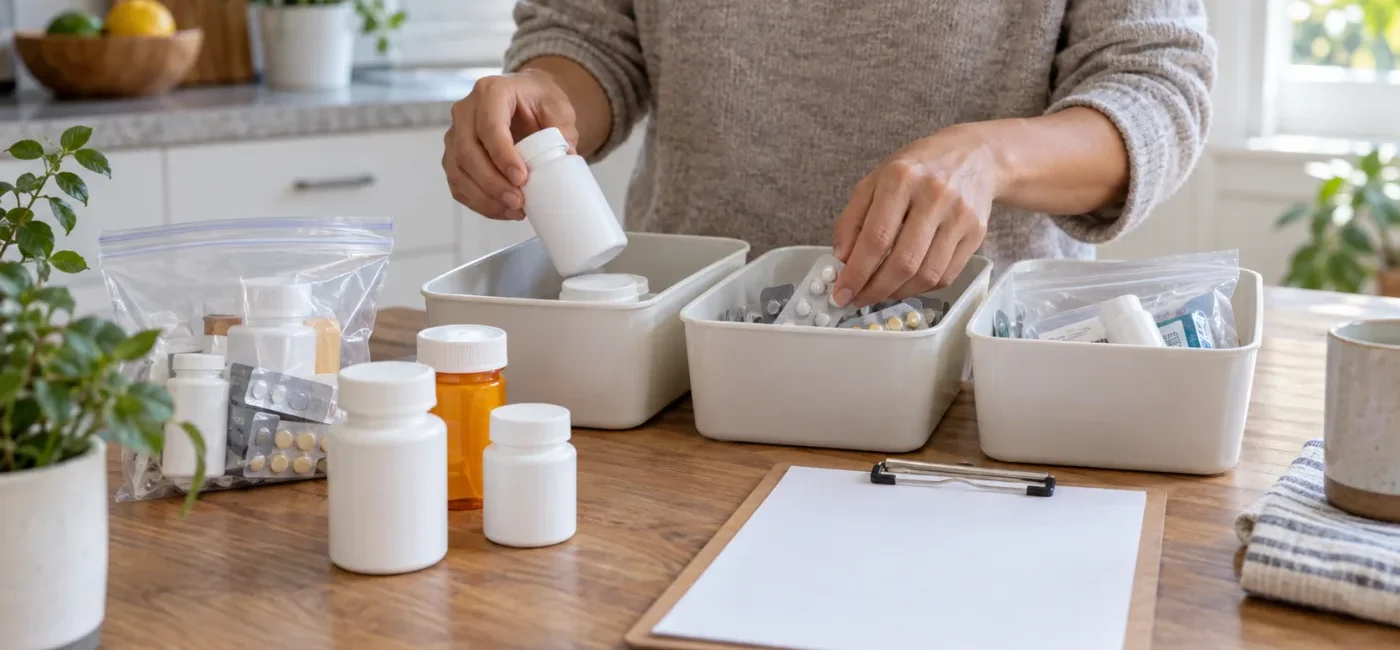
Clear a well-lit work surface and keep children and pets out of the area. Do not empty every bottle into one pile. Keep each medicine in its original container while you sort because the label identifies the drug, strength, patient, directions, prescription date, and dispensing pharmacy. If several household members use the same cabinet, give each person a separate section so names and doses do not get mixed.
Create four groups:
Do not save an old prescription “just in case” or share it with someone who has similar symptoms. A leftover antibiotic may be the wrong drug, dose, or treatment duration for a later illness. At the same time, do not abruptly stop an important current therapy merely because a date or instruction is unclear. Blood thinners, steroids, seizure medicines, psychiatric medicines, and many other therapies may require a planned transition. Put uncertain products in the verification group and call the prescriber or pharmacist.
The FDA’s guidance can be turned into a simple order of operations. First, read the container, package insert, or Medication Guide for product-specific disposal instructions. Second, look for an authorized drop-off or prepaid mail-back option. Third, if take-back is not readily available, check whether the exact medicine is on the current FDA flush list. Fourth, if it is not on the flush list, review the FDA’s household-trash method. Do not reverse this order by flushing everything first.
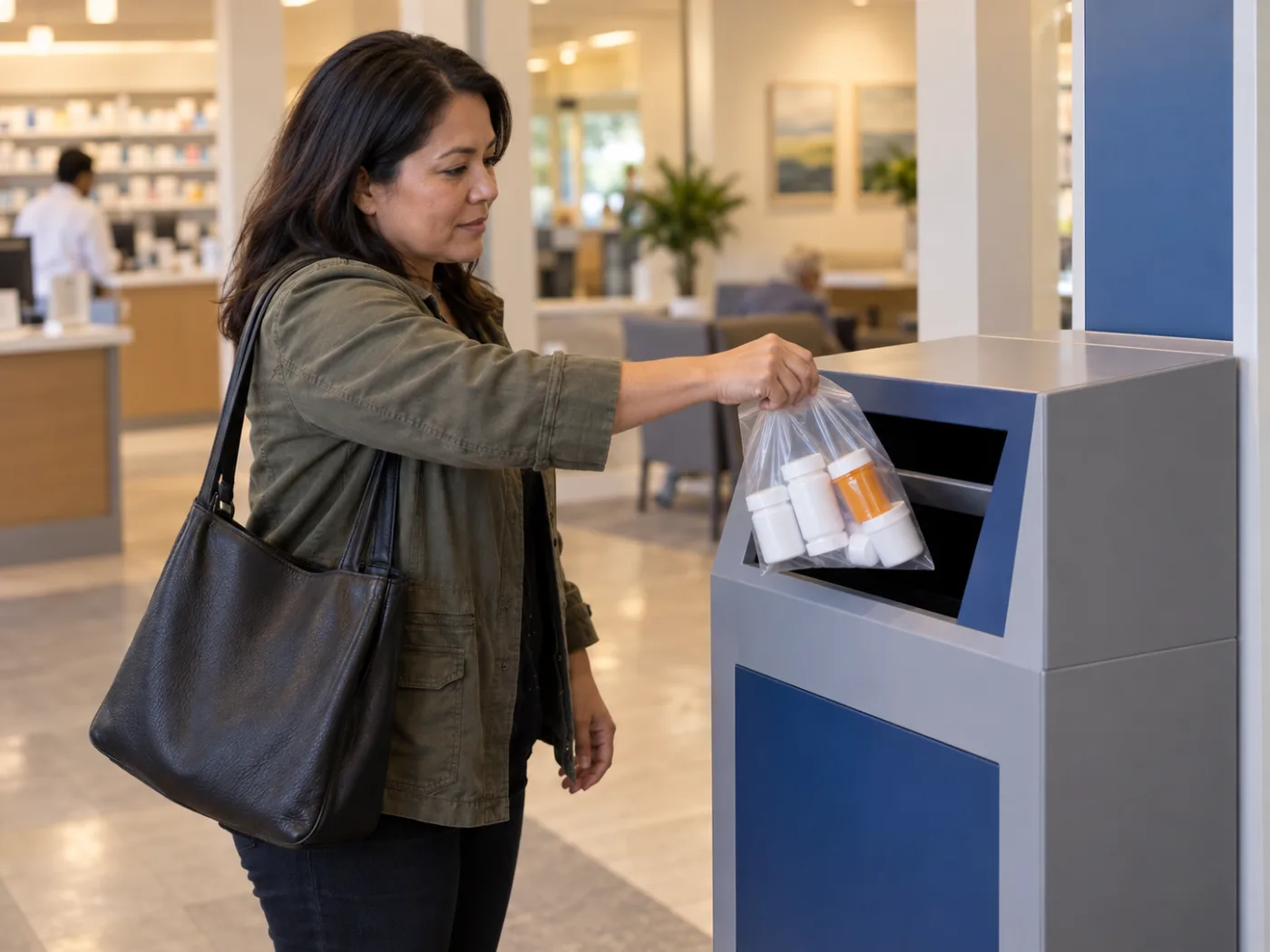
The Drug Enforcement Administration provides an official search tool for DEA-authorized collectors. Permanent kiosks may be located inside pharmacies, hospitals, clinics, or law-enforcement buildings. A listing does not guarantee that the kiosk is accessible at every hour or that it accepts every dosage form. Call the location before leaving home to confirm hours, building access, and accepted items.
Use the official DEA resource and search by ZIP code or city rather than entering detailed health information on an unfamiliar website. Do not assume a sponsored search result is a government service. When calling a site, you usually do not need to disclose your diagnosis. Ask whether the location accepts pills, liquids, controlled medicines, pet prescriptions, patches, inhalers, or sharps.
Before the trip, verify:
National Prescription Drug Take Back Day can be useful, but you do not have to wait for a special event if a permanent collector or mail-back option is available. If the medicine has misuse potential or children, visitors, or pets could reach it, store it in a locked location and arrange disposal promptly.
Prepaid drug mail-back envelopes can help people who have limited transportation or no nearby kiosk. Some pharmacies provide them at no charge; others sell them. Confirm that the package is specifically designed for medication take-back, and read its accepted-item and mailing instructions. Do not improvise by putting loose medicine in an ordinary shipping envelope.
Keep the filled envelope locked away from children and pets until it is mailed. If it is torn, wet, or cannot be sealed, contact the provider for replacement instructions instead of making an uncertain repair and sending it.
According to the FDA, when a take-back option is not readily available, almost all medicines that are not on the flush list can be placed in household trash using a specific process. The goal is to make the medicine unattractive and difficult to recover, contain leaks, and protect the patient’s identity. It does not mean chemically neutralizing the drug.
Do not put medicines in compost, food waste, or a recycling bin. A prescription bottle may look recyclable, but local rules differ and the label may expose personal information. Medicine itself does not belong in recycling. Ask your local program whether a completely empty, de-identified container can be recycled.
Two common slogans—“never flush medicine” and “flush every old prescription”—are both too broad. The FDA flush list is limited to certain medicines that are especially dangerous when used by the wrong person and may be sought for misuse. Even for a listed medicine, an immediately available take-back option is preferred. Flushing becomes the fallback only when take-back is not readily available and current FDA or product instructions direct it.
Do not rely on memory or appearance. Similar names can refer to different ingredients, formulations, or combinations. Do not flush something simply because it seems like a strong pain medicine. Read the exact active ingredient and dosage form, compare them with the current FDA list, and check the Medication Guide. If you are uncertain, give the pharmacist the precise product name and ask how to store it safely until disposal.
Used fentanyl patches deserve special attention because medicine can remain in a patch after use. Follow the product’s instructions for folding and disposal. Never leave a used patch loose on a counter or on top of a trash can where skin contact or pet exposure is possible. Do not assume every medicated patch follows the same rule.
An inhaler or aerosol can may remain pressurized. Puncturing, crushing, or burning it can cause injury. The FDA advises reading the product labeling and contacting the local trash or recycling facility about applicable rules. A kiosk that accepts tablets does not necessarily accept inhalers. Do not disassemble a canister or try to release residual pressure yourself.
Do not put loose needles, syringes, or lancets in a medicine kiosk or a thin plastic bag. Use an FDA-cleared sharps disposal container when possible, or follow your jurisdiction’s requirements for a rigid, puncture-resistant alternative. Do not overfill it; close it at the marked fill line. Ask a pharmacy, health department, or waste authority where the sealed container is accepted. Avoid recapping or manipulating a used needle unless the product instructions specifically require it.
An autoinjector, insulin pen, patch pump, or connected delivery device may combine a needle, battery, electronics, and residual medicine. Manufacturer return programs or local medical-waste rules may apply. Do not place the whole device in household trash or electronics recycling without checking. Show the pharmacist the exact model or consult the manufacturer’s official instructions.
A prescription label may contain a name, address, prescription number, clinician, pharmacy, and barcodes. On an empty container, use label removal, a privacy roller, or multiple cross-hatched marks so information cannot be read when held to light. Cover QR codes and barcodes as well. But stripping every label before reaching a collector can make it harder to identify a product if a question arises.
A practical compromise is to check the collector’s packaging policy first, then obscure patient identifiers while keeping the drug name and strength available if permitted. If the program asks you to transfer tablets to a clear bag, keep household members’ items separated and seal each bag. Avoid storing unnecessary label photos indefinitely in cloud albums, which creates another privacy exposure.
During a move, Lee finds six antibiotic tablets from an old prescription and a bottle of expired cough syrup. Lee does not save the antibiotic for the next cold or offer it to a relative. The labels stay in place while Lee calls a nearby collector. If that site accepts tablets but not liquids, the tablets can go there while Lee looks for another permanent collector or an approved mail-back option for the syrup. If take-back is not readily available and the syrup is not on the flush list, Lee reviews the FDA household-trash method and local waste rules.
Lee does not taste the syrup to judge it or pour it down the sink. A leaking bottle is placed upright in a larger sealed container and locked away until a verified disposal route is available.
Park has prescription pain medicine left after surgery. Park does not guess from the brand name whether it is an opioid or belongs on the flush list. The first action is to find an authorized collector, confirm its hours, and keep the original bottle locked until the trip. If take-back is not readily available, a pharmacist can verify the active ingredient and product-specific directions. Flushing is considered only when the exact medicine is on the current list and the FDA’s conditions are met.
The medicine is not shared, sold, or kept in a vehicle “for emergencies.” Vehicles experience large temperature swings and present theft and misuse risks. Once the treatment plan is complete, Park confirms that the drug is no longer needed and removes it from the home through the appropriate route.
An adult child should not discard a parent’s medicines without the parent’s involvement. Compare the current medication list with what is actually being taken, including as-needed products and supplements. Similar-looking containers may have different ingredients, and a prescription product may duplicate an over-the-counter ingredient. A clean, current list also helps when using the Medicare plan and prescription comparison checklist.
After sorting, secure current medicines from children or anyone who might take them unintentionally. Keep allergy and emergency information separately. Pairing medicine-cabinet review with another recurring task—such as the carbon monoxide alarm safety checklist—can make the routine easier to remember.
Stability and storage conditions vary by product, so a date alone does not establish whether a product is safe or effective. Do not automatically continue it or discard an essential therapy. Give a pharmacist or prescriber the exact name, date, package condition, and storage history. Arrange a replacement before stopping an important current medicine when appropriate.
Policies vary by collector. Some accept prescription and over-the-counter drugs but exclude supplements. Call first. If the location does not accept the product, review its label and local household-waste guidance.
You should protect personal information, but the collector’s packaging policy comes first. Some locations permit original containers; others ask for pills in a sealed bag. Confirm the rule, then obscure patient identifiers while retaining any product information needed for safe identification.
If take-back is not readily available and the product is not on the FDA flush list, the household-trash process may be appropriate. Put the mixture in a closable, leak-resistant container and follow local waste rules. Do not pour the liquid into a drain and discard only the empty bottle.
State drug-donation programs may impose strict eligibility, packaging, storage, unopened-product, and drug-type requirements. Never give a prescription directly to another person. Contact your state health authority or an approved program. If it cannot accept the medicine, use an authorized disposal route.
Do not assume it can. A device containing a needle may be governed by sharps or combination-device rules. Check the exact product label and ask the manufacturer, pharmacy, local health department, or waste authority for the correct route.
A scheduled event may be reasonable if the medicine can remain securely locked and there is no urgent exposure risk. For a medicine with misuse potential or one accessible to a child or pet, first ask about permanent collectors, mail-back envelopes, and pharmacist guidance.
Do not delay while researching disposal. Call 911 for trouble breathing, loss of consciousness, seizures, or other severe symptoms. For other suspected exposures in the United States, call Poison Help at 1-800-222-1222 promptly. Keep the product container nearby if it is safe to do so, and do not induce vomiting unless a professional instructs you.
The safe sequence is straightforward: separate current medicines from unwanted products, read special instructions, and use a permanent collection kiosk or approved mail-back program for most expired or unused medicines. Use the FDA flush list or household-trash method only when take-back is not readily available and the relevant conditions are met. Handle inhalers, aerosols, needles, autoinjectors, and connected devices through their appropriate routes.
Cleaning a medicine cabinet is not merely decluttering. It reduces accidental exposure, misuse, injuries, and privacy risks. You can split the task into two sessions—sort and verify today, then complete drop-off or mailing tomorrow. The important part is to move unwanted medicine all the way from the cabinet into a verified disposal system instead of leaving a bag on the counter indefinitely.
브라우저 메뉴에서 앱 설치 또는 홈 화면에 추가를 선택해 주세요.