A flood-damaged vehicle can look surprisingly ordinary after the water recedes and the cabin is cleaned. The seats may be dry, the paint may shine, and the dashboard may have no warning lights. Moisture and contaminated sediment can still remain in wiring connectors, airbag components, seat-belt mechanisms, sound insulation under the carpet, wheel bearings, and enclosed body cavities. That is why a careful used-car buyer should never rely on one clean history report, one smell test, or a seller’s verbal assurance.
The National Motor Vehicle Title Information System, or NMVTIS, is a useful starting point. The U.S. Department of Justice says its reports may show current title information, the latest reported odometer reading, brand history such as junk, salvage, or flood, insurance total-loss determinations, and transfers to recyclers or salvage yards. But states use different definitions and reporting practices, and data can be delayed or incomplete. “No flood record found” does not mean “this vehicle has never been exposed to water.” The safest process is to compare the title record, seller documents, physical evidence, diagnostic data, and an independent pre-purchase inspection.
This guide provides general U.S. consumer information. It does not certify any vehicle’s safety, value, insurability, or legal status. Title brands, warranty rights, disclosure duties, and remedies vary by state. Check the issuing state’s DMV rules and consult an independent qualified mechanic, insurer, lender, consumer-protection agency, or attorney when your situation requires individual advice.
Why flood exposure can cause problems later
Water exposure is not a single, uniform condition. Risk depends on whether the water was fresh, salty, or contaminated; how high it rose; how long the vehicle remained wet; whether the battery was connected; and how the vehicle was dried and repaired. Even shallow water can reach low-mounted harnesses and modules. Deeper water may affect restraint-system components, HVAC ducts, dashboard electronics, lubricated mechanical parts, and corrosion-protected body cavities.
Electrical damage may be delayed. A power window, camera, or audio screen might work during a short test drive but fail intermittently after corrosion advances inside a connector. Repeated battery drain, modules that lose communication, warning lights that appear and disappear, or several unrelated electrical faults can be expensive to diagnose. Salt water and polluted floodwater can create additional corrosion and contamination concerns.
Safety systems deserve special attention. Airbag control modules, crash sensors, seat-belt pretensioners, and under-seat connectors are not parts a buyer can certify by looking at a clean cabin. A seller’s statement that the car was “completely dried” does not replace a full diagnostic scan and lift inspection by a shop that understands water-damage patterns.
Seven document checks before you visit
Save the advertisement. Capture the price, VIN, mileage, trim, seller identity, posting date, and claims such as “clean title,” “no accidents,” or “no flood damage.” A PDF or screenshot gives you a record if the listing changes later.
Match the VIN in three places. Compare the listing with the VIN plate at the base of the windshield and the label on the driver’s door jamb. Do not order reports or send a deposit until any mismatch is explained.
Order a report from an approved NMVTIS provider. Look beyond a flood brand. Review salvage, junk, and rebuilt brands; insurance total-loss data; recycler or salvage-yard records; the latest reported odometer reading; and the sequence of title states.
Review the original title and state record. Check the owner’s name, lien status, issuing state, issue date, brands, and annotations. States do not use identical terms or thresholds, so verify the meaning with the DMV that issued the title.
Compare prior locations with the current sale. A vehicle moved from a storm-affected area is not automatically flood damaged. A rapid series of title changes across several states, however, deserves an explanation and supporting documents.
Read the FTC Buyers Guide. A dealer’s used car should display a Buyers Guide explaining whether it is sold as is or with a warranty and identifying the covered systems. Make sure verbal promises appear in the final documents.
Agree on an independent inspection. Ask in writing whether you may use a shop you select and whether a deposit is refundable if the inspection is unacceptable. Refusing an independent inspection or demanding immediate payment is a strong reason to walk away.
Inspect the car in daylight, in a dry location, and preferably before the engine has been started. Strong fragrance and a pre-warmed vehicle can hide odors or cold-start problems. Ask the seller not to start it before you arrive. Do not treat one stain or rusty bolt as proof. Look for a pattern that repeats in several low, hard-to-clean locations.
1. Odors and materials that do not match
Notice mildew, damp fabric, muddy water, or unusually strong deodorizer when the door first opens.
Compare wear throughout the cabin. New carpet in an otherwise worn interior deserves a reasonable explanation and receipt.
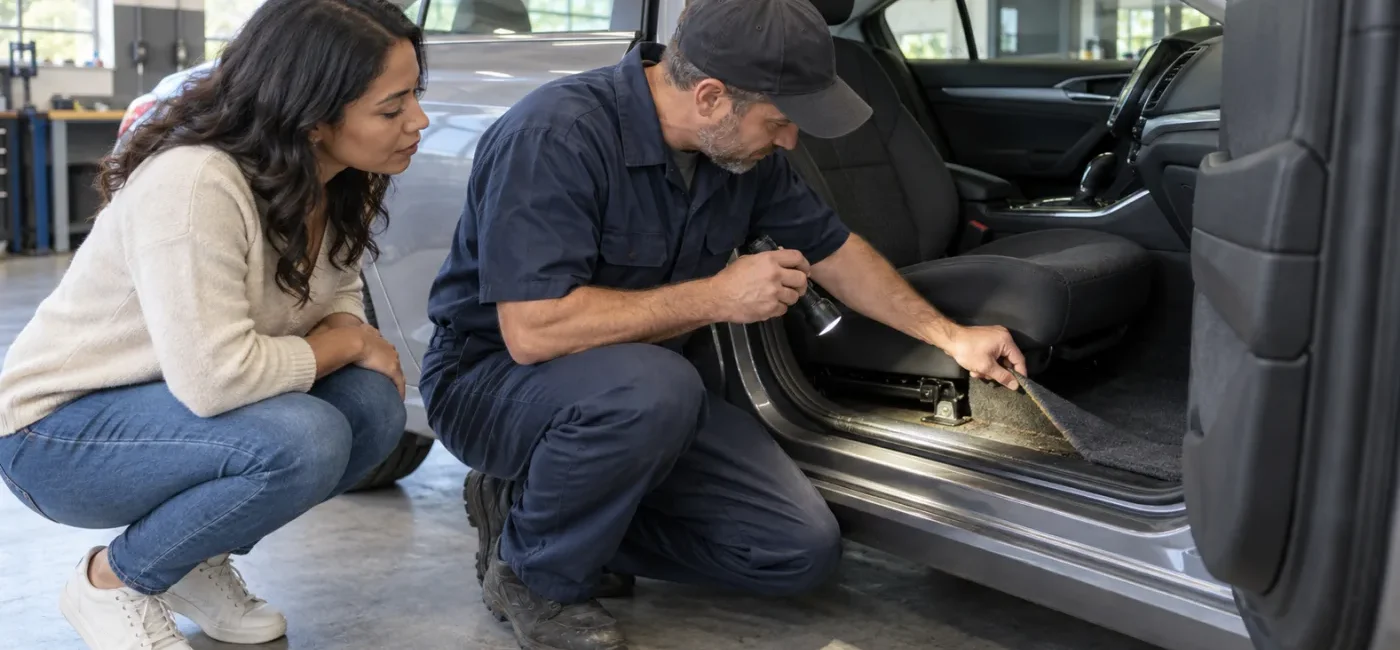
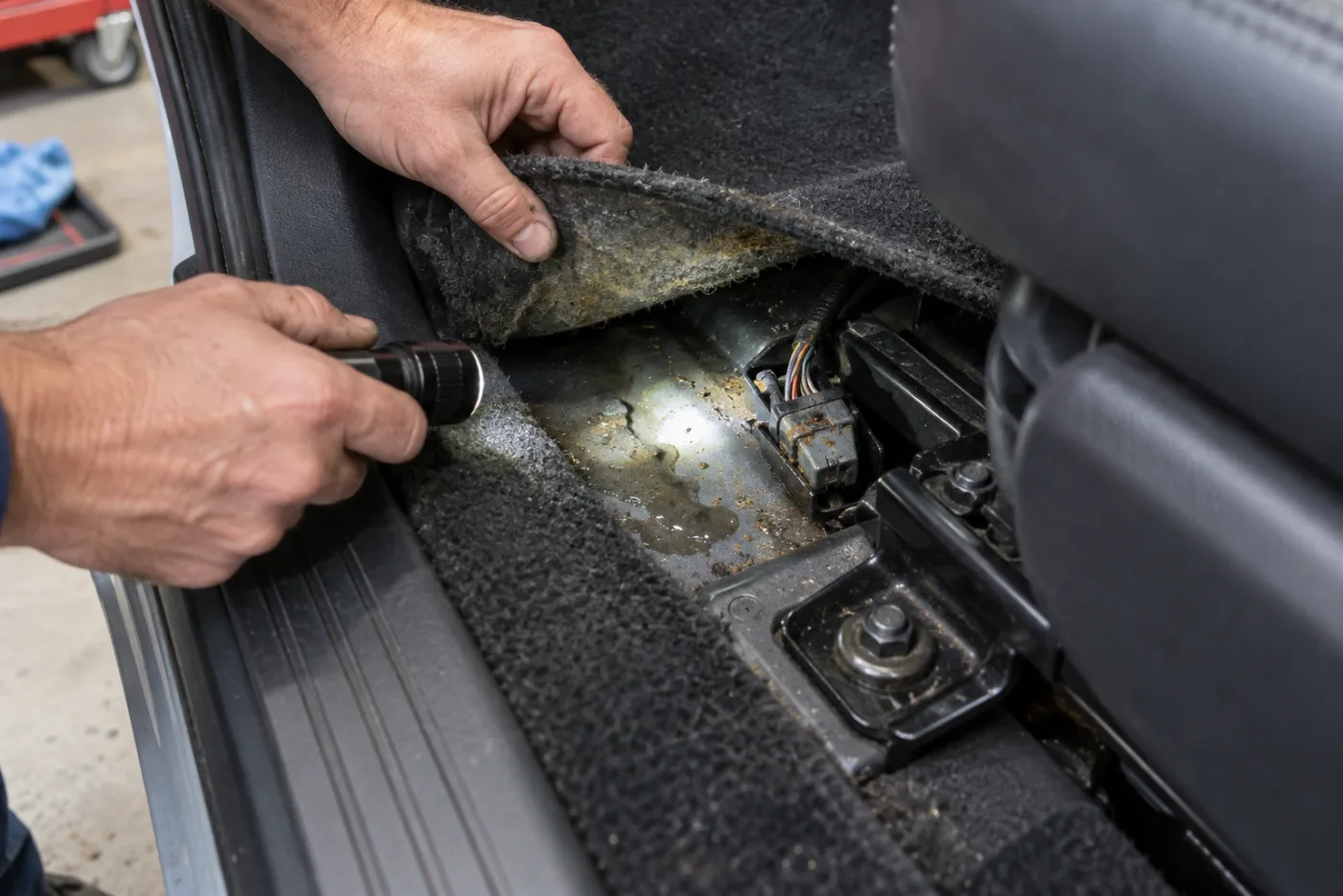
With permission, lift an accessible carpet edge or trunk floor panel. Look for damp padding, silt, sand, stains, or adhesive that appears recently disturbed.
Use a flashlight in the glove box, door pockets, cup-holder wells, under the seat rails, and other places that are difficult to detail.
2. Corrosion on metal and connectors
Check seat rails, seat mounting bolts, lower seat-belt anchors, and pedal brackets for unusual red rust or white oxidation.
Look at visible connectors below the seats and dashboard for green or blue corrosion, dried water marks, fresh tape, or improvised wiring.
Open the trunk floor and inspect the spare-tire well for pooled water, silt, rust, or recently applied sealant.
If exposed screws or bolts are much newer than the surrounding materials, ask why they were replaced.
3. Lights, warnings, and electronics
Before starting, confirm that warning lights illuminate for the normal bulb check and then turn off as expected. A safety warning that never illuminates can also require investigation.
Operate every window, lock, mirror, power seat, heater, air conditioner, audio control, USB port, camera, parking sensor, and interior light.
Watch for slow operation, intermittent failures, multiple warnings, flickering lights, or an infotainment screen that reboots.
Inspect headlamps and taillamps for persistent moisture, sediment, or replacement lamps with noticeably different manufacturing dates.
4. Repeating evidence outside and underneath
Check door-bottom drains, rocker-panel seams, wheel wells, and areas behind the bumper for trapped silt, leaves, or fine debris.
Ordinary underbody surface rust does not prove flooding. Consider the vehicle’s age and region, then look for a similar waterline or corrosion pattern inside the cabin and trunk.
Leave fluid-condition conclusions to a mechanic familiar with the model. Color alone does not establish flood exposure or mechanical health.
If one engine-bay section appears aggressively cleaned or several labels and connectors look recently replaced, request repair invoices.
Do not stop at the carpet surface. With permission, inspect the seat rails, floor edges, and visible low-mounted connectors for a consistent water-exposure pattern.
5. Seat belts and trunk compartments
Slowly extend each seat belt to its full length and inspect the webbing for a hidden waterline, mildew, or discoloration.
If a belt’s manufacturing label is much newer than the vehicle, ask whether it was replaced after a crash or another event.
Compare the condition of the jack, tools, spare-tire fastener, and trunk floor. Severe rust or completely new components can both merit questions.
Look behind removable weather stripping and along the lower hatch or trunk seams for dried mud.
What to request in an independent inspection
When booking a pre-purchase inspection, say that you specifically want possible flood exposure evaluated. A basic inspection may focus on tires, brakes, and visible leaks. Ask whether the shop can perform a full-module diagnostic scan, examine low-mounted connectors under the seats and dashboard, inspect the underbody on a lift, identify water and corrosion patterns, review restraint-system history, and test the battery and charging system.
A dashboard with no active warning light is not the end of the analysis. The technician should consider stored codes, communication faults, evidence of recently cleared codes, and unusual faults across several modules. A code does not prove flooding, and cleared codes do not automatically prove fraud. The useful question is whether the title record, physical condition, repair receipts, and diagnostic evidence support one consistent explanation.
Ask the shop to address these questions in writing:
Is there physical evidence consistent with flooding or prolonged moisture exposure?
Which connectors, modules, or safety components show a concern?
What needs immediate repair, and what should be monitored later?
How did the technician distinguish ordinary age or regional road-salt corrosion from abnormal water exposure?
Is additional diagnosis by a brand specialist, body shop, or restraint-system technician needed?
Open recalls are a separate issue. Follow Smartor’s NHTSA VIN recall and free-repair checklist to identify unrepaired safety recalls. Completing a recall does not repair unrelated flood damage.
Review the contract and total cost in the right order
Decide whether the vehicle is acceptable first. Review the history and inspection before negotiating a monthly payment. A low price may not cure unexplained safety or electrical risks.
Disclose any title brand to the insurer and lender. A flood, salvage, or rebuilt brand can affect coverage, collateral value, financing, registration, and future resale. Ask using the VIN before signing.
Put material promises in writing. If the seller represents that the car has no flood history or promises a particular repair, make sure the precise statement appears in the transaction documents.
Read warranty exclusions. Determine whether corrosion, wiring, sensors, pre-existing conditions, and water damage are excluded. A service contract is not automatically comprehensive protection.
Calculate the full ownership cost. Add the sale price, taxes, registration, dealer fees, inspection, immediate repairs, insurance, and loan interest. Do not compare offers by monthly payment alone.
If you will finance the car, use the auto-loan guide for comparing APR, term, and total cost. Extending the loan to make a questionable vehicle look affordable can leave you paying long after expensive electrical problems begin.
Decision example: the report is clean, but the car looks wrong
Imagine a five-year-old sedan with no flood brand or insurance total-loss entry in its NMVTIS report. The seller advertises a clean title. During the inspection, however, you find unusually new carpet, a matching line of corrosion on the seat rails and spare-tire well, sediment inside one headlamp, and an audio screen that reboots once.
The correct response is neither “this is definitely a flood car” nor “the report is clean, so it must be fine.” Match the VIN and original title again. Ask why the carpet was replaced and request invoices. Have a shop you selected perform a full-module scan and lift inspection. A seller who allows the inspection and supplies coherent repair records gives you evidence to evaluate. A seller who blocks the inspection, makes the deposit nonrefundable, or demands an immediate signature is giving you a practical reason to leave. Walking away from an unexplained risk is often the least expensive option.
Eight common mistakes
Treating one history report as a warranty: A report can reveal important records, but it cannot display damage that was never reported or has not arrived in the database.
Relying on odor alone: Cleaning, replacement carpet, and deodorizer can reduce smells. Inspect metal, connectors, the trunk, belts, and electronics.
Calling any rust proof of flooding: Road salt, coastal air, leaks, and age also cause corrosion. Look for a repeated pattern in protected, low interior areas.
Using only the seller’s shop: Choose an independent inspector who works for you and receives no benefit from the sale.
Assuming no warning light means no problem: Confirm the normal bulb check and review stored codes and intermittent network faults.
Sending a deposit too early: Verify the VIN, title, refund terms, and inspection permission before making a payment that may be difficult to recover.
Ignoring “as is” language: The words can significantly affect who pays for a later failure. Read the Buyers Guide and final contract together.
Accepting risk because the price is low: Repeated electrical diagnosis, limited insurance, and reduced resale value may exceed the original discount.
If you discover signs after the purchase
Preserve the original listing, messages, emails, Buyers Guide, contract, title copy, financing papers, and payment records.
Photograph and record the location of corrosion, water marks, contamination, and electronic faults. If a safety issue is suspected, stop driving and consider towing.
Ask an independent mechanic for a written diagnosis describing the evidence, likely cause, safety implications, and estimated repairs.
Contact the seller in writing with the documented facts, relevant contract language, and the remedy you are requesting.
Review complaint options with your state DMV, state attorney general or consumer-protection office, and the FTC. For a substantial loss or unclear contract rights, consult a local consumer-law attorney.
If an insurance claim may apply, provide facts and inspection records without guessing about when or how the damage occurred.
Final pre-purchase checklist
I saved the listing and all flood- and accident-related statements.
The VIN matches on the vehicle, title, listing, and contract.
I reviewed an NMVTIS report and the original current title.
I verified the meaning of any brand with the issuing state’s DMV.
I checked low interior areas, the trunk, seat belts, lamps, and electronic features.
A shop I selected performed a PPI that specifically considered flood exposure.
I checked recalls, insurance eligibility, and financing using the VIN.
The Buyers Guide, warranty, service contract, and final agreement are consistent.
I am prepared to leave if evidence remains unexplained or inspection is refused.
Frequently asked questions
Does a clean title prove the car was never flooded?
No. State branding standards and terminology differ, damage may never have been reported, and databases can receive information later. A clean title is important evidence, but it does not replace a physical inspection and an independent PPI.
Is a free VIN check enough?
Free tools can be useful for VIN basics and recall status, but do not assume they include complete title-brand, total-loss, or salvage-yard data. Use an approved NMVTIS provider, state records, the original title, and an independent inspection for their different purposes.
Does rust under the carpet always mean flooding?
No. A spilled drink, leaking window or sunroof, wet footwear, and chronic humidity can also cause moisture. A technician should look for a consistent waterline, corrosion across multiple connectors, evidence in the trunk and belts, and related electrical faults.
Should buyers always avoid rebuilt or salvage vehicles?
Rules and registration requirements vary, and branded vehicles are not all in the same condition. However, repair quality, safety, insurance, financing, and resale can be harder to evaluate. Understand why the brand was issued, obtain repair documentation, commission a specialized inspection, and compare the full risk with the price.
What if the dealer refuses an independent inspection?
Treat the refusal as a major warning. Regardless of whether a particular law requires the dealer to cooperate, you are not required to buy a car you cannot evaluate. Consider ending the transaction before signing financing documents or paying a nonrefundable deposit.
Can a flood-branded vehicle be insured?
Possibly, but availability and coverage depend on the state, title brand, insurer, and current condition. Before buying, provide the VIN and ask in writing about liability, collision and comprehensive eligibility, valuation, and exclusions.
What is the single most important inspection?
No single check replaces the others. The most useful action is to verify the VIN and title, then obtain a pre-purchase inspection from a qualified shop you selected and specifically ask it to evaluate possible flood exposure.