
Home Insurance Claim Denied? Evidence, Appeal and Complaint Checklist
Smartor 편집팀
August 26, 2026

한국어판: 한국어로 이 가이드 읽기
A denied or underpaid homeowners insurance claim is a decision, not necessarily the end of the process. The most effective next step is not a series of angry phone calls. It is a structured review of the policy language, the insurer’s stated facts, and the evidence supporting your position. Once those three pieces are aligned, you can ask for an internal review, use any dispute procedure in the policy, and contact the appropriate state insurance regulator if the issue remains unresolved.
This guide covers practical steps for a U.S. homeowners or renters insurance claim that was denied, reduced, delayed, or only partly accepted. Insurance contracts and state laws vary. This is general information, not individualized legal or insurance advice. A major loss, an approaching contractual deadline, a lawsuit threat, or a dispute that makes the home uninhabitable may justify prompt advice from a licensed professional in your state.
People often use “denied” to describe several different outcomes. A full denial says the loss is not covered. A partial approval accepts some damage but excludes other damage. An underpayment dispute may involve scope, quantities, labor rates, a deductible, or depreciation. A claim marked pending or under investigation may be waiting for documents rather than finally denied. A payment based on actual cash value may also leave recoverable depreciation that can be requested after repairs, depending on the policy.
That distinction changes the task. If a storm claim accepts newly damaged shingles but excludes long-term wear, the central question may be which damage came from the event. If a sudden pipe break is treated as long-term seepage, the evidence should address when the leak began, when it was discovered, and what a qualified professional observed. If coverage is accepted but the estimate is too low, the dispute may be about repair scope rather than the cause of loss.
If the explanation is vague, ask the company to identify in writing the policy provisions and investigation facts supporting its decision. A phone explanation can be useful, but a written explanation gives both sides a stable record. Obtain the complete policy package: declarations, base form, endorsements, renewal notices, and any special deductible or roof settlement provision.
Safety comes before claim strategy. Do not enter if wet electrical systems, structural instability, a gas odor, fire damage, or contaminated water creates a hazard. Follow instructions from emergency services and utility providers. When it is safe, take reasonable temporary measures such as stopping the water source, covering an opening, or moving undamaged property away from moisture.
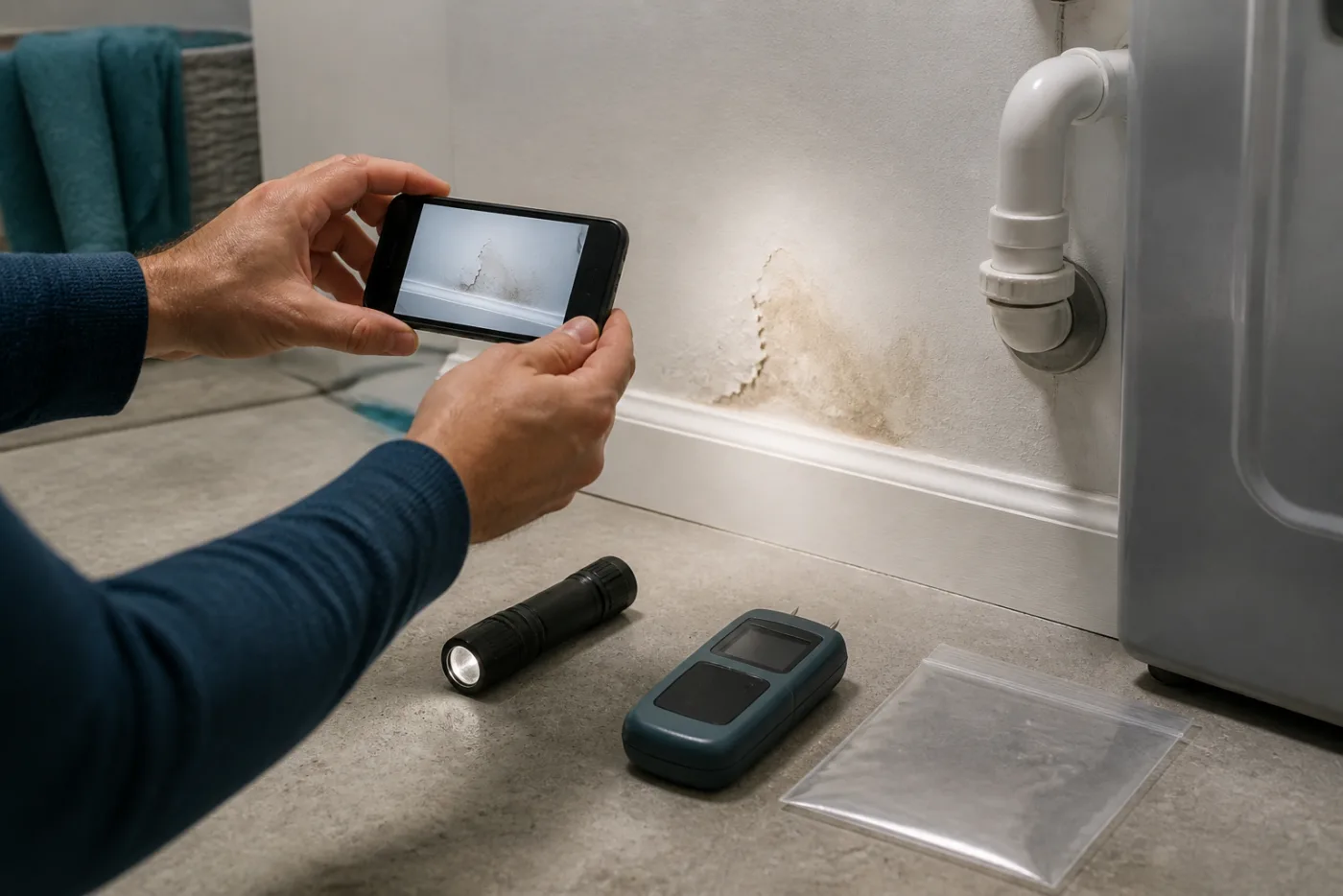
Avoid discarding or fully demolishing damaged material before it can be documented unless safety or emergency mitigation requires it. Photograph the condition before, during, and after emergency work. Ask the contractor whether representative samples can be kept safely. Save invoices showing the business name, date, work performed, and cost. Confirm rather than assume whether the policy or insurer requires notice before permanent repairs.
A persuasive review package is not simply a large upload of unrelated photos. It lets another person verify what happened. Create a folder named with the claim number, property, and date of loss. Keep original files separately from annotated copies, and preserve original photo metadata whenever possible.
Connect each file to the timeline with simple names such as “Photo-014-living-room-wide” or “Estimate-B-page-3.” If you already have a home inventory, cross-reference it. If not, you can still build one by room. Smartor’s home inventory and insurance-claim preparation guide explains how to organize photos, receipts, and product details.
A contractor estimate that is higher than the adjuster’s estimate does not explain the difference by itself. Compare scope, quantity, material, labor, demolition, disposal, drying, painting, permits, taxes, code-related work, and access requirements. If the same task has a different quantity, attach a measurement photo or sketch. If an entire task is missing, explain why it is necessary and where a qualified contractor included it.
Ask the contractor for the actual repair scope rather than telling the contractor to match the insurance payment. A useful estimate identifies the business, date, area, work steps, quantities, materials, and pricing. Include licensing information where your jurisdiction requires it. A short comparison table listing only disputed items is often easier to review than two long estimates with no explanation.
Suppose the insurer’s estimate includes drywall replacement and paint, while the independent estimate also includes insulation removal, controlled drying, moisture verification, and baseboard replacement. Do not write only, “The estimate is too low.” Cite photos 12 through 18, the moisture findings, and pages 3 through 5 of the contractor estimate. Then list the four omitted tasks and explain how each relates to the documented damage.
A payment lower than the repair estimate is not always a scope error. Confirm the deductible, whether the settlement uses replacement cost or actual cash value, whether any depreciation is recoverable after repairs, and whether a special roof or wind deductible applies. Endorsements can change the settlement method for roofs, cosmetic damage, water backup, matching materials, or building-code work.
Ask for an itemized payment calculation if the numbers are unclear. Separate the deductible, nonrecoverable depreciation, recoverable depreciation, coverage limit, and excluded items. If recoverable depreciation may be available, ask in writing what proof of completed repairs is required and what policy deadline applies. Do not rely on a deadline quoted for a different state or a different policy.
A longer letter is not automatically stronger. Put the requested action and the central reason on page one, then use numbered attachments for the details. Submit through a method the company accepts—such as its portal, email, or trackable mail—and retain proof of submission.
Sample structure
Subject: Request for review of claim 12345
Request: Please review the August 20 decision concerning the living-room wall and insulation.
Issue: The estimate includes surface painting, but the attached photos and licensed contractor estimate identify drying and insulation replacement required in the same affected area.
Attachments: A decision letter; B relevant policy pages; C photo index; D independent estimate; E emergency invoices; F communication log.
Requested response: Please identify the accepted and disputed items, the policy provisions applied, and whether a reinspection is needed.
Do not invent technical conclusions. If a contractor or engineer identified the cause, verify that the signed report actually says so. AI can help organize prose, but do not paste a Social Security number, bank information, full policy record, or other sensitive data into a public AI service. Check every generated quotation, policy reference, and legal statement against the original source.
Ask whether the insurer will reinspect the property when new evidence exists or the first inspection could not access an area. If the policy includes appraisal, read the clause carefully. Appraisal may address the amount of loss but may not decide whether a cause is covered. Review the cost allocation, appraiser selection, umpire process, and effect of an award before invoking it.
A public adjuster represents the policyholder in preparing and negotiating a claim. Before hiring one, check licensing requirements and the current license status through the state insurance regulator. Read the fee calculation, cancellation terms, advance costs, and exact services in the contract. A public adjuster is not automatically a lawyer and should not be assumed to provide legal advice.
Stop if a contractor or adjuster pressures you to sign a blank form, transfer broad rights you do not understand, inflate the claim, or hide the deductible. Be cautious with an assignment of benefits, a direction to pay, or a contract that controls all claim communication. Verify licenses on the regulator’s official website rather than relying on a screenshot supplied by the seller.
Insurance regulation in the United States is primarily state based. If the insurer’s internal process does not resolve the issue, identify the insurance department that has jurisdiction over the policy. The National Association of Insurance Commissioners maintains a directory linking to state insurance departments. Use the actual state website for current forms, authority, and deadlines.
A complaint package generally works best when it contains the claim number, insurer and adjuster, date of loss, concise issue, desired resolution, prior contacts, decision letter, relevant policy pages, photos, and estimates. Redact unrelated personal information. Match attachment names to the list in your complaint, save the confirmation number, and retain every portal message.
A regulator can review compliance and request a company response, but it is not always able to decide every factual dispute or act as a court. The Texas Department of Insurance, for example, tells homeowners to speak with the company, explain why they disagree with an adjuster estimate, send supporting documents such as a contractor estimate, and then use the complaint process when needed. The procedure and regulator authority in another state may differ.
If the home cannot be occupied, review additional living expense or loss-of-use coverage. Keep receipts for lodging and increased costs such as meals, laundry, parking, pet boarding, or transportation, but do not assume every expense is covered. Ask the insurer in writing about preapproval, limits, the covered period, and how often documentation must be submitted.
When a mortgage remains on the home, the insurance check may name the mortgage servicer as a co-payee. Contact the servicer’s loss-draft department to learn its endorsement, inspection, and staged-release process. Keep that process on a separate timeline from the coverage dispute so an approved payment is not delayed by missing mortgage documents.
Sometimes. New photographs, an independent estimate, a qualified cause report, or a missed policy provision may support a request to reopen or review the decision. The available process and deadline must be checked in the decision letter, policy, and official state guidance.
Do not delay emergency work needed to protect people and property. Permanent demolition and repair, however, should be coordinated so the insurer has a reasonable opportunity to inspect. Document the condition and the work, notify the insurer in writing, and retain receipts.
No. The company will evaluate whether the additional work concerns covered damage, is reasonably required, and falls within policy limits and settlement terms. A line-by-line explanation is more useful than the total difference alone.
No. The regulator provides oversight and consumer assistance but does not represent you as private counsel. A large loss, litigation threat, disputed deadline, or complex causation issue may require separate legal advice.
Flood is commonly handled separately from standard homeowners coverage, through a federal or private flood policy when purchased. Confirm which policy applies and keep the claim procedures separate. For prevention planning, see Smartor’s basement flood prevention checklist.
Ask the insurer and state insurance department whether interpretation or translated assistance is available. Confirm whether the policyholder must authorize a family member to participate. Keep the key request in writing, and do not sign a release or assignment you do not understand.
The clearest way to present a home-insurance dispute uses three columns. First, identify the policy language the insurer applied. Second, state the relevant facts in a dated timeline. Third, connect each fact to photographs, estimates, invoices, or reports. That structure helps an internal reviewer or state regulator understand the issue without guessing what each attachment means.
Break the work into manageable sessions. Secure the decision and complete policy today. Number the photos and reconcile the estimates next. Then write a one-page request with organized attachments. Record the submission confirmation and the expected response date. Give safety concerns and verified contractual deadlines priority, and convert important verbal explanations into written confirmation.
브라우저 메뉴에서 앱 설치 또는 홈 화면에 추가를 선택해 주세요.