
Hospital Discharge Medication Reconciliation: A 12-Question Checklist
Smartor 편집팀
August 19, 2026

Leaving the hospital with a new prescription does not automatically mean your medication plan is settled. The medicines you took before admission, medicines given in the hospital, new prescriptions, temporary holds, over-the-counter products, vitamins, and supplements all need to be compared. If they are not, a patient can accidentally take two versions of the same ingredient, restart something that was meant to stay on hold, or miss the first dose of an important new medicine.
A medication list records what you believe you are taking. Medication reconciliation compares that information with the hospital administration record, discharge orders, pharmacy records, and what you will actually do at home. It should explain look-alike or sound-alike names, identify duplicate ingredients, and clarify why each medicine was started, changed, held, or stopped.
The useful end product is one current plan that answers a simple question: What exactly will I take at my next scheduled dose after I get home? Every item should fall into one of four groups:
Instructions such as “take as needed” also need detail. Ask what symptom it treats, the minimum interval between doses, and the maximum allowed by your prescription. Do not fill gaps with a guess.
A planned procedure gives you time to prepare, but an emergency visit does not. Keep an updated, readable list ready now. A wallet-size summary is useful, and a complete printed or securely stored digital copy is even better. For disaster-ready storage and backup ideas, see Smartor’s emergency medication and medical information kit guide.
“One blood pressure pill” is not specific enough. Medicines for the same purpose can have very different ingredients and doses. When possible, bring the original labeled containers or a current printout from your pharmacy. Tell hospital staff before using any medicine you brought with you. Taking something privately from your bag can create a dangerous mismatch between the hospital record and what entered your body.
When a clinician asks what you take, include nonprescription products and supplements. If you do not know the time of your last dose, say so. Then verify it through a caregiver, a bottle label, the pharmacy, or the patient portal. Describe what happened during an allergy or previous adverse reaction instead of using the word “allergy” without details.
Handoffs create new places for information to be lost. After surgery, a transfer to another unit, or a change in clinical teams, ask when a temporarily held medicine should restart and why a home medicine is absent from the hospital list. Do not assume that a missing medicine was permanently discontinued. Do not assume that every old medicine should continue either. Tests, bleeding risk, kidney function, or inability to eat may have changed the short-term plan.
Discharge can feel rushed, but it is the most important checkpoint. Ask a trusted caregiver to listen with you when possible. Request a qualified medical interpreter if you need one. Have the team mark every medicine as continue, change, start, stop, or hold. Confirm which pharmacy received each new prescription and which dose comes next tonight or tomorrow morning.
Use teach-back: repeat the plan in your own words. For example, say, “My understanding is that I stop the old A tablet today and start B after breakfast tomorrow. Is that correct?” This gives the team a chance to catch a misunderstanding before you leave.
You do not need to memorize every answer. Ask for the plan in writing and mark anything that remains unresolved. The physician is not the only source of clarification. A hospital pharmacist, nurse, care manager, prescriber’s office, and community pharmacist may each resolve a different part of the handoff.
Use a well-lit table and make separate areas for the final discharge list, new prescriptions, and medicines already at home. Keep children and pets away. Do not open every container at once. Place stopped medicines in a separate bag marked “Do not take—confirm disposal” rather than leaving them in the active medication drawer.
Check the active ingredient, strength, dosage form, frequency, and start or stop date—not just the familiar name. An old bottle may say 10 mg while the new order says 20 mg. A once-daily schedule may have replaced twice-daily use. A generic and brand name may describe the same ingredient. A combination product may already contain something that also appears as a separate pill. If you see a possible duplicate, contact the pharmacist before taking it.
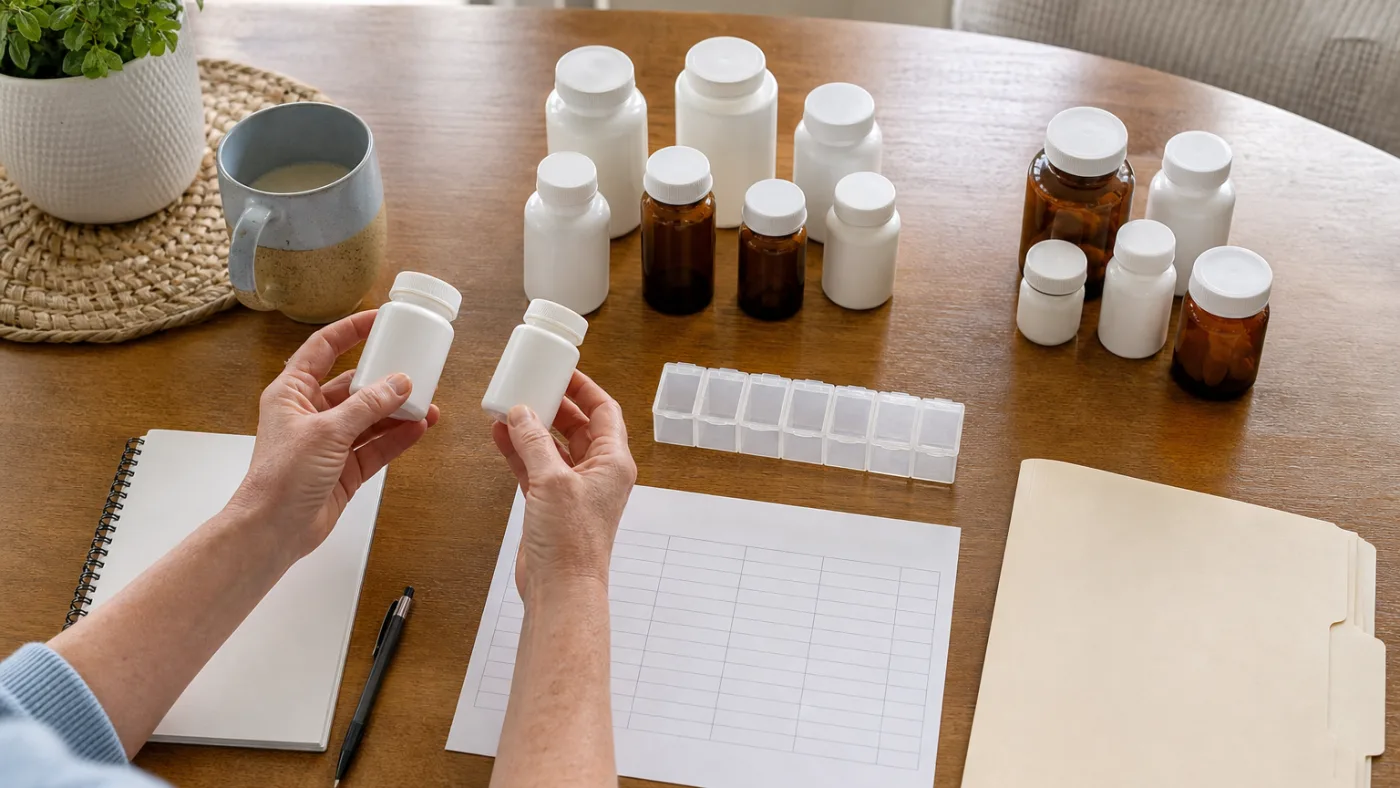
The time of the last hospital dose can determine the next safe dose. Taking another dose simply because you arrived home may duplicate what the hospital already gave. Write the next few times specifically—tonight, tomorrow morning, and tomorrow midday. Call the discharge number or pharmacy about any blank you cannot answer confidently.
Different versions on the refrigerator, in a wallet, and on a phone can cause the same confusion again. Add the date and time to the final version and clearly mark or destroy obsolete lists. Prepare to share the new list with your primary care clinician, specialists, caregiver, and regular pharmacy. If a phone holds the digital copy, Smartor’s lost or stolen phone response guide can help you secure that information.
Suppose a patient took a 10 mg blood pressure medicine at home, but the discharge prescription shows a different-looking name and a 20 mg tablet. They could be different ingredients, generic and brand names for the same ingredient, or a deliberate replacement. The patient should not decide that both are required, and should not discard the new medicine because the names look similar.
Instead, place both labeled bottles beside the discharge list and call the pharmacist. Explain the last dose received in the hospital and anything already taken at home. Ask the pharmacist to confirm the active ingredient, strength, and whether one replaces the other. If the written order is unclear, the pharmacist may contact the prescriber. Record the answer, date, and person who provided it on the new list.
A precise comparison works better than saying, “My medicine looks wrong.” Use a short script like this:
“I was discharged on August 19. The discharge list says A 20 mg every morning. My home bottle is A 10 mg, and the hospital gave me a dose this morning. I need to confirm whether I take 20 mg again today and whether the old 10 mg tablets are stopped.”
Have the exact spelling, bottle label, prescription number, and relevant discharge page ready. Use the hospital’s approved patient portal or secure communication method before sending sensitive information by ordinary text or email. If the first call does not resolve the issue, ask who will contact the prescriber and when you should expect a response.
This list is not a reason to label a medicine “dangerous” or make your own change. It is a reminder not to assume that yesterday’s instructions still apply after a hospital visit.
1. Refilling the weekly pill organizer from memory. Empty it and rebuild it only after comparing the final list.
2. Leaving stopped medicines among active bottles. Separate them so a tired patient or caregiver cannot restart them by accident.
3. Treating a generic and brand name as two medicines. Ask the pharmacist to compare active ingredients.
4. Hiding supplements because they are “not medicine.” Vitamins and herbs can still affect prescriptions, procedures, or testing.
5. Waiting until late evening to discover the pharmacy is closed. Confirm availability and pickup timing before leaving the hospital when possible.
6. Guessing the last-dose time. Say that you are unsure and help the team verify the record.
7. Letting several relatives maintain different lists. Assign one current version, date it, and identify who updates it.
8. Saying “yes” without understanding. Teach-back makes confusion visible while the care team is still available.
Do not assume either one is automatically current. A pharmacy app may not immediately show a medicine stopped inside the hospital, and the discharge record can contain an older entry or data error. Compare both with the actual labeled containers and ask the pharmacist or discharge team to resolve the difference.
First remove it from the active medicines and label it clearly. Confirm the instruction if anything is unclear. Once discontinuation is verified, use an FDA-recommended take-back site or your pharmacy’s disposal guidance. Do not flush medicines unless official instructions specifically identify that product for flushing.
Call the discharge team, prescriber, or pharmacist promptly. Do not substitute an old medicine on your own. Whether the prescription can move to another pharmacy or the start time can safely change depends on the medicine and your condition.
What staff can discuss depends on the patient’s consent and the organization’s privacy procedures. When the patient can communicate, register the authorized caregiver in advance. Have the patient’s name, date of birth, discharge date, and a narrow, specific question ready.
Follow the warning signs and contact numbers on the discharge instructions. Call 911 for a life-threatening emergency. For a suspected poisoning or overdose in the United States, call Poison Help at 1-800-222-1222. Tell the prescriber or pharmacist about less urgent suspected reactions, and do not adjust the dose on your own.
A safe discharge is not measured by the number of pages you receive. It depends on comparing the old and new plans, understanding why changes occurred, knowing the next dose time, and having a clear route for resolving discrepancies. Start today by writing the exact name, strength, and schedule of every product you use. At the next transition, show that list and use teach-back before you leave.
브라우저 메뉴에서 앱 설치 또는 홈 화면에 추가를 선택해 주세요.