
한국어판: 이 통학 안전 가이드를 한국어로 읽기
A safer trip to school is built less by a last-second reminder to “be careful” and more by a route and a few repeatable decisions. A familiar block can still contain backing vehicles, sight lines blocked by parked cars, a rushed child running toward a bus, or a driver turning through a crosswalk. The useful goal is to plan the entire trip—from the front door to the school entrance—and identify the places where a child should stop, look, wait, or ask an adult for help.
The National Highway Traffic Safety Administration describes school buses as among the safest vehicles on the road, while noting that children face more risk when approaching or leaving a bus than while riding in it. That is why this guide combines bus-stop behavior, walking and bicycling skills, parent drop-off, and backup communication into one practical family plan.
Eight checks to complete with your child this week
- Travel the route together during the actual morning and afternoon commute.
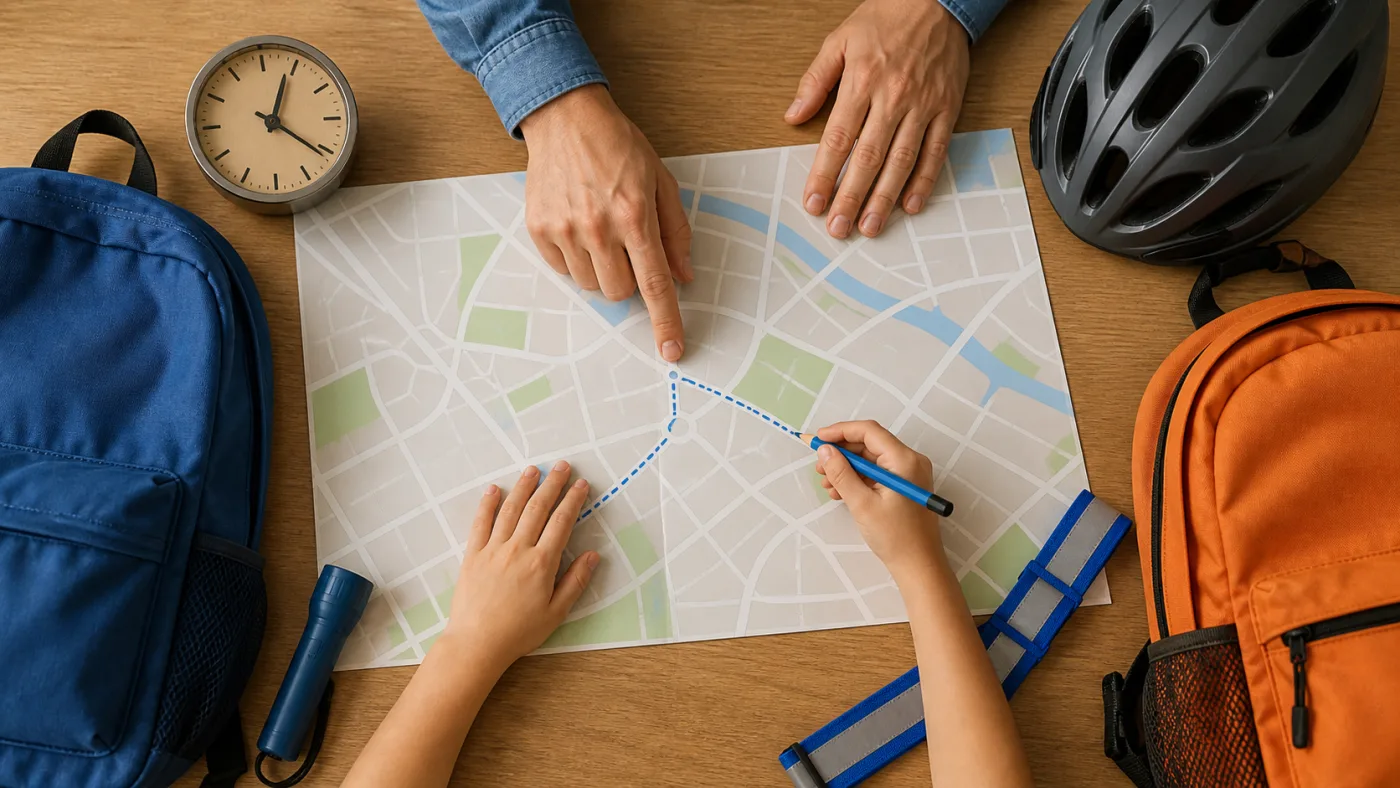
- Mark crosswalks, signals, blind corners, and driveways with frequent backing traffic.
- Plan to arrive at the bus stop at least five minutes early.
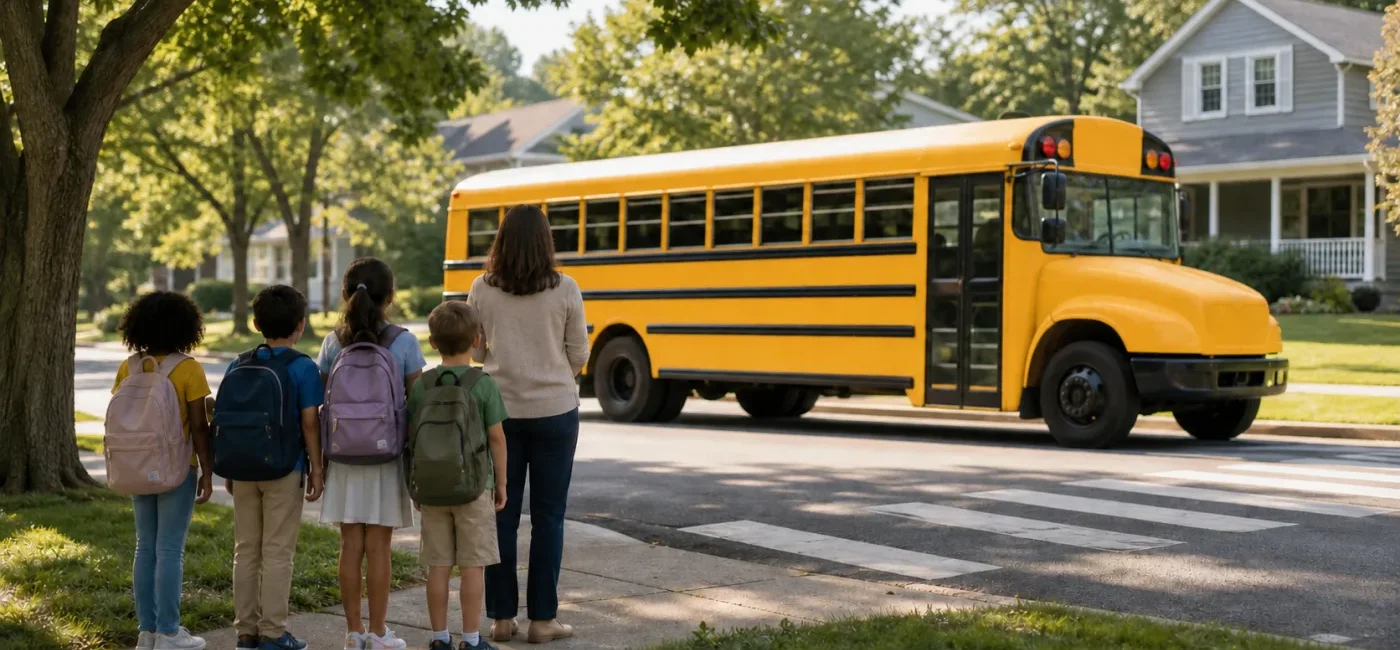
- Wait about 10 feet—five large child-sized steps—back from the curb.
- Make eye contact with the bus driver before crossing in front, and never walk behind the bus.
- For bicycling, check helmet fit, brakes, tires, visibility gear, and route—not just one item.
- Use the school’s designated drop-off zone and unload on the sidewalk side when possible.
- Name two trusted adults and a safe waiting place for a missed bus or delayed pickup.
1. Test the route at the time your child will use it
The shortest route on a map may not be the easiest route for a child to navigate safely. Morning commuter traffic, delivery vehicles, afternoon pickup lines, construction, and low sun can transform the same intersection. Walk or ride the route once during the normal morning window and again around dismissal. Notice where a child must make a judgment rather than simply follow a sidewalk.
Instead of minimizing distance alone, try to reduce the number of difficult decisions. A slightly longer route with continuous sidewalks, controlled crossings, lower vehicle speeds, and clear sight lines may be easier to follow than a shortcut across an uncontrolled multilane road. If the school district has assigned a bus stop or route, contact its transportation office before changing where a child boards.
Route audit checklist
- Does the sidewalk end or force walkers close to moving traffic?
- Do parked vehicles, trucks, fences, trees, or curves block sight lines?
- Are there apartment exits, parking lots, or driveways with frequent backing vehicles?
- Does the crossing signal provide enough time for your child’s walking pace?
- Will the route still work in rain, snow, darkness, or fallen leaves?
- Is there a verified safe place—such as the school office, a staffed library, or a trusted neighbor—where the child can seek help?
Replace a general warning with a location-specific action. “Stop before this driveway and look for moving wheels” is easier to rehearse than “watch out for cars.” At a busy corner, practice waiting for turning vehicles to make a complete stop even after the pedestrian signal changes.
2. School bus stops: Safety starts before the bus arrives
NHTSA advises children to reach the stop at least five minutes before the bus and to wait at least 10 feet from the curb. Arriving early eliminates the urge to run, cross impulsively, or approach the bus while it is moving. Packing backpacks, instruments, sports gear, and umbrellas the night before makes that buffer easier to keep.
A bus stop is not a play area. Children should avoid pushing, ball games, looking down at a phone, or blocking both ears with headphones. When the bus arrives, they should remain back until it stops completely, the door opens, and the driver indicates that boarding is safe. They should use the handrail and keep loose straps or clothing from catching in the door.
Explain the bus danger zone at a child’s eye level
Because the driver sits high above the road, a small child can disappear from view immediately in front of, beside, or behind the bus. If a child must cross in front, the child should move along the sidewalk or roadside until at least 10 feet ahead of the bus, stop, make eye contact with the driver, and wait for the driver’s signal. Even then, the child must look left, right, and left again because another motorist could pass the stopped bus illegally.
Children should never cross behind a school bus. If a phone, book, or water bottle falls near or under the bus, the child should tell the driver rather than retrieve it. Bending near the bus can put the child entirely outside the driver’s view.
What drivers should know about bus lights
- Flashing yellow lights: The bus is preparing to stop to load or unload. Slow down and prepare to stop.
- Flashing red lights and an extended stop arm: Children are boarding or exiting. Stop and wait until the red lights stop, the arm retracts, and the bus begins moving.
- State-law details: Every state prohibits illegally passing a stopped school bus with red lights and an extended stop arm, but rules for opposing traffic on a divided roadway can vary. Check your state driver manual rather than guessing.
3. On the bus: Sit, keep the aisle clear, and protect the driver’s attention
Children should take their assigned seat before the bus moves and remain seated, facing forward when possible. Yelling, throwing objects, and changing seats can distract the driver. Backpacks and instruments must stay out of the aisle and doorway. If the bus is equipped with seat belts, use them as the school and driver instruct.
Also give children a reporting plan. An immediate hazard should be described to the driver briefly and clearly. Bullying or a nonurgent concern can be reported to a caregiver and school after the ride using facts such as the route, stop, date, and what occurred. A child should not move around a traveling bus to record a photo.
4. Walking: Be visible and predictable
NHTSA advises pedestrians to use sidewalks when available. Where there is no sidewalk, walk facing traffic and as far from moving vehicles as practical. Cross at a crosswalk or intersection rather than emerging between parked vehicles. A “Walk” signal is permission to check and cross; it is not proof that every turning driver has seen the child.
Children are still developing the ability to estimate vehicle speed and distance. NHTSA generally advises that children younger than 10 not cross a street alone and that families identify an adult or sufficiently mature older sibling who can help. Age is only one factor. A child should consistently demonstrate stopping at the curb, scanning traffic, making eye contact, and waiting when something unexpected happens.
Four sentences to rehearse
- “I stop at the curb.”
- “I look left, right, and left again.”
- “I wait for the vehicle to stop and for the driver to see me.”
- “I walk while continuing to scan.”
Phones should stay in a pocket or backpack during a crossing. A simple family rule is to remove earbuds at intersections. On dark mornings and in poor weather, bright outerwear, reflective straps, or backpack reflectors help drivers notice a child earlier.
5. Bicycling: Check the bike, helmet, rider, and route together
A helmet alone does not complete a bicycle safety plan. The bike must fit well enough for the child to control and stop it. Before departure, check tire inflation, brakes, chain, wheel security, steering, and reflectors. Carry books in a backpack or secured rear carrier rather than in one hand or swinging from the handlebar. Tie shoelaces and secure loose pant legs away from the chain.
A helmet should sit level, cover the forehead, and resist sliding. Adjust the side and chin straps according to the manufacturer’s instructions. A helmet involved in a significant impact may need replacement even when damage is not obvious; follow the maker’s guidance.
NHTSA notes that many states treat a bicycle as a vehicle on the roadway. Riders generally travel with traffic, obey signs and signals, ride predictably, check behind before changing position, and signal turns. A child who has not developed traffic skills should begin on a separated path, bike lane, or low-speed, low-volume route. Sidewalk riding and youth helmet laws vary by location, so verify city, county, and state rules.
A 60-second ABC-style pre-ride check
- Air: Tires are within the manufacturer’s range and have no visible cuts or embedded objects.
- Brakes: Both brakes stop the wheels before the levers touch the handlebar.
- Chain and controls: Chain, pedals, handlebar, and wheels are secure and steering is smooth.
- Final check: Helmet, visible clothing, reflective equipment, and required front white and rear red lights are ready.
6. Family vehicles and carpools: Remove last-minute choices
Follow the school’s designated traffic pattern and staff directions. Do not unload in a bus zone, on a crosswalk, from a double-parked vehicle, or across a busy street simply to save time. When possible, children exit from the sidewalk side after the vehicle is fully stopped. Before moving, the driver confirms that every child is clear of the vehicle and roadway.
Backing is especially risky around schools. Walk around the vehicle before departure when appropriate, check mirrors and the camera without relying on either alone, and move slowly. Never pass another vehicle stopped at a crosswalk; that vehicle may be hiding a child. Drivers can pair the school routine with Smartor’s tire recall, pressure, and tread checklist.
Carpool agreements worth making in advance
- Confirm the regular and backup drivers, vehicles, and insurance arrangements.
- Use the appropriate child restraint or booster for each child’s age, size, and state requirements.
- Maintain an approved pickup list and one channel for schedule changes.
- Agree that no child waits alone in a vehicle.
- Do not make exceptions for seat belts, speeding, or handheld phone use.
7. Build a backup plan for a missed bus or delayed pickup
A plan is most valuable when the routine fails. Teach a child not to chase a bus, invent a new route, or accept an unplanned ride. Name a verified place to wait and two trusted adults to call. Put those names, phone numbers, and the school office number on a small card inside the backpack. Avoid displaying the child’s full name, school, and home address on the outside of a bag.
If the child carries a phone, practice what happens when the battery is dead or the device is missing. Review emergency-contact access, a family code word, and limited location-sharing settings. For the account-protection steps after a phone disappears, see the lost or stolen phone response checklist.
A child who needs prescription medication, an allergy response medicine, or medical instructions should have a plan coordinated with the school nurse and district policy. Do not place medication in a backpack without checking school and prescription requirements. Smartor’s emergency medication and medical information kit guide can help families organize the underlying information.
General information notice: This article provides general U.S. school-travel safety information. It does not replace an individualized assessment of a child’s development, medical needs, disability accommodations, school policy, or local law. Confirm routes and pickup rules with the school, district, transit provider, and current state or local guidance. Call 911 or the appropriate local emergency service for an immediate threat or crash.
Practical example: An elementary student misses the bus
Suppose Maya leaves late and sees the bus pulling away. Risky responses include chasing it, cutting across the street toward the next stop, or accepting an improvised ride. A family backup script should be simpler:
- Do not chase the bus; return home or to the designated safe location.
- Call trusted adult 1, then trusted adult 2.
- If neither answers, call the school office using the verified number.
- Do not start along a different route until an approved adult confirms the plan.
- That evening, correct the cause by moving departure earlier and packing the night before.
The advantage is that the child does not need to compare several uncertain options while anxious. If returning home is impossible, select a genuinely staffed and accessible place such as an apartment office, school security desk, or trusted neighbor who already knows the child.
Common mistakes and safer alternatives
- Mistake: Automatically choosing the shortest route.
Safer alternative: Compare sidewalks, signals, sight lines, speed, and backing traffic during school travel hours. - Mistake: Running when the bus is visible.
Safer alternative: Arrive five minutes early and use a rehearsed missed-bus plan. - Mistake: Assuming a driver will stop because a child is in a crosswalk.
Safer alternative: Wait for a complete stop and eye contact, then continue scanning. - Mistake: Treating a helmet as the entire bike plan.
Safer alternative: Check fit, brakes, tires, route, visibility, and rider skill together. - Mistake: Allowing any familiar family to handle a late pickup.
Safer alternative: Use an approved-person list and family code word. - Mistake: Treating location tracking as a substitute for a plan.
Safer alternative: Prepare for dead batteries and lost devices with a paper card and safe location.
Final family checklist
- We traveled the route during the actual morning and afternoon windows.
- Our child can identify the bus-stop waiting position and arrival time.
- We practiced crossing in front of the bus and explained why no one crosses behind it.
- We rehearsed stopping, scanning, and making eye contact at crossings.
- The bicycle and helmet fit; brakes and tires work.
- We have visibility gear and a bad-weather transportation alternative.
- We reviewed the school’s drop-off, early-dismissal, and pickup authorization rules.
- Our child can explain what to do after a missed bus or delayed pickup.
- Two trusted contacts and the school office number are available on paper.
- We will revisit the plan after a move, construction, route change, or seasonal light change.
FAQ
How early should a child arrive at the bus stop?
NHTSA recommends at least five minutes early. Follow a district’s longer buffer if required. The purpose is to prevent running and impulsive movement near traffic, not to hit a five-minute mark exactly.
How far from the curb should children wait?
NHTSA recommends at least 10 feet, or about five large child-sized steps. Use the school’s designated location while keeping children well away from traffic and visible to the driver.
May a child cross in front of the bus?
If the route requires it, the child should move at least 10 feet ahead, make eye contact with the driver, wait for the driver’s signal, and scan traffic independently. Never cross behind the bus. A district’s specific procedure takes priority.
At what age can a child walk to school alone?
There is no single national answer. NHTSA generally advises that children younger than 10 not cross streets alone, but the decision also depends on local law, traffic conditions, distance, development, practice, and school policy.
Can children ride bicycles on the sidewalk?
Sidewalk rules vary by city and state. Where riding is allowed, cyclists must yield to pedestrians and slow at driveways and intersections. Confirm local rules and choose a separated or low-traffic route appropriate to the child’s skills.
Must opposing traffic stop for a bus on a divided road?
All states prohibit illegally passing a school bus displaying red lights and an extended stop arm, but the duty of opposing traffic on a physically divided road varies. Consult the current state driver manual. When uncertain, slow or stop and locate the children before proceeding.
Is a location-sharing app enough?
No. Phones can be lost, discharged, disconnected, or inaccurate. Combine technology with a safe location, paper contacts, an approved pickup list, and a rehearsed response.
Bottom line
An effective school-travel plan does not need dozens of rules. Walk the route at the right time, assign a clear action to each difficult location, repeat one or two essential rules for each travel mode, and rehearse the day when the bus is missed or pickup is late. Predictable actions give a child a safer choice when the routine stops being predictable.
[…] Smartor 편집팀 August 25, 2026 English version: Read this school travel safety guide in English […]