Roadside Breakdown Safety Guide: Emergency Kit, Safe Stops, and Help
Smartor 편집팀
September 26, 2026

한국어판: 한국어로 이 가이드 읽기 →
A warning light, flat tire, or sudden loss of power can force a driver to make several decisions within seconds: whether the car can keep moving, which side of the road is safer, whether to stay inside, and who to call first. The most important skill is not diagnosing the mechanical problem. It is knowing how to get out of the travel lane, communicate an exact location, and reduce the risk of a secondary collision.
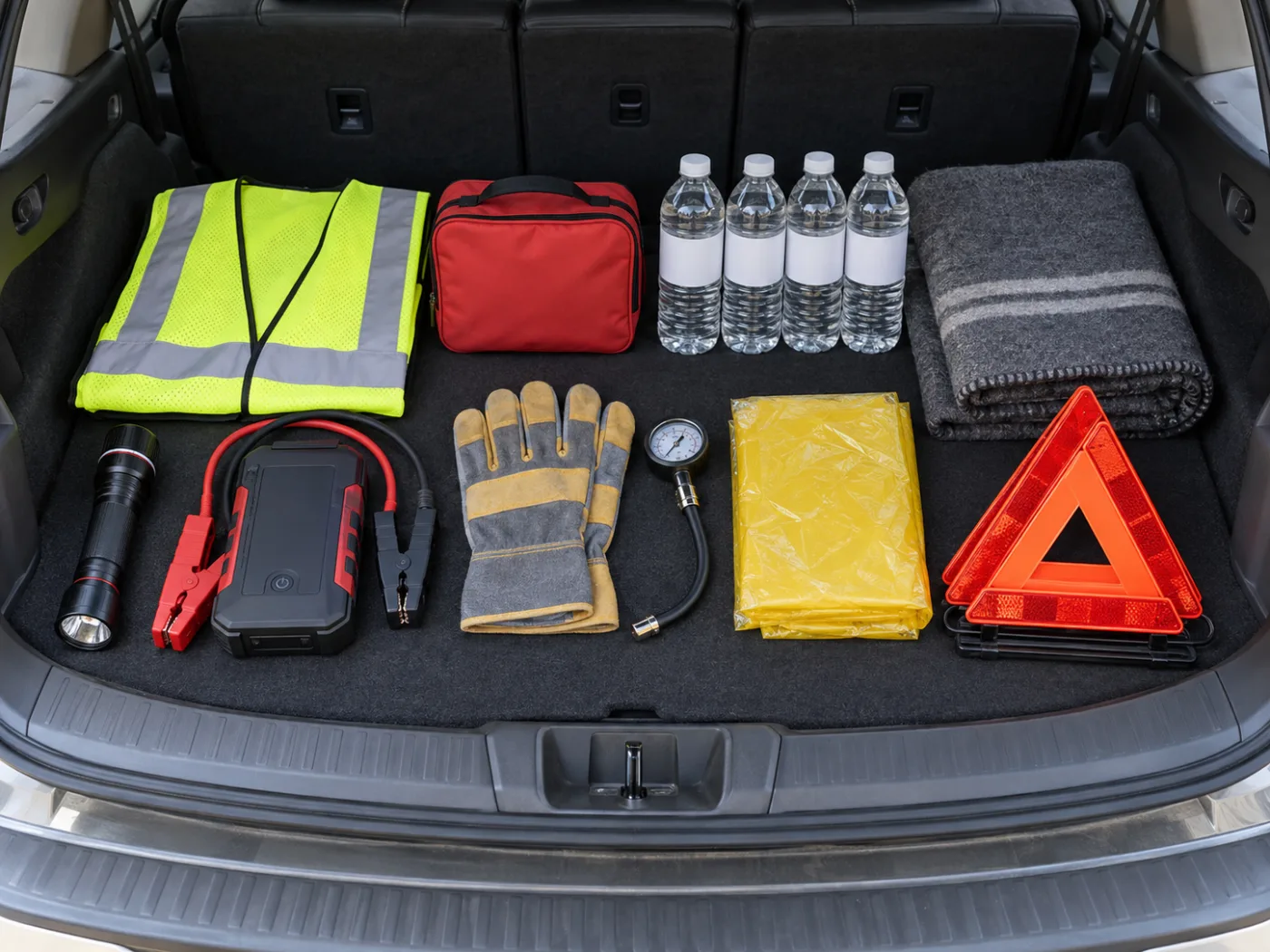
The National Highway Traffic Safety Administration recommends checking tires, the battery, cooling system, wipers, lights, and open recalls before a long drive. Its emergency-kit guidance includes a phone and charger, flashlight, first-aid supplies, jumper cables, a tire-pressure gauge, water, nonperishable food, and blankets. Those supplies only help if they are charged, accessible, secured, and used without putting someone in traffic. This guide organizes preparation around the order in which decisions arise during a real breakdown.
Note: This article provides general U.S. driving and personal-safety information. It is not legal, insurance, medical, or vehicle-specific advice. Crash-reporting duties, whether a vehicle may be moved, towing rules, and insurance coverage vary by state and policy. For injuries, fire, a fuel odor or leak, a vehicle stopped in a live lane, or an immediate collision risk, call 911 and follow responder instructions.
If the vehicle begins behaving abnormally, avoid hard braking or cutting across lanes. Hold the steering wheel firmly, ease off the accelerator, scan surrounding traffic, and activate the hazard lights. When the vehicle remains controllable, move gradually toward the nearest wide shoulder, exit, parking lot, or rest area. Even with a damaged tire, a short, slow movement out of a live lane may reduce a much greater collision hazard. Do not keep moving through smoke, visible flames, a strong fuel odor, or loss of steering or braking; call 911 for direction.
Example: Suppose the temperature warning appears on an interstate, steering and braking remain normal, and there is no smoke or unusual odor. Activate the flashers, avoid hard acceleration, and move to the next wide shoulder. Once the car is completely clear, shut it down and share the location. Do not open a hot radiator cap; pressurized coolant and steam can cause severe burns. If smoke or flames are visible instead, move everyone away from the vehicle, call 911, and do not return for bags or equipment.
The wrong first call can delay help. A 911 dispatcher is not a substitute for a battery jump in a secure parking lot. On the other hand, opening an insurance app first is not appropriate when a car is disabled in a high-speed lane or someone is injured.
Give more than a pin or “I am on the highway.” A useful report sounds like: “I-95 northbound, about one mile past Exit 42, on the right shoulder, white sedan with hazard lights on.” Include the road, direction, exit or mile marker, side of the road, vehicle color, and whether the car is completely outside the lane. A map pin and live location can help, but conserve the phone battery by dimming the screen and closing unnecessary apps.
There is no single answer for every breakdown. If the vehicle is completely on a wide shoulder, there is no fire or fuel hazard, and standing outside would expose people to traffic, remaining buckled inside may be safer. If the vehicle is in a live lane, smoke or fuel is present, or a rear impact is likely and a safe escape path exists, leave from the side away from traffic and move well beyond the vehicle, such as behind a guardrail when the terrain is safe.
Heavy rain, snow, extreme heat, and severe cold can make the environment outside dangerous. Ready.gov advises that in some winter-stranding situations, staying with the vehicle makes occupants easier for rescuers to find. That does not apply when the car itself is threatened by rising water, fire, or live traffic. Never drive into floodwater to test its depth, and obey road closures. The fall scenic-drive safety checklist can help with road, weather, and daylight planning before departure.
Several small, labeled pouches are usually easier to use than one overfilled bag. Separate items that must be reachable from the cabin from those stored in the cargo area, and secure everything so it cannot become a projectile in a crash. A closed vehicle can become extremely hot, and cold weather can reduce battery performance. Follow storage-temperature instructions for medications, water, batteries, adhesives, and food, and rotate them on a schedule.
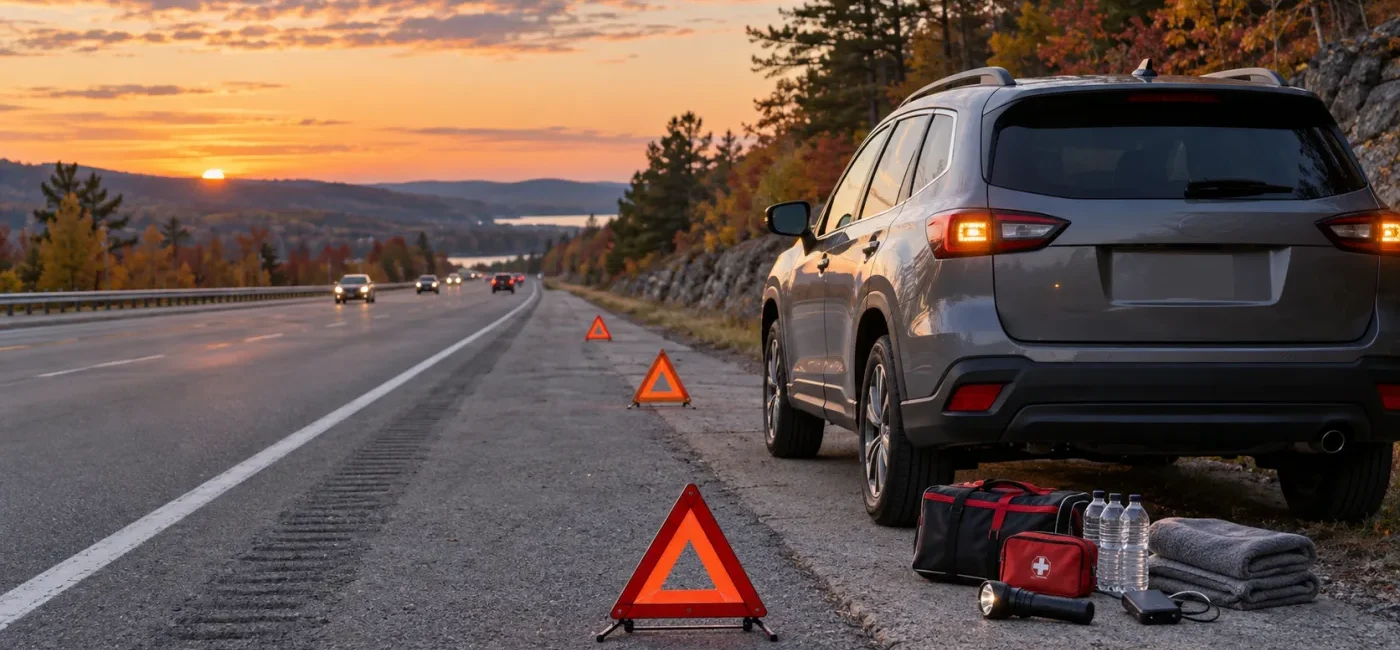
Walking along a shoulder to place triangles or flares can create its own hazard. Use a warning device only when traffic, shoulder width, visibility, terrain, state law, and product instructions allow it to be placed safely. Flame-producing flares can ignite leaking fuel or dry vegetation. The right question is not merely whether the kit contains a warning device, but whether leaving the vehicle to place it is safer than remaining protected.
Owning the tools does not make the scene safe. Consider working on the vehicle only when it is entirely away from traffic on level, firm ground, the work side has generous separation from moving vehicles, and you understand the owner’s-manual procedure. A narrow shoulder, blind curve, bridge, tunnel, snow, ice, mud, slope, or high-speed traffic at night are strong reasons to wait for professional help.
Battery locations, approved ground points, and hybrid or electric-vehicle procedures differ. Do not connect cables based only on red and black colors; follow the vehicle and jump-pack instructions. Do not attempt a jump if the battery is cracked, swollen, frozen, or leaking. Never touch an EV’s high-voltage components or orange cables.
A tire change requires the parking brake, correct jacking point, wheel restraint, and level ground. Never place any part of your body under a vehicle supported only by a jack. Temporary spare tires may have strict speed and distance limits, so read the tire marking and owner’s manual and arrange prompt service. During routine checks, review the DOT code, inflation pressure, tread wear, and recall status as well.
An EV can still become inoperable because of its 12-volt auxiliary battery, but jump-start and towing methods vary by model. Towing with drive wheels on the pavement can damage some vehicles, so confirm whether the manufacturer requires a flatbed and how to activate transport or tow mode. After a crash, if the underbody battery pack appears damaged or there is smoke, hissing, unusual heat, or an unfamiliar sweet or chemical odor, move away and tell 911 that the vehicle is electric.
Once everyone is safe, create a clear service record. Ask whether the provider was dispatched by the insurer or roadside plan, then confirm the call-out fee, included towing distance, per-mile overage, storage charge, after-hours charge, destination, and accepted payment method. The nearest repair shop is not automatically the best destination. Consider warranty work, a tire specialist, an insurer’s repair network, and business hours.
Before handing over the vehicle, photograph its exterior, wheels, dashboard mileage, towing company name, and truck number, and remove valuables. If the driver will not arrive at the shop with the car, confirm the key-drop and intake process. If an unsolicited operator arrives and pressures you to sign, verify the assignment with the roadside program or insurer. During policy renewal, use the auto-insurance coverage, deductible, and quote checklist to review roadside coverage as well.
New drivers may be more frightened by fast traffic approaching from behind than by the mechanical problem itself. Add a breakdown call sequence and location-sharing drill to the teen-driver and parent safety plan.
If there is no injury, fire, leak, blocked lane, or immediate collision risk and the location is genuinely secure, roadside assistance is usually the more appropriate call. If you or other drivers remain in danger, the shoulder is narrow, or you cannot judge the risk, explain the situation to 911 and follow instructions.
No. A car in a live lane or one with fire or fuel risk may require evacuation. When the vehicle is completely off the roadway on a wide shoulder and getting out would expose people to traffic, remaining buckled inside may be safer. Responder directions take priority.
There is no universal distance for every road. Speed, visibility, curves, hills, state requirements, and product instructions matter. First evaluate whether placing a device would require a dangerous walk near traffic. Do not leave protection merely because the kit contains triangles.
A sealant and inflator may help with certain small tread punctures, but not with many sidewall cuts, large failures, or wheel damage. Check expiration dates and vehicle and tire restrictions, and tell the tire shop what product was used.
Insurers, policies, states, and usage histories differ. Do not assume that a roadside call is handled exactly like a collision claim—or that it can never affect renewal. Ask the insurer how use is recorded and considered under the specific policy.
Extreme vehicle temperatures can affect containers, food, medicine, and batteries. Follow each product’s storage instructions. For essential medication, ask a pharmacist or medical professional how to balance carrying a daily supply with emergency preparation.
브라우저 메뉴에서 앱 설치 또는 홈 화면에 추가를 선택해 주세요.